The best plugins for cleaning up harsh mixes are the ones that help you fix the real problem without flattening the track. Harshness can come from bright synths, vocal sibilance, cymbal wash, distorted mids, stacked pads, or too many parts fighting in the same frequency range.
I wanted this list to focus on plugins I have reviewed on the site, as well as plugins that artists have discussed in our How It Was Made features.
That matters because cleaning up a harsh mix is rarely one move, and the right tool depends on where the problem is coming from. Soothe2 is the resonance-control pick, while FabFilter Pro-Q 4 is the surgical EQ I would reach for when I want exact control. oeksound Bloom is better when the source needs broader tonal balance, sonible smart 4 helps when several tracks are masking each other, and FabFilter Pro-C 3 handles harshness that comes from unstable levels or aggressive transients.
I don’t think I’d treat these as interchangeable because each one addresses a different aspect of the same mixing issue. If your mixes keep feeling sharp, crowded, or tiring at higher volumes, these are the tools I would start by comparing.
| Plugin | Main role | Best fit | Why I am including it |
|---|---|---|---|
| oeksound Soothe3 | Resonance control | Harsh vocals, sharp synths, brittle cymbals, and uneven recordings | It catches sharp resonances as they happen without forcing me to make dozens of manual EQ cuts. |
| FabFilter Pro-Q 4 | Surgical EQ and level-aware EQ | Exact cuts, mid-side cleanup, low-mid control, and problem-frequency work | It gives me full control when I already know where the harshness is coming from. |
| oeksound Bloom | Adaptive tone shaping | Sources that need a better overall balance before smaller EQ moves | It helps reshape the broader tone of a source before I start making narrow corrections. |
| sonible smart 4 | Intelligent spectral balancing | Busy sessions where several tracks are crowding each other | It helps sort out masking when the harshness is coming from the whole arrangement. |
| FabFilter Pro-C 3 | Compression and level control | Sharpness caused by peaks, transients, and uneven performance level | It handles harshness that shows up when a part gets louder, sharper, or too forward in motion. |
oeksound Soothe2

Soothe2 is the first plugin I think about when a mix feels harsh in a way that is too scattered for normal EQ. In my full Soothe2 review on Magnetic, I framed it as a resonance suppressor built to remove harshness, manage vocal sibilance, and treat uneven tone without forcing the producer to chase each problem frequency by hand.
That is the key difference between Soothe2 and Pro-Q 4 in the next section.
Pro-Q 4 is where I go when I already know what needs cutting, while Soothe2 is better when the harshness shifts with the performance or changes from phrase to phrase. Modera and JT Roach explained the same thing in their How It Was Made feature for “Covered” on Colorize, saying Soothe2 removes resonance in a selected band and helps identify layers that are clashing in the mix. I like it most on vocals, bright synth groups, hi-hats, cymbal layers, and buses where several small peaks start adding up into listener fatigue.
It can go too far if the depth is pushed too hard, so I usually want it catching the worst peaks rather than dulling the whole source. If I need one plugin on this list for harshness control before I start broader tone work, this is still the one.
Learn more: oeksound Soothe3.
FabFilter Pro-Q 4
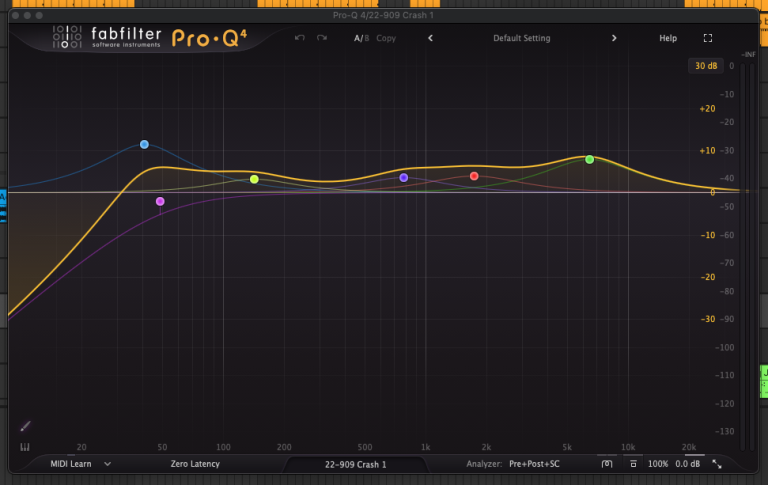
FabFilter Pro-Q 4 is the EQ I would reach for when harshness needs a specific answer instead of automatic resonance control. Shadow Child put it plainly in his How It Was Made feature for “Say It Now” on London Records, saying FabFilter has the interface “absolutely locked down,” which explains why producers lean on this EQ so much.
The interface makes it fast to find sharp areas, cut them with precision, and decide if the problem should be static or level-aware. Return of the Jaded made the same point from a different angle in his How It Was Made feature for “Attila” on Purified, where he talks about using Pro-Q3’s level-aware EQ to cut resonant peaks without altering the overall tone of a sound.
That is where Pro-Q 4 sits apart from Soothe2: it gives me the final decision on frequency, curve, stereo placement, and behavior. I like it for low-to-mid buildup, nasal vocal ranges, brittle synth tops, harsh percussion, and mid-side cleanup when the sides get too sharp. The current Pro-Q 4 workflow also helps me understand masking across several tracks rather than fixing one channel in isolation.
If Soothe2 is the fast resonance manager, Pro-Q 4 is the exact tool I want when the mix needs careful cuts that I can explain and repeat.
Shop: FabFilter Pro-Q 4.
oeksound Bloom
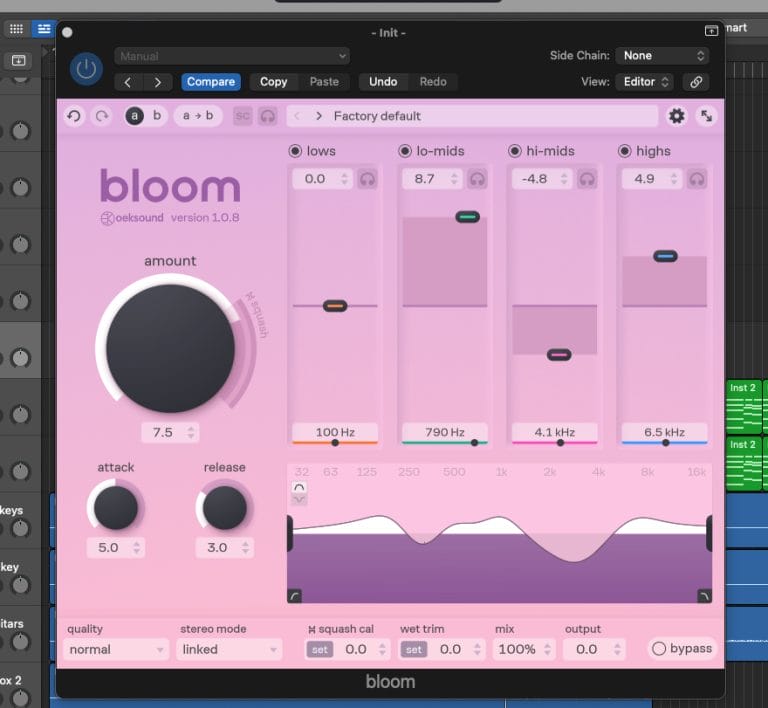
Bloom is the plugin I would reach for when harshness is less about one nasty peak and more about the whole source feeling tilted the wrong way. In Ben Lepper’s Bloom review on Magnetic, he explains that Bloom splits audio into lows, low-mids, high-mids, and highs, then lets you reshape the tone by moving a central control into a better balance.
That makes it different from Soothe2, even though the two come from the same developer and often get mentioned together. Soothe2 is focused on reducing problem resonances, while Bloom can push the overall tone in either direction and make a source feel more even. Jauz went much further in his How It Was Made feature for “Chains” featuring Nevve, where he called Bloom “one of the most exciting plugins” he had used in a long time and explained how it helped with width, tone, and frequency placement.
I would use it on synth buses, piano layers, vocal stacks, and full musical groups where the balance needs a broader correction before the finer EQ work starts.
It can move from cleanup into tone enhancement fast, so I would be careful with the amount and avoid making decisions in solo for too long. That is why I would use Bloom before Pro-Q 4 when I want the whole source to sit better, then use Pro-Q 4 afterward for smaller cuts.
Learn more: oeksound Bloom.
sonible smart 4
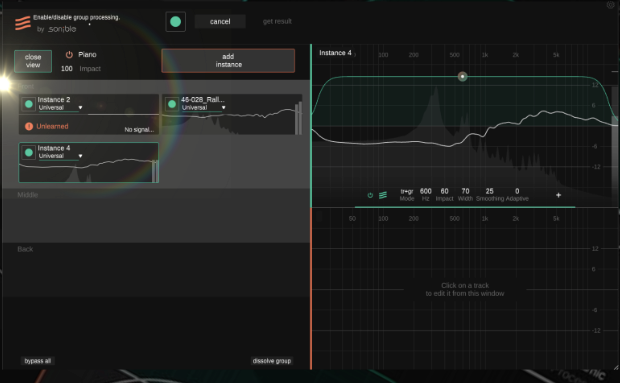
sonible smart 4 is the pick I would use when the harshness is coming from the whole arrangement rather than one track. In my smart 4 review on Magnetic, the main feature that mattered was the way multiple plugin instances can talk to each other and help build a clearer hierarchy across the mix.
That is important to think about because harshness is often a masking problem wearing the clothes of a tone problem. A vocal can feel sharp because the synth below it is crowding the same range, and a lead can feel thin because the pads are taking too much space around it. Compared with Pro-Q 4, smart 4 asks me to think less about single cuts and more about how the session is organized. Compared with Soothe2, it is not mainly there to catch resonant peaks as they jump out.
I like it most when a mix has too many parts fighting for similar space, and I need a cleaner top-down view of what should lead. It is the least manual tool on this list, which may be why it helps when the session is already crowded.
Shop: sonible smart 4.
FabFilter Pro-C 3
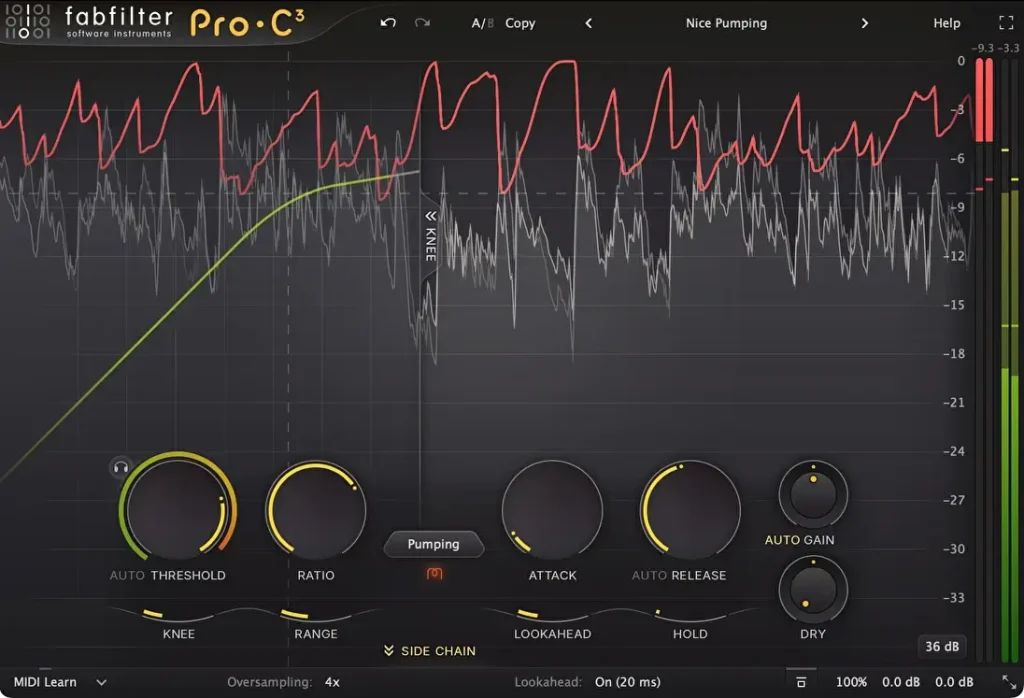
FabFilter Pro-C 3 earns its spot here because harshness is not always an EQ problem. Sometimes the issue is a vocal jumping forward on certain words, a synth transient poking out too aggressively, or a drum bus getting sharper when the groove hits harder. In my Pro-C 3 review on Magnetic, the big shift was how the plugin turns compression into a more connected system, especially when it talks to Pro-Q 4 and gives me a clearer view of level behavior across a session.
The detector EQ is the part I would point readers to first for harsh mixes, because it lets the compressor respond to the part of the signal causing the problem. That makes it different from Soothe2, which reduces resonances directly, and different from smart 4, which is focused on spectral balance and hierarchy. I also like the Character section because Tube, Diode, and Bright let me decide how much tone to include in the compression.
This can be a cleanup tool, although I would use it when the harshness is tied to movement and level rather than a fixed frequency pocket. If Pro-Q 4 fixes where the harshness lives, Pro-C 3 helps control when it becomes a problem.
Shop: FabFilter Pro-C 3
Honorable Mentions I Have Not Reviewed Yet
These also fit the search intent, though I would keep them in the on-radar section until I have enough review time or artist workflow notes to treat them as main picks.
| Plugin | Why it is on my radar | Best fit |
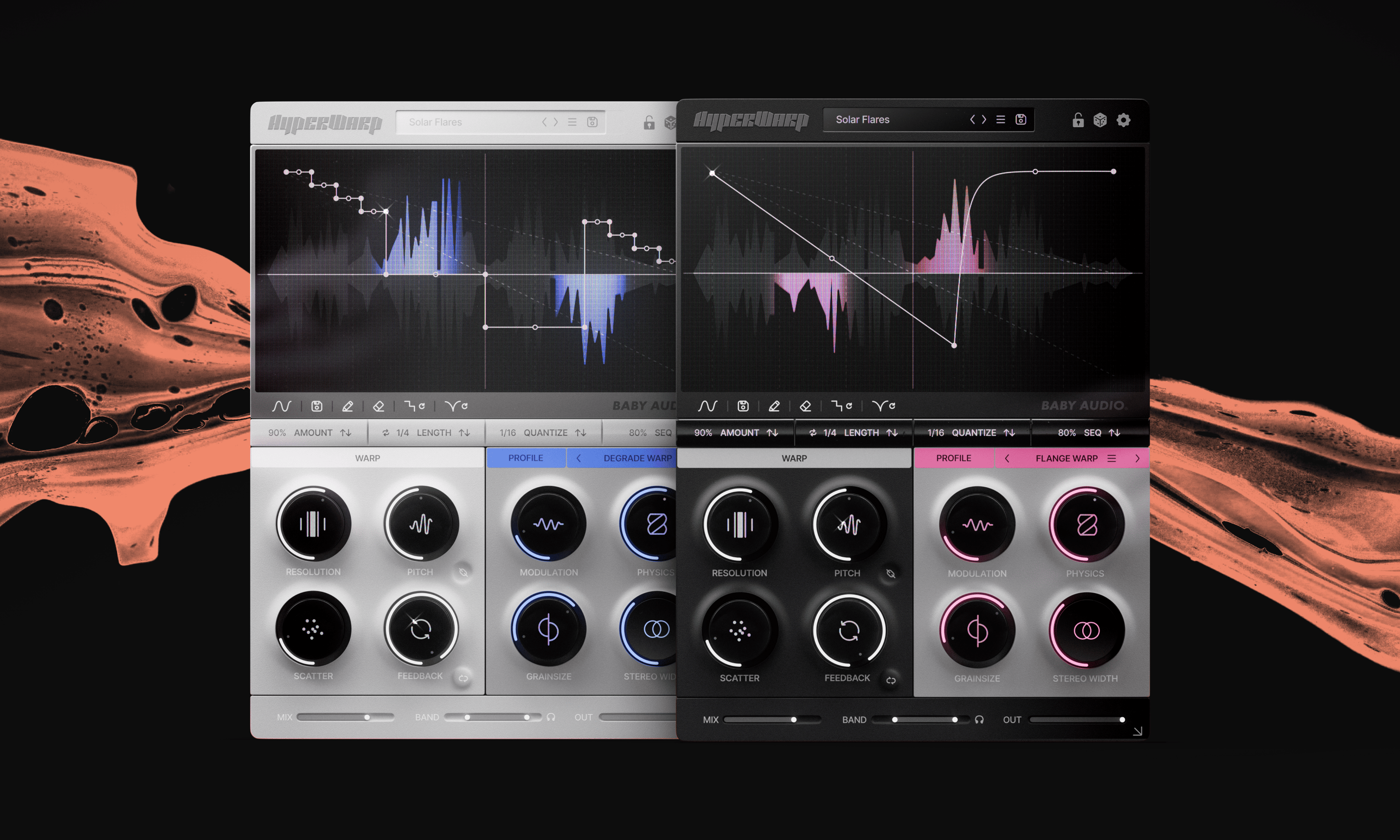
| Baby Audio Smooth Operator Pro | A spectral balancing plugin aimed at smoothing harshness and cleaning up tone fast | Producers who want a simpler alternative to deeper resonance tools |
| W.A. Production DERES | A de-resonance processor with static and adaptive modes | Producers who want a budget-conscious resonance-control option |
| Mastering The Mix MIXROOM | An intelligent EQ built around tonal guidance and reference matching | Producers who want EQ help against a target balance |
| Soundtheory Gullfoss | A smart EQ-style processor often used for clarity and balance | Producers who want fast tonal correction across tracks or buses |
For readers comparing those options directly, I would start with Smooth Operator Pro on Plugin Boutique, DERES on Plugin Boutique, MIXROOM on Plugin Boutique, and Gullfoss from Soundtheory.
Picking The Best Plugins For Cleaning Up Harsh Mixes For Your Setup
The best plugins for cleaning up harsh mixes don’t all do the same job, so I would be careful about buying only the one with the loudest reputation. Soothe2 is the first tool I would reach for when harsh resonances are moving around and manual EQ would take too long. FabFilter Pro-Q 4 is the better choice when I know exactly what needs to be cut and I want full control over the shape of that move.
Bloom is the broader tone-shaping pick when the source feels uneven rather than spiky. smart 4 makes the most sense when the whole session needs better hierarchy and the harshness is coming from parts competing with each other. Pro-C 3 belongs here because compression can fix sharpness that only appears when the level, attack, or performance changes. If I were building the cleanest-first toolkit from this list, I would start with Pro-Q 4 and Soothe2, then add Pro-C 3 once the level-control side starts to slow me down.
From there, Bloom and smart 4 become the smarter additions when the problem shifts from isolated harshness to broader tonal balance across the track.

Will Vance is a professional music producer who has been involved in the industry for the better part of a decade and has been the managing editor at Magnetic Magazine since mid-2022. In that time period, he has published thousands of articles on music production, industry think pieces and educational articles about the music industry. Over the last decade as a professional music producer, Will Vance has also ran multiple successful and highly respected record labels in the industry, including Where The Heart Is Records as well as having launched a new label with a focus on community through Magnetic Magazine. When not running these labels or producing his own music, Vance is likely writing for other top industry sites like Waves or the Hyperbits Masterclass or working on his upcoming book on mindfulness in music production. On the rare chance he's not thinking about music production, he's probably running a game of Dungeons and Dragons with his friends which he has been the dungeon master for for many years.