Table of Contents
Being labeled as a “pioneer” of anything in the dance music industry is a buzzword thrown more commonly than water bottles by shirtless bros at the rave, especially considering that few artists, producers, and DJs really live up to such an illustrious title. Jauz, though, is the exception that proves this rule, as he has repeatedly created trends, shaped sounds, and defined new genres single-handedly over the last decade.
And believe it or not, he’s on the cusp of doing it all over again with the drop of a brand new vocal-drive single that marks the relaunch of his label Bite This!, which seeks to be a platform to help nurture, develop, and support up-and-coming artists who share the same spirit of exploration and no-f**ks-given studio mentality that defined much of Jauz’s early career.
So to celebrate the launch of the label, the drop of the latest single, and just for an all-around opportunity to pick this madman’s brain about his favorite production tools, we invited him on to drop the sauce on his favorite plugins he used on his latest single ‘Chains.’
FOLLOW JAUZ: WEBSITE | INSTAGRAM | X | SOUNDCLOUD | FACEBOOK | SPOTIFY | YOUTUBE
Serum

If you’re reading this article, there’s almost no chance you haven’t heard of Serum before – I would argue that it’s probably become the #1 workhorse VST synthesizer in every producers arsenal, regardless of genres of music. To me, the beauty of Serum is that it’s one of the most straightforward synths to learn, but also has such limitless potential and customization.
I have an exceptionally intimate relationship with Serum – I was actually attending Icon Collective School of Music while Steve Duda, who created Serum, was one of the teachers. At the time, Native Instruments Massive was the most popular soft synth for modern dance music by a large margin. I remember Steve showing off early prototypes of Serum and murmurs around school of how it was going to change the game.
I probably laughed and told them they were out of their minds. I had no idea how monumental the creation of this plugin would be to my life as a producer. I’ve been using it since 2012, probably before it was even in its 1.0 release.
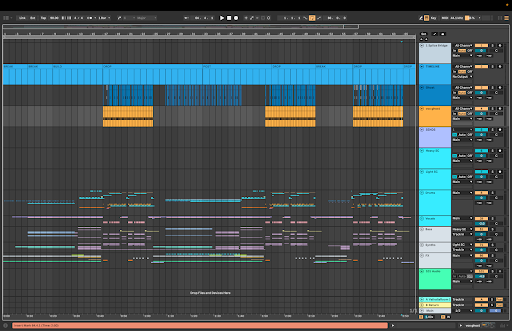
I used Serum for just about every single sound you hear in the song that isn’t a vocal or drum. The keys and reese bass in the chorus and verses, the drop synths/basses, the FX risers, the list goes on.
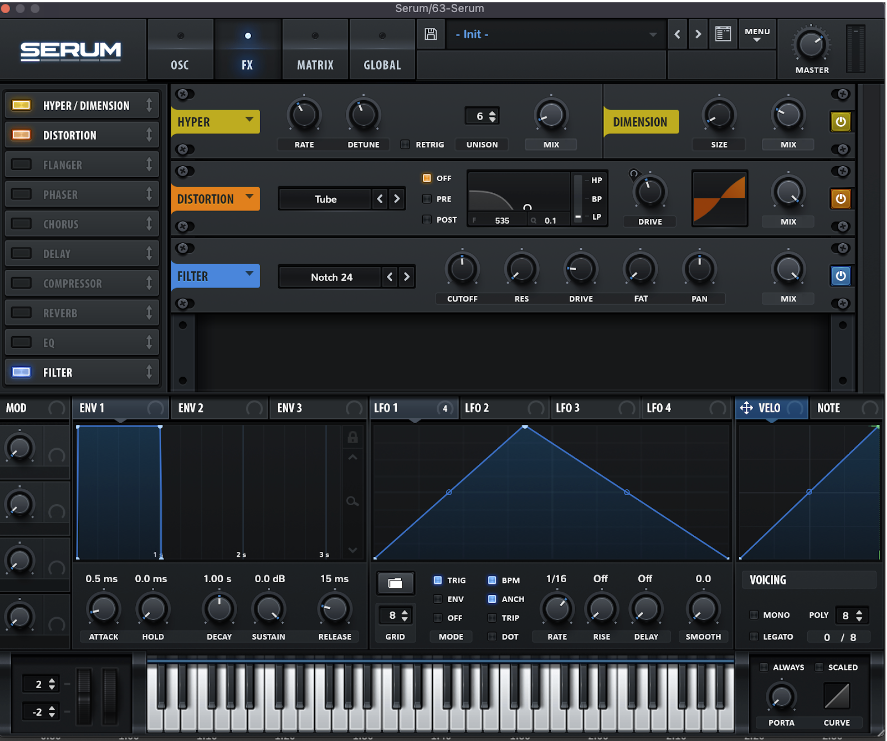
I decided to focus on the “Mid Bass” layer of the drop for this article, just to show you how dead simple it can be to make something sound amazing in Serum. As you can see, the preset title is “Init”, as in it’s the initial patch that boots up when you open Serum. I hardly ever save my Synth presets, which is probably not something I’d recommend, but for whatever reason I really like making synths from scratch each time I write a new song.
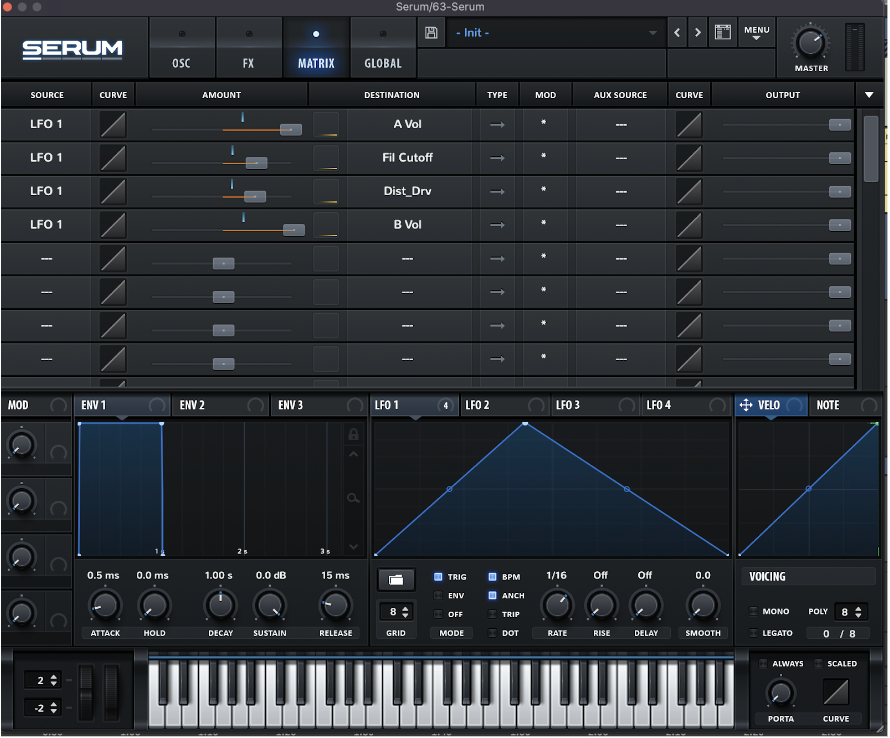
I think I do that in hopes that each song feels a little different and unique from one another. I also didn’t change the initial waveform either – I stuck with the standard Saw wave that loads up with initial serum as well. Most of what I do with sound design comes down to filtering and modulating different parameters of Serum to get the sound I want.
Since this sound is a “wobble” that follows the 16th note rhythm of the Vocal Lead and Chord Synths in the drop, I made a simple 16th note LFO shape, and used it to modulate the Volume, Filter Cutoff and Distortion Amount of the bass. Just making a few simple modulations like this and tweaking here and there can really help you shape something unique.
The only real processing I added to this sound is a Blues Drive from Ableton’s stock Amp plugin, some Erosion for some rattley high end, a Soft Sine Saturator to bring the frequencies together and add harmonics, a stock EQ 8 Filter for the high end and then a UAD Chorus to make the sound sit a little better in

I don’t think there’s any right or wrong way to use Serum, to be completely honest. It is such a blank canvas that the sky really is the limit.
However, one big piece of advice that I would give to artists who are new to Serum or synthesis in general is don’t be afraid of presets! Scrolling through a huge catalog of presets created by people who live and breathe synthesis is such a great way to learn the ins and outs of something like Serum, and I more often than not will end up using a preset that sounds close to what I want in the beginning of making a song just to help things along quickly, and then later on in the creative process I’ll go back and really tweak the sound to be exactly what I want.
OEKSOUND Bloom
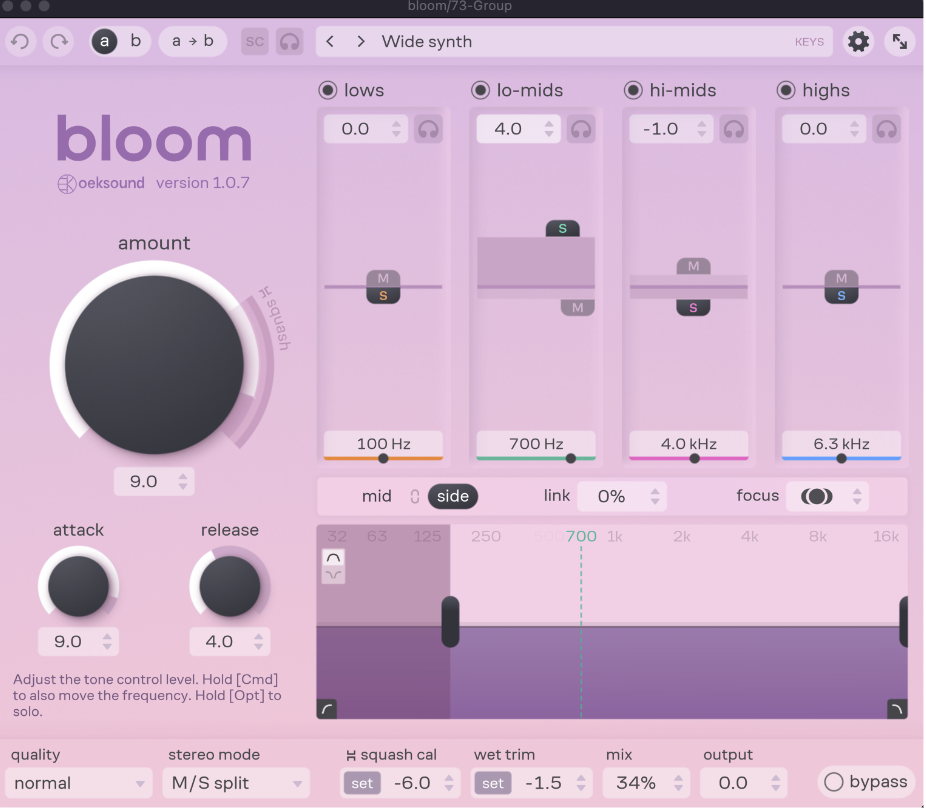
Bloom is one of the most exciting plugins I’ve used in a long, long time. A lot of you might be familiar with Oeksounds most popular plugin, Soothe, which has been touted as a “secret sauce” to just throw on any track or group to make it instantly sound better.
I think that’s partly true – Soothe is great for getting rid of specific harsh frequencies and making everything a bit more polished, giving you more room to push volume, etc. – but it’s NOTHING compared to Bloom. Honestly, Bloom is the plugin I’ve been searching for almost my entire producing career and have never really been able to find. It truly is a “push button to make it sound good” type of plugin, where you can basically just throw it on anything and the algorithm will instantly find frequencies to boost and cut to give whatever audio it’s listening to a more natural, warmer, lusher sound.
However I think it’s when you really dive into the plugin, swipe through the presets, and start honing in on specific “hot spot” frequencies that it really starts to shine. I do want to give a fair warning though – this is definitely one of those plugins you can get used to abusing, leading to either lazy production or actually just overdoing it and making everything kind of sound like sh*t. So like all good things in life, a little goes a long way!
I’ve been really loving this “Wide Synth” preset on things like super saws, or just sounds that I want to really push to the sides of the mix. It’s something I’ve always struggled with, and the way that this boosts and cuts certain frequencies in both the Mono and Stereo field really do the job. It still requires a bit of finessing as far as setting the specific frequencies that sound best for each sound, and adjusting the “squash cal” and mix percentage, but for me this has really been a gamechanger. I also have started using their “EDM Master” preset as a Mastering Dynamic EQ on my mastering chain for almost all of my new songs, including Chains.
Like I said before, use sparingly! Not only is this plugin CPU intensive, but it has the ability to make you “lost in the sauce,” overdoing certain sounds or your entire track until it actually sounds way worse than it did without Bloom. This is especially true if you tweak Bloom on a sound or group in solo mode, because you will focus too much on making everything sound amazing on it’s own.
The issue with that is you’ll end up with tons of frequency clashing all over your mix and nothing will fit together anymore! It’s kind of like Lego pieces. Each sound needs to fit a specific band of the frequency spectrum, and when used properly, Bloom (especially together with Soothe) can help you fit that sound in the exact pocket you need it to be in, and make it sound great at the same time.

Will Vance is a professional music producer who has been involved in the industry for the better part of a decade and has been the managing editor at Magnetic Magazine since mid-2022. In that time period, he has published thousands of articles on music production, industry think pieces and educational articles about the music industry. Over the last decade as a professional music producer, Will Vance has also ran multiple successful and highly respected record labels in the industry, including Where The Heart Is Records as well as having launched a new label with a focus on community through Magnetic Magazine. When not running these labels or producing his own music, Vance is likely writing for other top industry sites like Waves or the Hyperbits Masterclass or working on his upcoming book on mindfulness in music production. On the rare chance he's not thinking about music production, he's probably running a game of Dungeons and Dragons with his friends which he has been the dungeon master for for many years.