All images courtesy of Scaler
Scaler Music has announced several updates to its music production software collection, including an early preview of Scaler 3.4, the free release of Scaler Detector 1.2, and discounted pricing on its flagship plugins ahead of Black Friday.
The announcements come as the company continues developing its music theory tools beyond traditional chord detection, with a growing emphasis on giving producers immediate access to musical ideas they can edit, arrange, and transfer into their DAWs.
The upcoming Scaler 3.4 update is particularly interesting for producers who already use Scaler as part of their regular writing process. Its redesigned Discover and Suggest workflow promises a more accessible way to explore chord relationships, while new Sketch controls on the main page will allow users to experiment with eight chord boxes without navigating into a separate composition environment.
Scaler 3 already offers extensive options for exploring harmony, generating musical material, and developing arrangements, so the next update seems focused on making those capabilities easier to access during a session.
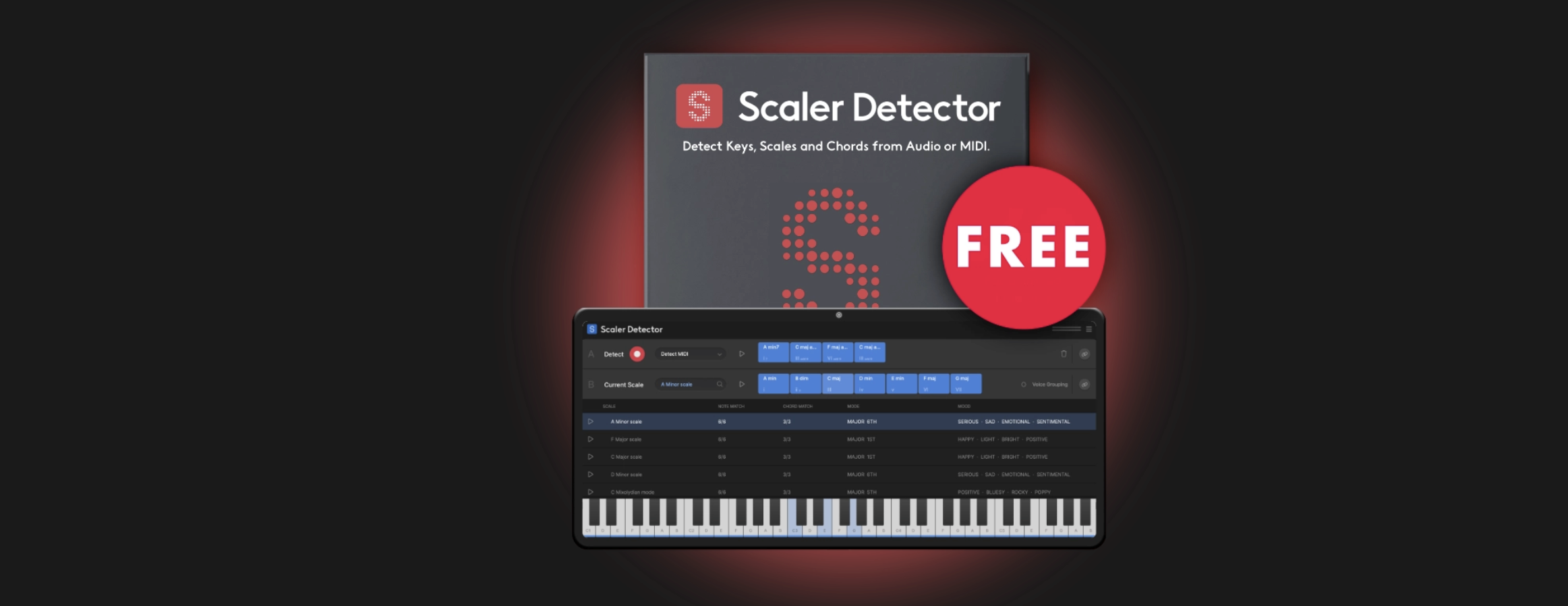
The more immediate announcement concerns Scaler Detector, which is now available for free.
The standalone application and plugin can analyze audio and MIDI to identify musical keys, scales, and chords, providing a way to examine recorded material without purchasing the complete Scaler 3 workstation. Version 1.2 adds new keyboard functionality and detection improvements, while the company’s early Black Friday sale reduces Scaler 3, Scaler EQ Pro, and Carbon Electra 2 to $69 each.
That combination gives existing users a preview of what’s coming while putting several of the company’s current tools on sale.
Scaler 3.4 Brings Chord Discovery And Sketch Controls Together
Scaler 3.4 is still in development, but the company has outlined two additions that should matter most to producers who regularly use the software to compose chord progressions.
The first is a redesigned Discover and Suggest experience.
Scaler already offers several ways to identify compatible chords, explore harmonic substitutions, and generate progressions based on a selected key. The new workflow makes those capabilities easier to navigate, especially when experimenting with chords and voicings beyond conventional major and minor triads.
The second addition introduces Sketch controls directly on the main page, with eight chord boxes available for experimenting with progressions.
This should reduce the amount of navigation required when moving between individual chord choices and a larger musical idea. For example, a producer working on a four-chord progression could use the additional boxes to experiment with substitutions, extensions, inversions, or alternative voicings while keeping the progression visible in the main interface.
That type of accessibility has become an important part of Scaler’s development. When I covered the Scaler 3.3 update, the additions included Multi-Bind, improvements to detection, a unified timeline, and expanded Motion controls. Those features addressed how producers organize musical ideas and turn them into arrangements, while the upcoming version seems to focus on the earlier step of choosing which chords to use.
The distinction is relevant because Scaler can perform considerably more tasks than identifying the key of a song. Producers can develop progressions, experiment with alternative chord voicings, generate MIDI material, and create accompanying melodic or rhythmic parts. Having those functions distributed across several pages provides room for detailed control, although it can also require additional navigation when working with a relatively simple progression.
Bringing Sketch controls closer to the main composition interface could improve that part of the process, especially for producers who prefer to experiment with harmonic ideas before committing them to a full arrangement.
Scaler Music has not announced a precise release date for version 3.4, although the update is expected during the fourth quarter of 2026. The company’s latest video update previews its new features.
Scaler Detector 1.2 Is Now Available For Free
Scaler Detector is receiving a different type of update, with the company making the application available as a free download alongside the release of version 1.2.
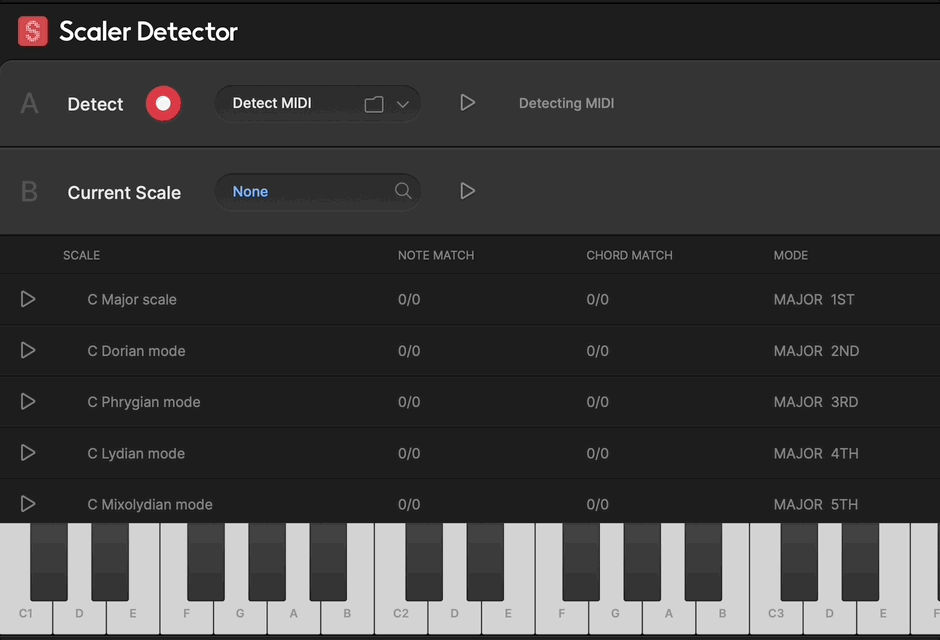
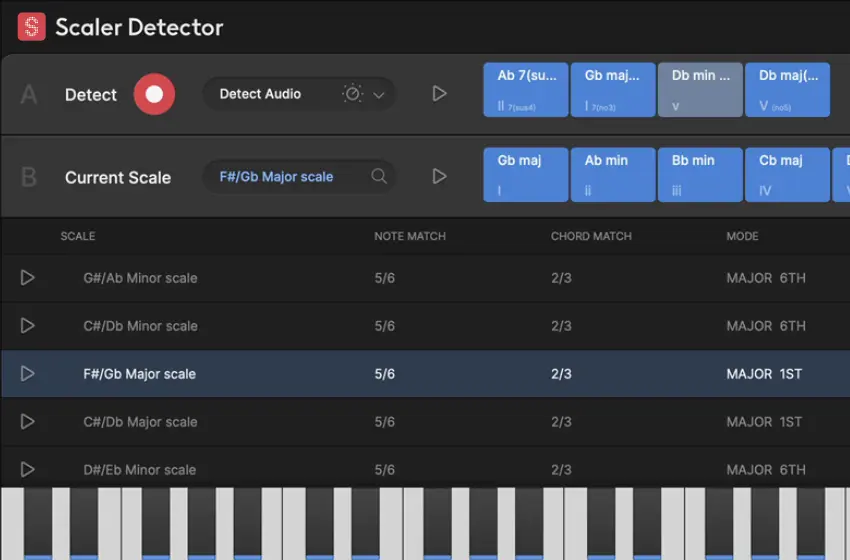
The plugin specializes in identifying musical information from audio and MIDI. Producers can feed it a recorded performance, imported audio file, or MIDI sequence, and the software analyzes the material to identify possible keys, scales, and chords. It can also display the detected notes on a keyboard and provide additional harmonic information for users who want to understand how a particular progression was constructed.
This makes Detector relevant to several common production tasks. A producer working with an unfamiliar sample might use it to identify the likely key before writing a bassline, while someone referencing an existing song could examine its chord progression and experiment with related harmonic ideas.
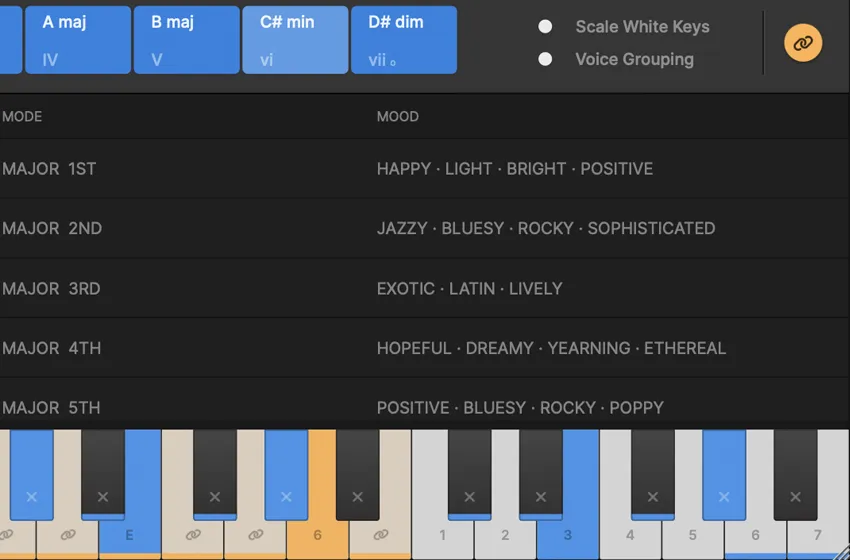
Version 1.2 introduces Scale White Keys, also described as Keys Lock, which maps the notes of a selected scale across the white keys of a MIDI keyboard. This lets producers play notes within the chosen scale without needing to use its original keyboard fingering.
For example, someone working in F-sharp minor could select that scale and use the white keys to trigger its notes. The function can simplify improvisation when experimenting with unfamiliar keys, particularly for producers who are comfortable writing MIDI but have limited formal keyboard training.
Scaler Detector also includes Bind to Keyboard and Voice Grouping. The former lets you trigger compatible chords with assigned keys, while Voice Grouping adjusts voicings to create smoother transitions between notes.
These functions extend Detector beyond basic key identification, giving users some of Scaler’s chord exploration capabilities within a smaller application.

Will Vance is a professional music producer who has been involved in the industry for the better part of a decade and has been the managing editor at Magnetic Magazine since mid-2022. In that time period, he has published thousands of articles on music production, industry think pieces and educational articles about the music industry. Over the last decade as a professional music producer, Will Vance has also ran multiple successful and highly respected record labels in the industry, including Where The Heart Is Records as well as having launched a new label with a focus on community through Magnetic Magazine. When not running these labels or producing his own music, Vance is likely writing for other top industry sites like Waves or the Hyperbits Masterclass or working on his upcoming book on mindfulness in music production. On the rare chance he's not thinking about music production, he's probably running a game of Dungeons and Dragons with his friends which he has been the dungeon master for for many years.