Table of Contents
I love the 480 Pro Plus, and it’s not just because I’ve spent years using Sennheiser headphones across just about every listening scenario imaginable. From studio work to travel and DJ gigs, the company has consistently delivered products that balance durability, comfort, and sound quality, making them a mainstay in my travel and DJ bags.
The HD 25 Closed Back remains one of my all-time favorite DJ headphones, a go-to behind the decks and for my home vinyl setup. I’ve also used several of Sennheiser’s consumer and professional models over the years, so I’m familiar with the company’s approach to headphone design. Great sound tuned to perfection, solid construction, replaceable parts, and products that seem built to survive years of real-world use. I’m still using my PXC-550 wireless models, and will until they die (they are close).
The new HD 480 Pro and Pro Plus are the latest additions to Sennheiser’s professional monitoring lineup. My review unit arrived before the retail packaging was finalized, so it’s one of the first units off the line. After spending several weeks using them in the studio, while traveling in Mexico (notice the drapes), and for everyday listening, these headphones are filling a gap for modern creators who work in more places than just a perfectly treated control room, and they’re a nice alternative to the HD-490 open-back model for road warriors.
I’m one to keep a few different headphones around the studio to test the sound, both open and closed-back, so these were a nice addition to the lineup in Magnetic Studio and will be traveling with me quite a bit in the future.
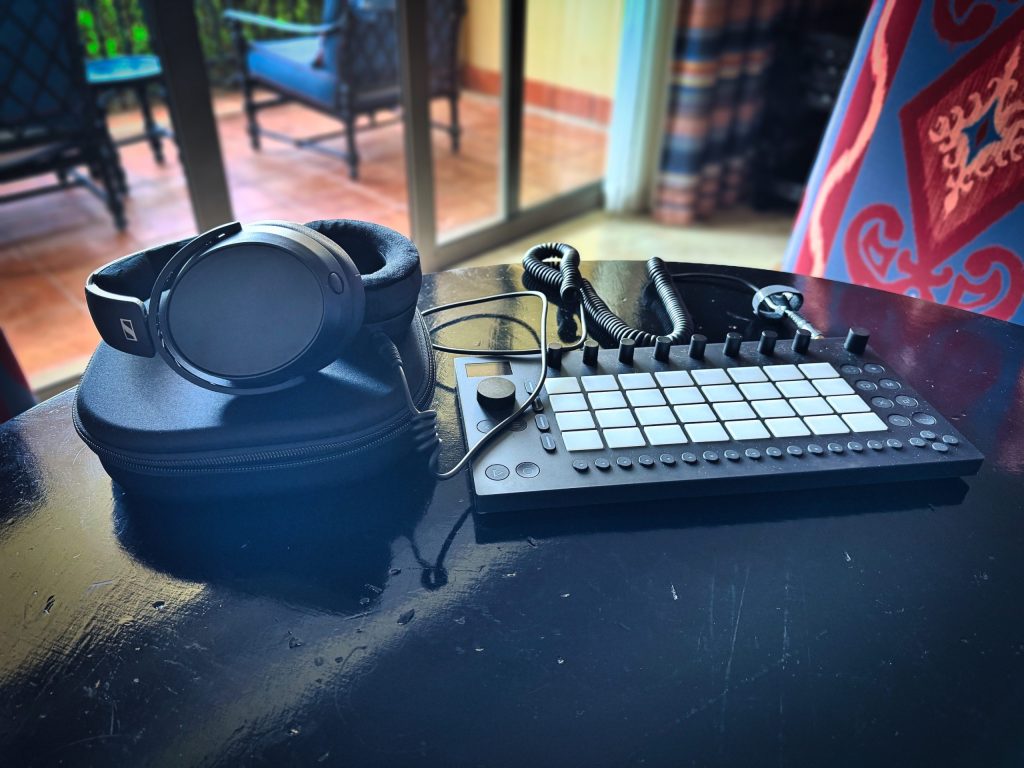
HD 480 Pro / Plus Build Quality
If you’ve used Sennheiser’s professional headphones before, the HD 480 PRO will feel immediately familiar.
The design is classic minimal, built for function and comfort. The metal-reinforced headband feels sturdy without adding unnecessary weight. Padding across the headband is generous, and the ear cups feel substantial without becoming bulky. In short, they are light and comfortable and will do you right when doing long listening sessions.
Note: The 480 Pro Plus does come with a hard case, extra earcups, and headband – This is the only difference between the regular Pro and Plus editions. My unit was pre-production, so I only received the hard case and not extra pads. I do think it’s essential to get the Plus if not for the case alone, but it’s nice to have spare pads if you are wearing these a lot.
One feature I appreciate is the ability to connect the cable to either ear cup. It sounds minor, and most headphone companies do this now, but depending on your studio setup, desk arrangement, or personal preference, being able to route the cable from either side makes daily use much easier.
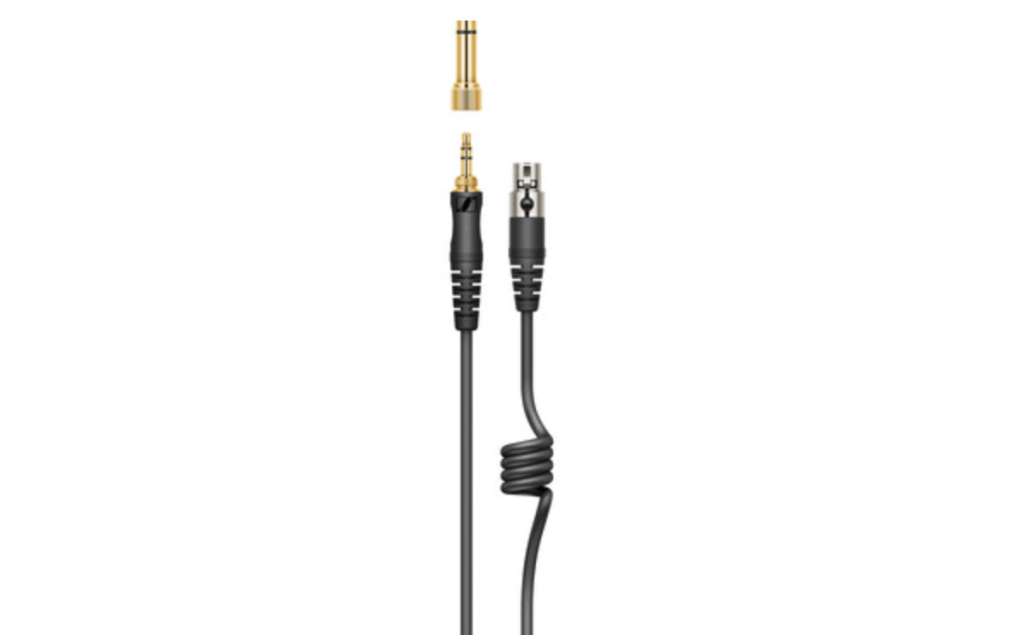
The included coiled cable is excellent. It’s thick, well-shielded, and has a patented coiled design to prevent cable noise, and it feels built to survive years of studio sessions and travel. Sennheiser also includes the adapters most people will need (3.5 mm and 1/4 inch), so you’re ready to connect to everything from an audio interface to a laptop.
Like many of the company’s professional products, serviceability is part of the appeal. Parts are replaceable, which means these aren’t headphones designed to be replaced once something wears out, so they will serve you well for years if you take proper care of them.

HD 480 Pro – Comfort
Comfort is one of the HD 480 PRO’s strongest features.
Closed-back headphones often rely on a heavy clamping force to improve isolation. The downside is that some of them feel uncomfortable pretty quickly and are not ideal for longer sessions.
The clamping force is relatively light on the HD 480 Pros, the ear pads provide plenty of cushioning, and the overall fit stays comfortable during long sessions.
How is the noise isolation? I was actually really impressed overall, as they managed to block out our high-pitched yappy Cavapoo almost completely during barking fits and performed well in spaces with ambient noise like the coffee shop I occasionally work from.
Whether you’re editing audio, tracking vocals, producing for hours, or simply listening through a few albums, these remain easy to wear. The only thing is they can get a little hot, but that’s just par for the course with over-ear headphones.

480 Pro Specifications and Frequency Response
Key Specs
- Design: Closed-back, circumaural
- Driver Type: Dynamic
- Impedance: 130 Ohms
- Frequency Response: 5 Hz – 28 kHz
- Total Harmonic Distortion: Less than 0.2%
- Cable: Detachable coiled cable
- Cable Connection: Left or right ear cup
- Weight: Approximately 330g without cable
Looking at the spec sheet, the first thing that stands out is the frequency response range of 5 Hz to 28 kHz.
Nobody hears 5 Hz, and very few people hear anywhere near 28 kHz. Most adults top out somewhere below 20 kHz, and that’s with very good hearing intact.
So why go to those extremes? Those specifications tell us something about the driver’s capability and how comfortably it can reproduce frequencies within the audible range. It’s kind of like the speedometer in a Porsche; it goes to 225, but there is no way you are taking it there.
What matters more is how Sennheiser tuned the headphone.
Based on both the published response curve and my listening tests, there appears to be a modest bass lift beginning around 30 Hz and continuing into parts of the bass range. Purists might call that coloration, and there is a practical reason for it: to give the closed-back a bigger soundstage. There are mixed reviews on this tuning, but I personally like it for the type of music that I’m listening to and producing, so it suits me well. One thing that is a stunner is the treble, and after reading many producers’/editorial hot takes, this seems to be a pretty consistent opinion.
Closed-back headphones naturally have acoustic limitations compared to open-back designs. By giving the low end a little extra support, Sennheiser manages to preserve weight and impact without turning these into bass-heavy consumer headphones.
The result is a sound signature that remains useful for professional work while also being enjoyable for everyday listening. It’s one of those cases where a slight departure from strict neutrality makes a lot of sense.
The 130-ohm impedance is worth mentioning as well. A modern MacBook has enough power to drive them, and I had no problem using them directly from my laptop. However, they definitely benefit from a high-quality interface, a headphone amplifier, or a portable DAC.
If you are listening to them on a phone, you can use a portable DAC like the HELM MQA to give your phone the power it needs to drive these headphones.
Sound Quality
Closed-back headphones rarely create the same spacious soundstage as a good pair of open-back headphones. That’s simply the nature of the design.
If I’m making critical mix decisions in my studio, I still tend to reach for open-back headphones or my monitors. Sennheiser’s HD 490 PRO remains an excellent option for that type of work.
The HD 480 PRO serves a different purpose. These are built for situations where isolation matters. Recording sessions, editing on the road, mobile production setups, hotel rooms, shared workspaces, and environments where open-back headphones simply aren’t practical. These headphones do a great job of compensating, and after 20 hours with them, I’ve found I can really get to a great place on my tracks without having to make big changes when I switch to my IK iLoud Precision 6 MKIIs.
One of my go-to test tracks is Massive Attack’s “Angel.” The iconic bass line has plenty of impact through the HD 480 PRO, but more importantly, it retains its texture and detail. You can hear the layers within the bass rather than simply feeling a wall of low frequencies.
For vocals and midrange performance, I spent time with Tracy Chapman. Her voice is one of my favorite references when evaluating headphones because there’s nowhere to hide “Fast Car” is the track to head for. The HD 480 PRO handles vocals beautifully. The midrange feels natural, detailed, and balanced without sounding pushed forward. Some reviewers didn’t love the midrange, and while this is totally subjective, I found it quite solid for the electronic genre and most others I listened to. However, these headphones don’t flex as hard in the mid range with genres like Jazz and Classic Rock, so that might be a soft spot in the overall performance, but nothing that overtly drags them down.
The treble is where these cans really jump out and shine, especially vocals and the crisp percussion of really well-made techno, with the drums tuned to perfection. Try running through some classic Plastikman tracks like “Spastik” or “Spaz” and you will be amazed, especially since these tracks were produced in 1994.
Overall, there’s enough detail to reveal subtle information in a mix without being so much that long listening sessions become fatiguing or irritating.
Overall, the tuning strikes a smart balance between studio accuracy and real-world enjoyment.
Power Requirements
At 130 Ohms, the HD 480 PRO sits in an interesting spot.
A modern MacBook has enough power to drive them without issue. I used them directly from my laptop and never felt like volume was lacking.
That said, these headphones definitely benefit from proper amplification.
When connected to a quality interface, headphone amp, or dedicated DAC, everything feels a little bigger, a little fuller, and a little more dynamic.
If you’re buying these primarily as a professional tool, chances are you already have an audio interface.
If you’re planning to use them primarily with a phone or portable device, I’d strongly recommend pairing them with a portable DAC. You’ll get much more out of what these headphones can do.
Who Are These For?
The HD 480 PRO makes the most sense for:
- Producers who work in multiple locations
- Engineers who need accurate closed-back monitoring
- Musicians tracking instruments or vocals
- Editors and content creators
- Travelers who want a reliable reference headphone
- Audiophiles looking for a balanced closed-back option
For my own workflow, these won’t replace my open-back headphones or studio monitors for critical mixing.
What they will become is my travel headphone.
They’re comfortable, durable, easy to pack, and versatile enough to handle everything from production work to casual listening. That’s where they really shine.
Sennheiser HD 480 Pro Plus Features:
- Clever closed-back design yields full-spectrum sound reproduction with zero unwanted coloration
- Advanced neodymium magnets provide superior driver efficiency
- Lightweight voice coils deliver an incredibly dynamic performance
- Multistage passive shielding bears outstanding signal integrity
- Vibration Attenuation System ensures exceptionally low distortion
- Patented cable-coil structure blocks cable noise
- Long-wearing precision-fit design with geometrically angled earcups
- Braille-guided L/R earcups and grooved earpads for eyeglasses
- Complementary 3m cable, additional headband pad, and carrying case
HD 480 PRO vs HD 490 PRO
The obvious comparison within Sennheiser’s lineup is the HD 490 PRO.
While the two headphones share a similar professional audience, they’re designed for very different jobs.
The HD 490 PRO is an open-back headphone aimed at critical listening, mixing, and mastering. It offers a wider soundstage, more natural imaging, and a greater sense of space. If you’re sitting in a treated studio making detailed mix decisions, the HD 490 PRO is probably the better tool.
The HD 480 PRO trades some of that spaciousness for isolation and portability. That’s not a compromise as much as it is a different mission. The closed-back design makes it better suited for tracking sessions, recording environments, mobile production setups, travel, and situations where outside noise becomes a problem.
If I were working exclusively in my studio, I’d reach for the HD 490 PRO first. If I’m getting on a plane, editing from a hotel room, tracking vocals, or working from a coffee shop, the HD 480 PRO becomes the more practical choice.
Many professionals could easily justify owning both.

The HD 480 PRO Plus Is Worth Considering
If you’re planning to travel regularly with these headphones, I’d again highly recommend looking at the HD 480 PRO Plus package. The included hard-shell carrying case provides meaningful protection and completes the package. Professional headphones spend a lot of time getting tossed into backpacks, flight cases, and carry-ons. Having a proper case makes a difference.
Pros
- Excellent build quality
- Comfortable for long sessions
- Light clamping force
- Cable can connect to either ear cup
- High-quality detachable coiled cable
- Controlled and detailed bass response
- Balanced overall tuning
- Replaceable parts
- Great for travel and mobile production
- Works well with laptops and audio interfaces
Cons
- Premium pricing compared to some competitors
- Benefits from dedicated amplification
- Soundstage not quite as good as open-back designs
- Casual listeners will not get full performance from a phone alone, and this is probably not the best choice for your typical music consumer.
Final Thoughts
The HD 480 PRO feels like a practical headphone designed by people who actually spend time in studios. This was the missing piece in this range of headphones, and they did a great job with it overall. It doesn’t try to reinvent the wheel. Instead, it zeros in on comfort, durability, reliability, and the best possible sound quality for a closed-back model.
For studio professionals who spend a lot of time working outside the studio, that’s exactly what matters. Will they replace my favorite open-back headphones? No.
Will they become the pair I grab when I’m traveling, editing remotely, working from a hotel room, or on the go, like a coffee shop? Absolutely.
That’s ultimately where the HD 480 PRO succeeds. It’s not trying to be everything. It’s trying to be the closed-back headphone you actually want to take with you for both work and play, and in my case, Sennheiser accomplished exactly that.
Purchase the Sennheiser 480 Pro Plus HERE Currently listed for $439.00

David Ireland is a professional strategist, creative, and marketer. He began his career in 1995 as creator and publisher of BPM Magazine. In August 2000, BPM Magazine merged with djmixed.com LLC, an online media company based in Los Angeles, which later evolved into the Overamerica Media Group [OMG] in 2003. In 2009, Ireland left Overamerica Media Group to serve as the VP of Marketing at Diesel. In 2011, he returned to his roots in media and cofounded the online electronic music publication Magnetic Magazine and created The Magnetic Agency Group. In June 2018, Ireland joined Winter Music Conference (now owned by Ultra Music Festival) as the Director to lead the reboot for 2019 and usher in a new era for the iconic brand. He served as Chief Marketing Officer at Victrola for three years, guiding product innovation and brand growth. He currently serves on the advisory board of Audiopool, a new music tech startup focused on AI-generated music licensing and artist revenue models.