The harder part of drum programming is rarely finding a punchy sound.
It is making the part feel like it belongs in the song.
That is the space UJAM is working in with Virtual Drummer NEON, a new addition to its Virtual Drummer Series built for contemporary pop, disco, dance, nu disco, synth-pop, funk, and electronic productions. The idea is to bring the impact and control producers expect from electronic drums, while keeping the groove and movement of a real drummer inside the performance.
That is a good target for modern production. A lot of dance-adjacent music needs drums that hit with machine-like precision, but a fully programmed part can get stiff fast. NEON is built around that gap: punch from electronic production, feel from performance-minded drum writing.
For producers working on disco-leaning tracks, glossy synth-pop, funky dance records, or current pop with tighter drum programming, that balance is the whole point.
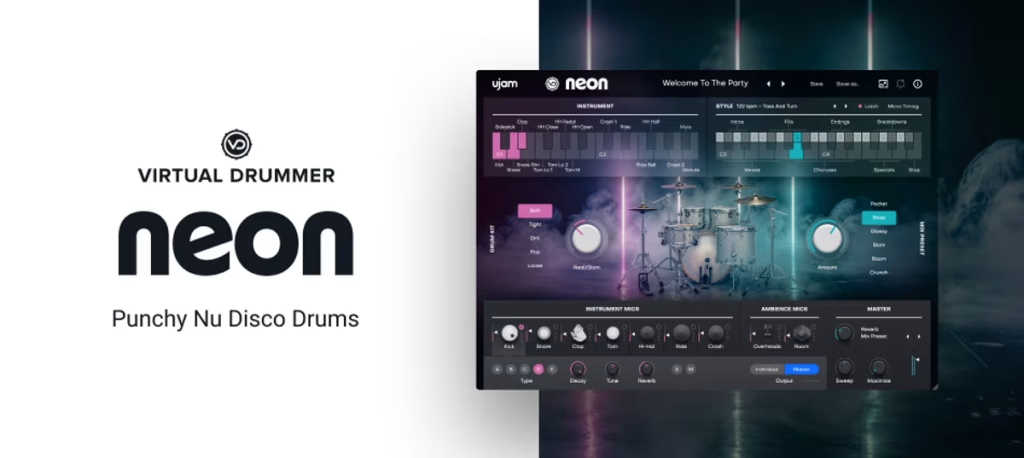
NEON is built around session-drummer logic
UJAM’s Virtual Drummer Series has always been about reducing the usual hurdles around real drum performances.
Recording drums properly means finding the drummer, the kit, the mics, the room, the engineering chain, and the right performance. Even then, the edit and mix can become its own job. UJAM’s approach is to give producers access to performance-ready drum parts inside a DAW, then let them customize the result.
NEON pushes that idea into a more electronic lane.
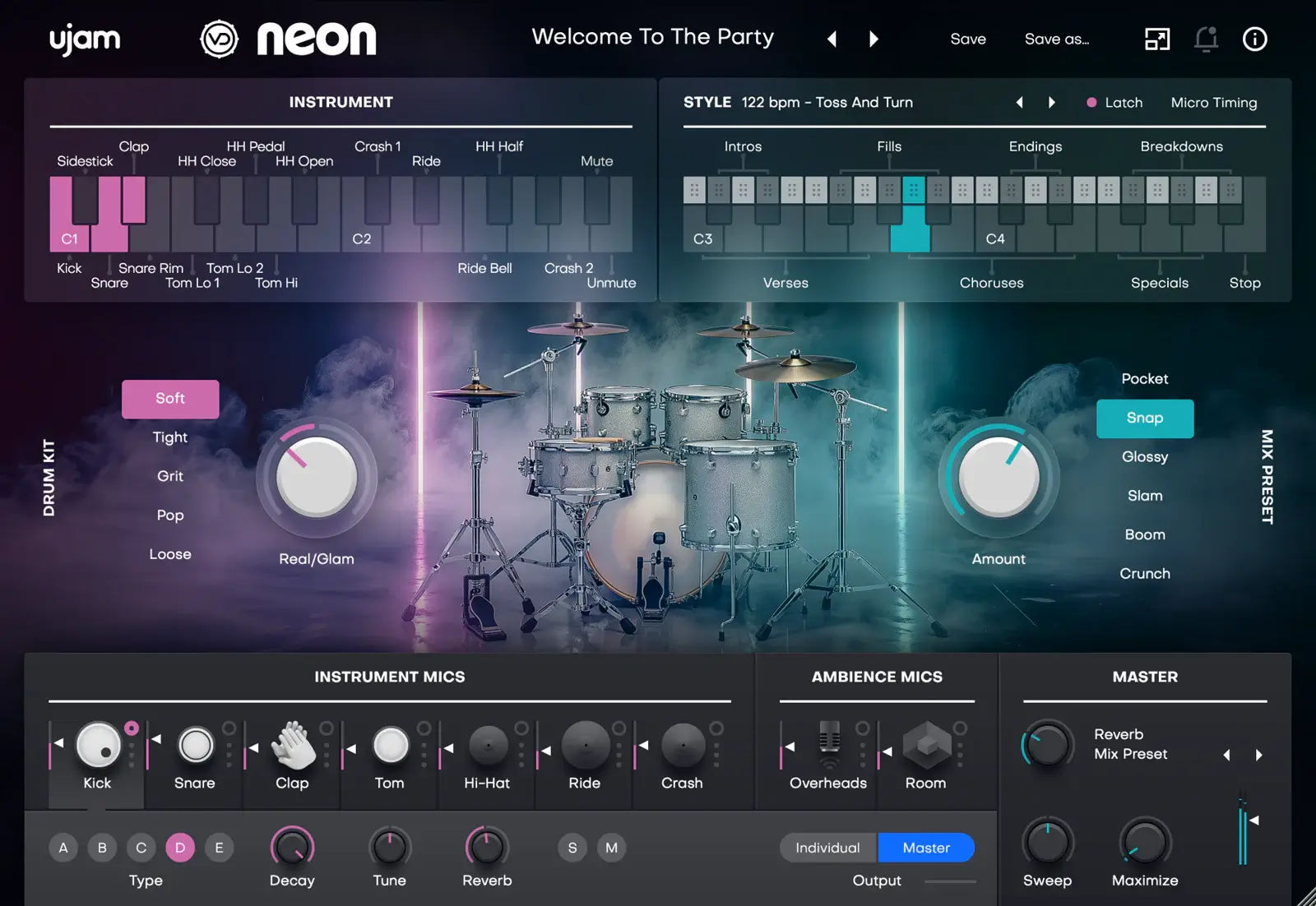
The plugin includes five customizable drum kits, hundreds of performance-ready grooves, drag-and-drop MIDI editing, mix presets, and flexible sound-shaping controls. That puts it in a different place than a basic drum machine or sample folder. The drums are meant to start from playable grooves, then bend toward the track as the producer edits the MIDI, changes the kit, and adjusts the mix.
That connects with our earlier piece on UJAM’s DRUMS, where the larger appeal was getting finished percussion ideas into a production without making the producer build everything from zero. NEON brings that same UJAM instinct into brighter, tighter, more dance-focused territory.
The Glam control points toward polished pop drums
The new Glam control is one of NEON’s clearest production shortcuts.
UJAM describes it as a way to move from a more natural acoustic performance to the polished, punchy sound associated with contemporary chart productions. That is a useful idea because modern pop and dance drums often sit between live performance and processed impact.
The drums need to feel played, but they also need to punch through dense synths, vocals, bass, guitars, and shiny top-end layers. Too natural, and the part can feel underpowered. Too processed, and the groove can lose personality.
Glam gives producers a single control for shifting that relationship. It is not a replacement for detailed mixing, but it gives the plugin a fast way to push the drums toward a more finished, radio-ready edge.
For a songwriter trying to get a demo into shape or a producer building a groove-heavy chorus, that kind of control can save time without locking the track into one fixed sound.
Nate Williams gives the plugin its funk and disco center
NEON’s musical direction comes from Nate Williams, a longtime collaborator with Jamiroquai and Steve Winwood.
That detail matters because NEON is not only trying to sound like electronic drums. It is trying to carry the push and pocket of funk, soul, and disco-rooted drumming into a modern production format.
Williams describes NEON as capturing the sound and energy of modern disco, with room to push the material toward rock, hip-hop, and other styles. That gives the plugin a broader role than a niche nu disco machine. The source material starts from funk and soul, then gives producers enough control to reshape the drums for their own track.
That approach fits well beside our article on free new disco sample packs and nu disco resources, because disco-inspired production lives or dies on feel. The kick and snare can be clean, the percussion can be bright, and the mix can be polished, but if the groove does not move properly, the style falls flat.
NEON’s value is that it starts from movement before the producer begins editing.
Drag-and-drop MIDI keeps the drums editable
The biggest mistake in virtual drummer plugins is making the performance feel finished in a way that cannot be changed.
NEON avoids that by including drag-and-drop MIDI editing. Producers can start with UJAM’s grooves, then pull them into the DAW and adjust the part around the song.
That matters because no drum performance should be treated as a one-size-fits-all loop. A verse may need less kick activity. A pre-chorus may need a tighter pickup. A chorus may need more open hats, more velocity, or a slightly altered fill. A funkier section may need ghost-note behavior to support the bassline.
Drag-and-drop MIDI lets producers keep the musical starting point while still taking ownership of the part.
That also places NEON near the same problem covered in our Boomcha article about stiff MIDI drums. Producers do not only need drum sounds. They need grooves that feel less rigid and parts that can adapt to the song instead of sitting on top of it.
NEON fits pop, disco, and dance producers who need speed
NEON is probably most appealing to producers who already know the drum direction they want, but do not want to spend half the day programming the first version.
A nu disco track may need tight kicks, claps, hats, and percussion that lock into a bassline. A synth-pop track may need punch without sounding too acoustic. A dance-pop production may need glossy drums that can sit under vocals and still keep the song moving. A funk-inspired electronic track may need feel before it needs more processing.
NEON gives those producers a faster start.
That does not mean the plugin is only for simple demos. The MIDI editing, kit customization, mix presets, and Glam control give it enough room to move deeper into production. But the first job is clear: help musicians, songwriters, and producers get convincing, energetic drums into a track quickly.
It supports VST2, VST3, AU2, and AAX formats on macOS and Windows, so it fits most common studio setups.
Pricing makes the launch window worth noting
UJAM is launching NEON with introductory pricing from August 12 to September 30, 2026.
During that window, NEON is $49, with a $39 loyalty price. After the introductory period, the regular price becomes $119, with a $99 loyalty price.
That is a sizable launch discount, especially for producers already using UJAM instruments or anyone looking for a groove-focused drum plugin aimed at pop, disco, dance, and electronic styles.
UJAM’s broader company background also gives the release some context. The company was co-founded by Hans Zimmer and Pharrell Williams, and its wider catalog is built around virtual instruments, plugins, and music production software designed to keep technical friction low.
NEON fits that pattern. It is not trying to make producers engineer a full drum session from scratch. It gives them a playable drummer concept with electronic punch, human timing, and enough editing control to shape the part around the track.
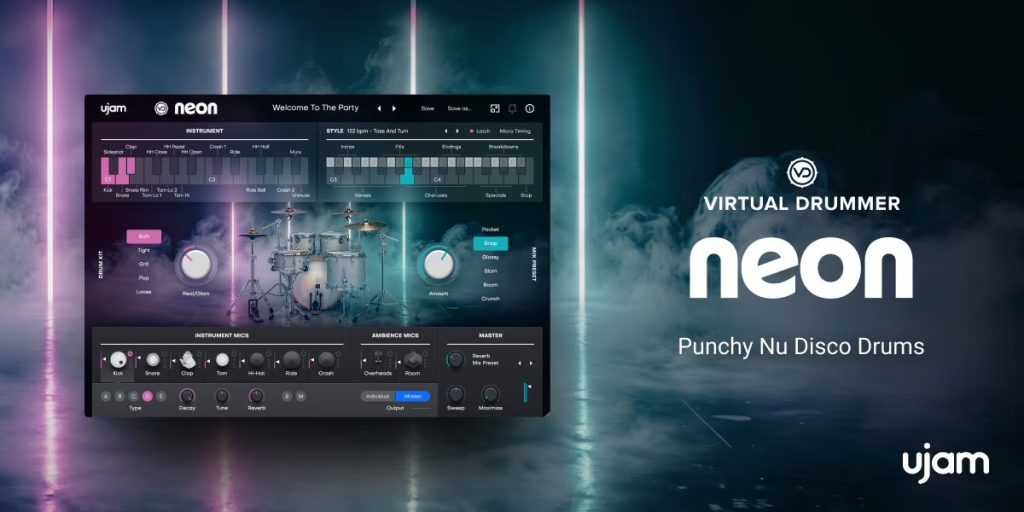
NEON gives modern dance drums a better starting point
The clearest case for NEON is this: a lot of current pop and electronic music wants drums that sit between a drummer and a drum machine.
UJAM built NEON around that middle ground.
The plugin gives producers the shape of a performance, the punch of electronic drums, the speed of preset grooves, and the control needed to customize the result inside a DAW. For disco, dance-pop, synth-pop, funk, and electronic producers, that can mean fewer empty loops and more grooves that already feel like they are moving with the song.
That is where NEON earns its place in the Virtual Drummer Series.
It does not ask producers to choose between programmed precision and human feel. It gives them a way to start with both, then decide how polished, natural, tight, or exaggerated the drums should become.
Virtual Drummer NEON is available now from UJAM.

Will Vance is a professional music producer who has been involved in the industry for the better part of a decade and has been the managing editor at Magnetic Magazine since mid-2022. In that time period, he has published thousands of articles on music production, industry think pieces and educational articles about the music industry. Over the last decade as a professional music producer, Will Vance has also ran multiple successful and highly respected record labels in the industry, including Where The Heart Is Records as well as having launched a new label with a focus on community through Magnetic Magazine. When not running these labels or producing his own music, Vance is likely writing for other top industry sites like Waves or the Hyperbits Masterclass or working on his upcoming book on mindfulness in music production. On the rare chance he's not thinking about music production, he's probably running a game of Dungeons and Dragons with his friends which he has been the dungeon master for for many years.