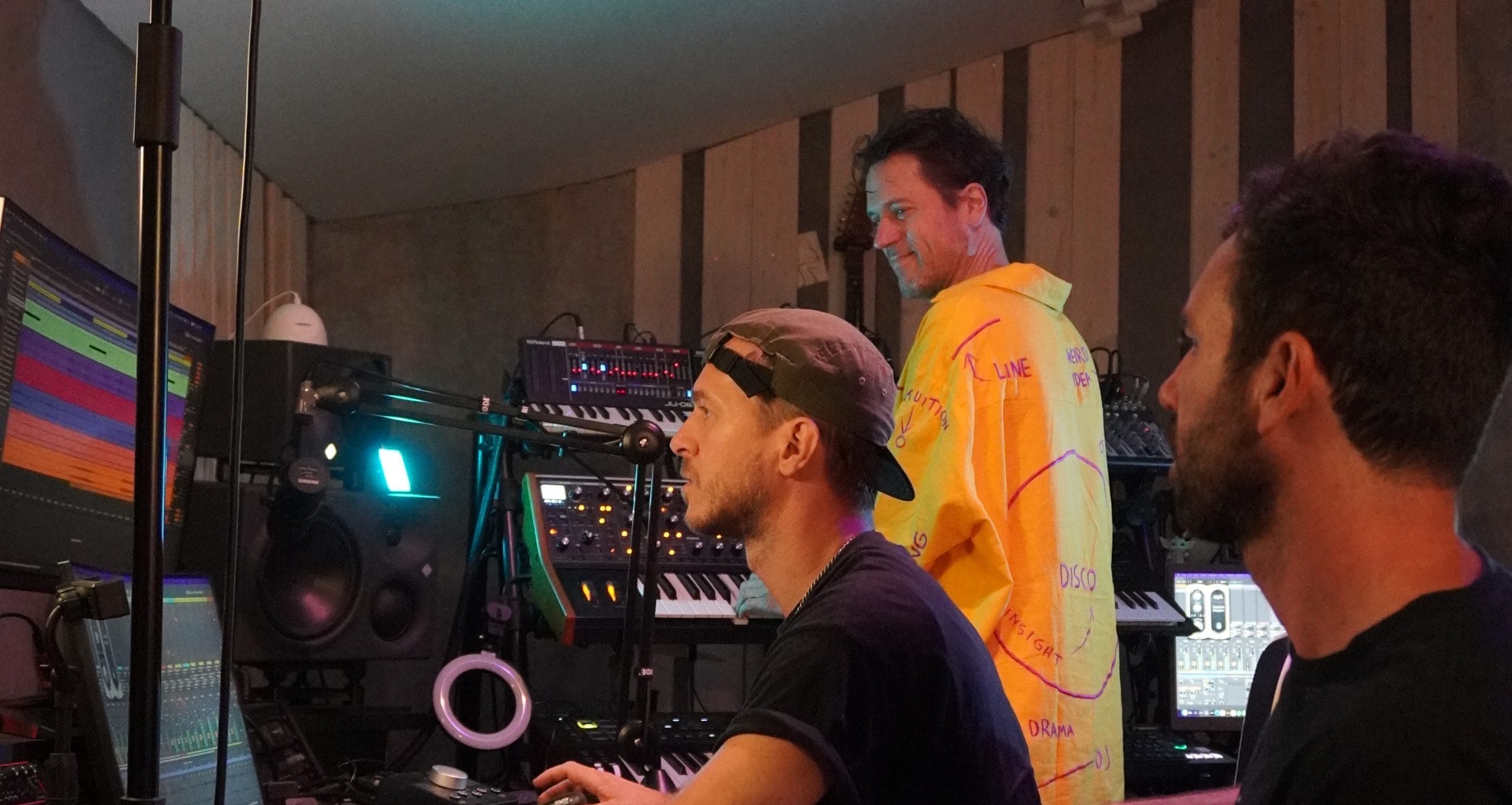
David Mayer (@david_mayer), Nico Stojan and Tooker’s “I Am” came out of the trio’s April 2026 SONARA basecamp on Isola di San Pietro, where they spent roughly two weeks making music without setting a fixed direction for what those studio days needed to produce. The track was officially released July 24 on SONARA Records, the label the trio launched with Jay Kurahashi-Sofue in 2025.
The production started from gritty layered drums before a vocal found in Nico Stojan’s collection began pulling the record toward classic house. From there, the trio kept revisiting their first instincts, reducing the vocal, reconsidering an intentionally wonky early bassline, and removing notes from repeating patterns to create room around the kick.
In the latest iteration of How It Was Made, David Mayer explains how they made the track below, getting into everything from Cherry Audio Memorymode and Softube Model 84 to Trackspacer, Soundtoys Tremolator, and Serum. The rest of the words are from the arist…
Starting “I Am” at the SONARA basecamp
“I Am” started during the April 2026 edition of our SONARA basecamp in Sardinia. More specifically, our last three gatherings happened on Isola di San Pietro, a tiny side island of Sardinia, where Tooker has his beautiful studio and where the label was born. It was the third time, me, Nico Stojan and Tooker had met to spend roughly two weeks together, just to make music. We started to call these gatherings “basecamps” when they became habitual. Without setting any specific goals and with an intentionally playful approach, we gave us the freedom to explore studio time whenever and as long into the mornig as we pleased. In this process, we generated plenty of very unique tracks in more or less intense studio sessions. Most of this music will be released over the course of the next months on SONARA Records.
Building the drums
“I Am” was intentionally built on mulitple layers of particularly gritty drumsamples and loud hihats. It basically started with the sound characteristic of a boompap production. Don’t we all love our dirty, crunchy drumsamples 😉
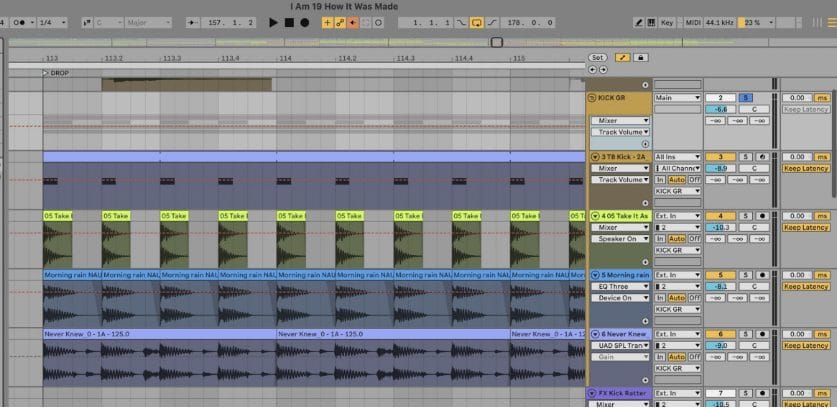
As you can see above, the kick is made up of four layers. Three of them are just dusty filth, filtered to merge into one for charecter. The fourth one the actual belly.
The charismatic vocal we found deep in Nico’s magic crates took control of our process and seemed to command us to choose a classic house-music approach. At first, we wanted to keep the vocal repeating as much as possible. It was repeating almost every 1 bars! We enjoyed this level of intensity. Those who enjoy tracks like Butch’s “No Worries” know what I am talking about 😉 But we finally concluded that our vocal would have more meaning if we reduce it to hit less frequently. The task at hand was to let go of the original idea, even if we initially loved the “I am” vocal repeating so much.
Tip: Reducing patterns.
After falling in love with the initial sketch, cooling off a bit and switching on the rational mind for looking more closely at my patterns is a crucial part of my process. I still tend to end up with too many notes playing at once. Selectively thinning out loops to their essential parts is a great exercise.
The fun part is that you can alter the exact placement of these cuts as much as you like throughout the arrangement. The ear might subconsciously catch those “inconsitencies”, keeping it interesting throughout.
Cherry Audio Memorymode
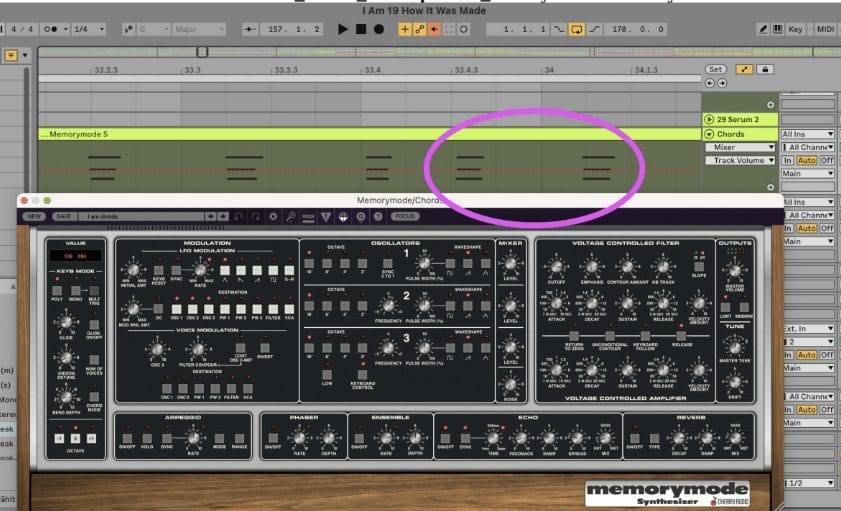
The house-keys, which were added soon after the first drum samples and became the catchy, melodic element everything was built around subsequently. They came from Cherry Audio’s Memorymode.
If you look at the screenshot above, you can see that the midi pattern is not quantized at all. We wanted to keep it’s appel raw and bold. To make it pop a little more, we layered it with a basic piano from NI’s Kontakt.
Softube Model 84
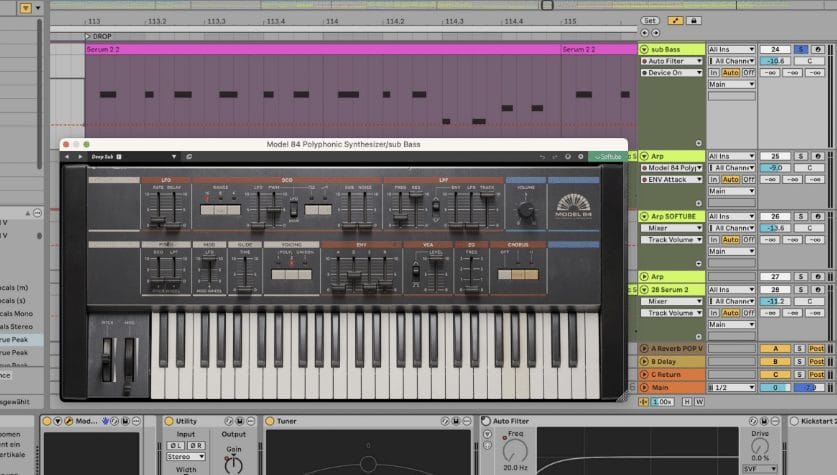
Soon after the keys wehre established, we had to follow up with a bass. We used Softube’s Juno emulation “Model 84” for multiple bass layers.
The first layout had an obnoxiously wonky bassline. We wanted it to be super edgy and daring. We tested such a version at a party with a crowd and it was fun for the moment. But when listening to it for a while in the studio, the wonkyness turned out to be too extreme, after all. Letting go of our attachment to the first scetch once again, we wanted to acheive a better flow, so we straightened it out considerably.
The thumpy parts of the bassline are remnants of that initial approach. But the bassline only really started to feel modern and more driving when we paired it with a 16-note bass roll to follow along. Both combined and sidechained into eachother using Wavesfactory’s Trackspacer resulted in a beautiful, rolling bassline.
Wavesfactory Trackspacer
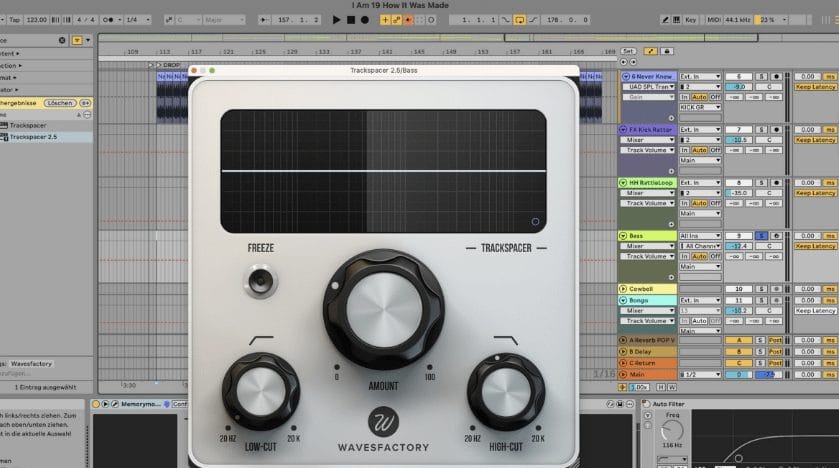
Tip: Wavesfactory’s Trackspaceris is easily one of my most frequently used plugins ever. Genious for ducking in any frequency range. Normally you’d use the kick as the sidechain signal against the bass. But please go ahead and try to duck a lead against a pad, too. It’s breathing life into averything instantly.
Memorymode + Soundtoys Tremolator
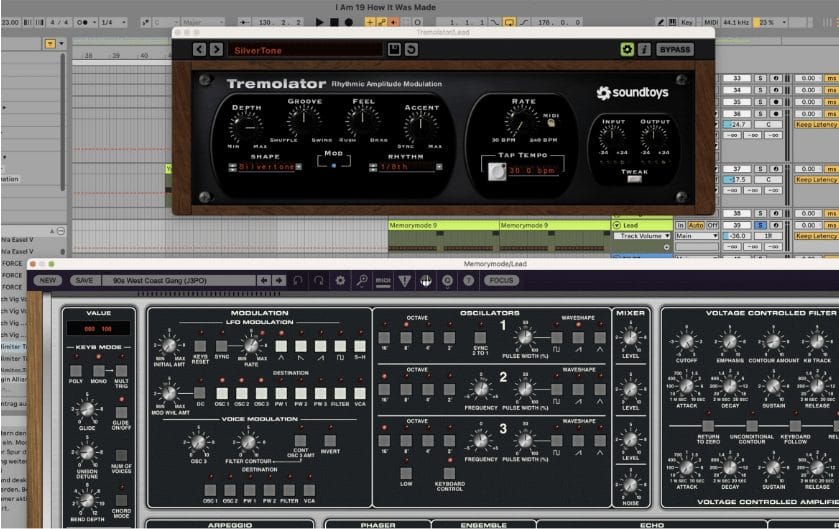
One of the hidden main lead elements in the track is that rather mosquito-like lead sound. You might not hear it at once, but if it was missing, you’d notice that a part of the track’s DNA was gone.
This lead-cluster is not playing an actual melody, just basically one, steady note. It comes, swells up and disappears again mulitple times throughout the arrangement and reflects on the strings we know from original house tunes from the past decades.
Tip: Steady stringsound.
This kind of classic, high-pitched, long noted, steady element sets up a very effective kind of tension-and-release situation:
When it comes in and stays steady, it kind of glues everything together and creates a softer vibe. But when it first swells and then suddenly cuts out and disappears, the moment of impact is imminent and everything that remains hits much harder in contrast. The following drop contracts/dries up and instantly becomes more effective, basically without adding any extra effects. In this case, subtraction is what makes the drop stand out.
We were actually looking for a West Coast style “gangsta whine” type sound, following the underlying hiphop appeal of the whole production. We naturrally came to choose the “90s West Coast Gang” preset in Memorymode.
For more brightness, we layered it with a clear string preset, eventually nudging everything towards a more classical house sound even more.
To make it move and become more alive within the rhythm pattern, we simply used long volume automations and Soundty’s Tremolator.
Tip: Tremolator by Soundtoys.
Tremolator can be chucked on almost anything that requires some more liveliness and movement within a pattern. It works by applying rhytmic volume modulations in any kind of pattern. Intensity could be slight or more noticeable. Tremolator may be applied to strings or leads, shakerloops, hihats or even drumloops – everything quickly comes alive while relying on a rather basic principle.
Xfer Serum
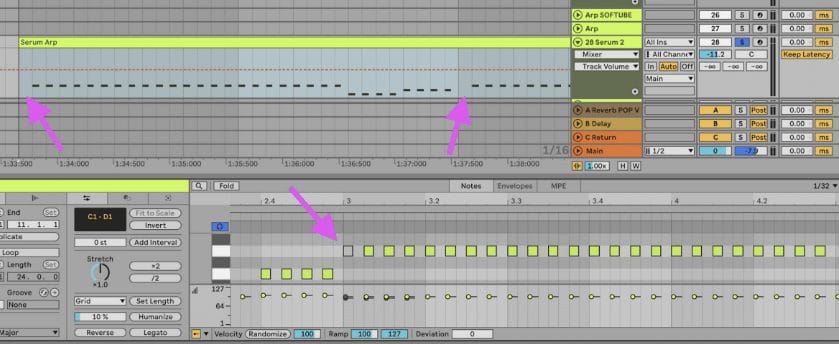
Those 16-notes arps are speeding up the track, adding more rhythm and tension. They came from Xfer Serum, a staple machine for clean and futuristic sounds. As you can see in the screenshot, the MIDI pattern is missing every first 16th note of the loop. I personally do this all the time, I may edit a hihat loop or any 16 note loop like this to create a dryer, more focused pocket for the kick without having to rely on precise ducking.
Tip: Cutting out notes entirely instead of ducking.
I often cut out these kinds of radical 16-note pockets in all sorts of elements on 1,2, 3, and 4. It could be in pads, keys or even bass loops. Alternatively, I apply short uoramp-fades. Even with everything quantized, the whole groove around the kick immediately feels more bouncy, more rhythmical, when that first note (or any other aditional notes) is missing from the loop to give space to other elements.

Will Vance is a professional music producer who has been involved in the industry for the better part of a decade and has been the managing editor at Magnetic Magazine since mid-2022. In that time period, he has published thousands of articles on music production, industry think pieces and educational articles about the music industry. Over the last decade as a professional music producer, Will Vance has also ran multiple successful and highly respected record labels in the industry, including Where The Heart Is Records as well as having launched a new label with a focus on community through Magnetic Magazine. When not running these labels or producing his own music, Vance is likely writing for other top industry sites like Waves or the Hyperbits Masterclass or working on his upcoming book on mindfulness in music production. On the rare chance he's not thinking about music production, he's probably running a game of Dungeons and Dragons with his friends which he has been the dungeon master for for many years.