
It is easy to talk about independence like it is some romantic thing artists choose because they want total freedom and no one telling them what to do.
The less Instagram-friendly version is that independence usually means doing the work before anyone has agreed to care. You are writing the record, building the label, figuring out the site, chasing the relationships, learning the business, asking for the opportunities, and still trying to make the music feel like it came from an actual human being instead of a content calendar.
That is where APOLLO’s “Above the Noise” starts to make sense.
He is a U.S. Army veteran, electronic artist, producer, DJ, and founder of Living Past Records, but the interesting part is not just the list of titles. It’s how all those pieces point to the same question: how do you keep building when everything around you is loud enough to pull you off course? The track is not framed here as another electronic single looking for playlist traction. It serves as a line in the sand.
This whole story also feels very early-stage and practical, which is why I like it.
APOLLO is talking about infrastructure, artist development, events, partnerships, media, venues, revenue, and the kind of long-term base that independent artists usually wish someone else would build for them. In the interview below, he talks about military discipline, learning when to loosen control, turning chaos into direction, why APOLLO is not a costume, and how Living Past Records is being built as something other artists can eventually plug into.
Interview With APOLLO
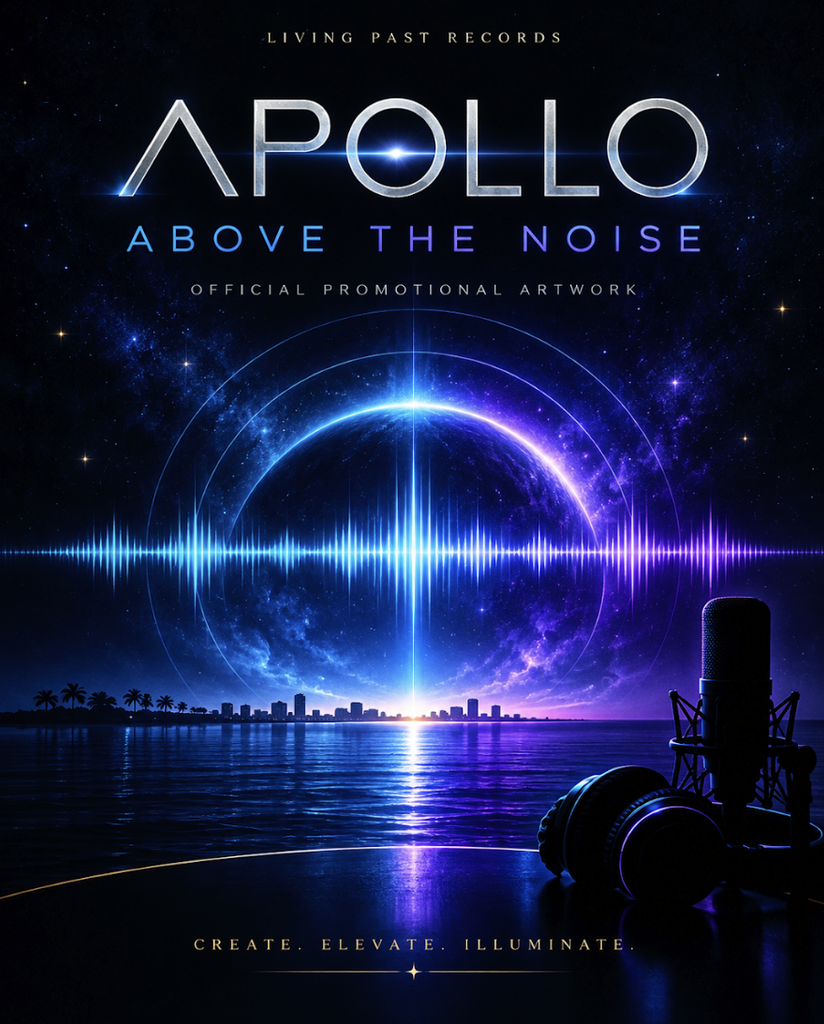
What was happening in your life when you started “Above the Noise,” and what did you want to express in the track that you hadn’t expressed before?
“Above the Noise” came from a period where life felt loud in every direction: instability, pressure, doubt, distractions, and other people’s expectations, all while I had a very clear vision of the life and company I wanted to build.
Eventually, I realized you can spend your whole life reacting to everybody else’s signal, or you can figure out what yours is and follow it.
That became the record.
My earlier music expressed emotion, but “Above the Noise” felt more like a declaration. It became less about “this is how I feel” and more about “this is who I’m becoming.”
The noise doesn’t necessarily disappear. You just learn how to find your signal inside it.
How did you want the production to reflect that idea of moving through interference?
I wanted the production itself to feel like movement through interference.
There are textures competing for space, changes in intensity, moments of tension, and then that feeling of continuing forward through all of it. I didn’t want a technically perfect electronic record that felt emotionally empty. I wanted movement, texture, tension, and personality.
Life doesn’t politely mute itself while you figure out who you are.
The arrangement reflects that. The noise remains, but the direction becomes clearer.
That idea is carrying into APOLLO as a whole. I don’t want to release interchangeable records just to feed an algorithm. I want the music, visuals, performances, and everything surrounding the project to feel like pieces of the same world.
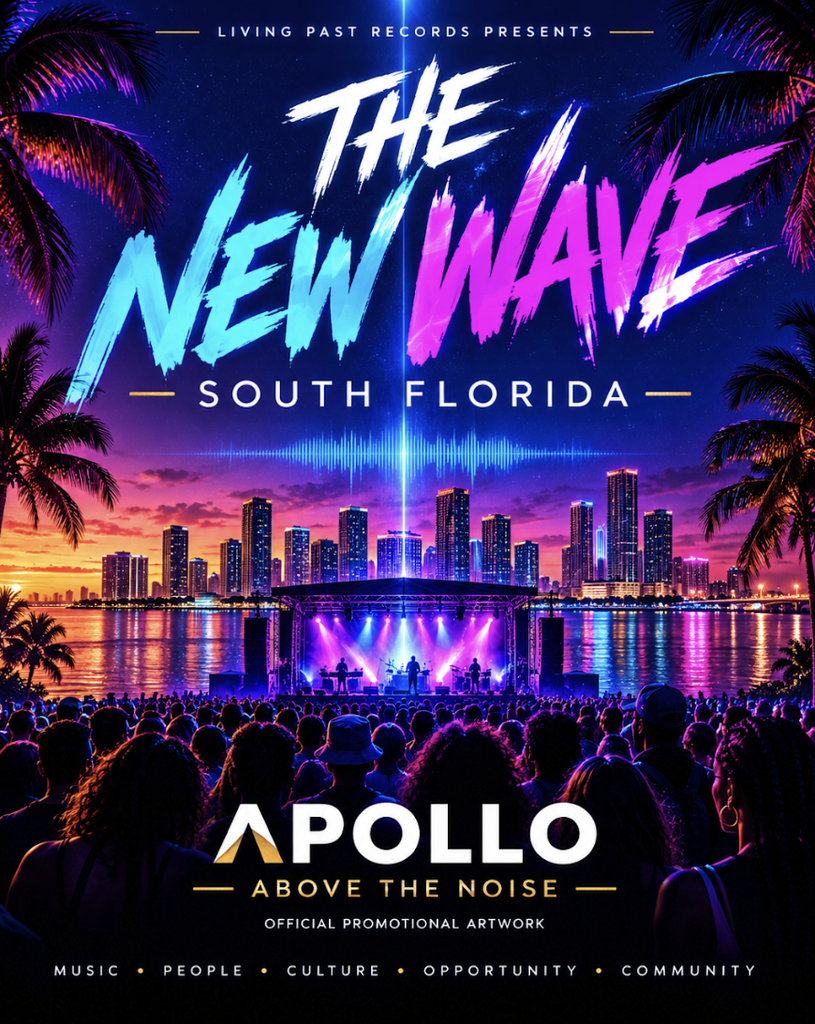
You’re a U.S. Army veteran as well as an artist and label founder. What did that background teach you about building something independently, and what did music force you to reconsider?
The Army taught me how to adapt when the original plan gets destroyed.
That has probably been one of the most useful lessons in both music and entrepreneurship. A plan falls apart? Adjust. A door closes? Find another one. Conditions aren’t ideal? Work with what you have and keep moving.
That mentality is all over Living Past Records.
What music forced me to reconsider was the idea that everything has to happen in a perfectly controlled order. Creativity doesn’t work like a military operation. Sometimes the best idea comes from an accident. Sometimes you have to stop trying to command the process and let something develop.
The Army gave me discipline. Music taught me when to loosen my grip.
I need both.
How do you keep APOLLO from becoming a costume or anonymous EDM persona instead of an extension of the person behind it?
APOLLO isn’t a costume. It’s me with the volume turned up.
I never wanted to create an anonymous EDM character and hide behind it. APOLLO gives me a way to amplify parts of myself: confidence, ambition, emotion, philosophy, and vision, that may not always be visible in everyday life.
That means the music and the way I present myself have to be things I genuinely stand behind. I’m not interested in manufacturing an identity because something happens to be trending.
That philosophy carries into Living Past Records too.
I don’t want LPR to become ten versions of APOLLO. I want artists to sound like themselves. I want their differences to remain intact.
Living Past Records isn’t supposed to erase what makes people different. It’s supposed to amplify it.
When did you realize Living Past Records needed to become more than a label page around your own music?
Eventually, I realized I wasn’t trying to build an artist page. I was trying to build infrastructure.
APOLLO is the artist. Living Past Records is what allows that vision to become larger than one artist.
Releasing independently gives me control over my own music. LPR gives me the ability to build around it: artist development, live events, media, production, partnerships, venue relationships, promotion, and eventually opportunities for other artists and creators.
I don’t want to spend my career waiting for a major label, gatekeeper, or perfect circumstances to give me permission to build something.
I would rather build the system myself.
I’m not trying to own every piece of the culture. I’m trying to build infrastructure people can plug into, and if that infrastructure creates value for them, it creates value for us too.
I don’t want Living Past Records to be another gatekeeper. I want it to be the gate people actually know how to walk through.

What do the next twelve months need to prove for APOLLO and Living Past Records?
The next twelve months are about turning everything currently moving behind the scenes into things people can actually see, hear, attend, and participate in.
For APOLLO, that means stronger releases, music videos and visual work, more performances, stronger media relationships, a larger real audience, and continued international growth. Seeing France emerge early as a meaningful streaming market caught my attention because performing internationally has always been part of the long-term vision.
For Living Past Records, I want to turn the network we’re building into actual projects: develop artists, expand partnerships, establish our live-event platform, work with more venues and production teams, create more media, and continue recruiting artists, DJs, producers, managers, and creatives who fit what we’re building.
I’ll judge success by more than streams or followers.
Are we more independent than we were a year ago?
Are the artists getting louder?
Are the events actually happening?
Are relationships turning into opportunities?
Is the company generating enough revenue to reinvest into artists, productions, and the next project?
If those answers keep becoming yes, then we’re moving in the right direction.
And if you’re an artist, DJ, producer, creative, venue, promoter, brand, or local establishment and what we’re building makes sense to you, I want that conversation.
Closing Thoughts
The best part of APOLLO’s answer is the line about not building an artist page, but building infrastructure.
That is a different level of ambition than putting a logo on a few singles and calling it a label. It means he is already thinking about where the music lives, who gathers around it, how events can extend it, what other artists might need, and how the business side can eventually feed the creative side instead of only draining it.
That connects with Mike Lisanti’s interview on what makes an artist ready for management. Lisanti talked about momentum as something a manager can amplify, but not invent from nothing. APOLLO applies that logic to his own world. He is not waiting for a manager, label, or gatekeeper to validate the project before he starts laying bricks.
The military background gives the story some weight, but the more interesting part is how he separates discipline from control.
The Army taught him to adapt when the plan gets destroyed. Music taught him that you can’t command every good idea into existence. That distinction matters for anyone building independently, because the daily work usually demands both: discipline to keep going, and enough looseness to recognize when the unexpected is better than what you planned.
The LPR side also sits close to Dorian Perron’s interview on Groover’s move from promotion to artist services. Perron was talking from the platform side, but the problem overlaps. Independent artists don’t need just one push around release week. They need ways to turn attention into a longer path. APOLLO seems to understand that Living Past Records cannot just be a release schedule if he wants it to become useful.
There is also a parallel with Soundplate’s interview on turning clicks into fans. That piece was practical in a different way: smart links, submissions, conversion, and the mechanics of audience-building. APOLLO’s interview is more personal, but it addresses the same underlying issue. Streams and followers are not the whole job. The job is turning attention into something people can return to.
That is probably why this interview works best as an early snapshot rather than a victory lap.
APOLLO is still building, and he knows it. But there is something worth watching in an artist who is not asking permission to start. He is making the record, building the label, calling rooms into existence, and trying to give others a place to plug in once the system is strong enough to hold them.

Magnetic byline note: This byline is used for staff produced updates and short announcements, often based on press materials and official release information. Editorial responsibility: David Ireland (Editor in Chief) and Will Vance (Managing Editor). About: https://magneticmag.com/about/ Masthead: https://magneticmag.com/masthead/ Contact: https://magneticmag.com/contact/







![How It Was Made: Lang Father i(Junkyard Dog) [Welofi]](https://magneticmag.com/wp-content/uploads/2026/10/Press-Pic_2-1024x576.jpg)