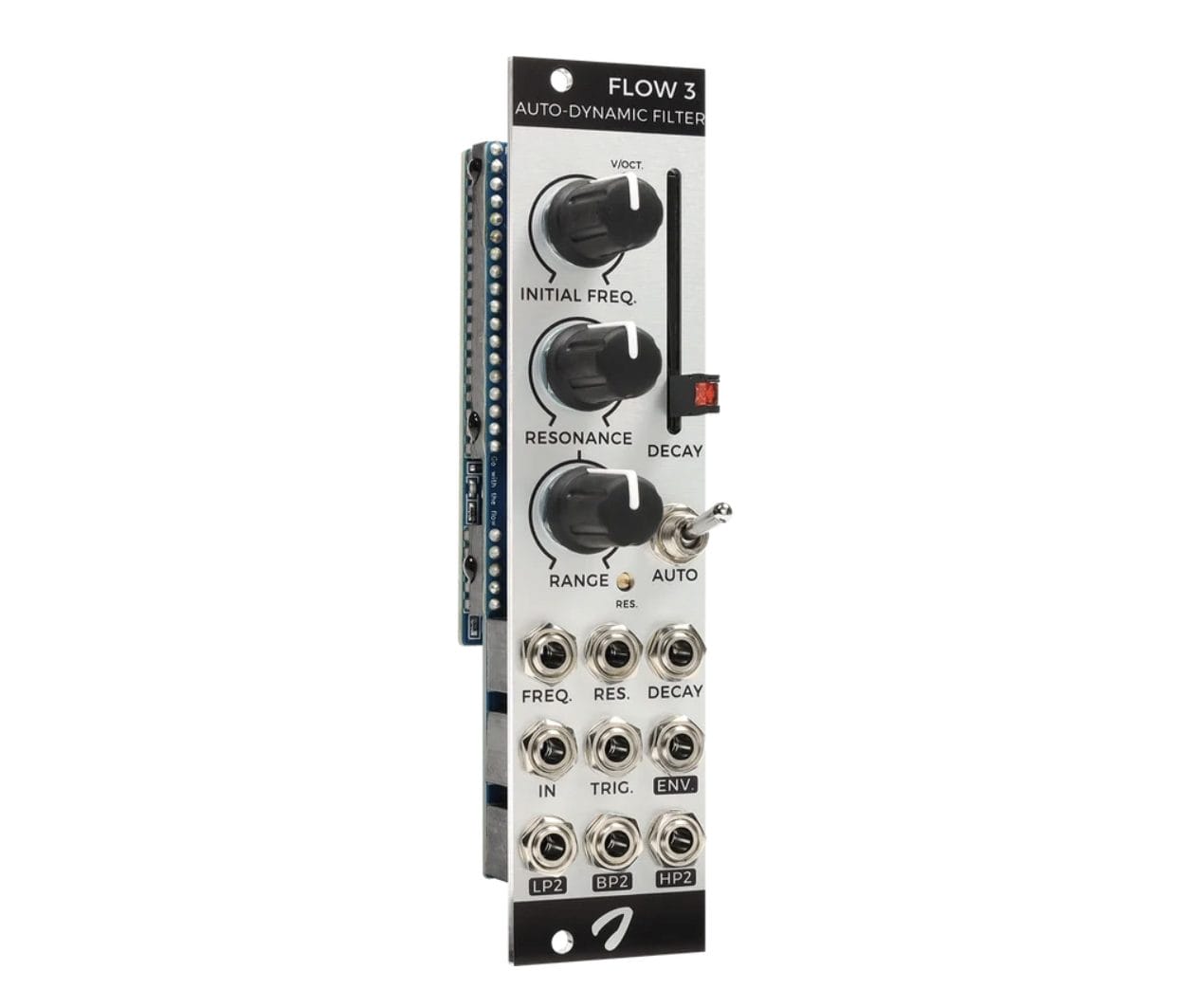
Joranalogue Audio Design has made Flow 3 available, and the best way to understand it is this: it is a compact Eurorack filter that does more than sit there waiting for modulation.
Flow 3 is a 6 HP auto-dynamic filter built around a new take on the classic state-variable filter design. That part alone puts it in familiar modular territory, with simultaneous low-pass, bandpass, and high-pass outputs giving patchers the usual building blocks for carving, splitting, and shaping signals.
The twist is that Flow 3 can move on its own.
A combined decay generator and envelope follower circuit can control the filter frequency over an adjustable range, either from external triggers or by following the amplitude shape of the incoming signal in AUTO mode. You can also use those methods at the same time. That gives the module a more alive feel than a filter that only reacts to whatever external modulation you patch into it.
That is the part I like here. Flow 3 is not trying to sell itself as a giant flagship module. It is a small, utility-looking filter with enough internal movement to become part of the groove, the transient, and the patch’s contour.
The Auto-Dynamic Circuit Is the Hook
Auto-filter ideas are not new, but the modular version of the idea gets more interesting when voltage control is involved.
Flow 3 can respond to the shape of the signal passing through it, which means the input can start driving its own tonal movement. A drum hit can push the cutoff. A bassline can open and close the filter with its own dynamics. A percussive sequence can become more animated without needing a separate envelope patched in for every move.
That makes Flow 3 easy to picture on kicks, bass stabs, plucks, and other transient-heavy sounds.
The press copy points directly at analogue kick drum design, which makes sense. A resonant filter with envelope movement is already one of the classic ways to build low-end percussion. Flow 3 gives that method a tight Eurorack format, with the option to drive the decay from a trigger or let the audio do some of the steering on its own.
For producers working hybrid or hardware-centered setups, this lands near the same larger question as our article on audio interfaces for hardware synth setups: how much of the sound should be shaped before it ever reaches the DAW? A module like Flow 3 is very much an answer from the front end of the chain.
Flow 3 Fits Joranalogue’s Usual Approach
Joranalogue has built its reputation on analogue circuits that look restrained on the panel but tend to go deeper once patched.
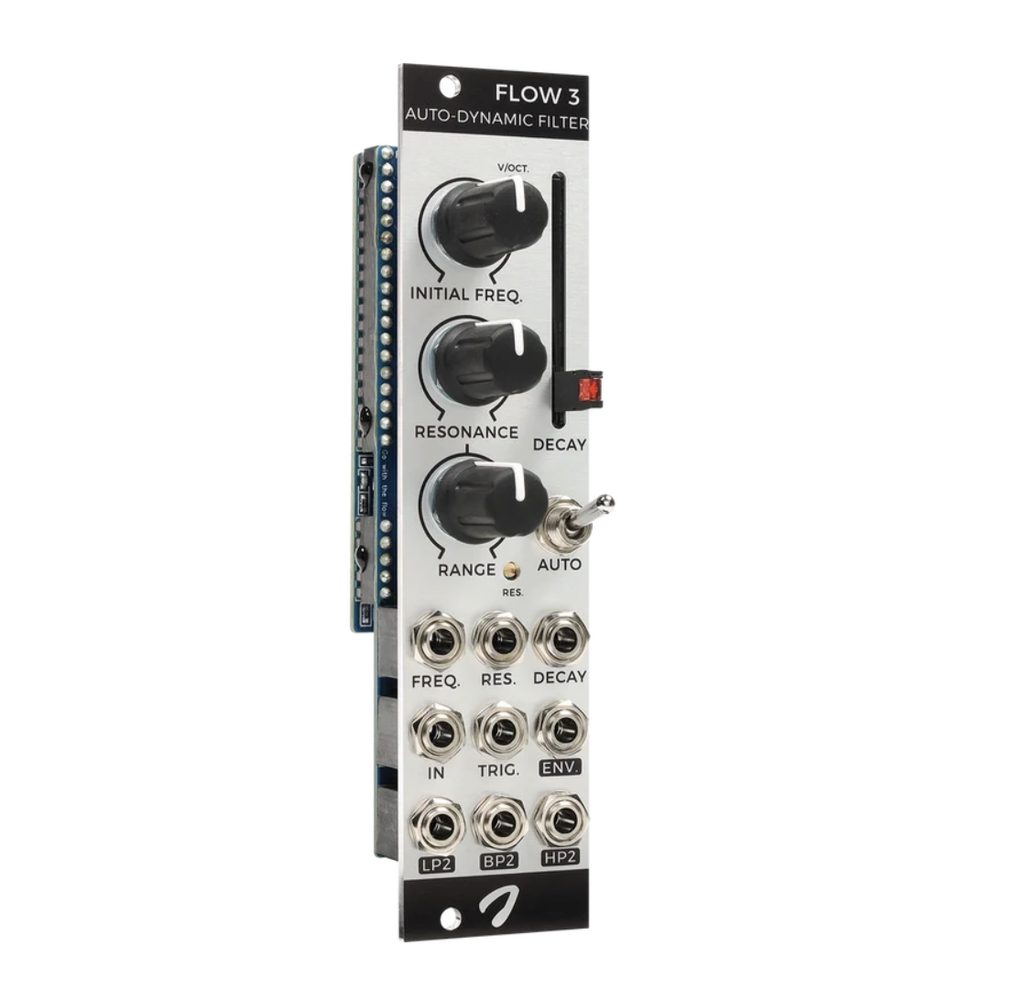
Flow 3 fits that pattern. It is made in Belgium, comes with the expected Eurorack power cable and mounting hardware, and measures 128.5 mm tall by 30 mm wide by 52 mm deep. Power draw is listed at +12 V: 45 mA and -12 V: 45 mA, with reverse-polarity MOSFET protection, 100 kΩ inputs, and compensated 0 Ω outputs.
Those specs are not glamorous, but modular users care about this stuff because rack space, power, depth, and signal behavior decide whether a module actually fits into a system.
For a wider experimental hardware comparison, our piece on SOMA Laboratory’s ENIGMA is a completely different kind of instrument, but it points to the same larger hunger in electronic music right now: physical systems that push producers out of routine sound design habits.
Flow 3 is less theatrical than ENIGMA, but it is still built around movement, interaction, and response.
Flow 3 Is Available Now
Joranalogue Audio Design’s Flow 3 is available now through its authorized dealer network at €215 EUR or $225 USD.
It is a compact 6 HP module, but the feature set gives it a bigger role than the size suggests. Use it as a resonant multimode filter. Use it to animate percussion. Use it for auto-filter movement. Use it as a crossover. Push it into self-oscillation and treat it as a quadrature VCO.
That is the appeal.
Flow 3 does not need to look dramatic to be interesting. It gives modular users a filter that can listen to the signal, react to the patch, and turn a small amount of rack space into a more animated part of the system.
For anyone building a Eurorack case around compact modules that still pull real patching weight, Flow 3 looks like a very Joranalogue answer: clean on the surface, deeper once voltage gets involved.

Will Vance is a professional music producer who has been involved in the industry for the better part of a decade and has been the managing editor at Magnetic Magazine since mid-2022. In that time period, he has published thousands of articles on music production, industry think pieces and educational articles about the music industry. Over the last decade as a professional music producer, Will Vance has also ran multiple successful and highly respected record labels in the industry, including Where The Heart Is Records as well as having launched a new label with a focus on community through Magnetic Magazine. When not running these labels or producing his own music, Vance is likely writing for other top industry sites like Waves or the Hyperbits Masterclass or working on his upcoming book on mindfulness in music production. On the rare chance he's not thinking about music production, he's probably running a game of Dungeons and Dragons with his friends which he has been the dungeon master for for many years.