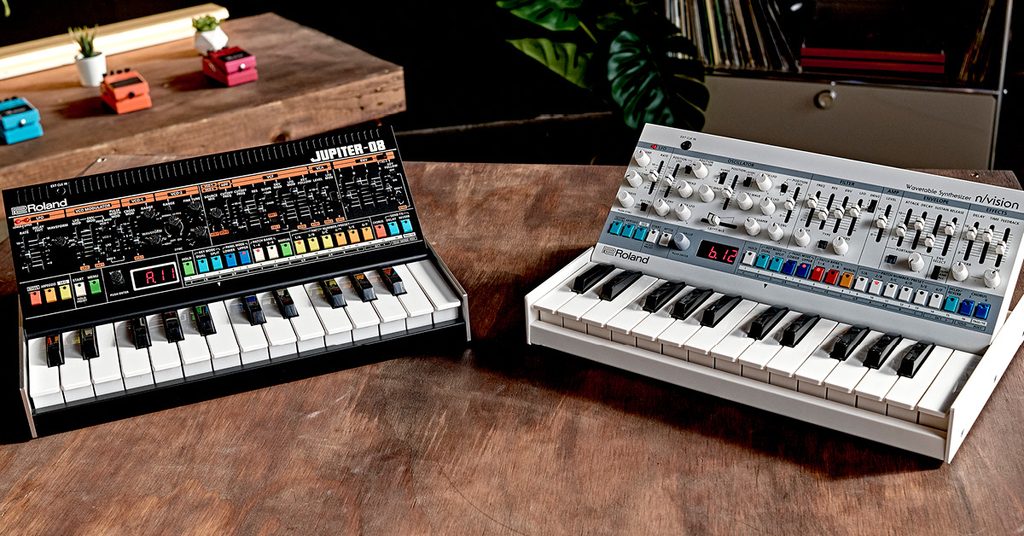
The best MIDI interfaces for hardware synths in 2026 are the ones that keep a hardware setup from turning into a cable-management problem before the session even starts. I learned that pretty quickly once my own room started filling up with synths, controllers, drum machines, and little boxes that all wanted MIDI in slightly different ways.
One MIDI port can handle a small setup, though it starts to feel limited once clock, notes, program changes, and controller data all need to move simultaneously.
That is why I wanted this list to be honest about the gear I have reviewed on Magnetic and where each product fits. The Black Lion Audio MIDI Eight is the only true dedicated MIDI interface in this group, so it gets the cleanest recommendation. The rest of the gear here has clear MIDI value, though most of it is an audio interface, a controller, or a standalone production box first.
That caveat matters because a producer searching for the best MIDI interfaces for hardware synths probably needs routing help, while another reader may need audio I/O, hands-on control, or a central writing hub. So I am starting with the real MIDI interface, then working through the Magnetic-tested gear that can support a hardware-heavy setup without pretending each product solves the same problem.
| Product | Category caveat | Best fit | Why I’m including it |
|---|---|---|---|
| Black Lion Audio MIDI Eight | True dedicated MIDI interface and router | Hardware-heavy studios and live rigs | 8-in, 8-out routing, 128 total MIDI channels, standalone modes, USB hub, LEDs, Panic button, and front-panel patching |
| Arturia AudioFuse 16Rig | Audio interface first, MIDI support second | Synth-heavy rooms that need audio I/O and MIDI in one hub | Huge I/O count, standalone operation, MIDI In, Out, and Thru, plus enough routing depth for larger setups |
| SSL 18 | Audio interface with MIDI I/O | Producers moving into a larger studio setup | Clean conversion, SSL input tone, ADAT expansion, and MIDI I/O as part of a larger studio center |
| Universal Audio Volt 876 | Rackmount audio interface with MIDI I/O | Producers tracking several synths or instruments at once | Eight combo inputs, ADAT expansion, word clock, MIDI I/O, and enough room for a growing studio |
| SSL 2+ | Compact audio interface with MIDI I/O | Small rooms and first hardware synth setups | Two-input interface with MIDI I/O, dual headphone outs, and a compact footprint |
| Novation Launch Control XL 3 | MIDI controller, not a routing box | Hybrid setups that need hands-on control | Eight faders, 24 endless encoders, 16 buttons, OLED feedback, and full-size MIDI I/O |
| Akai MPC Key 37 | Standalone workstation with MIDI and CV control | Producers who want sequencing, sampling, and hardware control from one keyboard | USB-MIDI, five-pin MIDI In and Out, CV/Gate outputs, and sustain inputs |
Black Lion Audio MIDI Eight

The Black Lion Audio MIDI Eight is the product that most directly answers this keyword because it is an actual dedicated MIDI interface and router.
When I reviewed it, the first thing that hit me was how plug-and-play it felt: I could connect the hardware, choose a routing mode, and get back to the session without opening a separate setup utility. It gives you 8 MIDI inputs, 8 MIDI outputs, 128 total MIDI channels, three standalone routing modes, a built-in USB hub, per-port activity LEDs, a Panic button, and front-panel MIDI access.
The main reason I like it has less to do with the spec sheet and more to do with how much cleaner the room feels once MIDI has its own center. Pass, Thru, and Merge modes handle the real routing tasks that arise when synths, controllers, sequencers, and drum machines all need to stay connected. Compared with every other product in this article, the MIDI Eight is the only one I would treat as the dedicated answer for MIDI routing first. It also pairs well with a bigger audio interface because the interface can handle sound while the MIDI Eight handles clock and control data.
This reminded me of my conversation with Hannes Bieger, where he asks, “Is the technical setup well maintained so that it doesn’t put any roadblocks in your way?” That is the exact lane the MIDI Eight sits in, because it keeps the technical side of a synth-heavy room from getting in the way of the idea.
Arturia AudioFuse 16Rig
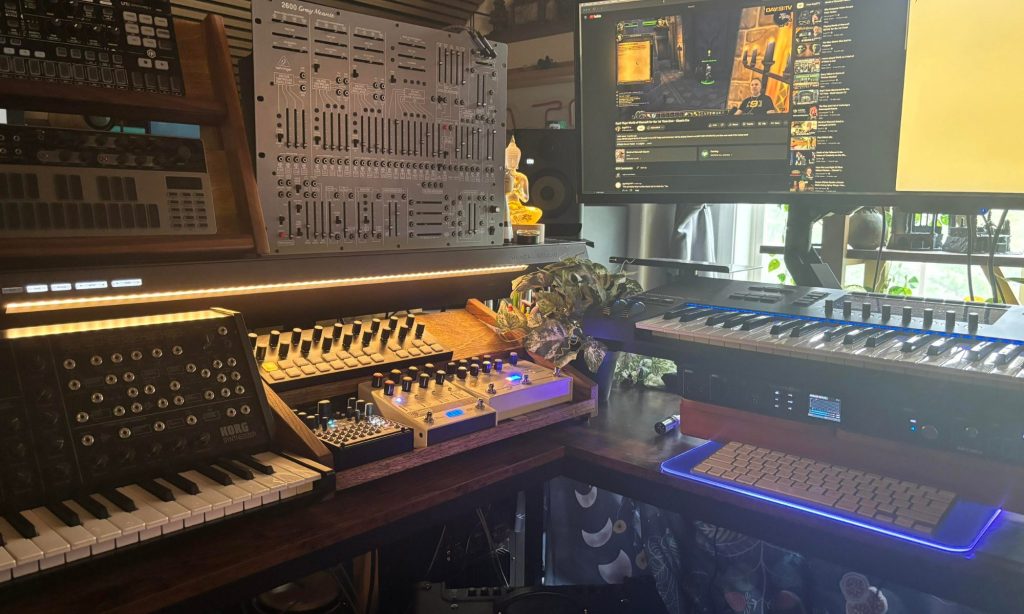
The Arturia AudioFuse 16Rig has a caveat right away: it is an audio interface first, not a dedicated MIDI interface.
I am including it because it is one of the clearest pieces of gear I have reviewed for producers whose rooms have grown past the small-interface stage. In my full review, I focused on how it provides a studio with a large audio center featuring 32×28 channels, analog and digital I/O, ADAT, word clock, standalone operation, and MIDI In, Out, and Thru. That MIDI Thru matters in this context because a synth room often needs gear to pass MIDI onward without making the routing feel messy.
Where the MIDI Eight handles the control-data side with real focus, the AudioFuse 16Rig handles the broader studio-center job. I would not tell a reader to buy the AudioFuse 16Rig instead of the MIDI Eight if the only problem is MIDI routing. I would tell them to look at it when the audio side of the room also needs a serious upgrade. In my setup, the cleaner split is simple: the AudioFuse handles the audio side, while the MIDI Eight gives the MIDI side its own structure.
SSL 18

The SSL 18 is another caveat pick because it is a studio audio interface with MIDI I/O rather than a dedicated MIDI router. I am including it because it fits the producer who wants a bigger interface and still needs a five-pin MIDI path for external gear.
The review focused on the way it brings SSL’s studio approach into a more accessible rackmount interface, with clean conversion, proper line-level support, ADAT expansion, and the Legacy 4K circuit on the input stage. That is a different value proposition than the Black Lion MIDI Eight, which does not care about preamps, converters, or the sound of what you are recording. The SSL 18 is about bringing synths, microphones, guitars, and external processors into a more organized studio setup.
The MIDI I/O is part of that larger setup, although I would frame it as a bridge rather than the main routing system. Compared with the Arturia AudioFuse 16Rig, the SSL 18 feels more focused on one-knob-per-function control and the SSL input path. Compared with the MIDI Eight, it solves a different job, so the caveat needs to stay clear in the copy.
Universal Audio Volt 876
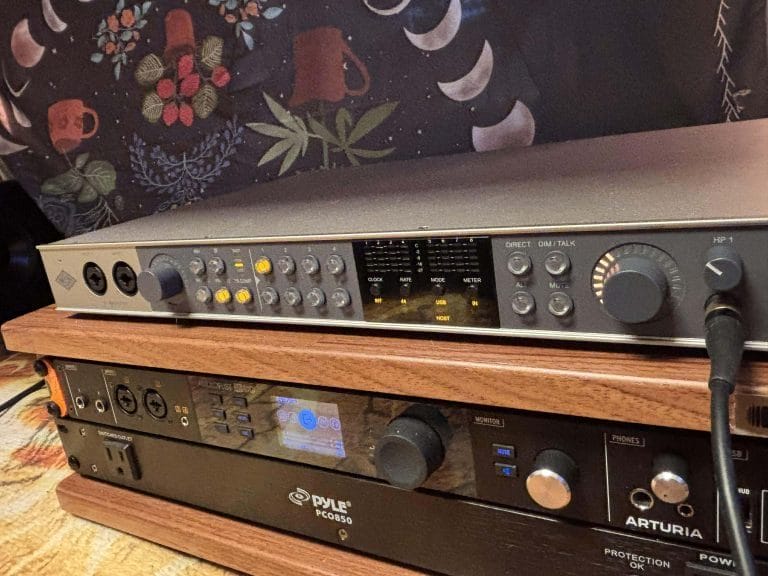
The Universal Audio Volt 876 is here because I reviewed it as a rackmount interface for producers who have outgrown a small two-channel setup.
It has MIDI I/O, so it can support external synths, although it is still an audio interface first. In my review, I talked about coming back to the Volt ecosystem after using the Arturia AudioFuse 16Rig, and the 876 felt like UA scaling that familiar Volt idea into a larger rack format. For synth-heavy rooms, the appeal is clear: eight combo inputs, balanced outputs, ADAT expansion, word clock, and MIDI I/O in one unit.
That makes it a better fit for someone who needs to record several sources at once, not someone who only needs deeper MIDI routing. Compared with the SSL 18, the Volt 876 feels like the more direct multichannel tracking move, while the SSL leans harder into its input character and studio-control feel. Compared with the MIDI Eight, the Volt 876 is solving the audio side first and giving you MIDI as part of that setup. I would include it for readers who want to clean up a growing studio and keep MIDI available without buying a dedicated router on day one.
SSL 2+

The SSL 2+ is the small-room caveat pick in this article, and I think that matters because not every hardware synth setup starts with a full rack.
The key detail is that the SSL 2+ has MIDI I/O, while the smaller SSL 2 does not fill that same role for external gear. In the review, I focused on the build quality, the two mic and instrument inputs, 24-bit/192 kHz conversion, Neutrik connectors, Alps pots, dual headphone outputs, and the Legacy 4K circuit. For a producer with one synth, one controller, or a small desktop setup, that can be enough to get MIDI into the system without adding another box. It does not compete with the Black Lion MIDI Eight on port count, routing modes, or studio-wide organization.
That is fine, because the SSL 2+ is meant for a different reader. I would recommend it to someone buying a first serious interface who wants to keep a proper five-pin MIDI path available. If that same person later adds more hardware, the MIDI Eight becomes the next logical step rather than a redundant purchase.
Novation Launch Control XL 3
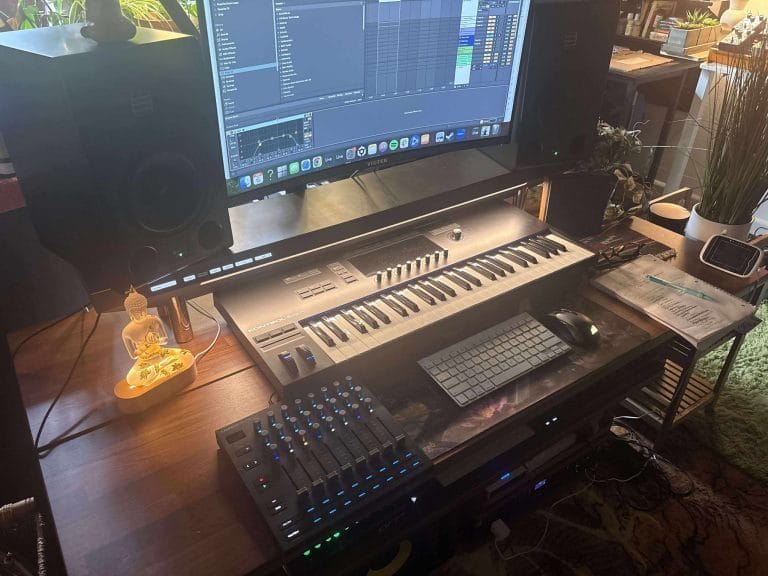
The Novation Launch Control XL 3 is the clearest non-interface caveat here because it is a MIDI controller with full-size MIDI I/O rather than a routing hub. I still want it in the piece because hands-on control is one of the biggest reasons hardware setups feel different from laptop-only production.
When I reviewed it, I kept coming back to the eight faders, 24 endless encoders, 16 buttons, transparent OLED display, and the way it can live at the center of a hybrid studio. That makes it very different from the SSL and UA entries, which are mostly about getting sound into the computer. The XL 3 is about touching levels, riding parameters, and keeping control near your hands rather than burying every move behind a screen. Its full-size MIDI I/O gives it a real hardware connection point, which is why it belongs here with a clear caveat attached.
This also reminded me of my TEED interview, where he said, “You have to be honest with yourself about what really moves you.” A controller like this matters when it helps you get to the moves you actually care about making, rather than adding one more layer between your hands and the hardware.
Akai MPC Key 37
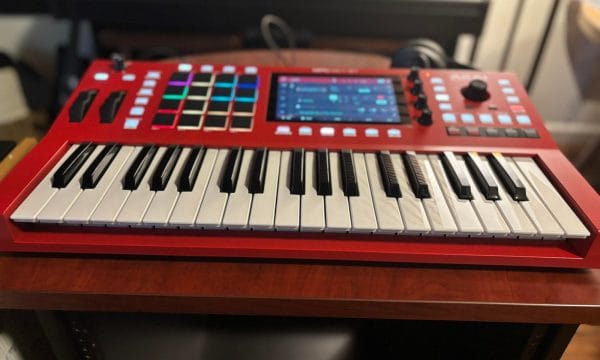
The Akai MPC Key 37 is the workstation caveat pick because it brings MIDI into a much bigger production environment. When I reviewed it, one of the sections that mattered for this article was the connection set: USB-MIDI, five-pin MIDI In and Out, CV/Gate control, sustain inputs, and the missing Thru port.
That missing Thru port is worth mentioning because it limits how cleanly the unit can sit in the middle of a daisy-chained MIDI setup. Still, the MPC Key 37 earns its place because it can sequence, sample, host instruments, and control external gear from one keyboard-led surface.
Compared with the Novation XL 3, this is less about DAW control and more about writing full ideas away from the computer. Compared with the Black Lion MIDI Eight, it is not trying to manage an entire room’s MIDI traffic. Its value is that it can become the writing and sequencing center for a compact hardware rig.
I would frame it as a creative control center with real MIDI and CV connectivity, while making it clear that a dedicated MIDI router may be needed once the studio expands.
Honorable Mentions I Have Not Reviewed Yet
These products fit the focus keyword more directly than some of the caveat picks above, although I have not reviewed them on Magnetic yet. I would keep them as on-radar options with outbound links rather than full recommendations.
| Product | Why it is on my radar | Best fit | External link |
| iConnectivity mioXL | 8-in, 12-out DIN MIDI, 10 USB-MIDI host ports, and Ethernet RTP-MIDI routing | Larger rooms with USB MIDI gear and networked MIDI needs | iConnectivity mioXL |
| MOTU MIDI Express 128 | 8 MIDI inputs, 9 MIDI outputs, and 128 MIDI channels in a rack unit | Producers who want a direct rackmount DIN MIDI interface | MOTU MIDI Express 128 |
| CME U6MIDI Pro | Compact 3-in, 3-out USB MIDI interface with routing, filtering, and mapping through UxMIDI Tools | Smaller synth stations and mobile setups | CME U6MIDI Pro |
| Conductive Labs MRCC 880 | Desktop MIDI router with hands-on routing, filtering, monitoring, and standalone operation | Producers who want direct front-panel routing without a computer | Conductive Labs MRCC 880 |
Wrapping Things Up
The Black Lion Audio MIDI Eight is the cleanest recommendation here because it is the only dedicated MIDI interface in this batch that I have reviewed on Magnetic.
Everything else needs the caveat that it supports a hardware synth setup without replacing a real MIDI router.
The Arturia AudioFuse 16Rig, SSL 18, Universal Audio Volt 876, and SSL 2+ make the most sense for producers who need both audio and MIDI I/O in a single studio center. The Novation Launch Control XL 3 is the control-focused pick, while the Akai MPC Key 37 is the sequencing and writing-focused pick. If a reader needs the most direct answer to best MIDI interfaces for hardware synths in 2026, I would point them to the MIDI Eight first.
If they are also upgrading the recording side of the room, the interface entries become much easier to justify. If they need hands-on control or standalone sequencing, the Novation and Akai options address different aspects of the same hardware problem. The purchase should match the actual bottleneck in the room: routing, recording, control, or sequencing.

Will Vance is a professional music producer who has been involved in the industry for the better part of a decade and has been the managing editor at Magnetic Magazine since mid-2022. In that time period, he has published thousands of articles on music production, industry think pieces and educational articles about the music industry. Over the last decade as a professional music producer, Will Vance has also ran multiple successful and highly respected record labels in the industry, including Where The Heart Is Records as well as having launched a new label with a focus on community through Magnetic Magazine. When not running these labels or producing his own music, Vance is likely writing for other top industry sites like Waves or the Hyperbits Masterclass or working on his upcoming book on mindfulness in music production. On the rare chance he's not thinking about music production, he's probably running a game of Dungeons and Dragons with his friends which he has been the dungeon master for for many years.