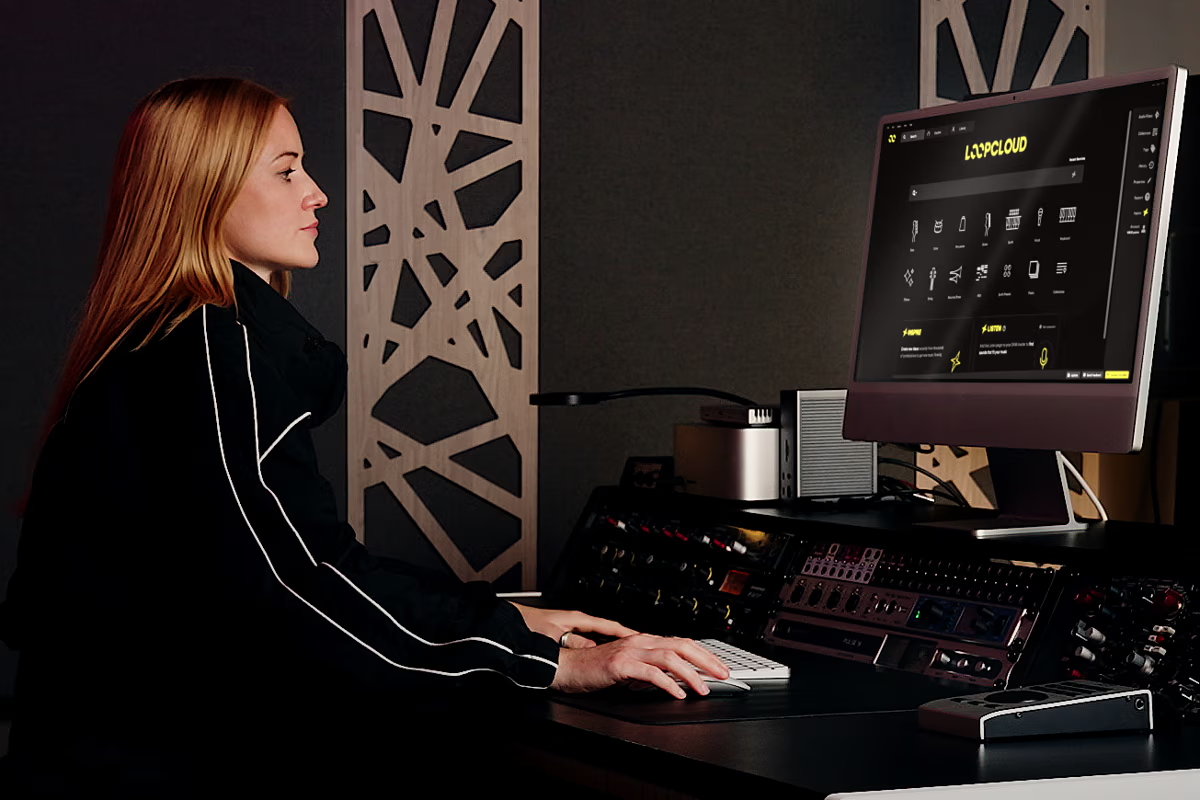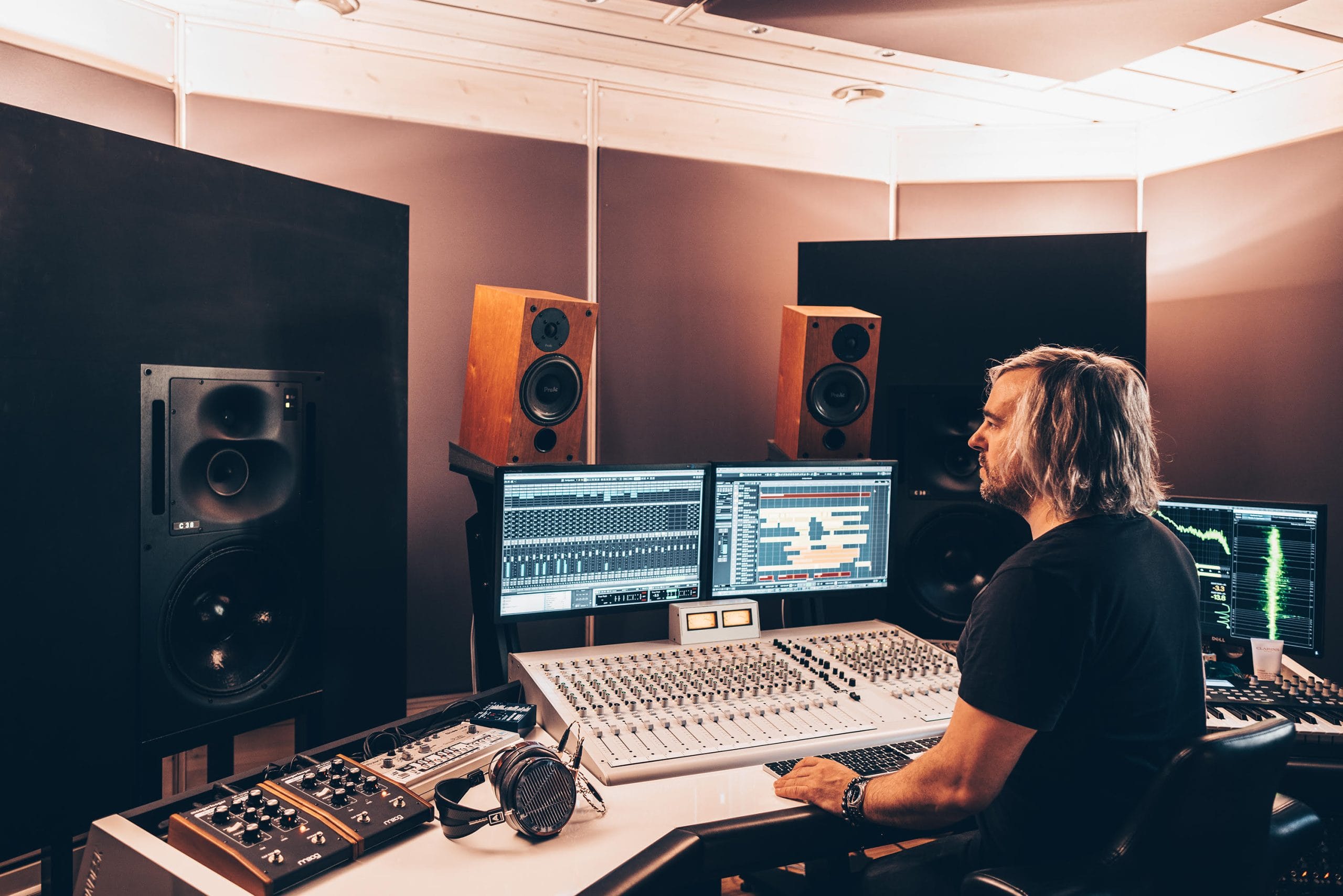
Hannes Bieger has been a fixture of the European electronic scene for over two decades, but his influence reaches far beyond his own releases. As a mix engineer and educator, he’s spent years refining not only his sound, but the spaces and tools that help others shape theirs. For artists looking to finish a record, book a private masterclass, or step inside a room that’s designed for sonic clarity and comfort, Hannes’ Berlin studio offers something more than gear: it offers intention.
From his analog summing chain to the design of his lounge, everything in Bieger’s world has been shaped by years of doing the work. It’s not about novelty but about building a workflow that removes friction and supports creativity. His rate structure reflects this flexibility: indie mixdowns start at €450 (+VAT), and custom masterclasses (designed for small groups or individuals) begin at €900/day. Everything else is tailored to the artist and the music.
In this interview, Hannes opens up about the soul of a good studio, how natural light and air affect his mixes, and why taking breaks from the process can sometimes lead to the best ideas. Whether you’re looking to book him or just recalibrate your own space, this is one of the cleanest articulations of what it means to take your creative environment seriously.
What makes your studio feel alive or yours?
I think this is a complex issue that is based on several different aspects. First of all, my studio is a space where I spent a lot of time, and it sort of grew alongside myself in a way.
It has been developed and shaped with many years of experience and many years of thinking about how I would like to work and what supports my work in the best possible way. In a way I think you could say, because of this, that my studio sort of is an extension of my person. It‘s my own workspace where I spend so much time, where I’m being creative, where I’m taking care of my clients, and where I’m working on my music and my art.
Every little aspect in here is shaped by myself according to what I thought at the time would suit me in the best possible way. I also like the wording of the question! I really think that a studio sort of has a living on its own, it is being alive in away. I have sometimes compared the recording studio to a polyp.
This creature may look like a jellyfish, it may look like one single animal, but in fact it’s an organism that consists of a multitude of individual living beings which all have their specific purpose, and which all together sort of form the one thing. And ideally, the interplay of all these components is greater than the sum of its parts.
How often do you change your space and why?
I have been working out of three different personal studios in my professional career, which now spans almost 25 years. And every time I was forced to leave the old space it was because of gentrification processes happening in Berlin, where I’m living and working. And every time this was also a cause for a lot of stress and difficulties – because building studios and moving studios is a very complex and also costly endeavor on so many different levels…!
Both times I moved my studio in Berlin I purpose-built a new space according to my wishes and means at the time. Each time I also came to think of this as some sort of opportunity to improve what I already had.
And both times I came out on the other side of this planning, construction and moving process with a workspace that was even better than the previous one, indeed! Although I have to stress that I can’t really do this too often, because it’s just a very, very complex and exhausting process. And it also takes a lot of time to get used to a new space. In my experience, in order to really feel comfortable with the room acoustics of the new place, and all other aspects related to that, I think you need minimum six to nine months until you really get the hang of the new environment.
That’s another reason why I think nobody should move their studios too often!
Do you believe your physical environment affects your music?
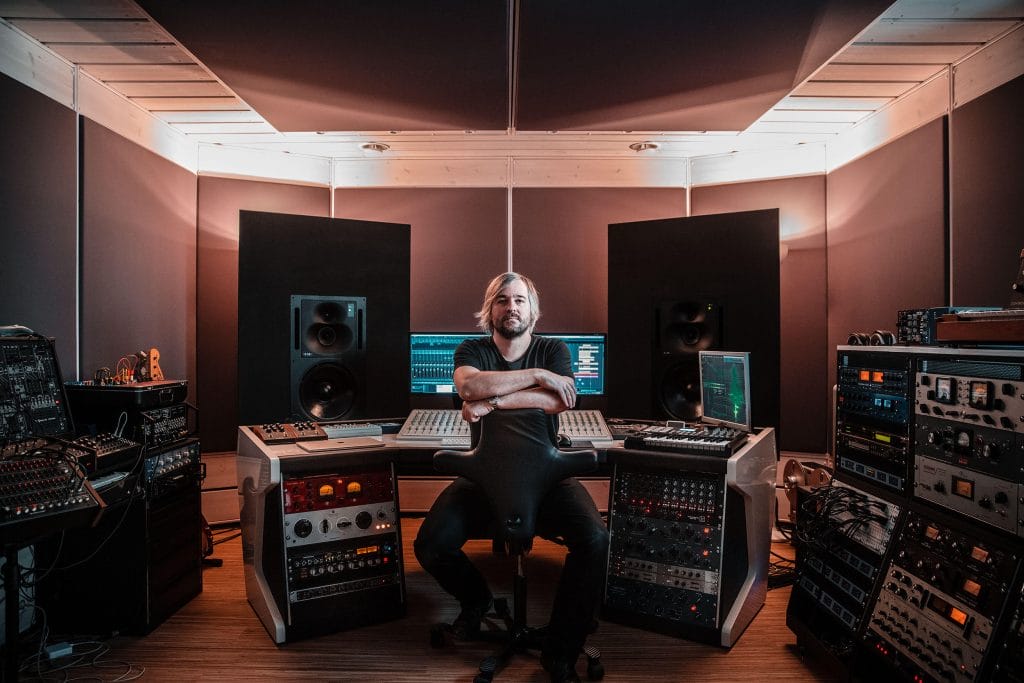
I absolutely do! I think as artists we are normally quite sensitive beings, and there are so many factors which are having a sometimes very, very profound influence on the creative process. And I am absolutely sure that a workspace is a tool, but I also like to see it sort of as a living room. I mean, it’s not only a space where you do work, it’s also a space where you want to feel comfortable and want to feel encouraged to be creative and stay creative. And there’s so much going into that.
Like – do you have daylight? Do you have some sort of connection to the outside world? Are you able to isolate yourself against distractions? Are you physically comfortable? How is the air you are breathing? Is the environment visually distracting or does it help you to focus? Is the technical setup well maintained so that it doesn’t put any roadblocks in your way? So I absolutely believe all of these aspects have a great influence on the creative process.
What details in your studio have nothing to do with music but support creativity?
I would say the overall design of the space is really, really important to me. I am a very visual person, even though music is what I do, but I also love design and architecture. And I wanted to create a space that has a nice vibe and that just feels welcoming. This is not just about the actual studio room. It’s also the lounge areas and all this kind of stuff. I also took great care of the design of these spaces. There’s a large table where you can sit and eat, and a couch that you can use to rest. And there’s a very, very nice espresso machine as well – I always say that this is the most important piece of equipment at the studio…
Have you ever made a great track in an unlikely space?
Yes, I actually did! And that’s the great thing about taking breaks from studio work and going somewhere else.
I figured that when I’m traveling and when I’m distancing myself enough from music, and from these very dense, busy work days that I normally have, filled with lots of sounds and music – when I distance myself from that long enough, I am experiencing silence in my head and in my mind, and I especially do so when I am staying by the ocean, which is my favorite type of holidays: staying on some remote island somewhere.
I actually wrote my latest Bedrock EP, Playa Perdida, on a deserted volcanic beach in Bali. And this was after a quite extensive period of traveling where I basically just sat on the beach and looked at the relentless ocean surf crashing in. And suddenly music started to form in my mind, coming out of nowhere.
And then I took some notes, and later I recreated in a hotel room what I envisioned sitting on the beach. I am really taking this experience to heart – I need more breaks and I need to present myself with more opportunities for the music to come to me by itself.
How does natural light, clutter, or comfort play into your sessions?
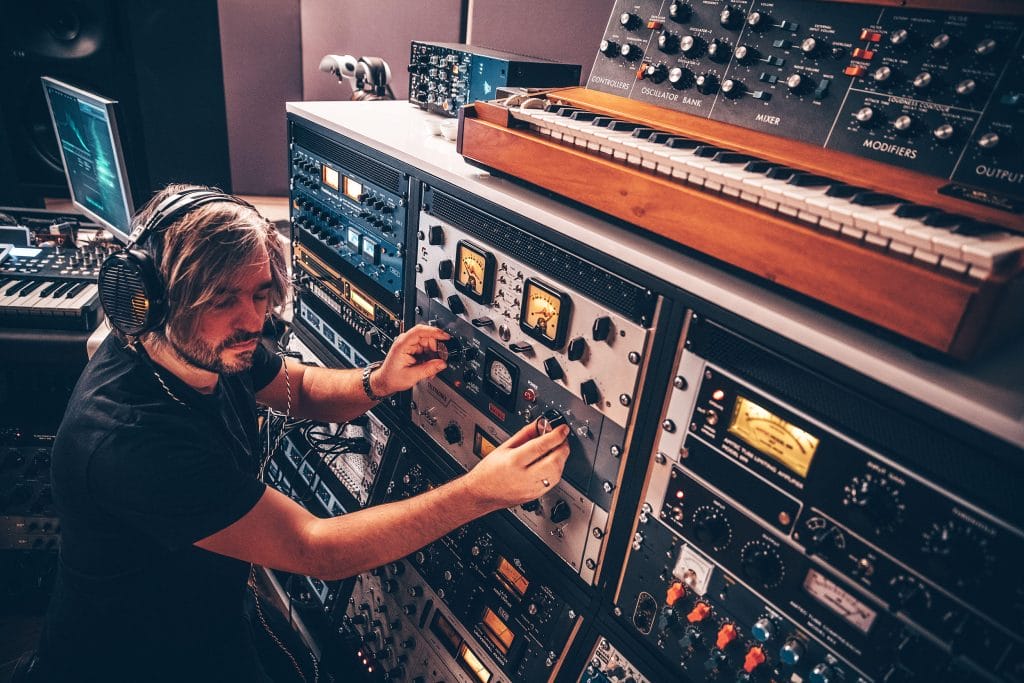
I luckily always have had studios with ample natural daylight. I think is very nice to not feel stowed away in some sort of shoebox in a basement somewhere! I think this is a source of great comfort, because even though I like immersing myself in music and enjoy being super focused on what I’m doing, daylight is also one way to stay connected with the outside world and not feel fully detached from daily life.
Clutter is an issue also which ties into what I mentioned before – the maintenance problems… I think creativity is something very precious, and anything that disrupts the creative flow once it has been established should be avoided at all costs! Maintenance issues as well as a totally cluttered room can be potentially severe roadblocks for the creative process, and this is why I always try to avoid them and have the studio as clean and clear and ready as it can be.
In terms of comfort I have mentioned coffee and food already… I think it’s really, really important to not forget that we are living organisms that need to be sustained! The physical comfort also comes into play in terms of the ergonomic layout of the studio. For example, I was very, very careful in selecting the chair I’m sitting on when I’m working. It’s a Danish chair. The model is Håg Capisco, which has this sort of unique saddle seat. It is great because it keeps you in a little bit more of an active seating position, not just slouching in some kind of lounge chair. I figured that I often spend more hours of the day on this chair than in my own bed, and so this is something really important because we are in this for the long haul… Anything that helps to support that and that makes you physically comfortable is a huge step forward!
What’s one small change you’ve made that improved your studio vibe immediately?
Depending on the perspective I wouldn’t necessarily think that it’s a small change, but light and lighting is so important! It’s really one aspect that must not be overlooked! I have already mentioned that I am very interested in architecture and design, and the lighting of the studio can be such a such an important thing to support an inviting creative atmosphere.
But on the other hand it can also be something that just actually makes you feel physically uncomfortable – and so I’ve always taken great care that the lighting situation in my studio is appropriate to whatever I’m doing in there.
Of course I have some very bright ceiling lights I can use for cleaning or fixing stuff, but when I’m working I create a situation with lots of indirect light, with carefully selected lamps.
The lighting needs to make you feel comfortable, it shouldn’t be too dark, it shouldn’t be too bright, it should be sort of variable for different situations. It, arguably, may seem like a smaller aspect of designing a studio, where so much attention goes into the technical setup and the acoustic properties and all this kind of stuff. But in my view, lighting can really, really make or break it in the end.

Will Vance is a professional music producer who has been involved in the industry for the better part of a decade and has been the managing editor at Magnetic Magazine since mid-2022. In that time period, he has published thousands of articles on music production, industry think pieces and educational articles about the music industry. Over the last decade as a professional music producer, Will Vance has also ran multiple successful and highly respected record labels in the industry, including Where The Heart Is Records as well as having launched a new label with a focus on community through Magnetic Magazine. When not running these labels or producing his own music, Vance is likely writing for other top industry sites like Waves or the Hyperbits Masterclass or working on his upcoming book on mindfulness in music production. On the rare chance he's not thinking about music production, he's probably running a game of Dungeons and Dragons with his friends which he has been the dungeon master for for many years.