Tips At A Glance
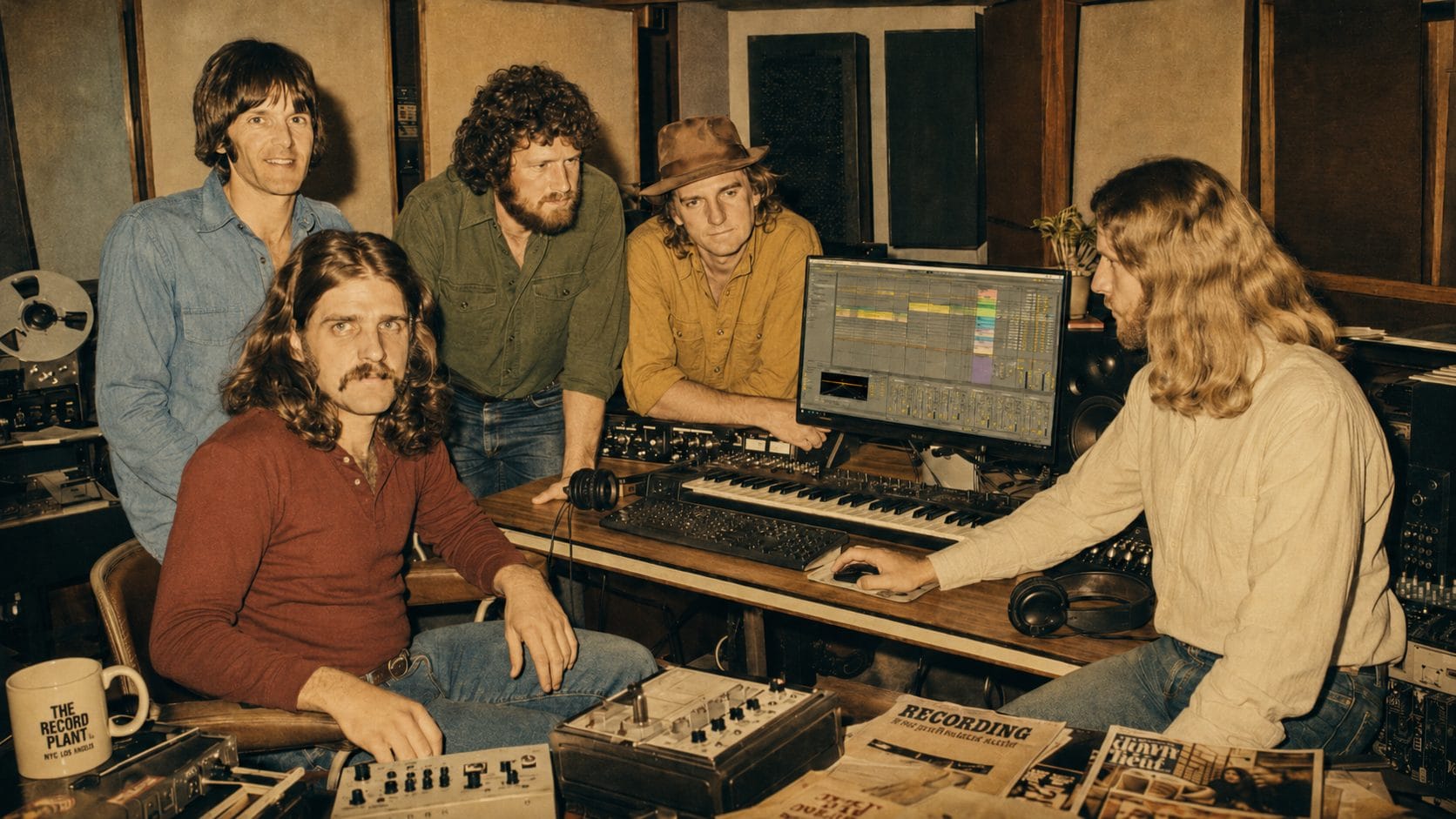
The Eagles’ “Hotel California” is one of the best songs to study if you are a producer trying to understand how songwriting, arrangement, harmony, lyrics, and performance all start feeding into the same central idea… and before we get into the weeds, yes the above picture is AI but it’s pretty silly isn’t it?!
It is easy to talk about the obvious stuff, like the guitar intro, the B minor progression, the dual solo, and the fact that the record is still everywhere decades later. But the real reason the song is so fun is that every major choice feels like it is helping the same point come together. The chords feel unresolved in an interesting and unconventioanl way, the lyrics feel strange without being overly random, the arrangement takes its time, and the guitar work keeps developing the story after the vocal drops out.
The song does not sit you down and explain exactly what every line means, which is probably why people are still arguing about it and writing about it all these years later. It gives you enough detail to feel the setting right away, then it leaves enough space for the listener to project their own meaning into it.
That is a massive lesson for producers, because most of us overcorrect when an idea feels unclear. We add layers, stack parts, write extra lines, or force another section into the arrangement, when the better move is usually to sharpen the core idea until the whole record starts pointing in the same direction.
Serve The Lead First
One of the most practical lessons in the whole “Hotel California” story is that the key had to change because the vocal needed to work.
That sounds obvious, but producers ignore this all the time. A guitar part, synth patch, bassline, or sample might feel perfect in isolation, then the vocalist gets in the room and suddenly the whole thing is in the wrong place. The Eagles tried the song in other keys before landing on B minor, and that decision mattered because Henley’s voice had to carry the lyric with authority.
This reminds me of my conversation with Hannes Bieger about creative flow, because a big part of making good records is knowing when the session is fighting the song instead of helping it. You have to be willing to move the key, rewrite the part, thin the arrangement, or lose the thing you were attached to. The vocal is where most listeners find the emotional center. If the production makes that harder, the production is wrong.
Build Around One Idea
The first thing I always come back to with “Hotel California” is how much of the song comes from one musical idea that had enough character to carry the whole thing. Don Felder did not walk in with a finished lyric, a complete vocal, and a full concept that everyone had to work around.
He had a guitar progression that already suggested a tone, giving Henley and Frey something to write into. That is a huge production lesson because so many tracks die when too many half-ideas fight for attention. You do not need six hooks in the first thirty seconds if the first loop actually has a point of view. The better question is whether the first idea gives the vocal something to react to.
If the loop already feels like it is pulling the listener somewhere, you can build around it instead of constantly trying to prove the track has enough going on. That is really the whole game with this song: the progression is interesting enough to repeat, and the arrangement is patient enough to let that repetition become part of the identity.
Let The Chords Do Work
The chord progression is doing way more than people usually give it credit for. You have B minor into F#7, then A into E, then G into D, then E minor back into F#7, and the whole thing keeps circling without giving you the kind of clean resolution a simpler song might hand over right away.
That is why the song feels like it is moving forward while also staying trapped in the same room.
For producers, that is such a useful thing to sit with, because we often try to create tension with arrangement moves first. We reach for risers, noise sweeps, filter automation, reverse crashes, bigger drums, and all the usual tricks before asking whether the chords are already doing enough. “Hotel California” is a reminder that harmony can create pressure before the production has to. Even a small chord-quality change can make a section feel less settled. If your track feels flat, the answer might not be another layer. It might be that the chords are too polite.
Make The Chorus Shift
The chorus does one of my favorite things a song can do, which is change the center of gravity without making the listener feel like they have been pulled into a totally different record.
The verse lives around B minor, then the chorus leans toward D major, and because those keys are related, the shift feels natural while still opening the song up. That is exactly the kind of move producers should be thinking about before they start solving every chorus problem with volume and density. A chorus does not always need a massive new stack of parts.
Sometimes it needs the harmony to tilt in a way that makes the same track feel like it has found a new angle. That is what happens when the title line arrives. The song feels wider, the setting becomes clearer, and the lyric suddenly has a bigger stage to sit on.
I think a lot of producers could get better results by asking whether the chorus has a writing lift before asking whether it has a production lift.
Give Lyrics Physical Details
The lyrics work because they give you physical details instead of handing you a thesis.
You get the highway, the hotel, the corridor, the voices, the wine, the mirrors, the knives, and the exit line, and all of those details let the listener build the meaning without being told exactly what to think.
That is probably the biggest lyric lesson in the whole song. If the idea is fame, excess, disillusionment, or getting trapped inside something you thought you wanted, the Eagles do not just say that directly.
They turn it into rooms, objects, people, sounds, and movement. That matters for producers because physical lyrics are easier to arrange around. A lyric with a clear setting gives you better cues for space, reverb, dryness, distance, and restraint. If the vocal gives you a room, you can decide how that room should feel in the production. If the lyric only gives you a vague emotion, you are stuck guessing.
Stop Producing Too Early
This is where I think a lot of producers mess themselves up, and I say that as someone who has done this way too many times.
You get a cool loop, you start hearing potential, and within ten minutes you are already building the full production around an idea that has not really proven itself yet. “Hotel California” is a good reminder that the writing has to hold attention before the production starts doing all the heavy lifting. The progression, lyric concept, and vocal shape are all doing real work before the record gets to the bigger arrangement payoffs.
That lines up with a lot of the creativity conversations I have had on Magnetic, especially the ones where artists talk about stepping back from the session and hearing the song as a listener again. SIDEPIECE made me think a lot about that idea, because good listening is not the same thing as hunting for things to copy or fix.
Sometimes the move is just to play the idea in a normal environment and ask whether it still has a pulse when the session window doesn’t make it feel important.
Write The Solo Like A Hook
The guitar solo in “Hotel California” is one of the clearest examples of an instrumental section functioning like songwriting. It does not feel like the band hit the solo section and started filling time.
Felder and Walsh are developing the same emotional information that the vocals have already set up, and by the time the harmonized guitar ending arrives, the song has another hook without adding another lyric.
That is a huge lesson for producers working in any style. A synth line, guitar part, chopped vocal, piano phrase, or bass fill should have a reason to exist beyond “this section needed something.” The target-note concept is useful here because the solo keeps connecting back to the chord progression instead of floating over it. That is why it feels composed rather than decorative.
If you are writing an instrumental hook, make it answer the chords. Make it feel like the song would be worse without it.
Let The Ending Mean Something
The fadeout at the end of “Hotel California” works because it actually matches the lyric.
The last vocal idea leaves you with someone who can check out, yet cannot really leave, and then the guitars keep going as the record fades away. That is such a good reminder that an ending is not just where the arrangement stops. It is the final production decision the listener hears, so it should say something about the song.
A hard stop says one thing…
A long reverb tail says something else. A stripped final chorus, a looped outro, or an unresolved fade can all change how the whole song feels in hindsight. “Hotel California” uses the fade in a way that supports the idea of being stuck inside the cycle. If you are producing a track about memory, obsession, temptation, burnout, or returning to the same mistake again, you should think twice before giving it an ending that feels too clean. The final seconds should still be writing the song.

Will Vance is a professional music producer who has been involved in the industry for the better part of a decade and has been the managing editor at Magnetic Magazine since mid-2022. In that time period, he has published thousands of articles on music production, industry think pieces and educational articles about the music industry. Over the last decade as a professional music producer, Will Vance has also ran multiple successful and highly respected record labels in the industry, including Where The Heart Is Records as well as having launched a new label with a focus on community through Magnetic Magazine. When not running these labels or producing his own music, Vance is likely writing for other top industry sites like Waves or the Hyperbits Masterclass or working on his upcoming book on mindfulness in music production. On the rare chance he's not thinking about music production, he's probably running a game of Dungeons and Dragons with his friends which he has been the dungeon master for for many years.