Table of Contents
Image Credit: Courtesy Of Art Director John Kosh, Photographer David Alexander, and The Eagles. Used For Creative Critique And Educational Purposes.
There’s probably no shortage of breakdowns out there trying to “explain” Hotel California—and I get why. It’s one of the most picked-apart songs in the entire rock canon.
But I’ve always thought that was the wrong way to frame this song, the lyrics absolutely must be read. That sounds like a small distinction, but it changes the whole angle of the conversation, because the second you stop treating “Hotel California” like a riddle, you start noticing how much of the writing is right there on the page.
But before we get too far into this analysis, if you’re interested in seeing them live, check their latest tour dates here to see if the Eagles are playing near you anytime soon.
The Eagles were never all that eager to pin it all down either. Don Henley has talked about the song as a “journey from innocence to experience,” and that is probably the cleanest doorway into it without acting like one sentence explains the whole thing. The song came out in late 1976, right as the band was moving away from the cleaner country-rock image and into something darker, stranger, and a little more deliberate. It won Record of the Year at the Grammys, the album sold in absurd numbers, and the opening line became one of those lyrics that people know even if they could not name three other Eagles songs.
But I think the reason “Hotel California” still works has less to do with the stats and more to do with how specific the writing is. It gives you the road, the hotel, the voices, the corridor, the wine, the mirrors, the knives, and that final line that everyone still quotes because it feels complete and unresolved at the same time.
That is also why I wanted to write a separate piece on what producers and songwriters can learn from “Hotel California,” because the chords, arrangement, guitar work, vocal key, and lyrics are all doing the same job from different angles. So if you want the studio-facing side of this, read that breakdown next, because this article is going to stay much closer to the words.
My background is in literature and creative writing, so that is the lane I am taking here. I want to look at the lyrics slowly, the way I would look at a poem or a short piece of fiction, and pay attention to what the song actually gives us instead of trying to force one tidy explanation onto it. I am not trying to overstate the case or turn a rock lyric into homework. I just think “Hotel California” is a better song when you stop asking what the secret answer is and start looking at how the images, setting, and final turn actually work.
Hotel California, at a glance
- The song takes place in a dreamlike setting that slowly reveals itself as a kind of trap
- Much of the imagery centers around excess, illusion, and the slow erosion of choice
- The final verse shifts the meaning of everything that came before it, quietly but completely
Lyrics
Hotel California Meaning
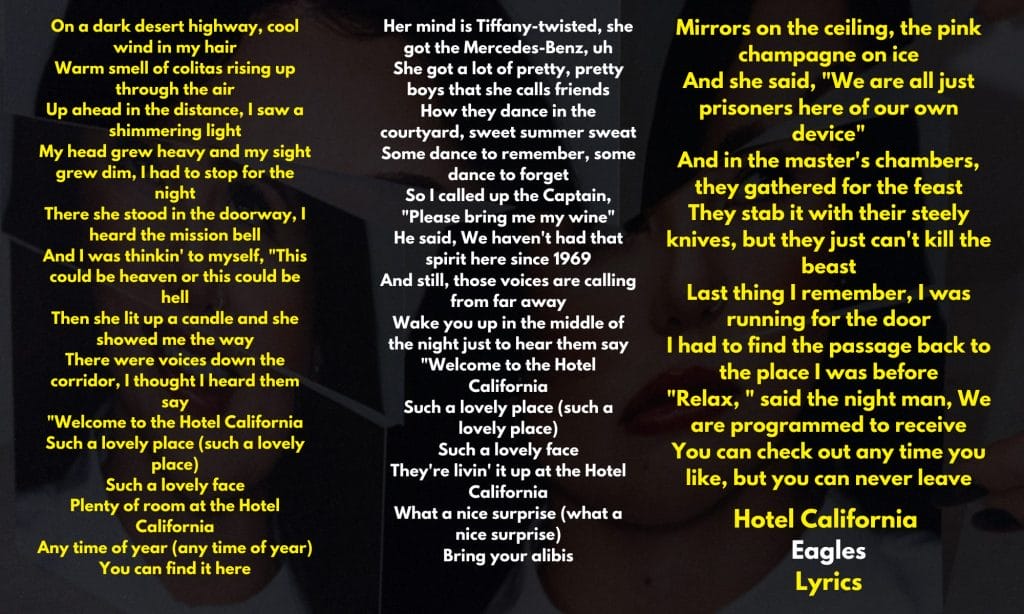
“On a dark desert highway / Cool wind in my hair / Warm smell of colitas rising up through the air”
I picture someone driving alone, the desert around them wide and quiet. At first, this feels freeing. I believe the artist chose this scene to show the start of a journey, before things turn strange.
Next comes the shimmering light and heavy head. He says he saw the light and had to stop. That tells me that he did not fully choose to enter the place. He was drawn in like by a force he could not resist.
James Thomson wrote in The City of Dreadful Night:
“The City is of Night; perchance of Death,
But certainly of Night.”
His city felt welcoming and eerie at once. I see the song doing the same by showing a nice road that leads to a strange stop.
“There she stood in the doorway / I heard the mission bell / This could be Heaven or this could be Hell”
Here the man meets a woman in a doorway and hears a bell. I believe he felt pulled into something. The bell could be holy or warning. That confusion makes him ask: is this place good, or is it dangerous?
Glenn Frey and Don Henley said in interviews they wanted the song to feel like being in a movie—uncertain, full of mystery. That fits this image. The man still wonders what he is walking into.
Trumbull Stickney’s poem Mnemosyne says:
“It is the future that creates his past.”
His mind twisted time. I see a connection there. The man in the song feels lost in time. He does not know what he is stepping into, but he is already there.
“Welcome to the Hotel California / Such a lovely place / Such a lovely face”
When I read those lines, I hear polite voices. They call it lovely. That word repeats like a soft trap in his head. I believe the voices smile while hiding something.
Don Henley said the song is about the high life in Los Angeles and its dark side. He explained it in 60 Minutes, saying it shows excitement and danger in one place. I think this section shows the promise and the risk at the same time.
Ernesto Cardenal wrote in Zero Hour:
“They came with gold and with mirrors,
And we admired ourselves in the mirrors.”
That reminds me of the hotel’s fancy decor. People come for the shine and stay blinded by it.
“Her mind is Tiffany-twisted / She got the Mercedes Benz … They dance to remember / They dance to forget”
I see a woman shaped by luxury. Her mind is twisted by jewels and cars. That suggests to me that riches changed her very way of thinking.
I believe this is a warning. The song shows a cost to comfort. Don Henley explained in interviews that the lyrics reflect how people in Hollywood can lose sight of who they truly are.
Stickney’s poem again clicks here. He shows memory trapping people:
“And what is not is for the poet real.”
That idea of living in a loop fits with dancing to remember or to forget. The people in the hotel chase time but never leave it.
“So I called up the Captain / ‘Please bring me my wine’ / He said, ‘We have not had that spirit here since 1969’”
I believe this line hits a deeper theme. The man seeks wine, comfort, or soul. The Captain answers that this place lost its spirit long ago. That suggests a deeper emptiness hiding under the luxury.
Henley explained that 1969 might represent the hope of the sixties. It was a time when people believed change could happen. After that, steady comfort took over. I think the song shows how a place can lose its soul, even while shining bright.
This connects to Cardenal again. Gold and mirrors can distract but not heal. The place looks alive, but the spirit is gone. That is the trap he warns about.
“We are all just prisoners here / Of our own device … You can check out any time you like / But you can never leave”
I see the big reveal here. People in the hotel built the prison around themselves. Their choices brought them here. They sleep, dance, drink—but freedom slips away.
The final line, where the man learns he can leave but never leave, feels like a gut punch. I believe this is the song’s main message: some choices can follow you forever.
Again, Thomson’s lines echo this:
“And men with nations, cities, worlds between
Still sat as if at home.”
He suggests that even far away, people remain stuck. That image lines up with the man in the song trying to walk out but still trapped.
Connecting Some Of The Bigger Themes And Motifs For Me
I think the thing that makes Hotel California hold up after all these years is that it does not over-explain itself. The band knew exactly what they were doing when they left the lyrics open-ended. In interviews, Henley said the song was about “the dark underbelly of the American dream,” but he also called it “a journey from innocence to experience,” which honestly feels like a cleaner way to frame it.
There’s no big reveal in this song—just a slow slide into a place that turns out to be harder to leave than it was to enter. And the further you go into it, the more you start to notice how many little choices—luxury, comfort, pleasure, beauty—start to feel like decisions that made themselves. That was kind of the band’s mindset too. Glenn Frey was pretty open about the fact that they wanted to move past their country-rock phase and write something more surreal, more layered. They called it a “cinematic” song, and that tracks—because once you’re in the hotel, it’s not just a place. It’s a world with its own rules.
That world has some real overlap with the ones built in the poems I’ve mentioned.
Thomson’s City of Dreadful Night is made entirely of illusion and repetition—people walking in silence through a city that reflects their own numbness back at them. It’s the same way the mirrors in the hotel are supposed to look like decoration, but end up feeling like a warning. Stickney’s Mnemosyne is quieter, but even more direct—it’s a poem about being trapped in your own thinking, your own past, your own loops.
Time folds in on itself.
Emotion detaches from action. And then you have Zero Hour, where Cardenal shows how beauty and material wealth are used to keep people calm, passive, distracted. One of the most telling lines in that poem is when he says, “They came with gold and with mirrors, and we admired ourselves in the mirrors.” That line hits the same nerve the Eagles were pressing: it’s easy to fall in love with a surface when you think it’s your reflection. Until you realize you’ve been staring at a wall this whole time.
That final verse—“You can check out any time you like, but you can never leave”—pulls the whole thing into focus. It’s not a horror story twist. It’s a quiet truth. The song is not warning us about some hotel off the highway. It’s pointing at something much closer to home: the way we build our own prisons through comfort, nostalgia, and routine. And that’s exactly where the Eagles were in real life when they wrote this.
They were drained, burnt out from touring, trying to top a massive record while wrestling with the very machine they were helping power. Henley even admitted they probably should have taken a year off, but the machine “demanded to be fed.” That right there could be a line in the song. So yeah, you can check out. You can take the gold record and the Grammy and the mirrored ceilings and walk out the front door.
But if the story stays in your head, and the illusion still works on you—that’s the part that never really lets you leave.

Will Vance is a professional music producer who has been involved in the industry for the better part of a decade and has been the managing editor at Magnetic Magazine since mid-2022. In that time period, he has published thousands of articles on music production, industry think pieces and educational articles about the music industry. Over the last decade as a professional music producer, Will Vance has also ran multiple successful and highly respected record labels in the industry, including Where The Heart Is Records as well as having launched a new label with a focus on community through Magnetic Magazine. When not running these labels or producing his own music, Vance is likely writing for other top industry sites like Waves or the Hyperbits Masterclass or working on his upcoming book on mindfulness in music production. On the rare chance he's not thinking about music production, he's probably running a game of Dungeons and Dragons with his friends which he has been the dungeon master for for many years.