Vinyl emulation plugins have been around long enough that most producers probably own at least one. Some concentrate on adding noise and pitch instability, while others combine saturation, filtering, and mechanical imperfections to make a clean recording resemble something sampled from an older record.
They’re popular for good reason, particularly when you’re working with synthesizers, percussion, and sampled instruments that need a little additional movement or coloration.
Modbap has introduced an interesting alternative with Wax Theory, a new $29.99 plugin that approaches record emulation through the physical behavior of vinyl playback. Instead of giving producers separate controls for distortion, noise, filtering, and wobble, Wax Theory connects those characteristics to the position of a simulated stylus. Moving the needle from the outer edge of a record toward the label changes how the audio is processed, following the changes in groove speed that occur during actual playback.
I’ve spent time with Modbap’s hardware before, including its Trinity drum synthesizer, and one thing I’ve appreciated about the company’s equipment is its emphasis on direct interaction.
Wax Theory follows that approach by concentrating most of the experience around a single control, giving producers a way to experiment with record coloration without spending several minutes configuring individual effects.
Wax Theory Changes Its Sound Based on Needle Position
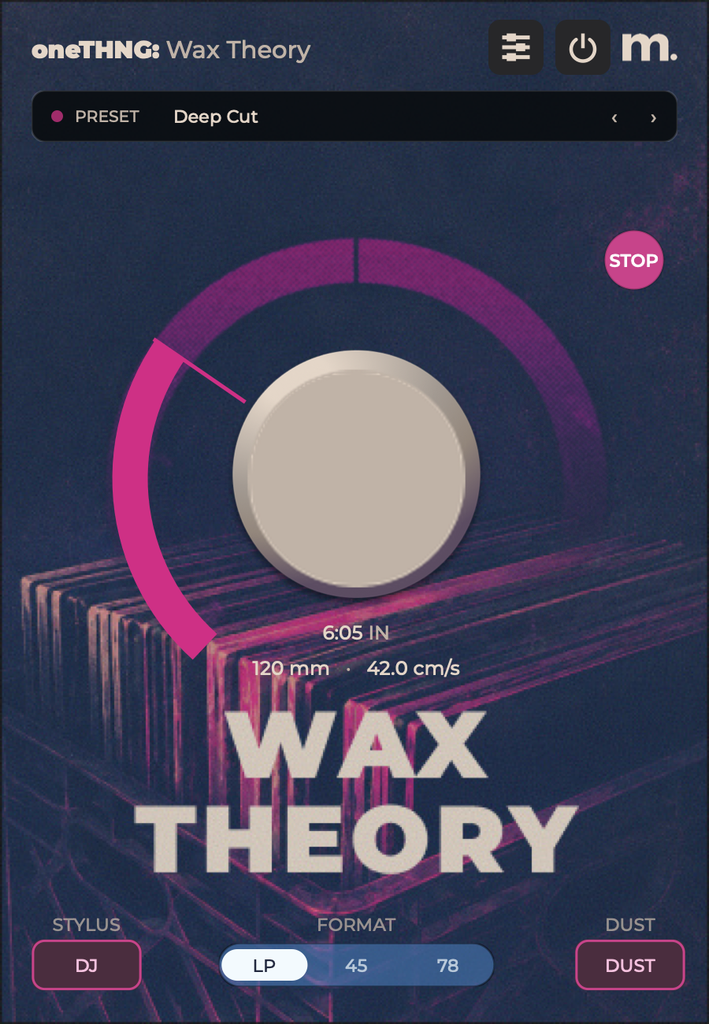
The central control is called SIDE, and it represents the position of a stylus across a record. Turning it counterclockwise places the needle near the outer lead-in groove, while moving it clockwise takes the stylus toward the inner run-out near the label.
That movement is important because the linear speed of a record’s groove decreases as the stylus approaches the center. On a conventional LP, Modbap models that change from approximately 51 centimeters per second at the outer edge to 21 centimeters per second near the run-out. As the simulated groove speed decreases, Wax Theory increases tracing distortion, introduces additional pitch instability, and gradually reduces the available high-frequency bandwidth.
In my XLN Audio RC-20 Retro Color review, I discussed how I typically use vinyl-style processing on synthesizer groups, percussion, and sampled instruments. RC-20 offers independent modules for adjusting noise, distortion, modulation, and other characteristics, making it appropriate when you want detailed control over each element. Wax Theory offers a different workflow, where the relationship between those characteristics is determined by the simulated record position.
Three Record Formats and Stylus Profiles Expand the Processing
Wax Theory includes three playback formats, each with its own modeled characteristics. The LP setting represents a 12-inch record playing at 33⅓ rpm, while the 45 setting reproduces a seven-inch single. A third option models a ten-inch 78 rpm shellac record, with a narrower frequency response, increased surface activity, and playback-speed variation.
The STYLUS section provides another set of processing options. HIFI offers the cleanest response, with relatively wide frequency coverage and reduced tracing distortion. DJ models a larger conical stylus, introducing additional distortion and a presence increase around 7 kHz, while WORN simulates a damaged or heavily used stylus with additional rasp and tonal changes.
The DUST control adds surface noise, clustered clicks, bearing rumble, and a repeating scratch that occurs once per simulated record revolution. These characteristics respond to the playback model rather than functioning as a completely separate noise recording placed underneath the source.
For producers experimenting with older sampling techniques, these options could provide several ways to alter the character of clean digital recordings. A piano loop could be processed through the 78 setting for reduced bandwidth, while a drum group might benefit from the additional distortion associated with the DJ stylus. The results would depend on the source material and how far the processing is applied.
We explored several related approaches in our roundup of free lo-fi plugins, including iZotope Vinyl and other processors that simulate mechanical noise, pitch variation, and degraded recording formats. Wax Theory concentrates more specifically on how record playback characteristics change across the physical surface of the disc.
I previously spent a month testing the company’s Trinity Digital Drum Synth, and its emphasis on relatively direct hardware controls was one of the reasons I enjoyed working with it.
Wax Theory applies a related idea to software, giving producers a limited number of controls that can produce several connected changes.
Is Modbap Wax Theory Worth $29.99?
Wax Theory is the second release in Modbap’s oneTHNG series, following Fidelity Theory, which explores changes in sample rate and bit depth through another simplified control system. The series reflects founder Corry Banks’ interest in developing focused software effects that don’t require extensive menus or complicated signal routing.
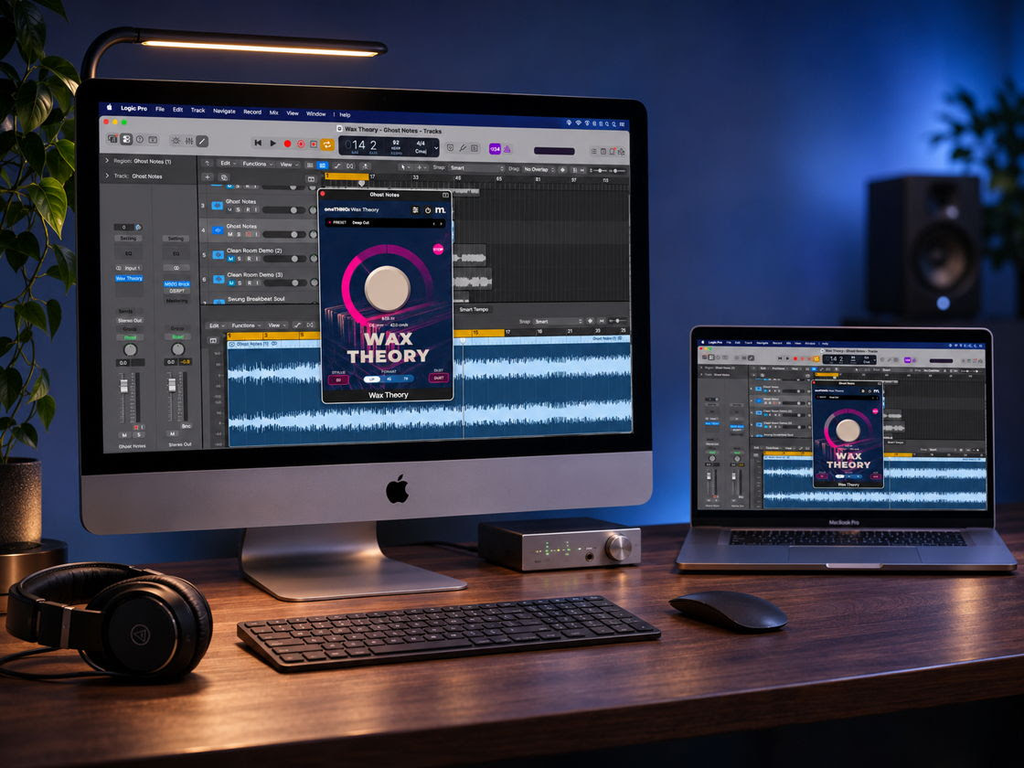
The plugin supports VST3 and AU formats on macOS 11 or later and 64-bit Windows 10 or later. It introduces 512 samples of latency, which is compensated by compatible host applications, and its interface can be resized between 75% and 200%.
Wax Theory normally costs $39.99 and is available at an introductory price of $29.99, with a free 14-day trial. At that price, it’s worth considering if you regularly use record emulation on loops, synthesizers, and percussion, particularly if you’re interested in automating several related processing characteristics through one parameter.
I wouldn’t necessarily replace an established multi-effect processor with Wax Theory because the two approaches address different requirements. If you want separate controls for every part of a vinyl effect, a more conventional processor may be preferable. Modbap’s approach is more focused, and that simplicity is the main reason I’d be interested in experimenting with it.
Explore Modbap Wax Theory or visit the official Modbap website for purchasing information and audio examples.

Will Vance is a professional music producer who has been involved in the industry for the better part of a decade and has been the managing editor at Magnetic Magazine since mid-2022. In that time period, he has published thousands of articles on music production, industry think pieces and educational articles about the music industry. Over the last decade as a professional music producer, Will Vance has also ran multiple successful and highly respected record labels in the industry, including Where The Heart Is Records as well as having launched a new label with a focus on community through Magnetic Magazine. When not running these labels or producing his own music, Vance is likely writing for other top industry sites like Waves or the Hyperbits Masterclass or working on his upcoming book on mindfulness in music production. On the rare chance he's not thinking about music production, he's probably running a game of Dungeons and Dragons with his friends which he has been the dungeon master for for many years.