Most producers are familiar with tape delays, analog bucket-brigade circuits, and the clean digital processors included with their DAWs. Each approaches the same basic task differently, introducing time between the original signal and its repetitions. But there’s a much less conventional approach to delay that Universal Audio helped develop in the early 1970s, and it involved sending sound through lengths of actual garden hose.
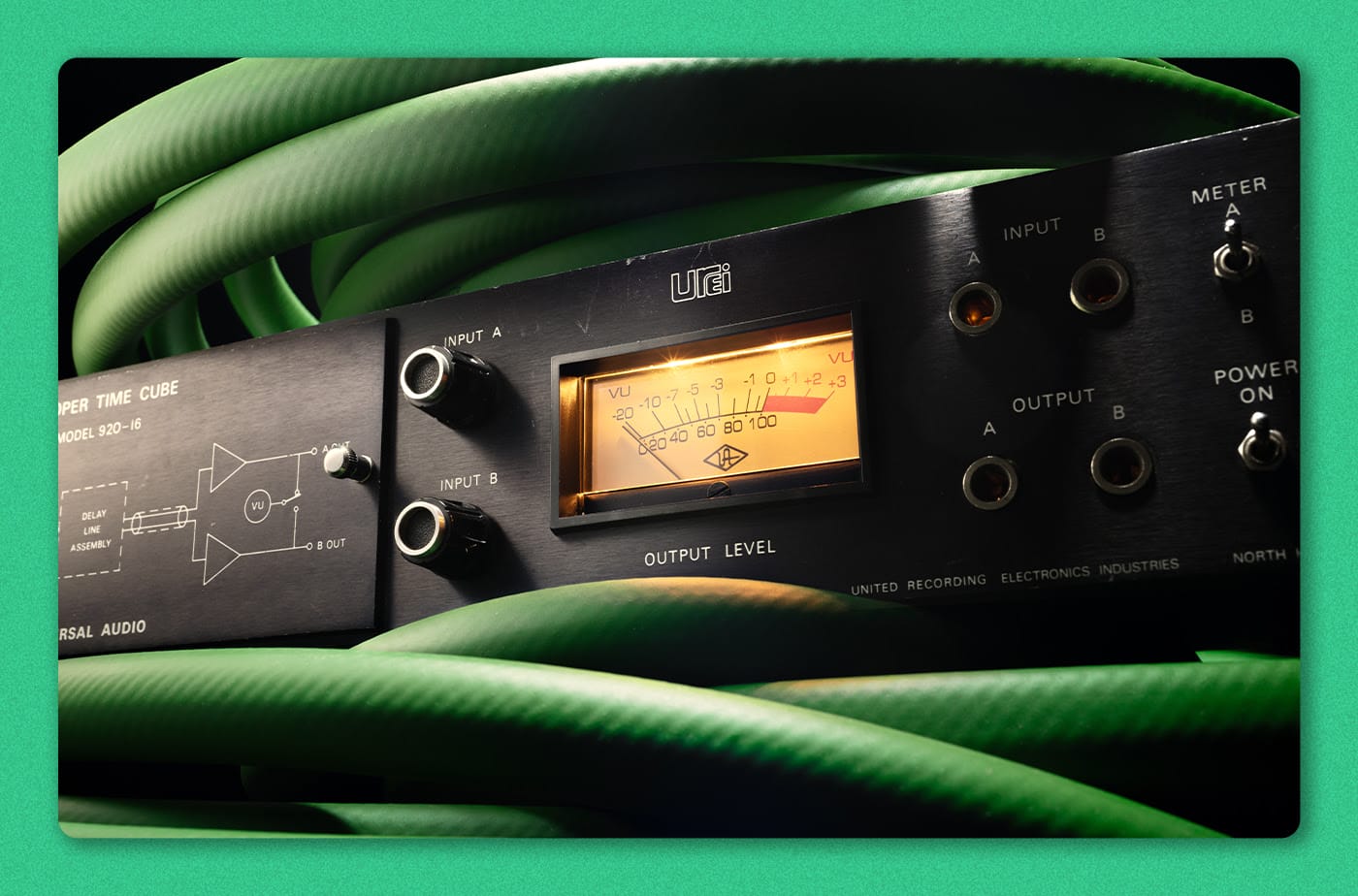
That was the operating principle behind the Cooper Time Cube, a studio processor introduced in 1971 by Universal Audio founder Bill Putnam Sr. and engineer Duane H. Cooper. Instead of storing audio on magnetic tape or using an electronic delay circuit, the unit transmitted sound through coiled tubing and captured it at the other end. The physical distance introduced a short delay, while the tubing influenced the frequency response of the resulting signal.
Universal Audio has now made its Cooper Time Cube Delay plugin available natively for macOS and Windows, removing the requirement for Apollo or UAD-2 hardware. The software has been available in the company’s DSP ecosystem for years, but this release makes the processor accessible to producers working entirely on their computers.
At an introductory price of $49, it’s also considerably easier to experiment with than obtaining one of the original hardware units.
How a Garden Hose Became a Studio Delay
The original Cooper Time Cube was a fairly unusual engineering solution, even by the standards of early studio equipment. It consisted of a plywood enclosure containing coiled lengths of hose, with transducers positioned at the ends to transmit and receive sound. The assembly was suspended to reduce mechanical interference, with the tubing providing the physical distance needed to delay the signal.
Unlike tape machines, which relied on recording and playback heads positioned along moving magnetic tape, the Time Cube used the relatively slow speed of sound traveling through air. The resulting delay was particularly appropriate for short doubling effects, where a second version of a vocal or instrument arrives just after the original without becoming an obvious rhythmic repetition.
I’ve explored the appeal of older delay designs in my review of Universal Audio’s Del-Verb Ambience Companion. That pedal combines several vintage-inspired delay and reverb models, including tape, analog, and digital echo. The Time Cube is different because its original delay mechanism was acoustic rather than electronic, giving the modeled effect a specific frequency response associated with sound traveling through tubing.
What the Native Cooper Time Cube Plugin Actually Does
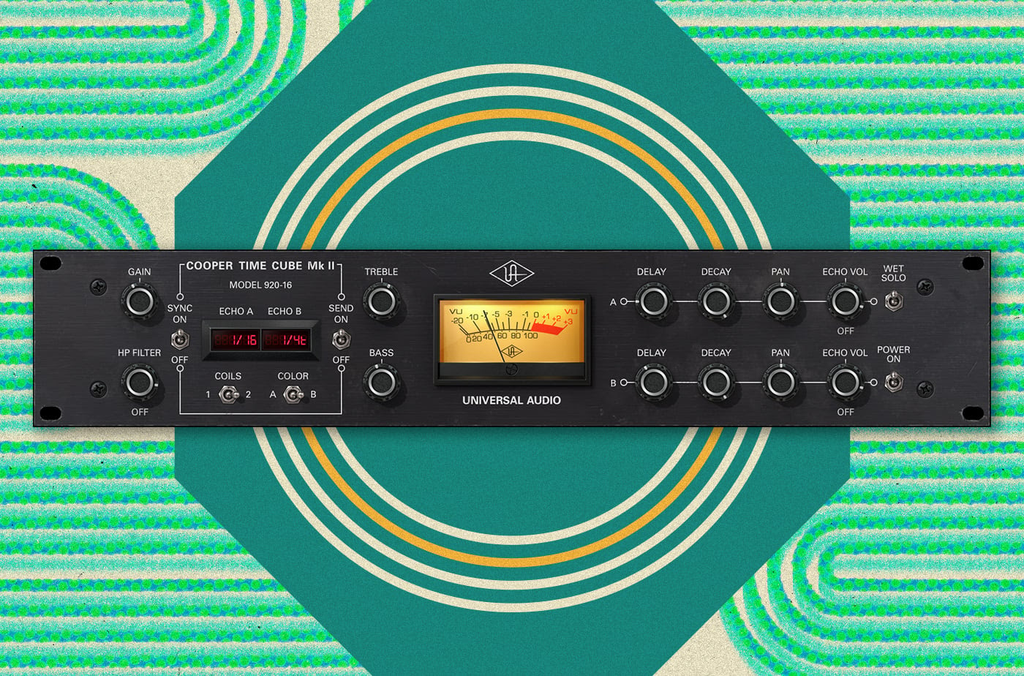
The plugin provides two independent delay lines, each with its own decay, volume, and pan controls. Producers can synchronize their timing to a DAW session or adjust the delay independently, with available times ranging from five milliseconds to 2.5 seconds. The original hardware’s single- and double-hose configurations are represented through selectable processing modes.
That range makes the plugin appropriate for considerably different applications. Very short delays can create doubling on vocals, synthesizers, and guitars, while longer settings allow more conventional echoes and rhythmic repetitions. The independent controls also provide opportunities to position repetitions across the stereo field without introducing identical timing on each side.
Tone shaping is handled through Treble, Bass, Color, and high-pass filtering, giving producers control over how much low- and high-frequency information remains in the delayed signal. Those adjustments are particularly relevant when using delay on vocals or percussion, where excessive low-frequency content and competing transients can quickly complicate a mix.
This relates closely to our conversation with the BLEASS development team about creative delay processing. They discussed how short delays, filtering, stereo positioning, and parallel processing can help repeated signals remain audible without interfering with the original recording.
Why Native Support Changes the Cooper Time Cube’s Appeal
The biggest development is access. Until now, Cooper Time Cube was primarily an option for producers using Universal Audio’s DSP hardware. The new native version runs directly on a compatible Mac or Windows computer, making it available within conventional DAW sessions without needing a dedicated processor.
It’s part of Universal Audio’s wider transition toward native software, which we’ve followed through releases including the UAD A-Type Multiband Enhancer. That move has allowed producers to use an increasing number of the company’s established processors without committing to its interface ecosystem.
The standalone introductory price is $49 through December 31, 2026, compared with the regular $99 price. There’s an additional Black Friday promotion: customers purchasing at least $29 of eligible software can add Cooper Time Cube Delay for $1 through November 30.
For me, the interesting part of this release is how specific its original design was. The Time Cube wasn’t intended to replace every type of delay available to engineers. It provided a particular approach to short echoes and doubling that became associated with a relatively small number of physical units. Bringing that design into native software gives contemporary producers a chance to explore those characteristics without the limitations of acquiring and maintaining the original equipment.
Learn more about Universal Audio Cooper Time Cube Delay or explore the UAD Spark subscription

Will Vance is a professional music producer who has been involved in the industry for the better part of a decade and has been the managing editor at Magnetic Magazine since mid-2022. In that time period, he has published thousands of articles on music production, industry think pieces and educational articles about the music industry. Over the last decade as a professional music producer, Will Vance has also ran multiple successful and highly respected record labels in the industry, including Where The Heart Is Records as well as having launched a new label with a focus on community through Magnetic Magazine. When not running these labels or producing his own music, Vance is likely writing for other top industry sites like Waves or the Hyperbits Masterclass or working on his upcoming book on mindfulness in music production. On the rare chance he's not thinking about music production, he's probably running a game of Dungeons and Dragons with his friends which he has been the dungeon master for for many years.