FM synthesis has a reputation for producing some incredibly interesting sounds while requiring a fair amount of patience to program. The relationship between operators, modulation depths, and harmonic content can make relatively simple adjustments produce unexpectedly large changes. That’s part of what makes FM interesting, although it also explains why plenty of producers end up relying on presets rather than developing their own patches.
Audio Damage has introduced a new instrument aimed at making that process easier to work with.
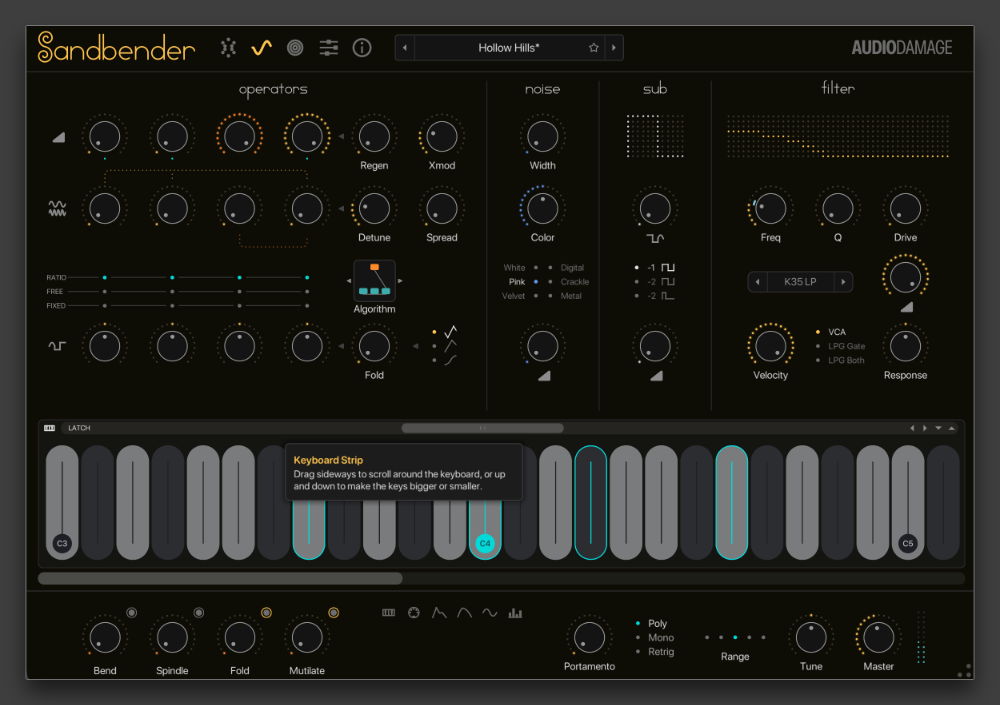
Sandbender is a four-operator FM synthesizer that combines conventional frequency modulation with wave shaping, filtering, extensive modulation, and a performance interface designed for mouse and touchscreen interaction. The instrument also includes a system for generating new patches from existing sounds, giving producers another way to experiment without programming every parameter individually.
The release arrives alongside Audio Damage’s 2026 Black Friday promotion, which reduces the price of its desktop software by 50% using code BFCM2026.
That makes this an interesting time to examine the company’s broader collection of synthesizers and effects, particularly for producers interested in experimental processing and software instruments that offer substantial control over their sound.
Sandbender Makes FM Synthesis Easier to Explore
Sandbender begins with four FM operators, ten preset algorithms, and an editor that allows users to create their own routing configurations. Each operator includes a dedicated waveshaper that can move between triangle, sine, and pulse waveforms, while additional controls provide wavefolding, a sub-oscillator, and six noise generators. The synthesizer also includes eleven filter types and a modeled low-pass gate, allowing producers to shape the resulting harmonics after the initial FM processing.
The most interesting part of the design is how Audio Damage has organized modulation. Instead of requiring producers to work through a conventional modulation matrix, Sandbender allows sources to be dragged directly onto individual controls. Those sources include envelopes, LFOs, function generators, a sixteen-step sequencer, MIDI controls, and expressive input through MPE.
Four assignable macros allow multiple parameters to be controlled together, which should make it easier to develop sounds that change throughout an arrangement.
The approach connects with my recent coverage of Twisted-Electrons’ FLEXfm groovebox, which also uses four-operator synthesis while introducing additional methods for developing and arranging electronic sounds. Sandbender takes a software-focused approach, concentrating on modulation, performance controls, and rapid sound development rather than combining synthesis with a complete hardware production environment.
Audio Damage Adds Touch Controls, Gesture Recording, and Six Effects
Sandbender’s PERFORM page is another feature worth examining. The interface contains two movable control points, with each axis assignable to a synthesizer parameter, macro, filter control, or effect setting. Producers can manipulate these using a mouse or touchscreen, then capture the movements in a tempo-synchronized recording lasting between one and eight bars. Those recordings are saved with the preset, allowing the same parameter movements to be recalled during subsequent performances.
For electronic producers, that could be particularly interesting when developing bass sequences, sustained pads, or transitional effects. Rather than drawing several automation lanes inside a DAW, you could assign related parameters to the performance interface and record the changes in real time.
The instrument also supports eight-voice polyphony, MPE, MTS-ESP microtuning, and adjustable oversampling, with the sound engine optimized for relatively low CPU usage.
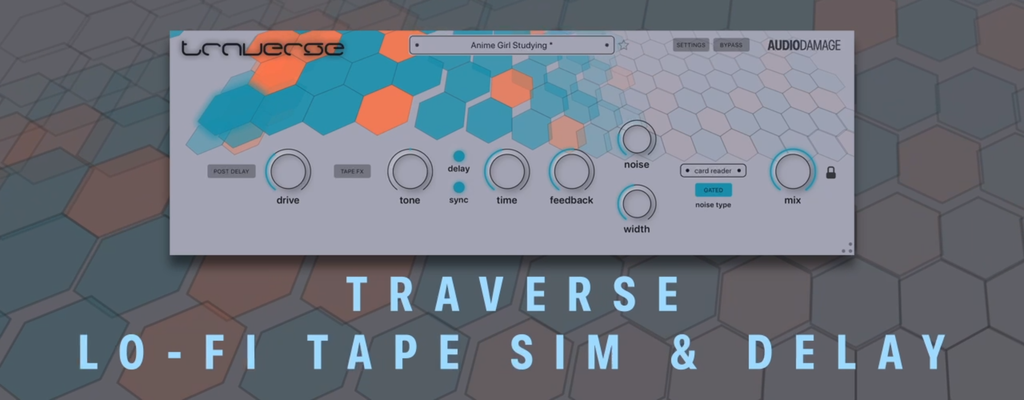
I’ve previously covered Audio Damage Traverse, which combines cassette modeling with stereo delay and several options for introducing instability into a recording.
Sandbender approaches experimentation earlier in the process, allowing producers to develop those characteristics within the instrument before additional processing is applied. The company’s broader catalog also includes Quanta 2, a granular synthesizer that appeared in our How It Was Made interview with Starsmith, where the producer explained how processing vocal and piano recordings influenced the finished track.
Audio Damage’s Black Friday Sale Takes 50% Off Its Software
The other announcement is Audio Damage’s Black Friday promotion, offering 50% off orders in its official store with code BFCM2026.
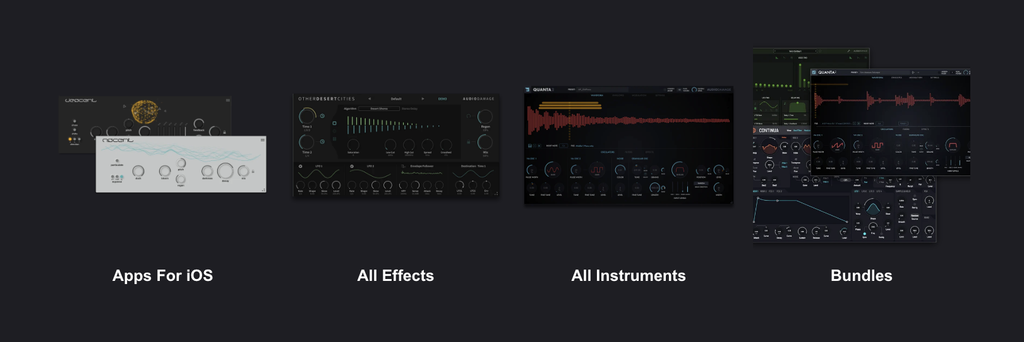
The discount covers the company’s desktop software catalog, making it a good time to explore instruments such as Quanta 2, Continua, and Axon 3, as well as effects including Other Desert Cities, Replicant 3, Dubstation, and Traverse. The company is also discounting its iOS applications by 40% to 60%, with those reductions applied through Apple’s App Store.
Sandbender is listed at $99 for desktop, with an introductory iOS price of $6.99. The desktop version supports CLAP, VST3, AU, and AAX formats depending on the operating system, while the iOS version supports AUv3. As with Audio Damage’s existing software, the desktop license is perpetual and does not require a subscription, dongle, or conventional DRM activation. A fully functional demo is available with a twenty-minute session limit and preset saving disabled.
I’d concentrate on Sandbender if you’re looking for an FM instrument that offers substantial control without requiring constant navigation through routing menus. Its custom algorithms, direct modulation assignments, and performance recording could make it interesting for producers who want to develop sounds through interaction rather than relying exclusively on preset selection.
The Black Friday promotion also provides an opportunity to revisit Audio Damage’s established instruments and effects. I’d recommend identifying which type of processing is currently missing from your setup before purchasing additional plugins, particularly when the company’s catalog covers everything from granular synthesis to delay, distortion, and modulation.
Learn more about Audio Damage Sandbender or browse the Audio Damage store.
Use BFCM2026 at checkout for the advertised 50% discount.

Will Vance is a professional music producer who has been involved in the industry for the better part of a decade and has been the managing editor at Magnetic Magazine since mid-2022. In that time period, he has published thousands of articles on music production, industry think pieces and educational articles about the music industry. Over the last decade as a professional music producer, Will Vance has also ran multiple successful and highly respected record labels in the industry, including Where The Heart Is Records as well as having launched a new label with a focus on community through Magnetic Magazine. When not running these labels or producing his own music, Vance is likely writing for other top industry sites like Waves or the Hyperbits Masterclass or working on his upcoming book on mindfulness in music production. On the rare chance he's not thinking about music production, he's probably running a game of Dungeons and Dragons with his friends which he has been the dungeon master for for many years.