
Guitars are already capable of producing an enormous range of sounds when you start experimenting with pedals, amplifiers, and recording techniques, but most of those methods still begin with someone physically playing the strings. You pluck a note, strum a chord, or use a bow, then manipulate the recording afterward.
ADDAC System has introduced two accessories that change how a guitar generates sound in the first place.
The Portuguese manufacturer’s new Rotary Exciter and Resonator Clamps attach directly to the instrument and use electromagnetic or mechanical excitation to make its strings vibrate without conventional playing techniques. The idea is to access sustained tones, harmonic interactions, and unusual resonances that can be recorded, processed, and incorporated into electronic compositions.
What interests me about these devices is that they’re designed around the physical properties of the guitar rather than attempting to reproduce those characteristics through software. A synthesizer can generate a sustained tone with relative ease, but sending that signal through actual guitar strings adds another layer of interaction shaped by their tuning, tension, and natural resonance.
ADDAC is effectively giving producers another way to incorporate physical instruments into their sound design without requiring a traditional instrumental performance.
The ADDAC006 Rotary Exciter Generates Sustained Guitar Tones
The ADDAC006 Rotary Exciter Clamp uses a brushless motor capable of reaching 7,000 RPM to rotate a pair of opposing magnets. The resulting magnetic field interacts with the guitar strings, causing them to vibrate when the rotational frequency corresponds with their tuning or harmonic frequencies. That allows the instrument to produce sustained tones without requiring the guitarist to continuously pluck or strum the strings.
A dedicated speed control adjusts the motor’s rotation, changing which frequencies excite the instrument. The distance between the clamp and the strings also affects the response, giving players additional control through its physical positioning. ADDAC designed the clamp for guitar necks up to 60 mm wide, with power supplied through a standard center-negative 9V DC pedal adapter that delivers 200 mA. A five-meter extension cable is included for connecting the device to a pedalboard.
For producers making ambient electronic music, this opens up some interesting recording possibilities.
You could use the clamp to sustain a chord while playing individual notes over it, record the resulting harmonics, and process those recordings through delays, reverbs, or granular effects. I explored a related approach in my feature on Lecx Stacy’s production techniques, where repeated guitar processing and resampling became an important part of developing electronic material.
The Rotary Exciter introduces a different starting point by manipulating the physical strings before the sound reaches the recording software.
The ADDAC007 Resonator Turns Guitar Strings Into an Audio Processor
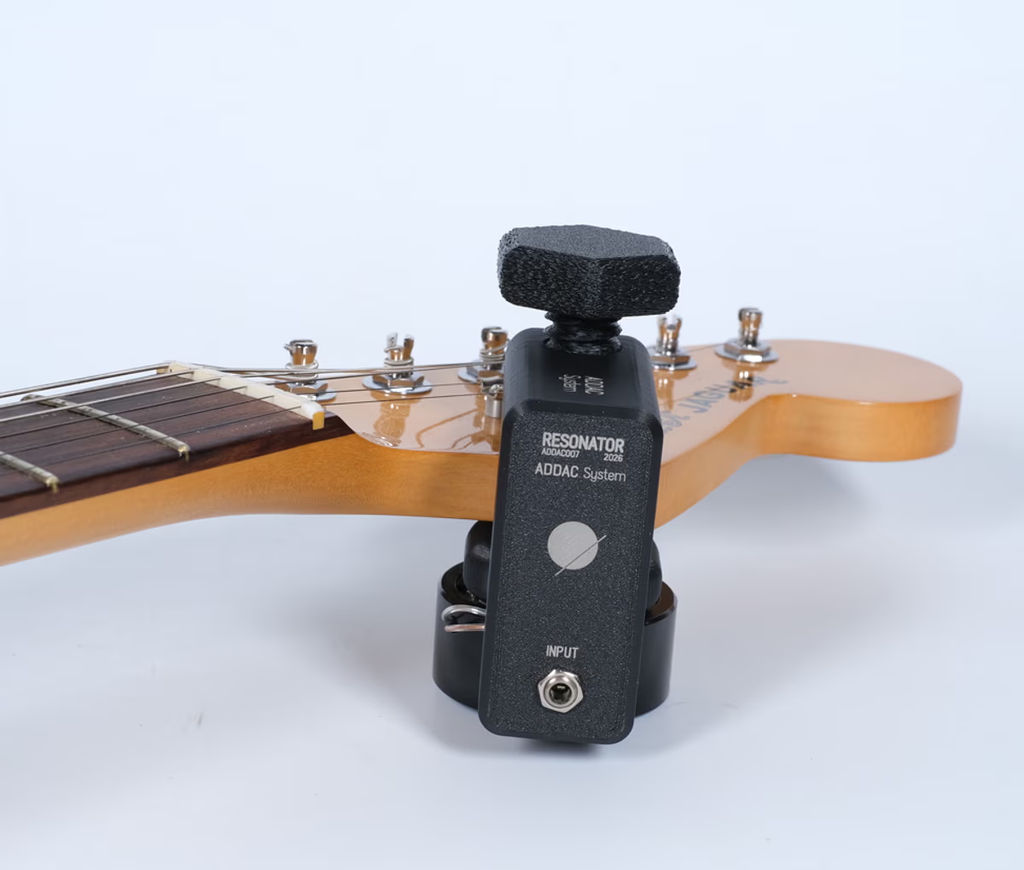
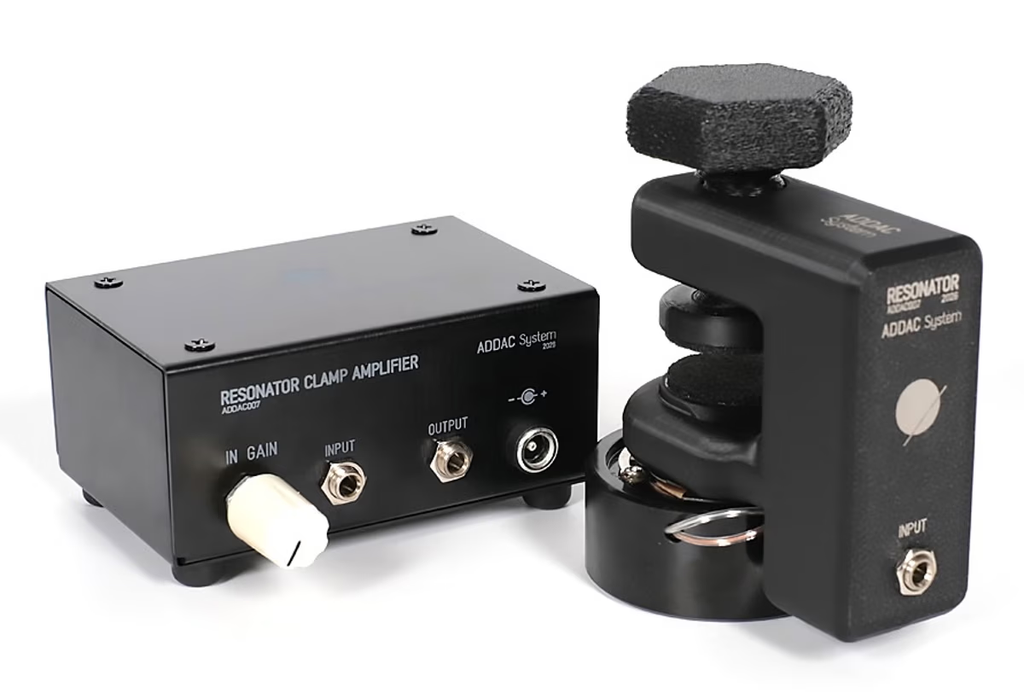
The ADDAC007 Resonator Clamp takes a different approach. Rather than generating movement through rotating magnets, it uses a transducer attached to the guitar’s headstock to transmit vibrations from an external audio signal into the instrument. The guitar strings respond according to their tuning and resonant frequencies, allowing the sound to be captured through the instrument’s pickup.
The system includes a separate amplifier box with input-level attenuation and connections for the transducer. It accepts external audio sources, including signals originating from synthesizers and DAWs, and requires a 9V–12V DC, 3A power supply. The standard ADDAC007 fits headstocks up to 20 mm thick, while the wider ADDAC007W accommodates surfaces up to 45 mm.
The current official product specification lists 3.5 mm mono connections, so producers should check their cabling when integrating it with other studio equipment.
This is particularly interesting for electronic music because the guitar becomes an additional stage of sound processing rather than simply a recorded instrument. Sending a synthesizer sequence into the Resonator could excite different strings as the notes change, while short percussion sounds could create sustained harmonic responses. The concept has some similarities to the resonant processing explored in my Erica Synths Razornator coverage, although ADDAC uses actual guitar strings instead of tuned delay circuits. The resulting response depends on the instrument itself, including how the strings are tuned and which are allowed to vibrate.
What These Guitar Clamps Mean for Electronic Producers
One reason these accessories interest me is that they let me experiment with physical resonance without buying a specialized string instrument or a larger modular system. ADDAC has already explored related ideas through its modular Four Strings Series, but the clamp versions allow guitarists and producers to use an instrument they may already own.
The two devices also differ in an interesting way.
The Rotary Exciter generates vibration through a rotating magnetic field, allowing the guitar to sustain material independently of an external audio input. The Resonator uses an incoming signal to excite the strings, making it particularly well-suited for experimenting with synthesizer processing, feedback arrangements, and acoustic responses to programmed sequences. For producers working with recorded instruments and electronic effects, that second approach may be particularly appealing.
I previously covered another interpretation of physical resonance in my feature on the Morphor ECHON 6, which uses analogue resonator circuits to generate complex harmonic interactions. ADDAC’s approach is considerably simpler from a hardware perspective, making use of an existing guitar to provide the vibrating strings.
The ADDAC006 Rotary Exciter Clamp is available for €120, while the ADDAC007 Resonator Clamp costs €200, with prices listed before applicable VAT. These are specialized accessories, and the amount of experimentation involved means they’re unlikely to appeal to every guitarist. For producers interested in sustained guitar recordings, physical sound processing, and combining acoustic instruments with synthesizers, however, they offer an unusual way to develop original material.
Learn more through the official ADDAC006 Rotary Exciter and ADDAC007 Resonator product pages.

Will Vance is a professional music producer who has been involved in the industry for the better part of a decade and has been the managing editor at Magnetic Magazine since mid-2022. In that time period, he has published thousands of articles on music production, industry think pieces and educational articles about the music industry. Over the last decade as a professional music producer, Will Vance has also ran multiple successful and highly respected record labels in the industry, including Where The Heart Is Records as well as having launched a new label with a focus on community through Magnetic Magazine. When not running these labels or producing his own music, Vance is likely writing for other top industry sites like Waves or the Hyperbits Masterclass or working on his upcoming book on mindfulness in music production. On the rare chance he's not thinking about music production, he's probably running a game of Dungeons and Dragons with his friends which he has been the dungeon master for for many years.