Images Courtesy Of Meze Audio
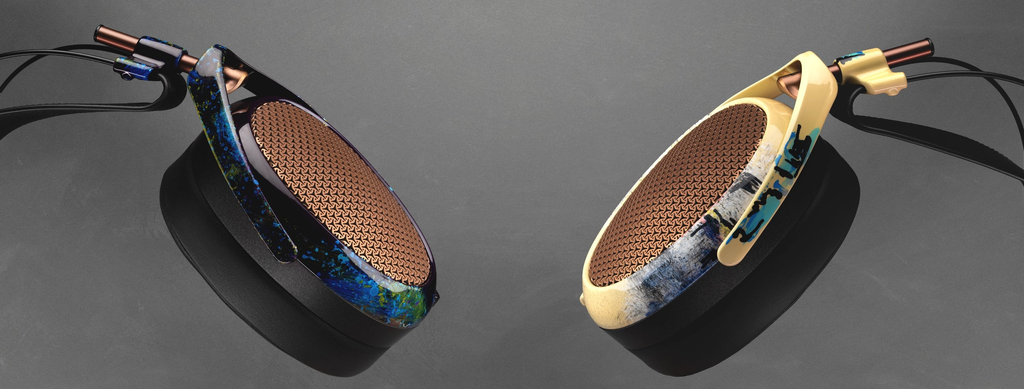
Meze Audio has introduced the POET Jazz Edition, a collection of eleven individually hand-painted headphones that takes the Romanian manufacturer’s existing $2,000 planar magnetic model and gives each pair a completely different appearance. The collection includes designs named Blue Note, Bebop Static, Midnight Session, and Swing State, with each one intended to represent a particular aspect of jazz music.
Meze sells each pair individually for $2,399 and has confirmed that it will not reproduce any design once sold.
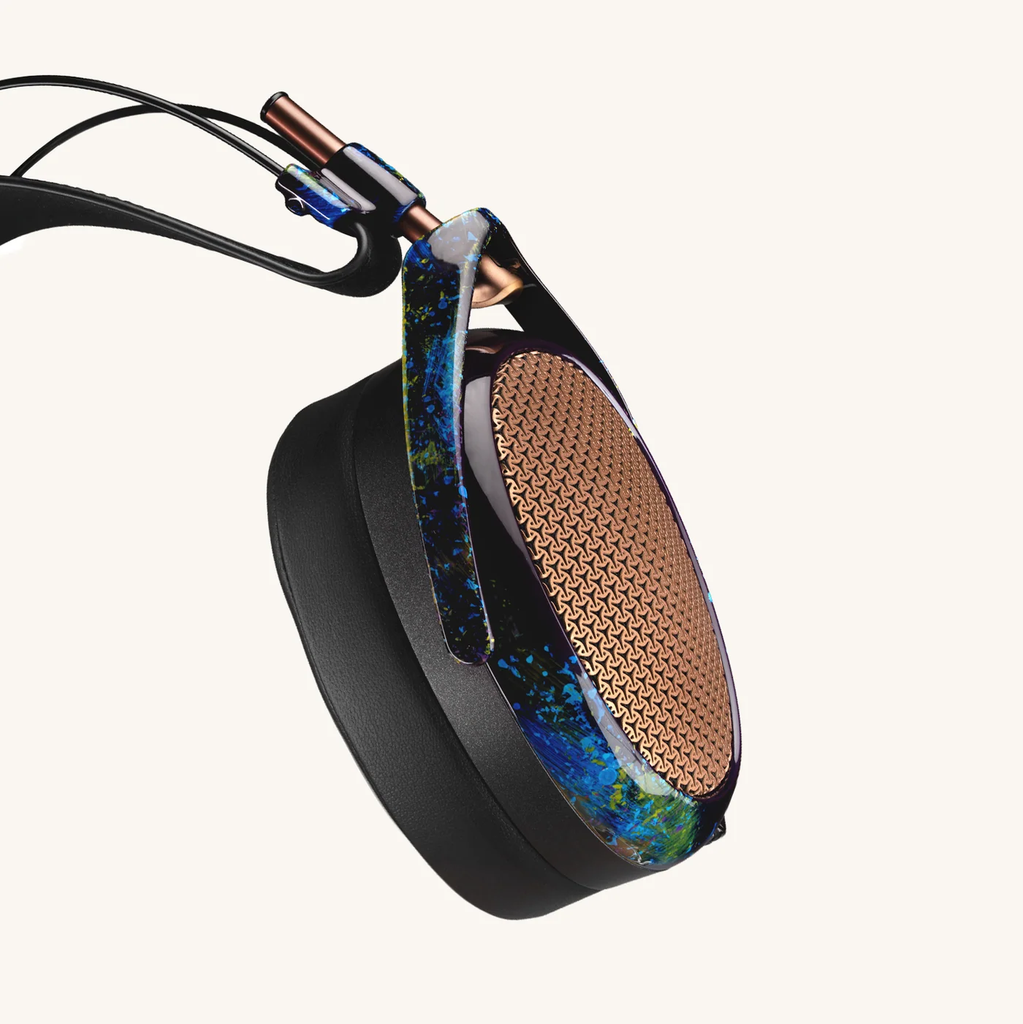
The release is an unusual addition to the high-end headphone market because the changes concentrate entirely on the physical presentation. Underneath the artwork is the same POET headphone, using Rinaro’s MZ6 Isodynamic Hybrid Array drivers, an open-back enclosure, and the company’s existing headband and ear cushion system.
Rather than introducing a different acoustic configuration or revised driver, Meze has commissioned eleven individual finishes that turn an established headphone into a collectible object.
What interests me here is the decision to keep the actual headphone design unchanged.
At this price, buyers are already paying for a fairly specialized listening product, and the Jazz Edition adds another $399 for an individual artistic treatment. Whether that extra cost is worth it depends on how much someone values owning an object that cannot be purchased again in the same appearance.
The technical specifications remain relevant, but the reason for choosing this edition over the regular POET is primarily visual.
What Makes the Meze Audio POET Jazz Edition Different?
Meze Audio has developed a reputation for paying close attention to the physical construction of its headphones, often using materials and finishes that receive as much attention as the acoustic specifications.
The POET Jazz Edition extends that approach by introducing artwork to three areas of the existing headphone: the earcups, brackets, and adjustment sliders.
The headphones retain their original mechanical design, with the painted surfaces contrasting against the unmodified industrial components.
The collection contains eleven individual designs, each associated with a different characteristic or convention of jazz music.
Blue Note uses the emotional associations of the blues as its inspiration, while Swing State considers the relationship between rhythmic movement and musical performance.
Bebop Static references the rapid melodic phrases and rhythmic accents associated with bebop. Midnight Session takes inspiration from late-night jazz performances, while First Take concentrates on the spontaneous decisions musicians make when recording or performing together.
Brass and Smoke references brass instrumentation and traditional jazz club environments. Free Form considers improvisation, while Low End draws inspiration from the double bass and lower-frequency instruments.
The remaining three designs are Offbeat, which explores unexpected accents and rhythmic placement; Afterglow, which considers the final moments of a musical performance; and Encore, inspired by musicians returning to perform after a concert’s planned conclusion.
These names are interpretive references rather than descriptions of different headphone tunings. Each pair receives its own visual treatment, but Meze does not claim that the eleven designs reproduce jazz recordings differently.
This is an important distinction because headphone manufacturers frequently introduce special editions that change the materials surrounding the drivers or introduce adjustments to the acoustic enclosure. The Jazz Edition does not advertise a modified driver, new frequency response, or exclusive acoustic tuning.
Its distinguishing feature is the individually painted exterior.
Meze also confirms that the artwork is intentionally limited to specific metal components rather than covering the entire headset. That preserves the original product’s appearance while allowing each individual pair to have a different finish.
The Planar Magnetic Technology Inside the POET
The POET Jazz Edition is based on the company’s existing open-back planar magnetic headphone, which was introduced in 2025.
The standard model uses Rinaro’s MZ6 Isodynamic Hybrid Array driver, developed specifically for Meze and incorporating technology related to the drivers found in the company’s higher-priced ELITE headphones.
Unlike a conventional moving-coil driver, which uses a voice coil connected to a diaphragm, a planar magnetic driver uses a thin diaphragm with conductive elements distributed across its surface. Magnetic forces move the diaphragm in response to the incoming electrical audio waveform.
The MZ6 incorporates a dual-coil configuration designed to reproduce different parts of the frequency spectrum.
A switchback coil occupies the upper part of the driver and is optimized for lower frequencies, while a spiral coil positioned nearer the ear canal handles much of the midrange and high-frequency reproduction.
The driver also uses a hybrid neodymium magnet arrangement to establish the magnetic field necessary to move the diaphragm.
Meze specifies a frequency response of 4 Hz to 96 kHz, an impedance of 55 ohms, and a sensitivity rating of 101 dB SPL/mW at 1 kHz. The company also reports total harmonic distortion below 0.05%.
Those are manufacturer specifications and should not be interpreted as independent measurements of the Jazz Edition’s performance.
Another technical feature is the Acoustic Metamaterial Tuning System, or AMTS, developed by Dan Clark Audio and licensed for use in the POET.
AMTS uses a physical component positioned over selected areas of the driver to attenuate particular high-frequency resonances. The intended result is a controlled treble response without relying entirely on conventional acoustic damping materials.
The headphone weighs about 405 grams and uses a magnesium chassis, a flexible titanium alloy headband, and magnetic ear cushions.
The magnetic mounting system lets you remove and replace the ear cushions without disassembling the entire headphone.
That’s particularly relevant for a product designed to remain in service for years, especially one with exterior artwork that cannot be reproduced.
For listeners already considering a premium planar magnetic headphone, the underlying technology is worth examining independently of the limited-edition finish. In our earlier article on Meze Audio’s ASTRU flagship in-ear monitors, we discussed a different approach to driver design, with Meze using a single dynamic driver and a multilayer diaphragm incorporating gold and titanium.
The POET uses a different transducer design, but it maintains the same focus on materials, replaceable components, and long-term serviceability as the company’s broader product development.
The POET Jazz Edition is available through Meze Audio’s official website, priced at $2,399 per pair while remaining stock lasts.

Will Vance is a professional music producer who has been involved in the industry for the better part of a decade and has been the managing editor at Magnetic Magazine since mid-2022. In that time period, he has published thousands of articles on music production, industry think pieces and educational articles about the music industry. Over the last decade as a professional music producer, Will Vance has also ran multiple successful and highly respected record labels in the industry, including Where The Heart Is Records as well as having launched a new label with a focus on community through Magnetic Magazine. When not running these labels or producing his own music, Vance is likely writing for other top industry sites like Waves or the Hyperbits Masterclass or working on his upcoming book on mindfulness in music production. On the rare chance he's not thinking about music production, he's probably running a game of Dungeons and Dragons with his friends which he has been the dungeon master for for many years.