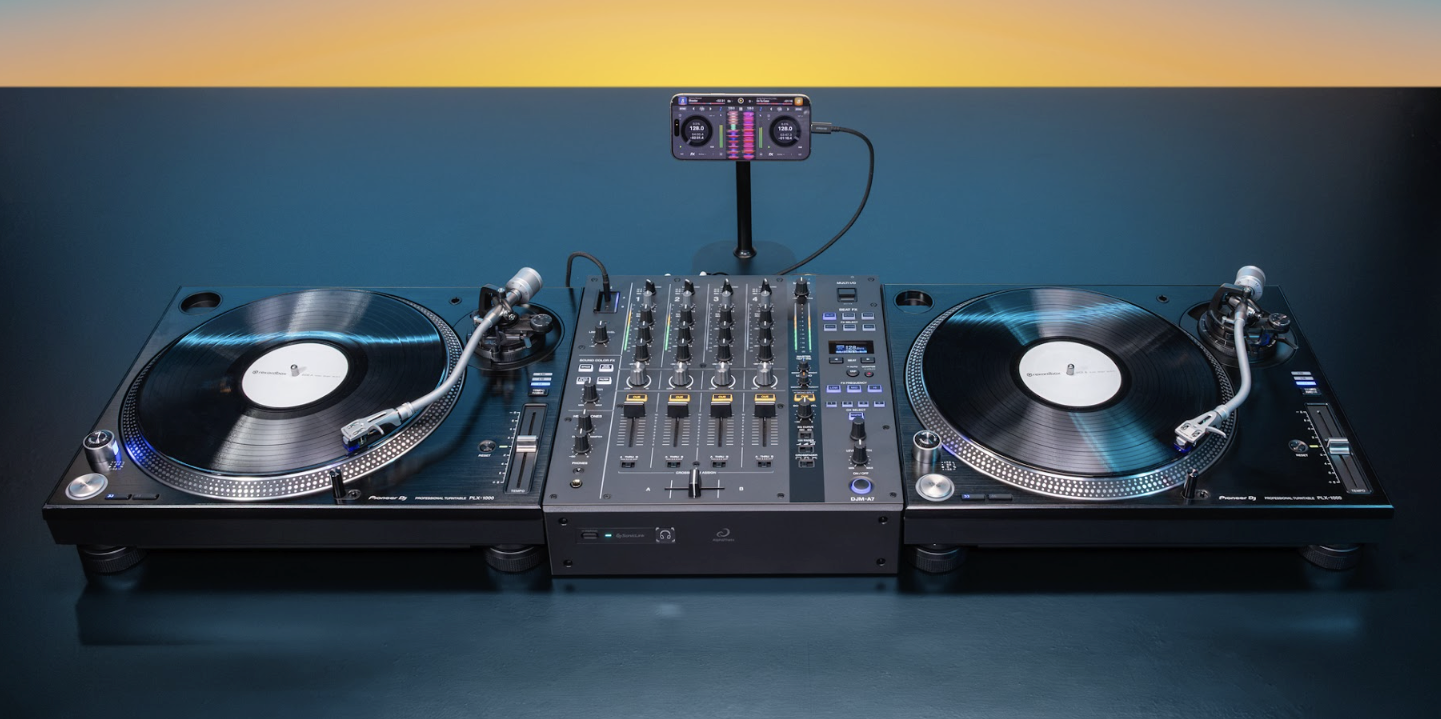
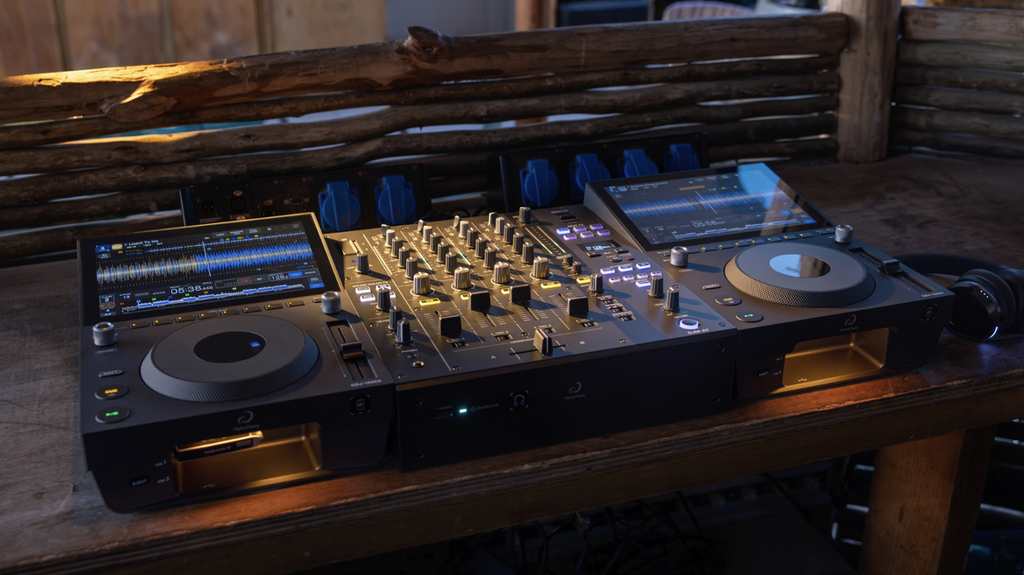
There’s a pretty large difference between the equipment DJs want to use and what smaller venues can reasonably afford to install. Walk into a major nightclub and you’ll generally find equipment that accommodates multiple performers, complicated changeovers, and a dedicated sound system. Walk into a neighborhood bar, restaurant, or smaller event space, and the setup might need to accommodate several DJs using different software, laptops, and media players without anyone on staff who understands the technical details.
AlphaTheta’s new DJM-A7 addresses that situation with a four-channel mixer designed around the familiar layout of the flagship DJM-A9. Priced at $1,599, it includes dual USB-C connections, professional audio conversion, software compatibility, and several features introduced through the company’s newer DJ equipment. It also occupies approximately the same amount of space as the older DJM-750MK2, making it a potential replacement for venues already using that model.
What makes the DJM-A7 interesting, though, is that AlphaTheta has included features that aren’t available on the more expensive DJM-A9.
Its new Master Texture controls allow DJs to adjust the overall tonal character of the main output, while built-in SonicLink provides wireless headphone monitoring without requiring an external transmitter. Those additions suggest that AlphaTheta is thinking about smaller venues as a distinct category rather than treating the A7 exclusively as a less expensive version of its flagship.

The DJM-A7 Introduces Master Texture for Smaller Venues
The most unusual feature is Master Texture, a pair of dedicated controls designed to adjust the tonal character of the mixer’s master output. One knob handles the higher frequencies, moving between settings labeled Smoky and Bright, while the second controls the low frequencies through Smooth and Punchy settings.
The idea is to give DJs or venue managers a straightforward way to make tonal adjustments when the room, audience, or music changes. A venue playing relatively quiet background music during dinner might want a different low-frequency presentation when the same room becomes a dancefloor later in the evening. Likewise, particularly aggressive high frequencies might need attention in a smaller space where the sound system hasn’t been carefully calibrated.
AlphaTheta describes Master Texture as an industry-first feature, based on its own research conducted in July 2026. That’s worth qualifying because the feature shouldn’t be confused with automatic room correction or professional acoustic measurement. It doesn’t analyze the venue or independently correct problems in the sound system. Instead, it provides manual tonal controls that can help operators make adjustments without accessing additional processing equipment.
I recently examined a different approach to sound manipulation in my coverage of the AlphaTheta DJM-V5, which inherits the DJM-V10’s more extensive channel processing and effects. The DJM-A7 approaches the problem from another direction, keeping the familiar four-channel mixing arrangement while giving users additional control over the complete output.
Dual USB-C, SonicLink, and Link Cue Simplify DJ Changeovers
The DJM-A7 borrows its channel-strip layout and 45 mm faders from the DJM-A9, along with 32-bit ESS analog-to-digital and digital-to-analog converters. DJs accustomed to the company’s existing club mixers should recognize the controls immediately, which can be important when switching equipment during a performance.
Two USB-C ports allow DJs to connect separate computers simultaneously, reducing the need to disconnect the outgoing performer’s laptop before the next set begins. The mixer supports rekordbox on Mac and Windows through hardware unlock, alongside Serato DJ Pro, djay Pro, and djay for iOS. Serato and djay require their respective paid subscriptions or licenses.
SonicLink is another addition worth examining. The DJM-A7 includes AlphaTheta’s proprietary wireless headphone technology, supporting compatible models such as the HDJ-F9 and HDJ-F10 with approximately 9 ms transmission latency. The HDJ-F9 also supports touch pairing, although this requires the appropriate mixer firmware. I’ve previously discussed the technology in my DJ headphone recommendations, particularly its advantages over conventional Bluetooth when precise cue monitoring is required.
The DJM-A7 also supports Link Cue through compatible PRO DJ LINK players. DJs can preview tracks without loading them to a deck or listen to another position within a playing track without changing what the audience hears. That capability complements the increasingly connected DJ setups we’ve explored in our coverage of AlphaTheta’s SoundSwitch integration, where player information can also be shared with compatible lighting systems.
The DJM-A7 Adds New Effects but Makes Some Compromises
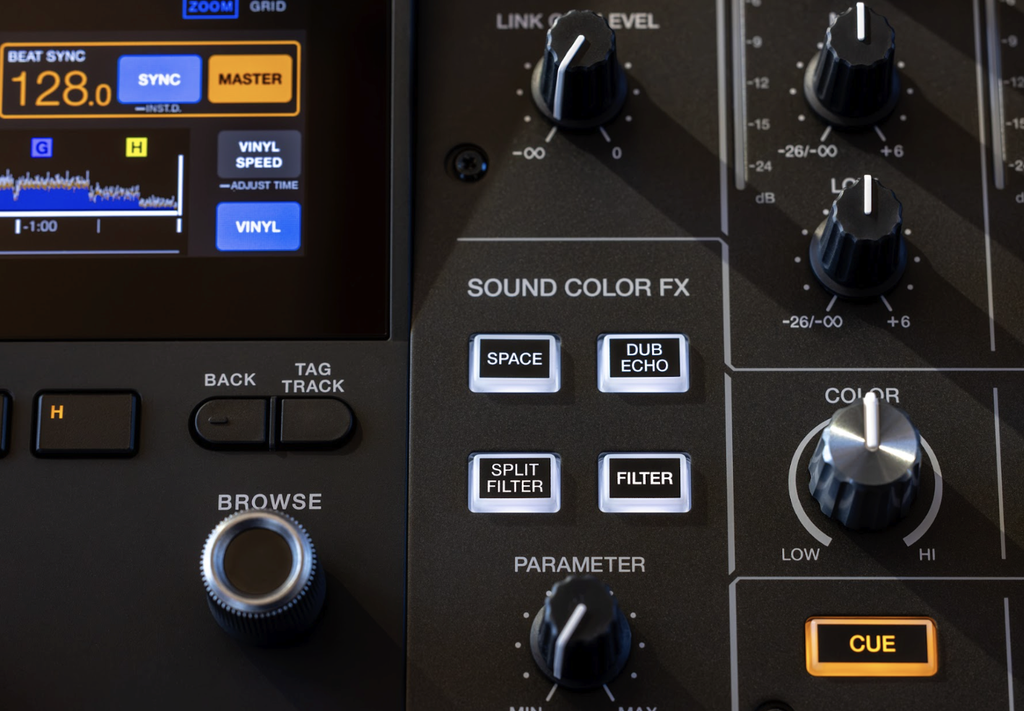
The effects section introduces Split Filter, which concentrates its processing primarily on the midrange while preserving much of the low- and high-frequency content. It joins Space, Dub Echo, and Filter as one of four Sound Color FX. Six additional effects are available through dedicated illuminated buttons, including Delay, Spiral, Trans, Echo, Reverb, and Roll.
The mixer also includes Soft Mix Curve, which gradually reduces high-frequency content as a channel fader is lowered. This gives DJs another way to control transitions without making additional EQ adjustments. An integrated MULTI I/O connection supports digital audio exchange with AlphaTheta’s RMX-IGNITE effects unit through a single USB cable.
There are compromises to consider.
The DJM-A9 offers 14 Beat FX, six Sound Color FX, additional microphone functionality, and a broader selection of professional connections. The DJM-A7 has six Beat FX, a single microphone input, and no conventional analog send-and-return connections. Its two headphone sockets also share one cue system rather than offering the independent monitoring sections found on the flagship.

Is the DJM-A7 Worth $1,599?
The DJM-A7 measures approximately 13 inches wide, 15.3 inches deep, and 4.25 inches tall, weighing 14.8 pounds. It offers four line inputs, four phono inputs, balanced XLR master outputs, TRS booth outputs, and a dedicated RCA recording output. AlphaTheta expects the mixer to become available through authorized dealers during November 2026.
For a smaller venue replacing an older DJM-750MK2, the dual USB-C connections, software compatibility, and Link Cue functionality could justify considering an upgrade. For a DJ who already owns the DJM-A9, the decision is less obvious because the newer mixer introduces Master Texture and SonicLink while removing several professional features.
What interests me about the DJM-A7 is that AlphaTheta hasn’t simply reduced the dimensions of an existing mixer. It’s concentrating on recurring problems in smaller venues, including laptop changeovers, flexible software connections, monitoring, and basic control over the room’s tonal presentation.
Whether those priorities justify $1,599 depends on the setup, but the DJM-A7 provides a clear alternative to buying the company’s largest club mixer when the additional features aren’t required.
Learn more through the official AlphaTheta DJM-A7 product page or visit the Pioneer DJ Store for purchasing information.

Will Vance is a professional music producer who has been involved in the industry for the better part of a decade and has been the managing editor at Magnetic Magazine since mid-2022. In that time period, he has published thousands of articles on music production, industry think pieces and educational articles about the music industry. Over the last decade as a professional music producer, Will Vance has also ran multiple successful and highly respected record labels in the industry, including Where The Heart Is Records as well as having launched a new label with a focus on community through Magnetic Magazine. When not running these labels or producing his own music, Vance is likely writing for other top industry sites like Waves or the Hyperbits Masterclass or working on his upcoming book on mindfulness in music production. On the rare chance he's not thinking about music production, he's probably running a game of Dungeons and Dragons with his friends which he has been the dungeon master for for many years.