Audio interfaces have become remarkably capable over the past few years, and producers can now get excellent recording quality, reliable microphone preamps, and plenty of connectivity without spending a fortune. The problem is that most interfaces still concentrate on getting audio into and out of your computer, leaving important parts of the production process to additional hardware or software.
Room correction usually requires a separate calibration system, tonal processing happens through external equipment or plugins, and managing those additional components can complicate an otherwise straightforward recording setup.
Audient is taking a different approach with its new iD range, introducing four desktop audio interfaces built around what the company calls its Analog Intelligence platform.
The lineup includes the iD1, iD2, iD2+, and iD4+, replacing the familiar iD4, iD14, iD24, and iD44 models. Each interface shares the same core audio technology, including Audient Console Mic Preamps, 32-bit conversion, onboard DSP, and a range of analog processing options; the main differences come down to connectivity and studio requirements.
What interests me most is the decision to incorporate hardware-based monitor correction directly into every interface. I’ve spent years using and reviewing room correction systems, and having that functionality handled independently of the DAW can simplify the process considerably. Audient is combining that capability with onboard effects and analogue tone shaping, giving producers a collection of recording and monitoring tools that would traditionally involve several separate products.
More information is available through Audient’s official website.
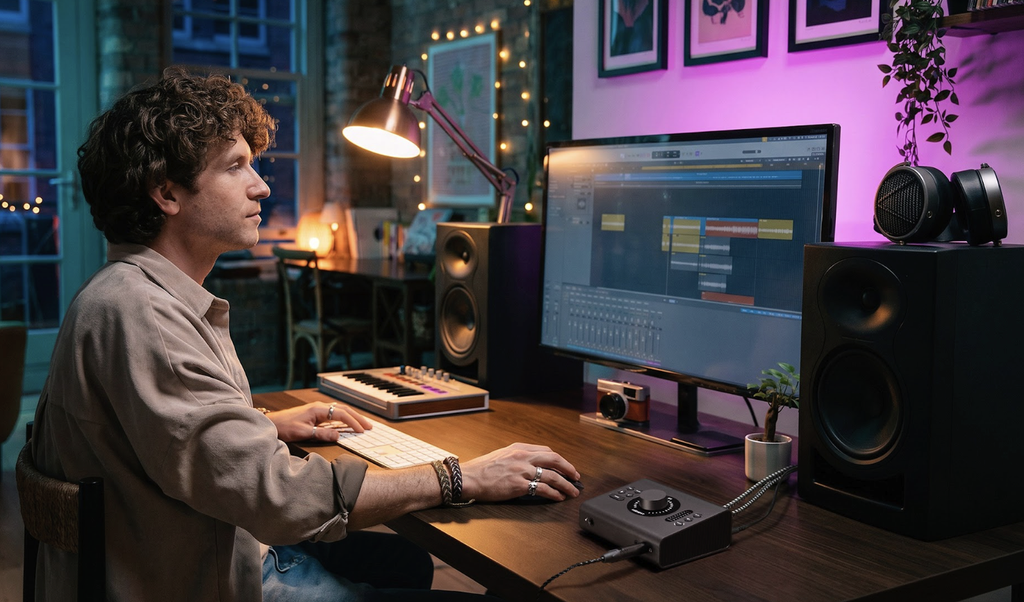
RoomTune Brings Hardware Room Correction Into the Interface
RoomTune is Audient’s new proprietary monitor correction system, included with every interface in the range. It measures the listening environment using a reference microphone and applies corrective processing through the interface’s onboard DSP. Unlike a conventional calibration plugin, the correction remains active independently of the DAW, meaning it applies when producing, mixing, streaming music, or listening through other computer applications without using additional CPU resources.
This is an approach I’ve appreciated in other monitoring systems, particularly when reviewing IK Multimedia’s ARC Studio, where moving the correction processing outside the computer made it easier to maintain a consistent listening environment across different applications.
Audient has also explored this category with its ORIA Mini, a dedicated correction processor developed around Sonarworks technology. RoomTune takes a related concept and incorporates it directly into the audio interface, eliminating the need for another hardware device when using its supported speaker outputs.
There are a few details worth knowing. RoomTune supports stereo speaker correction at launch, while headphone correction and additional target profiles are planned for a future free update.
The system requires Audient’s RM1 reference microphone, which comes with the iD2+ and iD4+ but costs $54.99 separately for the iD1 and iD2. And while calibration can help address frequency-response problems at the listening position, producers should still consider acoustic treatment, speaker placement, and room geometry rather than assuming software correction can resolve every monitoring issue.
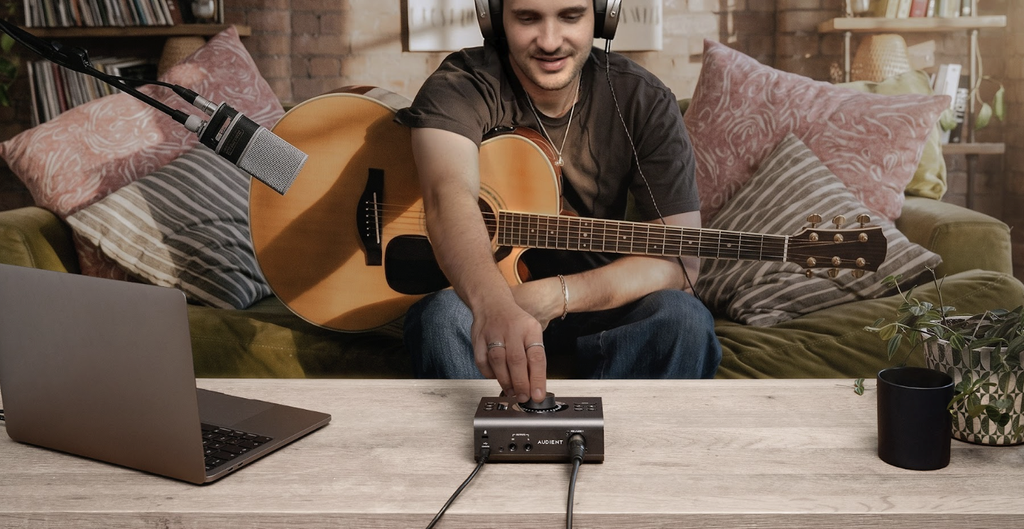
Audient’s Analogue Tone Suite Adds Four Recording Options
The second major addition is Audient’s Analogue Tone Suite, which provides four ways to shape incoming audio before it reaches the DAW. Orbit adjusts microphone input impedance through a discrete analogue circuit, changing how the connected microphone interacts with the preamp. HMX introduces harmonic saturation using a custom MOSFET circuit, while LIFT applies high-frequency enhancement. GLOW combines the HMX and LIFT processing, providing additional harmonic content and upper-frequency emphasis through one setting.
I find this particularly interesting because many producers do most of their tonal processing after recording, even when they’re working with sounds that could benefit from additional character during tracking.
Having these options available at the input stage allows engineers to make those decisions before the audio reaches their recording software, whether they’re working with vocals, guitars, synthesizers, or other instruments.
The important consideration is that analogue processing applied during recording becomes part of the captured signal, so these controls should be treated as deliberate recording decisions rather than adjustments that can always be undone afterward.
Four New iD Interfaces Cover Different Studio Setups
Audient has simplified the naming system to make the lineup easier to understand, with the number in each model generally indicating how many microphone preamps it includes. The iD1 ($199) replaces the iD4 and provides two inputs and two outputs, including one console microphone preamp and a JFET instrument input that can operate simultaneously. The iD2 ($299) replaces the iD14, expanding to two microphone preamps, 10 inputs, six outputs, ADAT input expansion, and monitor control for two speaker sets.
The iD2+ ($499) replaces the iD24 and adds 14 outputs, two balanced hardware inserts, eight channels of ADAT input and output, and an included RM1 calibration microphone. The iD4+ ($699) replaces the iD44, expanding to 20 inputs and 24 outputs, four microphone preamps, two JFET instrument inputs, two hardware inserts, and 16 channels of ADAT input and output.
It also includes two independent headphone amplifiers supporting up to four cue mixes, along with the RM1 microphone. For producers integrating external compressors, EQs, additional converters, and other studio equipment, the expanded connectivity of the two larger models is an important distinction.
The entire range features redesigned enclosures with sloped top panels, stepped metal encoders, illuminated controls, and updated metering. Audient is making the iD2, iD2+, and iD4+ available from November 12, with the iD1 expected in early 2027. For producers considering an interface upgrade, the main development is the amount of recording, monitoring, and processing functionality included across the lineup.
RoomTune is particularly interesting because it addresses an important part of studio monitoring that many interface manufacturers still leave to separate products, while the Analogue Tone Suite provides additional control over the audio being captured. Hands-on testing will determine how these systems perform, but Audient is clearly asking its interfaces to handle considerably more of the recording process.

Will Vance is a professional music producer who has been involved in the industry for the better part of a decade and has been the managing editor at Magnetic Magazine since mid-2022. In that time period, he has published thousands of articles on music production, industry think pieces and educational articles about the music industry. Over the last decade as a professional music producer, Will Vance has also ran multiple successful and highly respected record labels in the industry, including Where The Heart Is Records as well as having launched a new label with a focus on community through Magnetic Magazine. When not running these labels or producing his own music, Vance is likely writing for other top industry sites like Waves or the Hyperbits Masterclass or working on his upcoming book on mindfulness in music production. On the rare chance he's not thinking about music production, he's probably running a game of Dungeons and Dragons with his friends which he has been the dungeon master for for many years.