Meze Audio has built a reputation over the past decade for headphones that combine careful engineering with design that actually feels intentional rather than purely technical. The company’s latest release, the ASTRU in-ear monitors, continues that approach but focuses on a single idea: pushing a single dynamic driver as far as possible before adding complexity.
The new flagship in-ear model introduces a driver design built around a multilayer diaphragm that incorporates more than 80 ultra-thin layers of gold, bonded to a titanium layer and mounted on a PEEK base.
That structure is the core of ASTRU’s tuning philosophy. Instead of stacking multiple drivers to divide the frequency spectrum, Meze leans into a single transducer that handles the entire range while maintaining speed, weight, and control.
For listeners who spend long stretches working inside headphones, especially producers, engineers, or DJs who rely on IEMs while traveling, that approach has real appeal.
A well-tuned dynamic driver often carries a more cohesive sense of movement across the frequency range, which can make long listening sessions easier on the ears.

A single-driver design built for coherence and impact
ASTRU uses a 10 mm dynamic driver that Meze developed specifically for this model. The multilayer diaphragm sits at the center of the design. According to the company, the gold-coated dome is created through a 48-hour vacuum magnetron sputtering process, which deposits extremely thin layers of gold onto the diaphragm surface before it is bonded to titanium and mounted on a PEEK base.
In practical terms, the goal is to balance three things that often compete with each other in IEM design: transient speed, low-end physicality, and treble extension. Dynamic drivers have long been favored for their natural low-frequency response and physical impact, but they sometimes struggle with speed compared to multi-driver setups. The layered diaphragm structure aims to tighten that response while maintaining the warmth and weight listeners expect from a dynamic design.
The result is a tuning approach that focuses on full-bodied sound rather than hyper-analytical presentation. That kind of profile tends to translate well across multiple listening environments, from dedicated listening rigs to portable players and laptops.
Titanium construction and a fully equipped listening setup
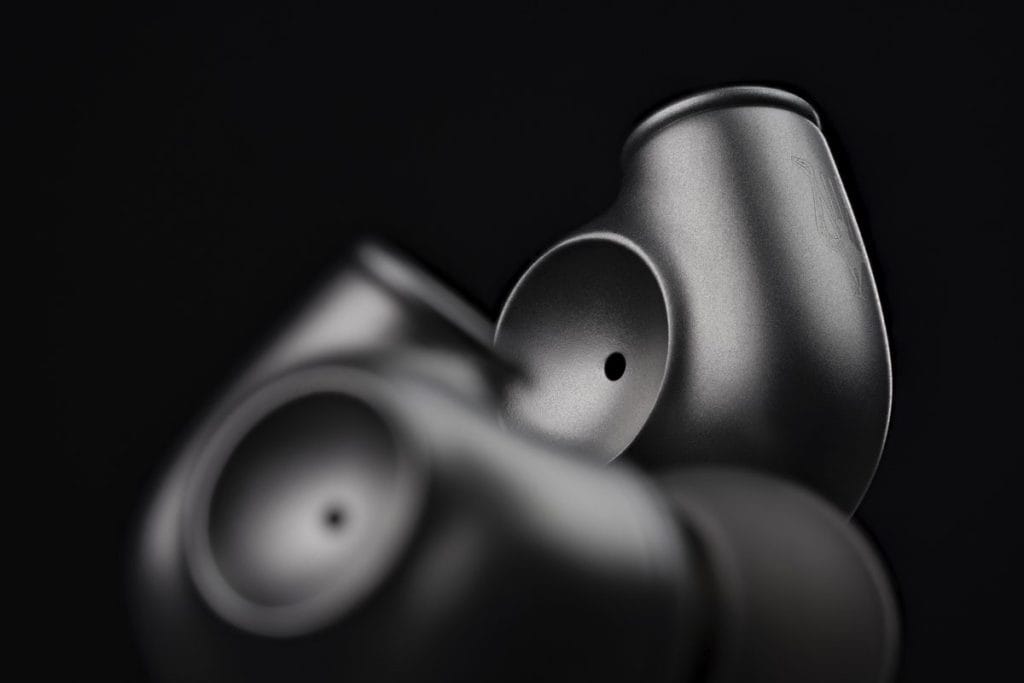
The physical design of ASTRU reflects the same level of attention. Each shell is CNC-machined from a single block of titanium, then finished through a multi-stage electroplating process that produces a satin texture. Meze says each matched pair requires up to seven days of processing, which aligns with the company’s reputation for slow, detail-oriented manufacturing.
Comfort also played a large role in the shell geometry. The shape has been refined to sit naturally inside the ear over long listening sessions, something that matters when IEMs are used for mixing, editing, or long flights between gigs.
ASTRU ships with a balanced cable featuring a 4.4 mm termination, a common connection for higher-end portable audio players and headphone amplifiers. The package also includes a 4.4 mm to 3.5 mm adapter, five ear tip sizes, and two carry options, a protective pouch and a soft PU leather envelope.
A flagship IEM that avoids the multi-driver arms race
One interesting part of ASTRU’s positioning is that it intentionally avoids the multi-driver approach that has dominated the high-end IEM market for years. Many flagship earphones now combine multiple balanced armatures with dynamic drivers or planar elements. Meze’s decision to stay with a single dynamic driver signals confidence in that design philosophy.
For listeners who prefer coherence and natural tonality over extremely segmented frequency reproduction, that approach can feel more musical over long sessions.
The Meze Audio ASTRU will make its first public appearance at CanJam New York and will be available starting March 20, 2026 with a retail price of $899 / €899 / £819.

Will Vance is a professional music producer who has been involved in the industry for the better part of a decade and has been the managing editor at Magnetic Magazine since mid-2022. In that time period, he has published thousands of articles on music production, industry think pieces and educational articles about the music industry. Over the last decade as a professional music producer, Will Vance has also ran multiple successful and highly respected record labels in the industry, including Where The Heart Is Records as well as having launched a new label with a focus on community through Magnetic Magazine. When not running these labels or producing his own music, Vance is likely writing for other top industry sites like Waves or the Hyperbits Masterclass or working on his upcoming book on mindfulness in music production. On the rare chance he's not thinking about music production, he's probably running a game of Dungeons and Dragons with his friends which he has been the dungeon master for for many years.