One thing I appreciate about collecting records is how much attention goes into everything around the actual listening experience. You’ve got the turntable, speakers, amplifier, and eventually a collection of albums you probably spent years putting together, but there’s also something to be said for how you display the record you’re currently listening to.
That’s what interested me about the PETRU Sync Pro, a wooden record stand with a built-in audio visualizer that responds to music through an LED display underneath the album artwork.
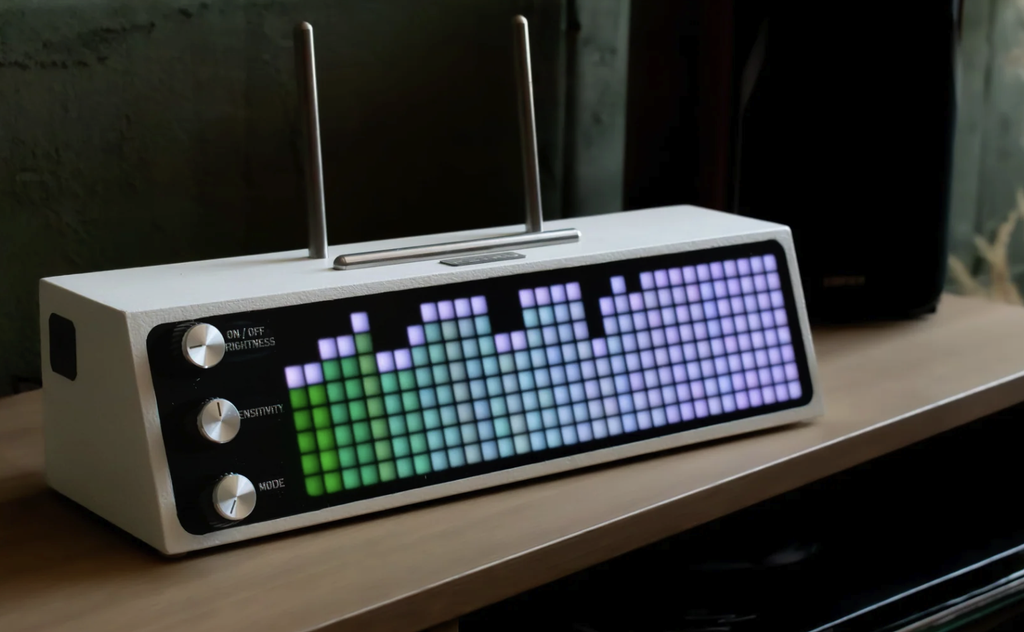
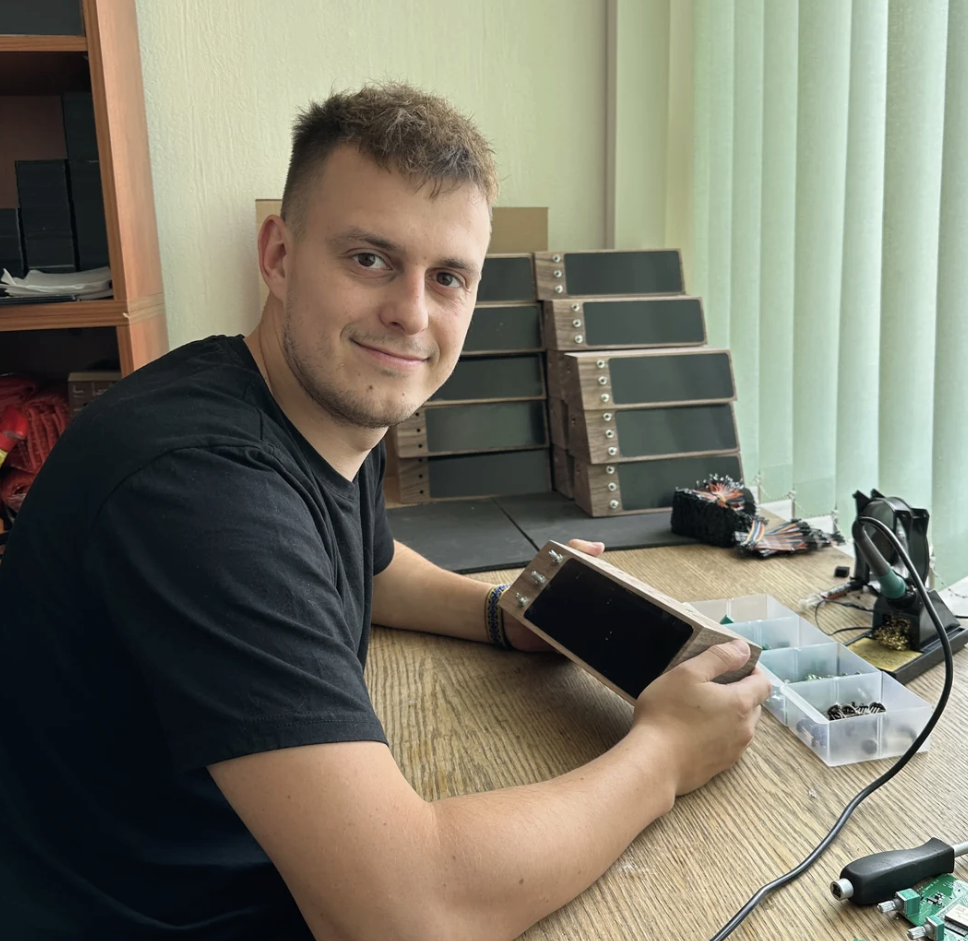
Made by a small family-run business in Kaunas, Lithuania, the Sync Pro builds on PETRU’s original record display with 27 visualization modes, adjustable colors, direct audio inputs, and a clock that gives the device another purpose when music isn’t playing. It costs $309, comes in several wood finishes, and can pick up sound through its microphone or connect directly to compatible audio equipment.

The company sent me a unit to evaluate, and one of my first questions concerned the speed of its visual response, particularly whether the animations could be slowed down for a more restrained display.
That question led to a wider conversation with Rokas from PETRU (@petru.designs) about how the company approaches product design, why the album artwork remains the focus of the display, and what makes an audio-reactive light feel connected to the music rather than simply flashing whenever something gets loud. We also talked about why PETRU prefers physical controls to an app and how feedback from existing customers influenced the Pro’s development.
For anybody interested in vinyl accessories, listening-room design, or finding a gift for somebody who already owns a turntable, there’s plenty worth considering here.
Interview With PETRU
What did you notice about your own record-listening habits that first made you want to design the Sync Pro?
None of us listens quite the same way, and not all of it runs through a turntable. One room has the record player, another has a CD player, and the DJ controller appears most weekends.
The first Sync handles all of that through its microphone, and that is exactly why it works anywhere: you put it on a shelf, press one button, and it goes. Nothing to connect, nothing to think about.
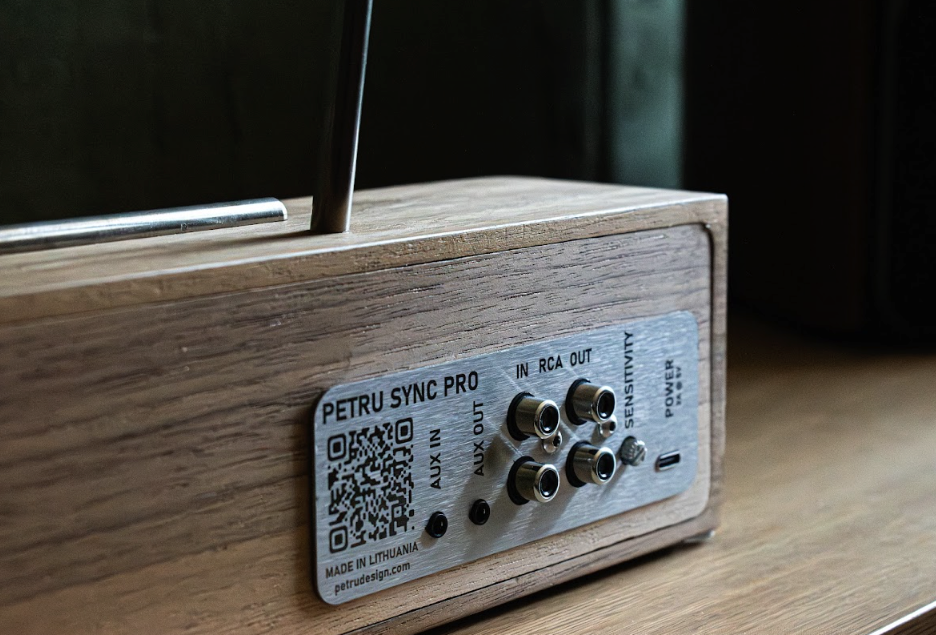
What we kept wanting for ourselves was the option to wire it in as well. So the Pro takes a line in from anything with an output – turntable, amp, CD player, DJ controller, mixer, and the microphone is still there for when you would rather not run a cable. It is the same idea with a second way in.
How did you decide how much visual attention the Sync Pro should attract while someone is listening?
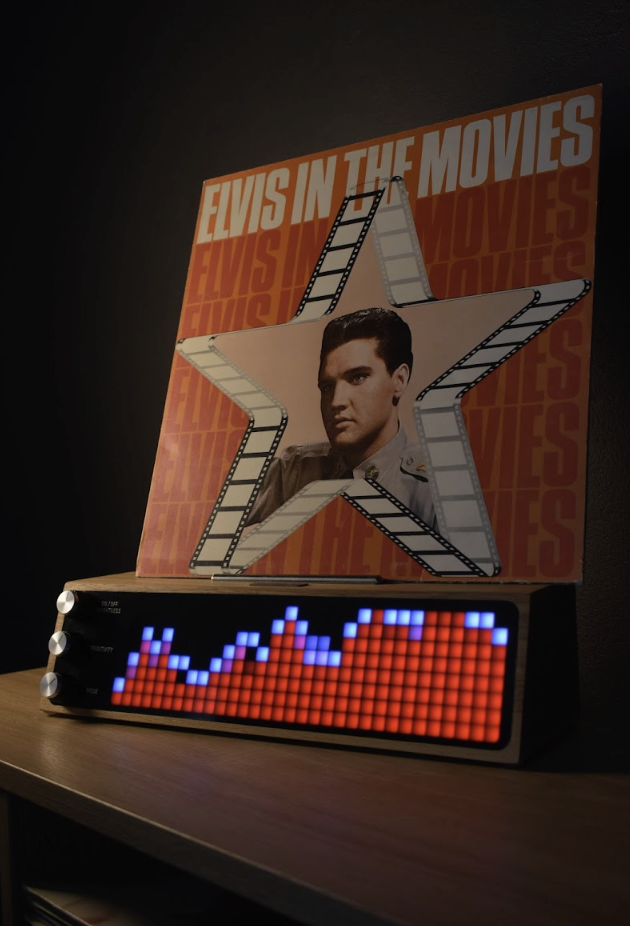
One rule we kept coming back to: never compete with the sleeve. The record you chose is the thing on display. The light sits under it, lower and wider, so it works like a shelf the artwork stands on – not a screen beside it.
That is also why the controls are physical knobs on the front instead of an app. Brightness and sensitivity are things you adjust by feel, in the moment, usually turning them down. Of the twenty-seven modes, maybe five are loud. The rest are slow, and a few barely move at all. We expected people to use the dramatic ones and found that most settle on something quiet within a week.
We also added colour control, which turned out to matter more than we thought. People match the display to whatever is standing on it – the sleeve of the LP, or the CD case, so the two read as one object instead of a record next to a light.
The Sync Pro responds to music with light and movement. What makes that response feel connected to a song?
Less to do with brightness or colour than people expect. It is mostly timing, and specifically the fall.
Making a bar jump on a transient is easy – that is just the signal arriving. The character is in how it comes back down. Too fast and the whole thing looks twitchy, like it is reacting to noise rather than music. Too slow and everything smears into one slow breathing shape and you stop believing it is connected to anything at all.
The awkward part is that there is no single right answer, because records do not agree with each other. A dub record with a lot of space wants a long fall. A dense mix wants a short one. A string quartet wants something that barely moves. We could not honestly pick one setting and call it correct, which is why there are twenty-seven modes and a sensitivity knob instead of a single “music mode”.
The other half of it is the source. Wired in, it is reading the record itself, so what you are watching is the mix the way it was made.
The Sync Pro can also function as a clock or ambient light. Why was it important for the object to have a purpose when a record was no longer playing?
A record side is about twenty minutes. If the object only works during those twenty minutes, it is dark for the rest of the day, and something dark on a shelf is just clutter you have to dust.
We make these by hand and it felt wrong to build something that careful and have it spend most of its life switched off. So it becomes a clock when the music stops, or a slow ambient light, or it holds a line of text. The point is that it stays part of the room instead of waiting to be useful.
As PETRU develops new products, what criteria will you use to decide whether an idea deserves a place in someone’s listening room?
Some of it starts at our bench, and some of it starts in our inbox. The honest version is that we need both.
We have ideas of our own – that is why we started building these in the first place. But an idea at the bench is only a guess until somebody who actually lives with one tells you whether it matters. The Pro is the clearest example. We knew roughly where we wanted to take it, and the people who already owned a Sync sharpened it: the line input, the colour control, the clock. Some of those we were circling anyway. The community told us which ones were worth the work, and in what order.
So the test for anything new is whether it survives that conversation. If a stranger in Portland and someone down the road in Kaunas independently want the same thing, that is a far stronger signal than our own enthusiasm at the workbench.
The other half is restraint. A listening room is personal, and it is already full. We are not trying to add to it – we would rather make one thing people keep than three they end up tidying away.
What Is The PETRU Sync Pro?
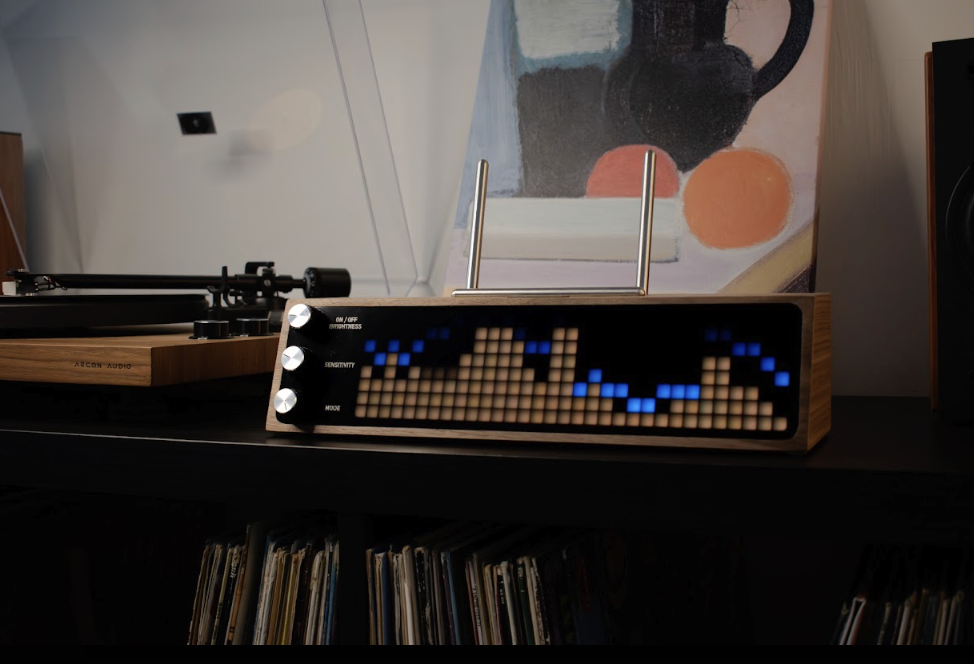
The PETRU Sync Pro is a combination record sleeve display and audio-reactive LED visualizer, designed to sit alongside a turntable, stereo system, or other music source. The body is made from wood, with finishes including natural walnut, black, and white, and the adjustable metal supports accommodate LP sleeves and CD cases.
Compared with the original PETRU Sync, the Pro introduces a larger 33 cm display, 27 visualization modes, adjustable colors, and direct audio connectivity. The original model relies on a built-in microphone, while the Pro includes RCA and 3.5 mm inputs and corresponding outputs, allowing it to receive a line-level signal from compatible audio equipment. A separate phono preamp may be required for turntables without a line-level output.
Physical controls on the front let users change modes, adjust brightness, and change input sensitivity without using a phone. Additional settings include a clock with 12-hour and 24-hour formats, ambient lighting, and customizable scrolling text of up to 30 characters. The device operates through USB-C power and retains the last selected visualization mode.
| Feature | Details |
|---|---|
| Price | $309 USD |
| Display modes | 27 |
| Audio input | Microphone, RCA, 3.5 mm |
| Audio output | RCA, 3.5 mm |
| Controls | Mode, brightness, sensitivity, color |
| Additional functions | Clock, ambient light, scrolling text |
| Dimensions | 33 × 10 × 8 cm |
| Finish options | Natural walnut, black, white |
| Power | USB-C, 5V / 3A minimum |
| Warranty | Lifetime warranty advertised by PETRU |
The product is designed primarily for music presentation rather than audio monitoring, although its direct input allows the visualization to follow a connected signal without relying on whatever the microphone happens to hear in the room.
Explore the PETRU Sync Pro and available finishes
Final Thoughts From The Editor
What interested me most about PETRU’s answers was how deliberately the company has designed the visualizer around the record sleeve rather than treating the display as the main attraction. Magnetic actually reviewed the original PETRU record stand in 2025, and the new Pro addresses some of the limitations associated with the original design, particularly the lack of direct audio connectivity and the smaller selection of display modes. We’ve also covered the Vylumi Flö illuminated vinyl display, which takes a different approach by illuminating the physical record. What I like about PETRU’s direction is the emphasis on keeping the album artwork visible while giving listeners a reasonable amount of control over what happens underneath it.
I do think there’s one limitation worth discussing, particularly for producers and people who might be interested in using the visualizer alongside their studio equipment.
The other point I appreciated was PETRU’s decision to retain physical controls instead of requiring another mobile app. In our interview with Andy Rigby-Jones of Union Audio, he discussed how much attention goes into the layout and physical interaction of audio equipment, and I think there’s a connection to PETRU’s approach. The Sync Pro isn’t doing anything particularly complicated from a user-interaction perspective, and that’s appropriate for something intended to remain beside a record player.
Our recent coverage of Pro-Ject’s updated Debut Carbon turntable offers another example of a manufacturer concentrating on a clearly defined purpose instead of adding features simply because they’re available.
At $309, the Sync Pro is a considered purchase for something that doesn’t directly improve audio playback, and I’d approach it as a listening-room accessory rather than essential hi-fi equipment.
But I can understand its appeal as a gift for somebody who has already invested in a record collection and wants a dedicated place to display the artwork while listening. The direct input, additional modes, and clock are sensible improvements over the original, while the lack of independent reaction-speed adjustment is something I’d like to see addressed in a future version. For me, PETRU’s most interesting decision is that it has concentrated on improving a relatively simple object rather than trying to turn it into something considerably more complicated.

Will Vance is a professional music producer who has been involved in the industry for the better part of a decade and has been the managing editor at Magnetic Magazine since mid-2022. In that time period, he has published thousands of articles on music production, industry think pieces and educational articles about the music industry. Over the last decade as a professional music producer, Will Vance has also ran multiple successful and highly respected record labels in the industry, including Where The Heart Is Records as well as having launched a new label with a focus on community through Magnetic Magazine. When not running these labels or producing his own music, Vance is likely writing for other top industry sites like Waves or the Hyperbits Masterclass or working on his upcoming book on mindfulness in music production. On the rare chance he's not thinking about music production, he's probably running a game of Dungeons and Dragons with his friends which he has been the dungeon master for for many years.