Many melodic techno records build on big synths and dramatic breakdowns, but M07‘s “Broken” starts from a much more personal place.
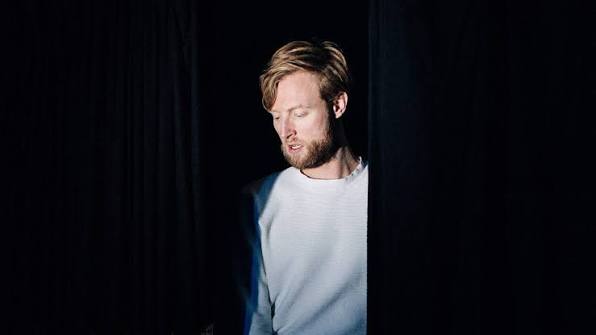
The Los Angeles-born producer spent nearly a decade living in Kyiv before leaving Ukraine with his family following Russia’s full-scale invasion in 2022. Now based in Spain, he’s returning to music production with material that draws directly from those experiences, including “Broken,” the first single from his forthcoming SIGNAL EP on Key Factory Music.
The record was written remotely with Ukrainian vocalist Alona Chernenko, one-half of the alt-pop duo Nesamovyta, while she was living in Kyiv during the electricity blackouts of January 2026. That context gives the vocal a particular significance, especially against the track’s distorted rave stabs, tightly controlled bass and atmospheric synth programming.
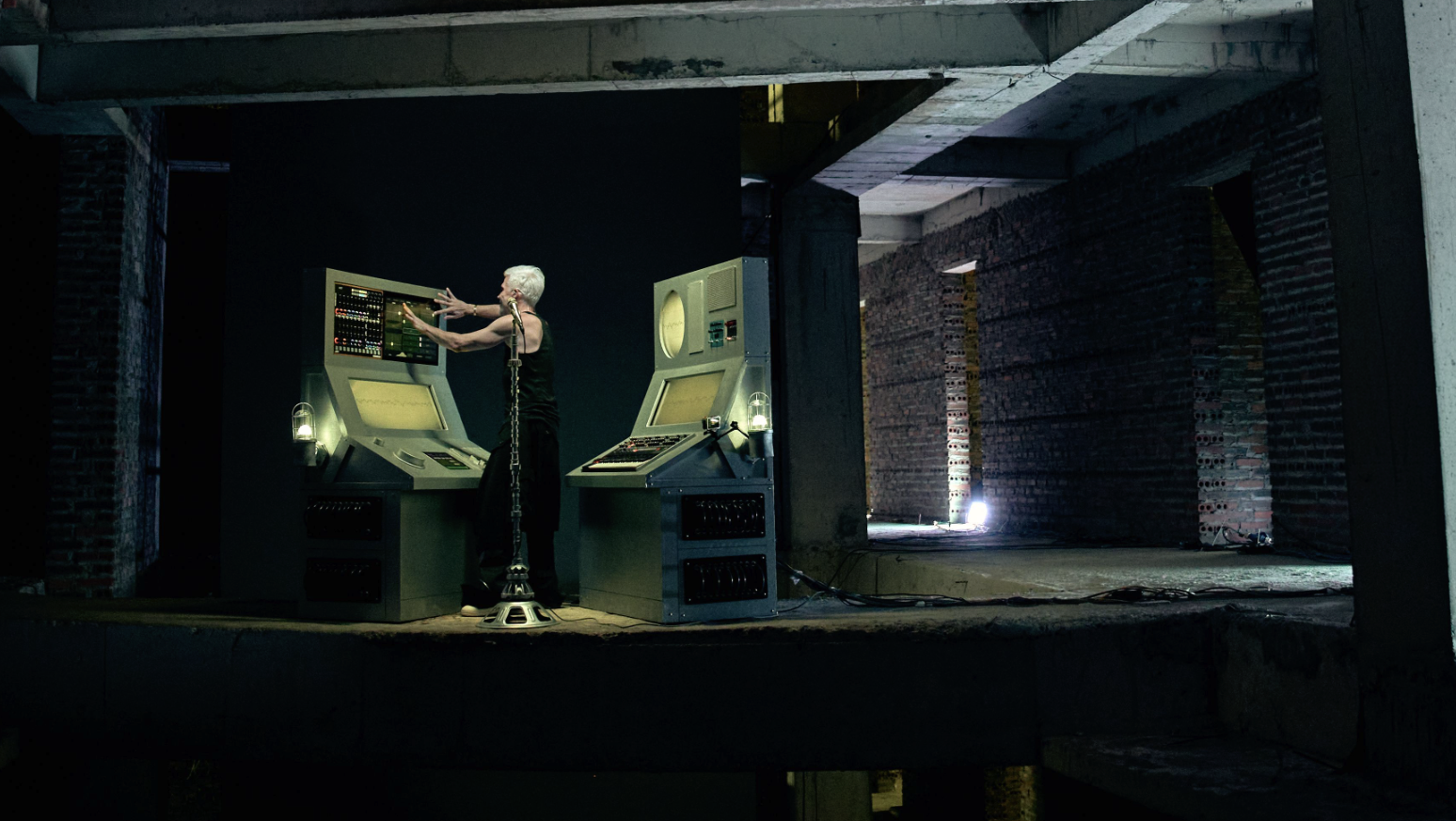
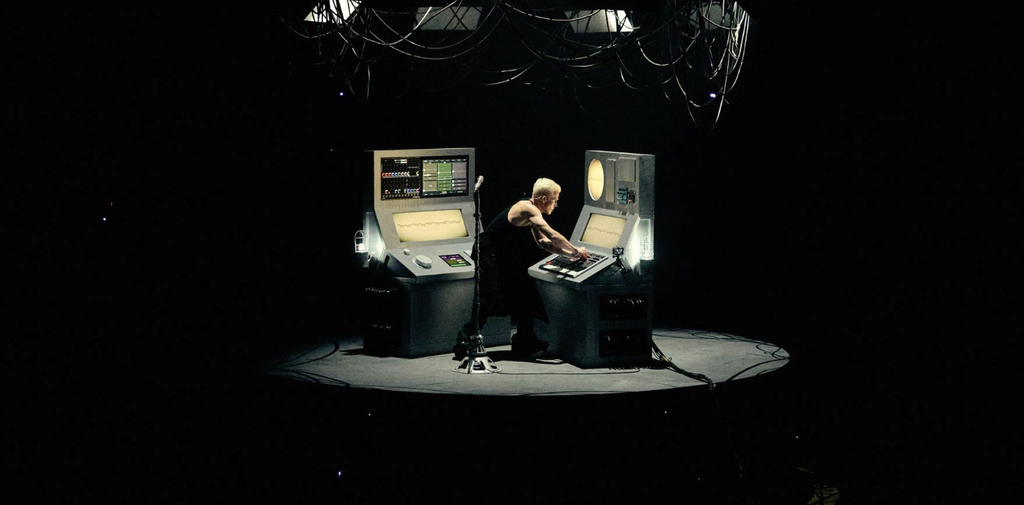
The release also introduces M07’s upcoming SIGNAL live performance film, which premieres at Amsterdam Dance Event on October 22, ahead of a wider release and the accompanying EP in early 2027.
From a production perspective, what’s particularly interesting is how much attention M07 gives to individual sounds and their relationship to everything around them. His approach combines detailed Serum 2 programming, frequency-specific sidechaining, multiple stages of saturation and carefully layered reverbs, all working toward a record that feels physical without sacrificing the emotional character of Chernenko’s performance.
Below, M07 (@m07world) explains how he built “Broken” in Ableton Live 12, the plugins behind its main elements and the production decisions that shaped the finished track.
Introduction: M07 on “Broken”
BROKEN is the first single from SIGNAL, my next EP.
I wrote it over Telegram with Alona Chernenko of Nesamovyta, who also sings on the record. I was in Spain, Alona in Kyiv, in January 2026, during the blackouts from the strikes on Ukraine’s energy infrastructure — millions of people on a few hours of electricity a day. She sings “nobody wanna be broken” and the whole record is built to carry that line: a slow, heavy roll at 128 BPM in F minor, one rave stab that announces the drop, and a sub that does most of the emotional work underneath her.
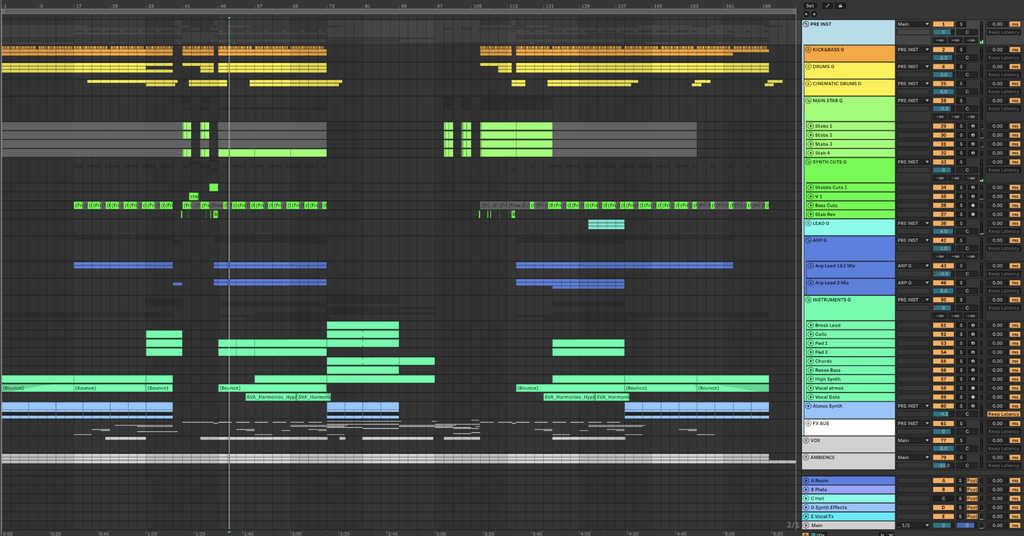
The session lives in Ableton Live 12. It runs as one long arrangement with everything grouped — kick & bass, drums, cinematic drums, the main stab, cuts, leads, arps, instruments, an FX bus, and the vocal chain on its own.
The whole thing was later bounced to audio for the mix, and for the live show we built a new arrangement that recreates the track using only native Ableton synths, plugins and effects, plus an external Prophet-6. But the original sound design all happened in the session below.
Xfer Serum 2
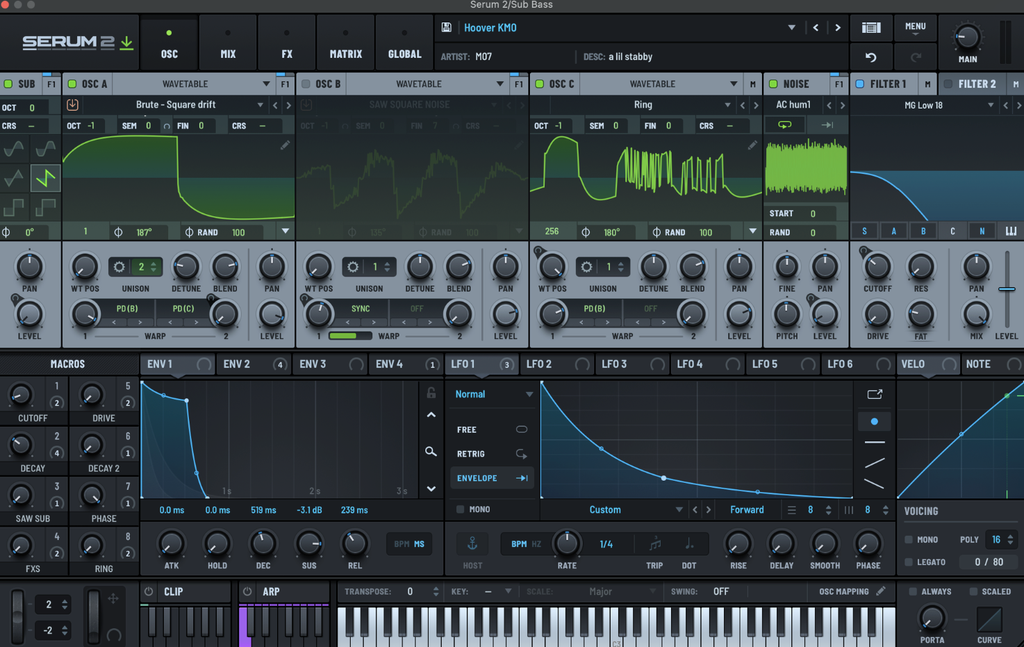
Serum 2 is Xfer’s follow-up to the wavetable synth half the planet learned on, and the big change is that it stopped being “just” a wavetable synth. You now get three oscillators plus a sub and a noise source, granular and sample and spectral modes, a proper multi-slot effects rack inside the instrument, and a modulation matrix you can fill without ever leaving the page. It still sounds clean and direct — that’s the point of Serum — but the FX and the new warp modes let you make it dirty and unstable when you want to.
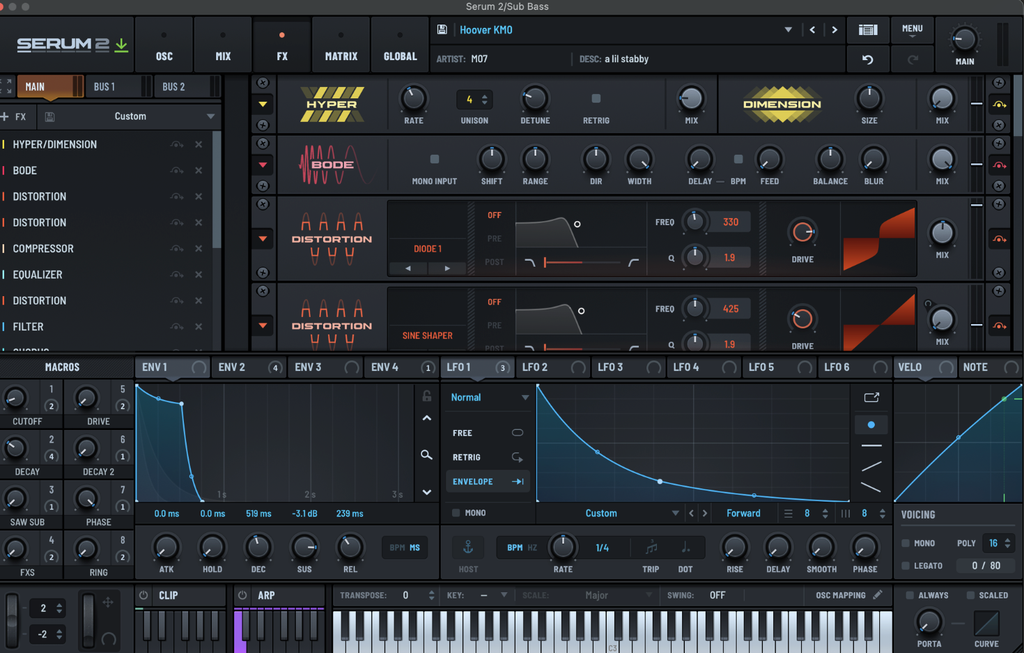
Two sounds in BROKEN are Serum 2, and they’re the two that matter. The first is the stab that heralds the drop — the hoover-style rave stab. It’s my own patch — I call it Hoover KM0: OSC A on the “Brute – Square drift” wavetable with two unison voices, OSC C on the “Ring” table adding the metallic edge, and a noise layer set to “AC hum1”, so the whole chord has a faint mains hum baked into it. It runs through the MG Low 18 filter with a snappy envelope — zero attack, about 500 ms decay, sustain pulled down 3 dB, short release — and then through Serum’s internal FX rack: Hyper/Dimension for width, a Bode frequency shifter to knock it slightly out of tune with itself, two distortion stages (a diode clipper and a sine shaper), then compressor, EQ, filter and chorus. Envelope 2 opens the filter cutoff and the reverb send at the same time, and Macro 1 sits on the cutoff so I could ride it in the arrangement. Three copies of that patch are stacked as Stabs 1–3, each slightly different, with a Nexus stab underneath and a reversed bounce leading into it.
The second Serum 2 sound is the sub, a patch I call East Sub: monophonic, OSC A on “AT Dixie” being FM’d by OSC B (“AT Furthrrrr” with PWM) and a Bend warp, through the MG Low 24 filter, with a slow triangle LFO (1.8 Hz, retriggered) giving the low end a little breathing motion. It is pitched down an octave by a MIDI Pitch device in front of it and it sits under a second Serum layer I call Guitar Bass, which adds the mid-range growl.
If you’re making melodic techno or progressive, my advice is: stop treating Serum 2 as a preset browser and start treating the FX rack as part of the oscillator. A frequency shifter at a tiny amount, before distortion, is the difference between a stab that sounds like a plugin and a stab that sounds like a machine in a room. Use the noise oscillator for texture, not just for hits — a bit of hum or vinyl noise under a chord makes it feel recorded rather than generated. And map one macro to cutoff and one to decay, so you can shape the same patch across a breakdown and a drop without re-drawing envelopes.
Cableguys ShaperBox 3
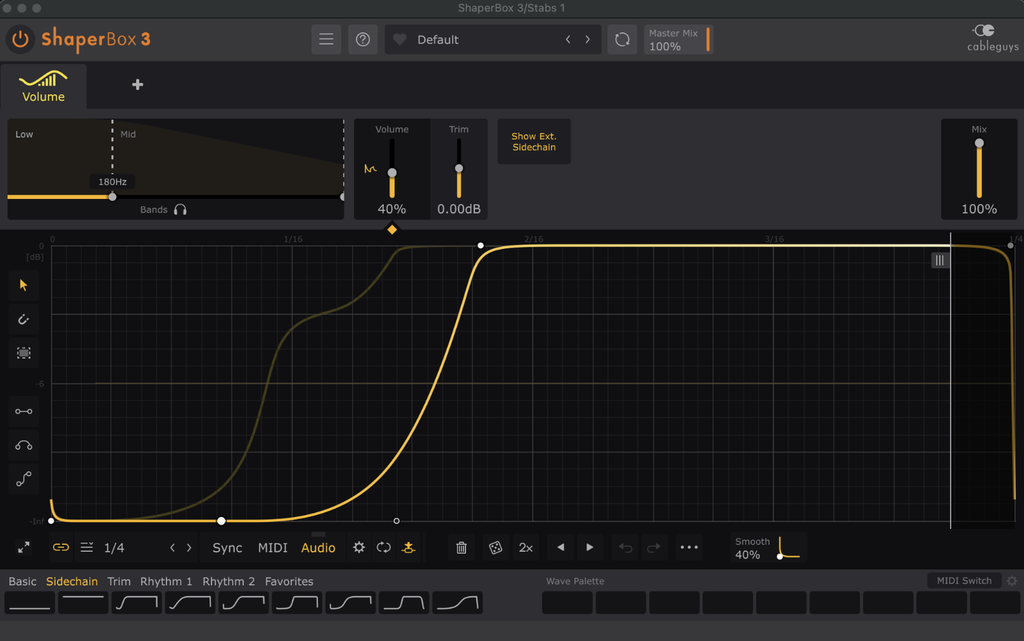
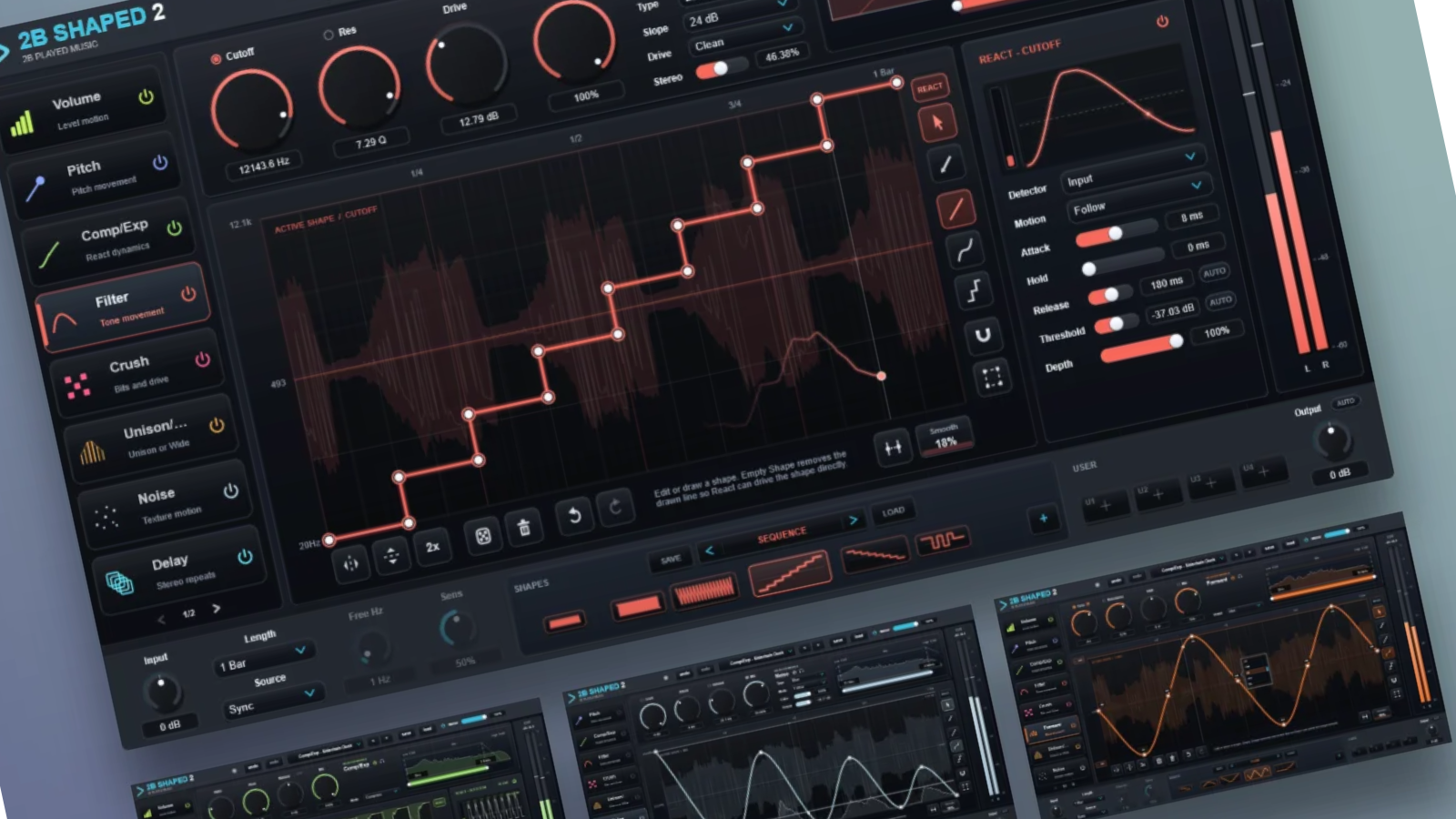
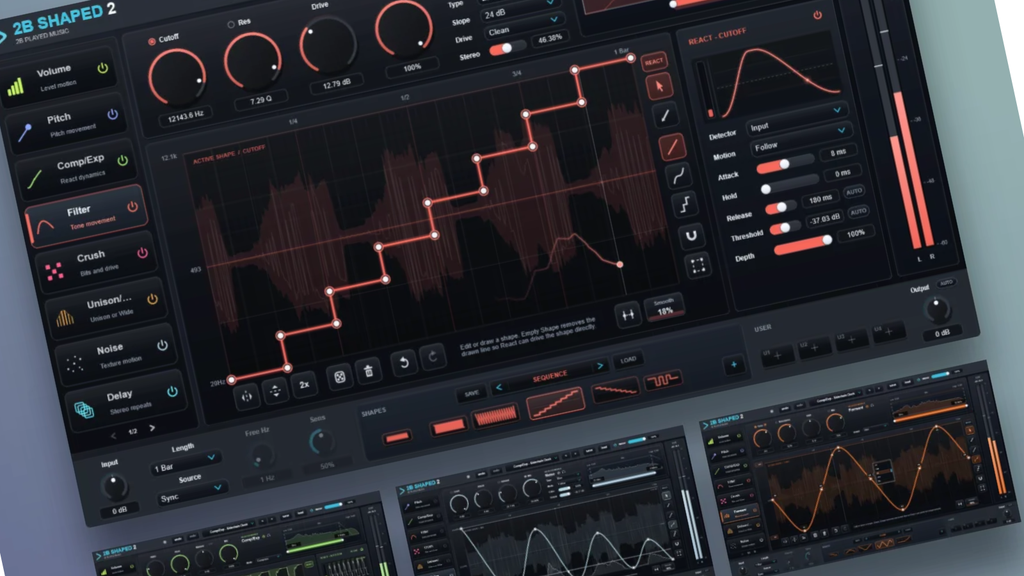
ShaperBox 3 is Cableguys’ multi-effect where each “shaper” — volume, filter, width, pan, drive, time, crush, noise, liquid — is drawn as a curve on a tempo-synced grid. The volume shaper is the one everybody uses as a sidechain replacement, but the important part is that every curve can be split into up to three frequency bands and triggered from audio, MIDI or the host clock. So you’re not ducking a signal; you’re ducking the part of a signal you choose, on a shape you drew.
In BROKEN it’s on almost everything: kick, sub, both basses, the stab group, the pads, the arps. On the stab it’s a single VolumeShaper on a quarter-note cycle, split at 180 Hz, and the two bands get different curves — the lows drop hard and come back late so the kick and sub own the bottom, while the mids and highs only dip about 40% and recover early, so the stab still reads as a chord across the beat. It’s triggered from the Kick track’s post-FX sidechain, not the host clock, which matters when the kick pattern drops out in the breakdowns. The same idea is on the sub, but there I’m ducking a much narrower low band so the sub and kick literally never overlap.
For melodic techno the tip is: split the band before you draw the curve. A full-band pump on a stab or pad makes the whole mix breathe in that “festival” way, which is exactly what this record shouldn’t do. A low band that ducks deep and a top band that barely moves gives you the tightness of a sidechain with none of the wobble. And trigger it from the kick’s audio, not the grid, so your breakdowns don’t keep pumping to a kick that isn’t there.
Brainworx Black Box Analog Design HG-2MS
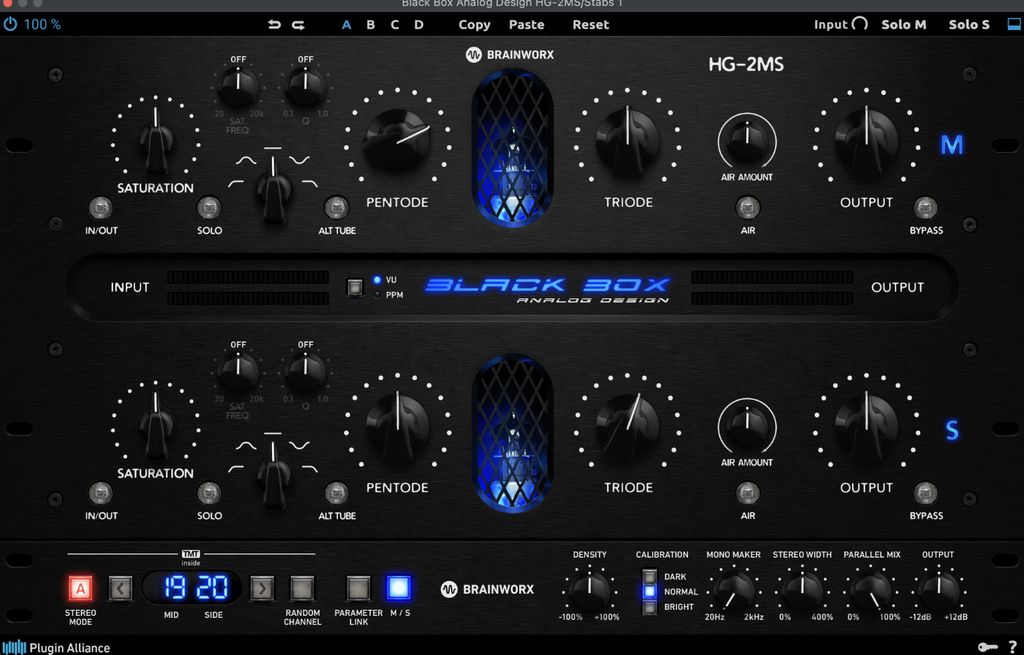
The HG-2MS is Brainworx’s plugin version of the Black Box Analog Design HG-2 — a two-stage valve saturator with a pentode and a triode running in parallel, plus a “saturation” stage with a frequency-selectable emphasis, air, and a density control. The MS version adds mid/side processing so you can hit the middle and sides of a signal with different amounts of tube. It’s a mastering tool on paper; in practice it’s the best “make this sound like it went through something expensive” box I own.
I use it in stereo mode on the stab, with the pentode pushed hard and the triode about halfway, before a Decapitator (hosted in Blue Cat’s PatchWork) and after a Saturn 2. That ordering is deliberate: Saturn adds the multiband harmonics, the HG-2MS glues them and rounds off the top, and Decapitator is the final bit of grit on the transient. The same plugin is on the chords, the arps, the pads, the cinematic drum group and on the drum bus inside a rack with a Distressor and an S73. It never does much on any single element; it does a lot across all of them.
The lesson for producers in this lane is that saturation is a mix decision, not a sound design one. Put the HG-2MS on groups rather than tracks, keep the pentode for the things that need to feel bigger and the triode for the things that need to feel warmer, and A/B with the bypass every time — it’s very easy to fall in love with “louder”. If you want the M07 sound: real, but slightly distorted. This is the “slightly”.
Relab LX480 v4
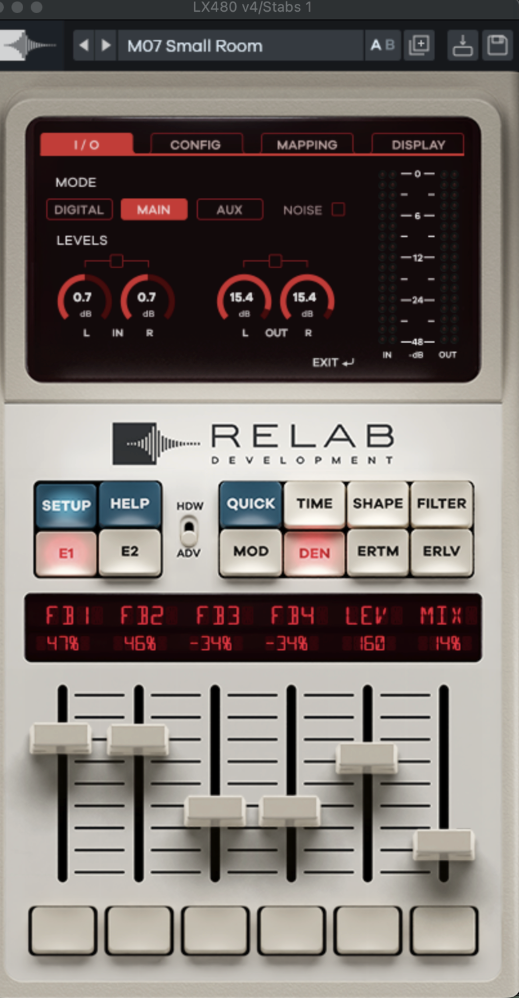
The LX480 is Relab’s emulation of the Lexicon 480L, the reverb on a huge amount of the records I grew up with. Version 4 gives you the original algorithms — Random Hall, Plate, Room, Ambience and the rest — with the 480’s odd, beautiful early-reflection character, its density and diffusion controls, and a proper modern UI in front of the old LARC-style faders. It sounds expensive at very low mix amounts, which is why it ends up everywhere.
On the stab there are two of them in series, and that’s the trick. The first is a short, diffused room — which I saved as M07 Small Room — at only 14% mix with the output pushed up so the early reflections sit right behind the transient. The second is a long hall, M07 Highway Hall, at 7% mix with diffusion at 100% and a slow envelope on the tail. The short one makes the stab feel like it’s in a space; the long one makes the space feel bigger than the room. Envelope 2 in Serum opens the reverb send at the same time as the filter, so the hits bloom as the chord opens. There’s another LX480 on the A Room return, two more on the synth-effects return, and one on the cinematic drums.
If you’re producing melodic techno: stop using one big reverb at 30%. Use two small ones. A short room at 10–15% and a long hall at 5–8%, both on the insert rather than a send, gives you size without smear and keeps the low mids clean. Put the short one first. And automate the mix or the send from the same envelope that opens your filter — reverb that grows with the sound is what makes a stab feel like it’s arriving, rather than just playing.
Quick Fire Hot Takes on the Scene + Production
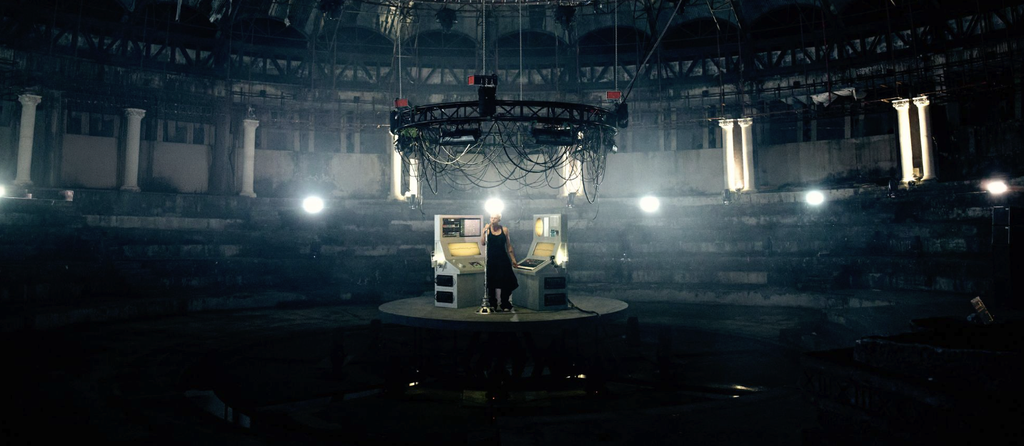
Hot Take #1: Melodic techno has become a genre of presets and a pipeline of “epic” visuals, and the audience can hear it. The records that will still matter in five years are the ones that sound like a person in a room with a reason to make them.
Hot Take #2: Sidechain is not a sound, it’s a mix decision. If your whole track pumps, you’ve turned a bass management problem into a genre.
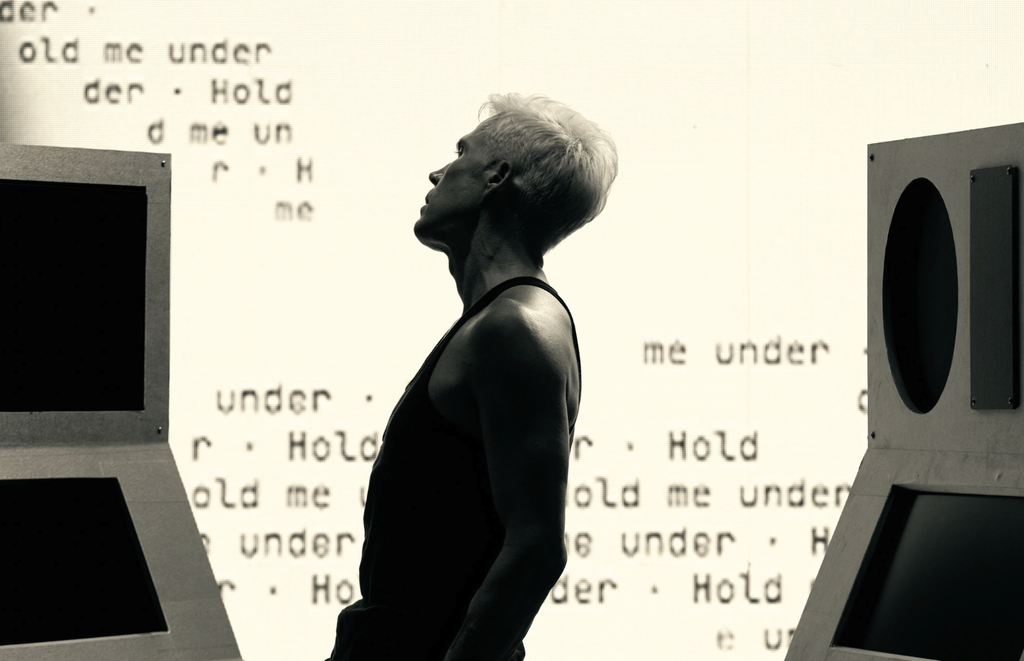
Hot Take #3: Nobody needs another synth. Learn the FX rack of the one you have, put a frequency shifter in front of a distortion, and you’ll get further than any new plugin will take you.
Hot Take #4: The best thing that happened to electronic music in the last two years is that artists started building whole worlds – films, live A/V, a real story – instead of dropping a single with a 15-second clip. The worst thing is that most of those worlds are made with the same stock footage. :-/

Will Vance is a professional music producer who has been involved in the industry for the better part of a decade and has been the managing editor at Magnetic Magazine since mid-2022. In that time period, he has published thousands of articles on music production, industry think pieces and educational articles about the music industry. Over the last decade as a professional music producer, Will Vance has also ran multiple successful and highly respected record labels in the industry, including Where The Heart Is Records as well as having launched a new label with a focus on community through Magnetic Magazine. When not running these labels or producing his own music, Vance is likely writing for other top industry sites like Waves or the Hyperbits Masterclass or working on his upcoming book on mindfulness in music production. On the rare chance he's not thinking about music production, he's probably running a game of Dungeons and Dragons with his friends which he has been the dungeon master for for many years.