One of the greatest challenges for emerging DJs and producers is leaving a lasting impression on listeners—transcending the stage experience to build a community of followers that keeps the artist top of mind. It is crucial to understand that the musical experience does not end when the festival lights go down; on the contrary, the experience itself carries immense weight. Creating memorable moments for show attendees is the best way to sustain the bond between artist and fan beyond streaming platforms and live performances.
For independent artists, DJs, producers, and small record labels, carving out a path in the competitive music landscape is a monumental task. For them, developing a merchandise strategy goes far beyond simply printing a logo on a T-shirt; it can play an important role in building an artist’s identity and connection with fans. Building a successful image is a major undertaking that involves finding creative ways to express the project’s personality, offering something meaningful to followers, and fostering a community that continues to grow between releases and performances.
Start by creating a recognizable identity.
Building a strong visual identity is the best way to begin; if you look at successful cases in the industry, you will notice that all major artists possess visual identities that make them stand out from the rest. This is because they have found a logo, image, or color palette that defines them—elements for which they are now instantly recognized. Top-tier artists like Marshmello, Avicii, and Alan Walker all possess—beyond the quality of their music—visual or merchandising elements that the whole world recognizes. Effective merchandising begins with a coherent and powerful visual identity; an EP cover, an easily recognizable logo, a mascot, or graphic elements used in a live show can all serve as the starting point for a collection.
This type of strategy is most easily recognized among electronic music artists, who often work within highly defined visual universes—incorporating typography, illustrations, symbols, and colors that are distinctive and directly linked to their sound and brand.
Translating these elements into physical products allows fans to recognize the project even outside its musical context. This greatly aids in positioning a new artist’s brand in the minds of customers, as physical items can serve as a hook that draws fans in.
In this regard, it is not about randomly replicating elements or mass-producing identical items; the key is to identify the elements that distinguish your brand—those that instantly evoke your music upon sight—and to ensure that every product is perceived as a physical extension of your artistry and your own artistic personality.
Diversify your merchandise.

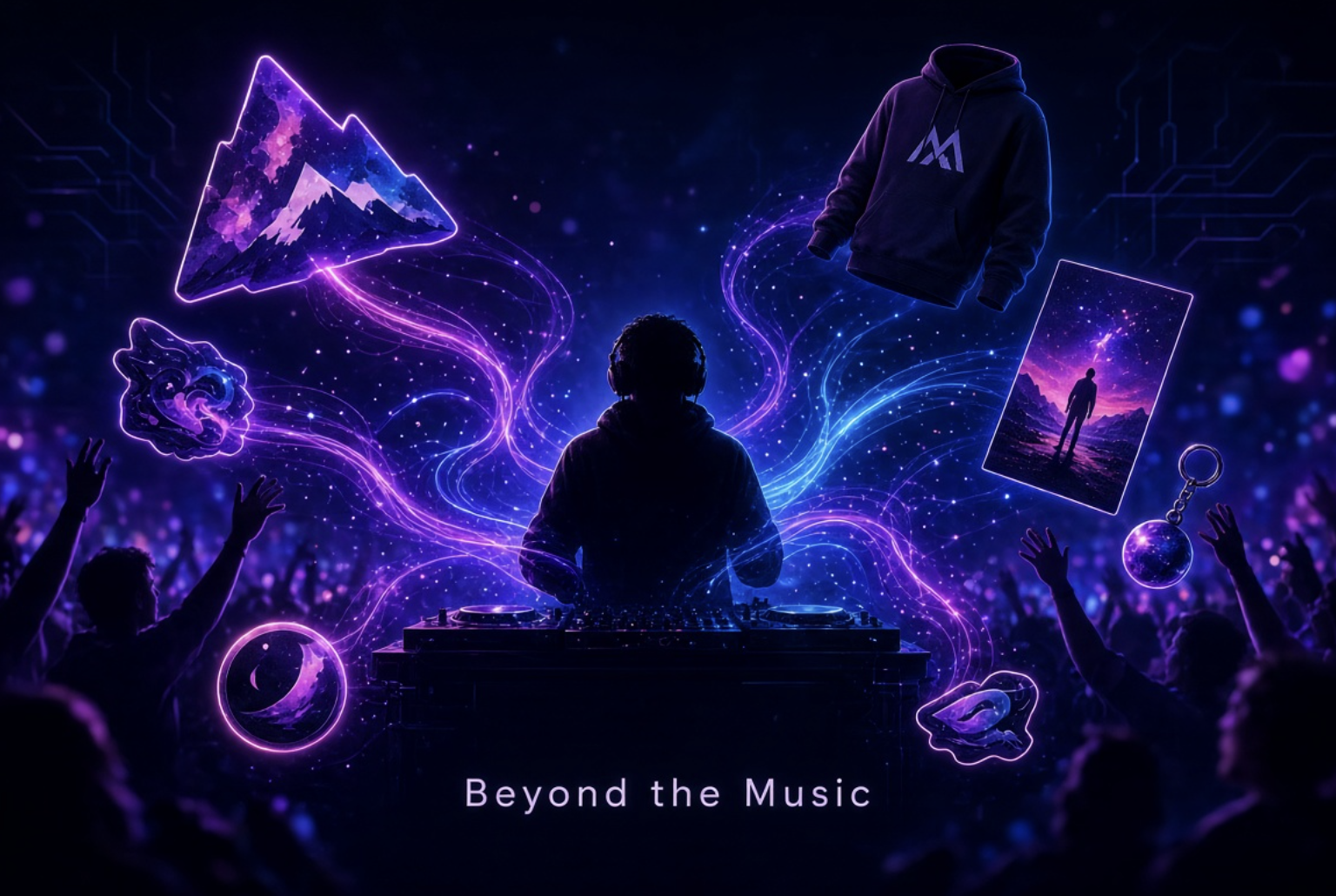
While hoodies remain the most popular choice for this type of strategy, it is important to note that they aren’t the only successful option; there are endless possibilities for keepsakes. Posters, collectible accessories, and small items allow you to explore various types of merchandise beyond just clothing. Furthermore, small accessories have the advantage of being easily displayed where fans can see them—on a shelf, in a themed corner, or simply on a wall or refrigerator—eliminating the risk of them being buried in a closet and worn only occasionally.
Varying your merchandise allows you to offer different price points and better align with demand; you can segment your audience and identify the optimal price range for your goods, helping to offset the cost of the (usually expensive) physical album. The key is giving fans the chance to own a memento at a price that doesn’t break the bank, while still fulfilling the same purpose as a more expensive item. The goal isn’t to get every fan to buy something, but rather to offer various ways to support the project based on their preferences and budget.
Products—like everything else in life—need to serve a purpose or have a reason for existing. For instance, a poster should reflect the artistic direction of a new album, whereas keepsakes or small physical items should aim to remind fans of the experience or memory of a recent concert. In many cases, identifying and selecting items that genuinely connect with your audience is more effective than expanding your catalog without a clear concept.
Recognizable logos, illustrations, and mascots can also translate into smaller collectible merchandise. Custom die-cut magnets are one option for artists who want a product shaped around a particular visual element rather than a standard rectangle. A band’s mascot, an album illustration, or a distinctive tour graphic could all provide a starting point for a design that feels connected to the music. These magnets can be made from 20-mil flexible magnetic vinyl and are intended primarily for indoor use on compatible magnetic surfaces. With orders starting at one unit, artists can explore a design on a small scale before deciding whether it belongs in a larger merchandise collection.
Their compact format can make them worth considering for artists looking to test ideas on a small scale, although the choice of product should ultimately depend on the design, the target audience, and the associated costs.
Link Merchandise to Releases and Live Events
Merchandise can take on greater significance when tied to a specific moment. A collection inspired by a new EP, a special collaboration, or a tour can help fans associate an item with a particular phase of an artist’s career.
Festivals and live performances also offer exciting opportunities. For an artist playing multiple festivals throughout the year, an item linked to a specific show can become a memento of that experience—especially if it incorporates visual elements from the performance.
Limited editions can be effective when there is a genuine reason to make them special, such as a collaboration, an anniversary, or a specific release. However, artificially limiting availability does not guarantee buyer interest; design, the connection to the music, and the bond with the community remain paramount.
It is also wise to maintain some flexibility. Not every product needs to be part of a permanent collection. Some items might launch alongside a new release, while others could remain available for longer periods, depending on demand and the artist’s capacity to handle orders.
Test your ideas and plan your merchandise budget
Understandably, for a music artist, the whole process of budget planning and product testing can seem incredibly complex. Are you often caught between uncertainties: is your plan sound or flawed? There is the fear that ordering too much stock could tie up your capital in slow-moving inventory, while ordering too little means missing out on sales opportunities. To eliminate this fear and move forward with confidence, we always recommend starting by conducting surveys or using simple tools to gather fan feedback. The goal is to gauge opinions, organize a pre-sale, or start with small quantities to identify which products generate the most interest among your audience.
The best option here is unit-based production; this facilitates testing. While it doesn’t eliminate financial risk, it allows you to take measured steps and obtain concrete results before launching a large-scale campaign. However, manufacturing costs are only part of the equation; you must also consider packaging, platform commissions, shipping fees, potential taxes, and the time required to prepare and manage each order. Your distribution method also plays a key role in the decision.
Selling at concerts involves logistics like transportation and managing sales—whether via a marketplace or on-site—whereas an online store allows you to reach fans in other cities or countries but brings the challenges of organizing shipping and handling customer service. Therefore, it is wise to evaluate your ideas based on more than just positive social media comments; the fact that people like a design doesn’t necessarily mean enough people are willing to buy it. Whenever possible, comparing initial interest with actual orders will help you plan future collections and select products that align with the artist’s identity, audience preferences, budget, and logistical capacity.
Integrate merchandise into the fan experience.
The relationship between merchandise and the audience stems from the relationship between the artist and the audience. Social media can showcase the creative process behind a design, while an online store allows customers to browse products by category. Concerts offer the advantage of direct sales to fans; in terms of relationship-building, in-person sales are unsurpassed when the goal is to foster a stronger bond connecting the artist, the merchandise, and the fan.
The ability to share the story behind the products you offer is invaluable. It provides an unmatched opportunity to introduce yourself and allow customers to connect with your story, your art, and the hard work involved—sharing visual references, anecdotes, and the connection between a design and a specific release. This approach adds context to the product and helps fans better understand the creative intent behind it.
As an artist, you must recognize that a seamless purchasing experience is essential. Optimizing your sales presence—including a multi-platform digital footprint, clear photography, accurate product descriptions, and transparent shipping costs—helps the buyer understand exactly what they are paying for and what to expect from your products. This builds a foundation of trust that can endure over time. To explore these strategies further, artists can read Magnetic Magazine’s guide to how independent artists can monetize their merchandise without a label and its overview of six physical merch creation platforms producers should know about in 2026. Both articles offer additional perspectives on choosing merchandise formats, managing production, and finding ways to connect with fans beyond streaming and live performances.
Build a Connection That Lasts Beyond the Music
Merchandise does not replace the music, live performances, or the direct relationship with fans. Its value lies in complementing those experiences and offering fans another way to connect with an artist.
For some projects, that connection might be expressed through a T-shirt or a poster; for others, through a small collectible item linked to a release or a special performance. There is no single formula, and success depends on factors such as the audience, design, pricing, and execution.
Starting with a clear identity, exploring products that make sense, and learning from fan feedback allows for the development of a more sustainable strategy. Ultimately, the most compelling merchandise is not simply that which bears an artist’s name, but rather that which conveys something recognizable about their music and offers fans a tangible way to be part of their world.

Magnetic byline note: This byline is used for staff produced updates and short announcements, often based on press materials and official release information. Editorial responsibility: David Ireland (Editor in Chief) and Will Vance (Managing Editor). About: https://magneticmag.com/about/ Masthead: https://magneticmag.com/masthead/ Contact: https://magneticmag.com/contact/