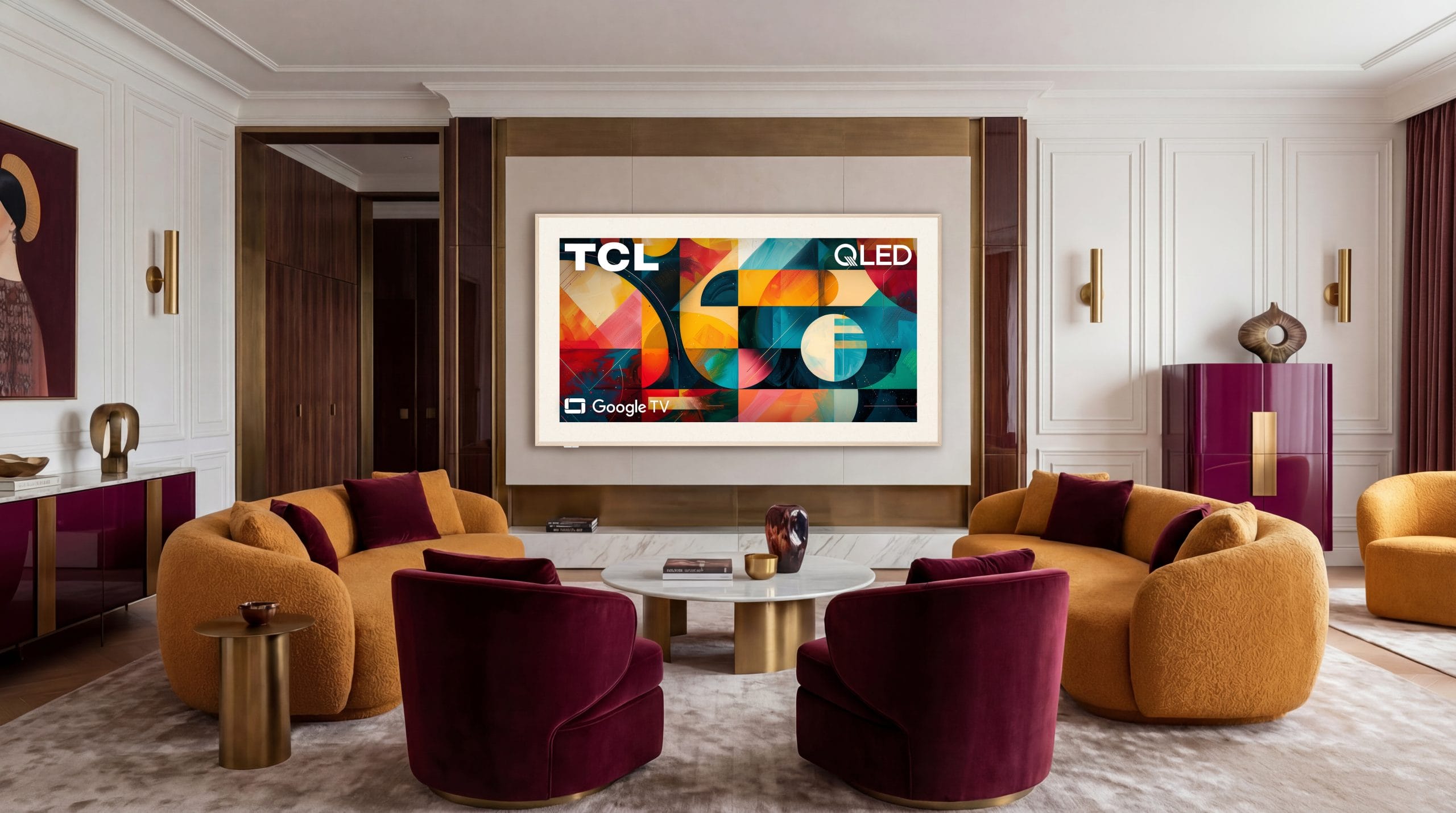
TVs keep showing up in creative rooms for a reason, and it has less to do with passive watching than with atmosphere. A studio is rarely only a studio anymore. For many producers, writers, DJs, editors, and artists, the same room has to work as a bedroom, listening space, writing corner, gaming setup, reference room, video call background, late-night hangout, and place where the next idea has to feel possible.
That is where TCL’s expanded Designer Series starts to make sense.
The new A300L and A400U lines are built as flush-mounted TVs that can sit on a wall with a cleaner art-display presence, while still acting like full modern 4K Google TV screens when the room changes function. Both ship with a flush wall mount in the box, and both include a curated Art Library, AI Art generation, multiple art matte options, and a personal photo gallery mode.
The timing makes sense coming out of IFA because this is the kind of consumer tech that fits the way creative people are building rooms in 2026.
A big black rectangle on the wall can kill the vibe of a small studio fast. But a screen that can become artwork, a mood board, a playback monitor, an ambient lighting companion, or a visual reference point starts to serve the room differently.

Studio Rooms Need to Feel Like They Invite Work
The best studio setups usually have a certain charge.
Not expensive for the sake of being expensive, and not staged like a showroom, but tuned enough that sitting down in the room makes you want to do something. That feeling is hard to fake. It comes from lighting, speaker placement, desk height, acoustic treatment, small objects, cables kept under control, and the room’s visual mood when nothing is happening yet.
A wall-mounted TV can either help that feeling or ruin it. If it looks like an oversized blank panel, it pulls the room toward a living-room energy. If it can sit flush, display artwork, hold personal photos, or show a soft visual layer while music is playing, it becomes part of the creative environment instead of a visual interruption.
That is the strongest case for the A300L.
TCL says it sits just 1.1 inches deep, uses an ultra-matte anti-glare screen, and ships with an off-white bezel plus a light wood magnetic frame that can be swapped in a few seconds. That mix of shallow profile, matte finish, and frame options makes it the more design-forward pick for people who care about how the room feels when the TV is not being used as a TV.
For anyone building a studio that doubles as a bedroom, that detail is especially relevant. The screen cannot dominate the room all day. It has to disappear a little.

A300L Is the Better Fit for Bedroom-Studio Setups
The A300L is the more obvious choice for a bedroom-studio, writing room, or apartment setup where the screen needs to act like wall art between actual viewing moments. It is available now in 55, 65, and 75 inches, with an 85-inch model coming soon. Pricing starts at $1,099 for the 55-inch model, $1,499 for 65 inches, and $1,999 for 75 inches.
The ultra-matte anti-glare screen is the main creative-room feature. Studio spaces often have awkward light: a window behind the desk, LEDs near gear, lamps beside a bed, or sunlight coming in at the wrong angle during the few hours you actually have to write. A matte screen can help the TV feel less reflective and less visually loud, especially when displaying art or reference images.
The interchangeable frame also helps the A300L feel less locked into one room style. Off-white and light wood will likely fit better in calmer home-studio spaces than a standard black-framed TV. That sounds cosmetic, but creative rooms are built from cosmetics.
The way a room looks changes how long you want to stay in it.
The A300L also includes a 144Hz panel, Dolby Vision, HDR10+ and HLG, 20W audio with Dolby Atmos, four HDMI ports, and eARC. For a studio-adjacent room, that means it can move between art display, music-video playback, console gaming, film reference, and normal streaming without feeling like a design object that forgot to be functional.

A400U Is the Screen for Producers Who Also Game and Watch Loud
The A400U takes the Designer Series concept in a more performance-focused direction. It uses 4K QD-Mini LED, TCL’s Halo Control System, Local Dimming Pro+, a 144Hz native panel, 4K/144Hz support on HDMI 1 and 2, Dolby Vision, HDR10+, and DTS passthrough. It is available in 55, 65, 75, and 85 inches, with prices at $999, $1,499, $1,999, and $2,499.
That makes the A400U the better fit for rooms where the TV is expected to do heavier work.
Think studio by day, gaming or film room by night. Or a producer’s apartment where the same screen is used for YouTube references, visualizers, sample-pack browsing from the couch, game nights, set playback, and late-night movie decompression after a long work block.
The 144Hz support and dual 4K/144Hz HDMI inputs are the key details for gamers and high-refresh setups. The QD-Mini LED and local dimming features give it a more serious picture-performance pitch than the A300L, while the Designer Series format keeps the wall presence cleaner than a normal entertainment-first TV.
That makes the A400U the practical choice for people who still want the art-mode and flush-mount look but don’t want to give up higher-end viewing and gaming features.
Dual-Purpose Rooms Need Gear That Does Not Fight the Space
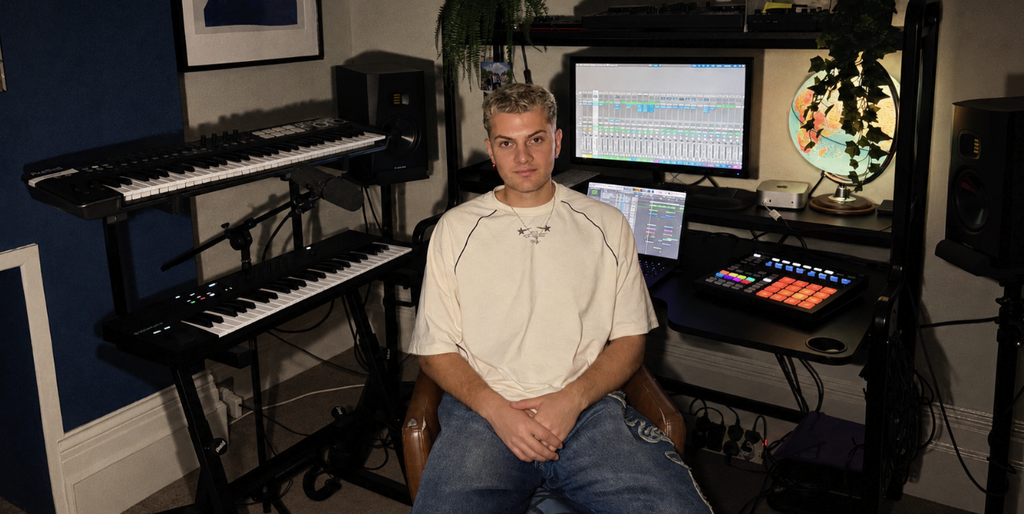
Many creative people don’t have a dedicated studio and instead they have one room doing too many jobs. Bedroom and studio. Living room and writing room. DJ setup and guest room. Editing desk and gaming setup. That makes the design language of every object more important because there is nowhere to hide the gear when the workday ends.
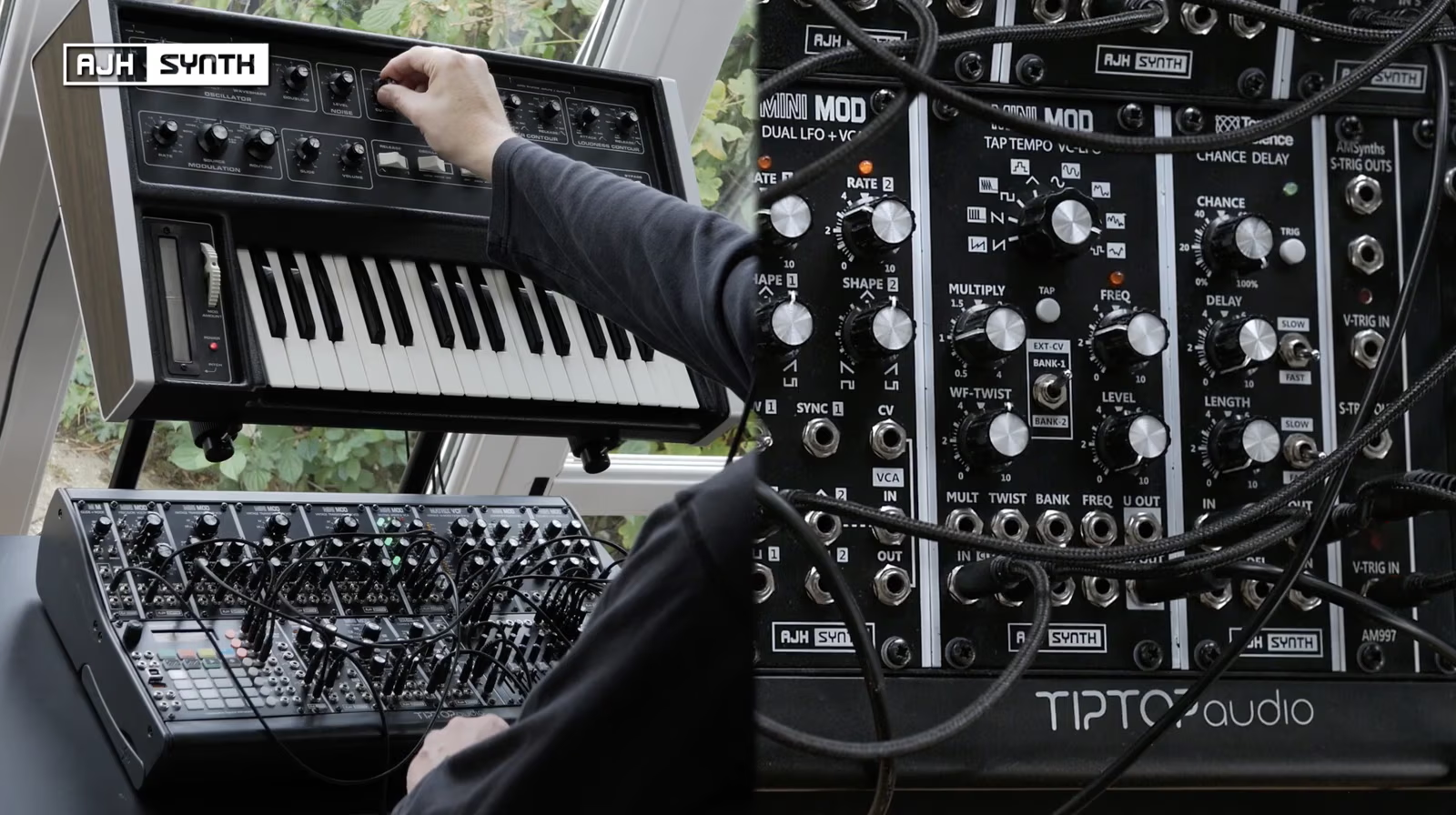
The Designer Series idea fits that reality. A flush-mounted TV with art features can shift the room away from pure entertainment mode and toward a more intentional creative space. It can sit behind a synth rig without making the room feel like a media room. It can hang across from a bed without making the whole bedroom feel built around streaming. It can support a home-studio setup without competing visually with speakers, keyboards, plants, lamps, and acoustic panels.
This is also why I would treat the A300L and A400U differently. The A300L is the calmer design piece for people who want the TV to fade into the room. The A400U is the higher-performance option for people who still want the screen to feel integrated, but need more picture firepower for gaming, films, and deeper entertainment use.
TCL’s New Designer Series Fits the Modern Creative Apartment
The best way to understand TCL’s A300L and A400U is not as luxury wall-art TVs for people who hate visible electronics. The better read is that these screens are aimed at homes where design and function keep crossing into each other.
For a producer, that could mean a screen that displays album art while playing references, shifts into Google TV after a session, handles console gaming when the room turns social, then goes back to looking like framed art when the night is over. For someone working from a bedroom or small apartment, that flexibility is not extra. It’s why the product category exists.
The A300L gives the clearest wall-art look, with its 1.1-inch depth, ultra-matte screen, off-white bezel, and swappable light wood magnetic frame. The A400U gives the stronger performance story, with QD-Mini LED, Local Dimming Pro+, 144Hz gaming support, and an 85-inch option for people with the wall space.
Both lines are available now in the U.S., with the A300L 85-inch model coming soon. For studio builders, apartment producers, and anyone trying to make one room feel creative without giving up entertainment, TCL’s Designer Series expansion makes a clear argument: the screen on the wall should help set the tone, not pull you out of it.

Will Vance is a professional music producer who has been involved in the industry for the better part of a decade and has been the managing editor at Magnetic Magazine since mid-2022. In that time period, he has published thousands of articles on music production, industry think pieces and educational articles about the music industry. Over the last decade as a professional music producer, Will Vance has also ran multiple successful and highly respected record labels in the industry, including Where The Heart Is Records as well as having launched a new label with a focus on community through Magnetic Magazine. When not running these labels or producing his own music, Vance is likely writing for other top industry sites like Waves or the Hyperbits Masterclass or working on his upcoming book on mindfulness in music production. On the rare chance he's not thinking about music production, he's probably running a game of Dungeons and Dragons with his friends which he has been the dungeon master for for many years.