Images Courtesy of Apos
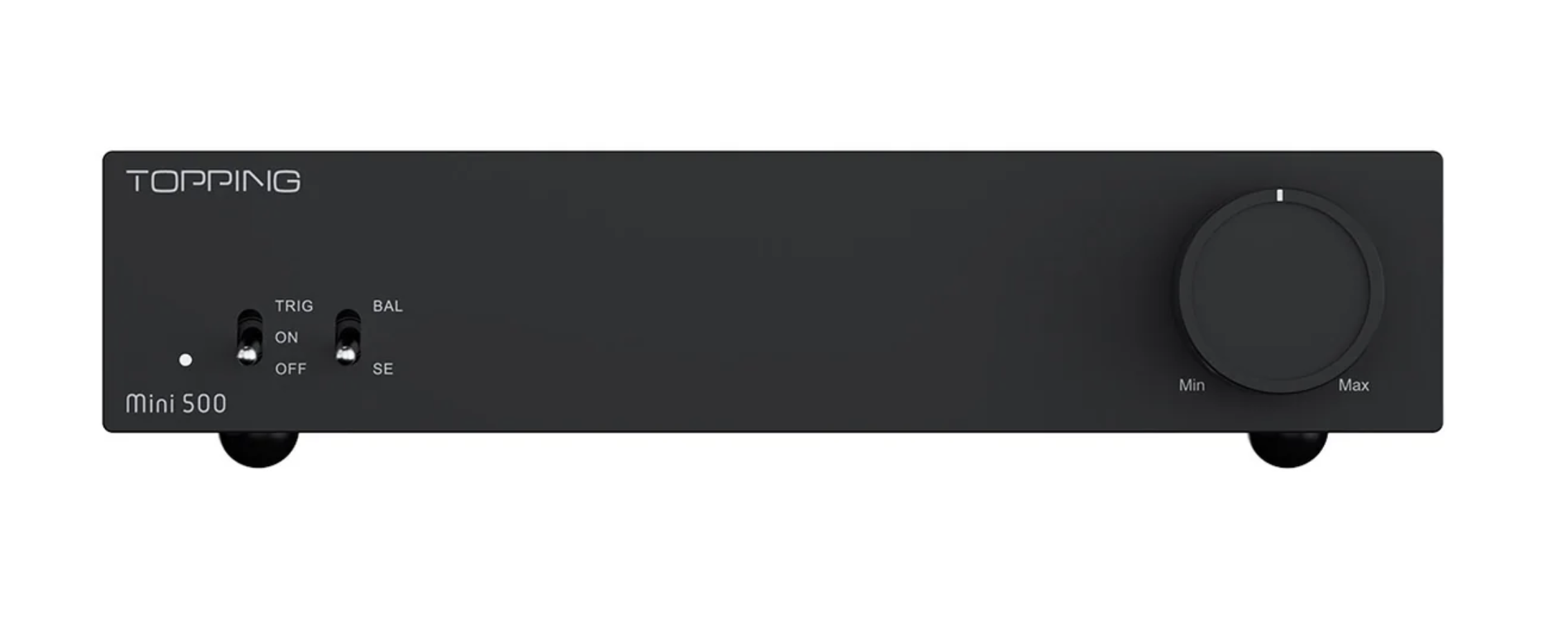
TOPPING has released the Mini 500, a $229 desktop power amplifier that provides considerable output for its size while accommodating several different listening configurations. The fully balanced Class D amplifier delivers 220W per channel into 4-ohm speakers at less than 1% THD+N, with the option to switch to mono operation to drive a single speaker or passive subwoofer. It also includes balanced and unbalanced connections, an analog volume control, and a compact aluminum enclosure measuring just 7.48 inches wide.
The specifications are interesting because TOPPING has concentrated on amplification rather than adding streaming, digital conversion, or wireless connectivity.
The Mini 500 is designed to receive an analog audio signal from an existing source and amplify it for passive loudspeakers. Depending on the rest of the equipment, that could mean connecting a DAC directly to the amplifier, using an external preamplifier, or incorporating the Mini 500 into an existing hi-fi system.
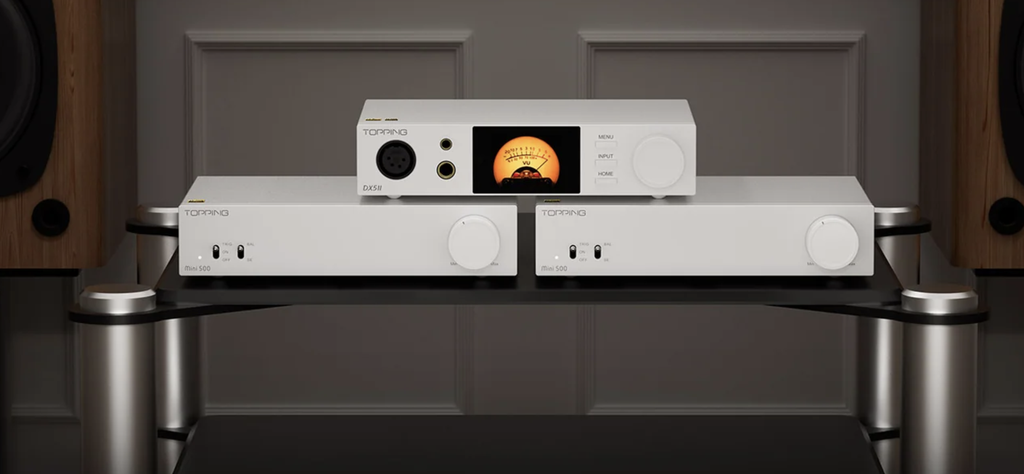
Including stereo and mono operating modes gives the amplifier another application beyond a conventional pair of bookshelf speakers. Owners can start with one Mini 500 in stereo and later add a second unit, assigning each amplifier to a separate speaker.
There are limitations to understand, particularly the different power ratings and associated distortion measurements, but the Mini 500 offers several system configurations without requiring buyers to invest in a larger integrated amplifier.
TOPPING Mini 500 Power Ratings Explained
The Mini 500 uses Class D amplification with a native bridge-tied load, or BTL, architecture. This design uses differential output stages to drive the speaker, allowing the amplifier to deliver power without necessarily connecting the speaker’s negative terminal to chassis ground.
Class D amplifiers are commonly used in compact audio equipment because their switching architecture can provide high electrical efficiency compared with conventional linear amplifier designs. That reduces the amount of electrical energy converted into heat, although thermal management remains important when substantial output is delivered for extended periods.
TOPPING specifies several different power ratings for the Mini 500, and understanding the measurement conditions is important.
In stereo operation, the amplifier provides:
- 220W per channel into 4Ω at THD+N below 1%.
- 120W per channel into 8Ω at THD+N below 1%.
- 250W per channel into 4Ω at THD+N below 10%.
- 150W per channel into 8Ω at THD+N below 10%.
The distinction between the 1% and 10% figures deserves attention because manufacturers sometimes advertise the highest possible output without explaining the associated distortion threshold.
THD+N measures total harmonic distortion and noise relative to the audio signal. A power specification measured below 10% THD+N permits considerably greater distortion than one measured below 1%.
For the Mini 500, the 220W and 120W stereo figures provide a more informative comparison when evaluating power output at the lower stated distortion threshold.
That still doesn’t establish how the amplifier will perform with every speaker. Impedance changes across the frequency spectrum, and the power needed depends on speaker sensitivity, listening distance, room characteristics, and the required volume.
However, the published ratings indicate that the Mini 500 is designed to accommodate passive speakers beyond the relatively undemanding requirements of a small desktop listening position.
Balanced Inputs and Volume Control Simplify System Integration
The Mini 500 provides two input configurations: balanced XLR/6.35mm TRS combo connections and conventional RCA connections.
The balanced inputs are particularly relevant to listeners who already own DACs, preamplifiers, or professional audio equipment with balanced analog outputs.
TOPPING uses a fully differential signal path to reduce interference shared between the two conductors of a balanced connection. The company specifies a signal-to-noise ratio of 126dB and channel crosstalk of -111dB through the balanced inputs.
The equivalent signal-to-noise figure through the RCA connections is 123dB, with channel crosstalk specified at -98dB.
At 5W into an 8-ohm load, TOPPING reports 0.0004% THD+N through the balanced input using an A-weighted 1kHz measurement.
These are manufacturer measurements under defined test conditions, not independently verified listening results. They indicate the intended electrical performance, but the audibility of these differences depends on the speakers, room, playback level, and the rest of the system.
The amplifier also offers two volume control methods.
In VOL mode, the front-panel analog potentiometer adjusts the listening level. This lets the Mini 500 run with an analog source that provides a suitable line-level signal.
In BYPASS mode, the volume control is removed from the signal path, allowing an external preamplifier or DAC with adjustable output to determine the listening level.
Consider that second configuration when integrating the amplifier into an existing desktop audio system.
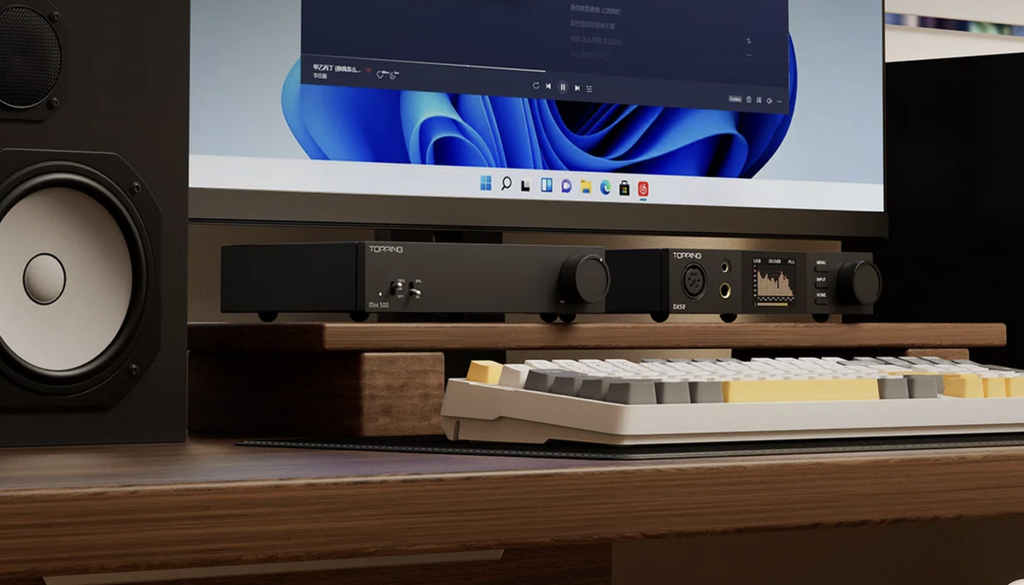
For example, a producer might already have a DAC with balanced line outputs and an adjustable output level. Connecting it to the Mini 500 would amplify passive speakers without needing a separate preamplifier.
In our recent article about the FiiO CLASS A desktop amplifier, we examined a related system configuration, where a headphone amplifier can also provide line-level output to downstream equipment.
The Mini 500 occupies a different position in that type of arrangement because its primary purpose is supplying power to passive speakers.
One important caution concerns BYPASS mode. The amplifier operates at fixed maximum volume when the front-panel control is bypassed. TOPPING advises reducing the upstream device’s output level before switching modes to avoid unexpectedly high speaker volume.
The Mini 500 also includes a 12V trigger input, allowing power operation to follow a compatible DAC or preamplifier. This is a relatively small feature, although it can be convenient in a system containing several independent components.
How the Mini 500 Compares With Integrated Amplifiers
At $229, the Mini 500 sits in a different category than integrated streaming amplifiers that combine digital conversion, networking, and speaker amplification.
For example, in our review of the WiiM Amp, we examined a product designed to combine streaming services, digital inputs, wireless connectivity, and amplification for passive speakers.
The WiiM approach targets listeners who want several functions in one enclosure.
Listeners considering a passive desktop system should also examine the speakers themselves. In our earlier feature on Audio3’s passive and active loudspeaker designs, we discussed how speaker construction, acoustic loading, and system integration affect the choices involved in assembling a listening setup.
The Mini 500 provides an additional amplification option for compatible passive designs, although speaker selection remains an independent decision.

TOPPING Mini 500 Price, Dimensions, and Availability
Despite its power ratings, the Mini 500 occupies relatively little space.
The aluminum enclosure measures 7.48 inches wide, 6.46 inches deep, and 1.73 inches high, equivalent to approximately 19 × 16.4 × 4.4 centimeters.
It weighs approximately 2.4 pounds, or 1.09 kilograms.
TOPPING includes heatsinks on the rear panel and bottom plate to dissipate heat during operation. The compact dimensions may appeal to listeners who want a separate power amplifier without dedicating a large amount of desk or shelving space to it.
The amplifier is supplied with an external power adapter, power cable, and product information card.
Available finishes include black, silver, and white, and Apos and participating retailers list the unit at $229.
At this price, the Mini 500’s most interesting features are its stereo and mono capabilities, balanced analog inputs, and ability to operate either with its own volume control or as a dedicated power amplifier.

Its published electrical specifications also warrant attention, particularly the low distortion figures at moderate output levels. However, those numbers should be considered alongside the different measurement conditions used for maximum power.
The Mini 500 is intended for listeners who already have, or plan to assemble, a separate-component audio system. It provides amplification without incorporating functions that may already exist elsewhere in that system.
The TOPPING Mini 500 is available now for $229 through Apos, with further product information available from TOPPING.

Will Vance is a professional music producer who has been involved in the industry for the better part of a decade and has been the managing editor at Magnetic Magazine since mid-2022. In that time period, he has published thousands of articles on music production, industry think pieces and educational articles about the music industry. Over the last decade as a professional music producer, Will Vance has also ran multiple successful and highly respected record labels in the industry, including Where The Heart Is Records as well as having launched a new label with a focus on community through Magnetic Magazine. When not running these labels or producing his own music, Vance is likely writing for other top industry sites like Waves or the Hyperbits Masterclass or working on his upcoming book on mindfulness in music production. On the rare chance he's not thinking about music production, he's probably running a game of Dungeons and Dragons with his friends which he has been the dungeon master for for many years.