LALAL.AI’s new Guitars stem is interesting because the company is not pretending that every AI music update needs to sound like a sci-fi manifesto. This is a specific fix for a specific problem: guitar parts are messy, layered, processed, doubled, and easy for separation models to misread when they are forced to decide whether something is acoustic or electric before pulling it out of a track.
Until now, LALAL.AI offered Acoustic Guitar and Electric Guitar as separate stems.
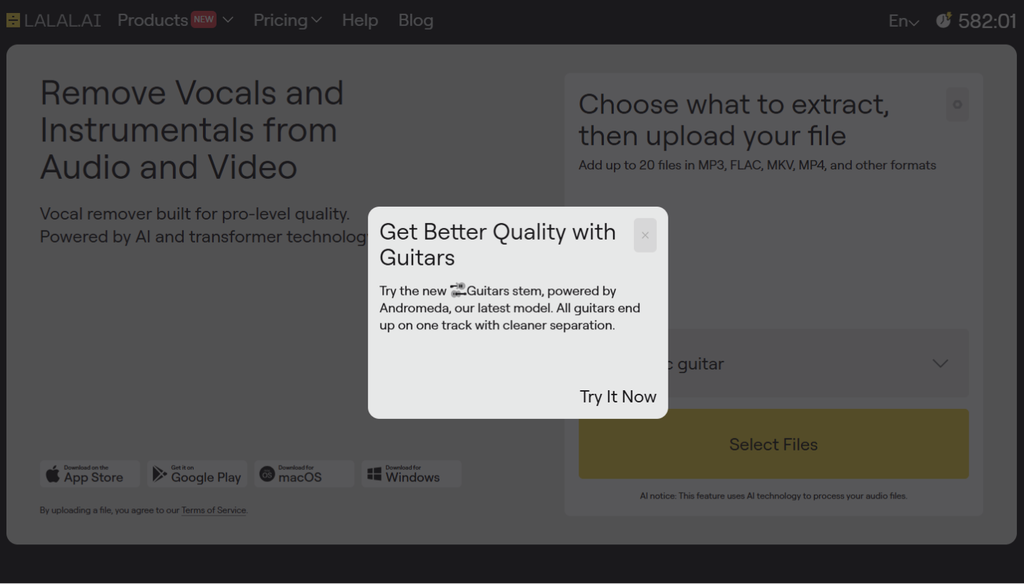
That worked in cases where the source material was obvious, but it also created a failure point. If a model changed its mind midway through a track, one guitar performance could get split across two different stems, leaving each part thinner and less complete than it should be. The new Guitars stem in Andromeda removes that decision entirely by treating all guitar parts as one class.
That means strummed acoustics, clean electrics, distorted rhythm parts, picked lines, leads, and layered doubles can now be pulled into a single guitar file. For remixers, sample flippers, indie producers, mashup makers, and anyone building backing tracks for practice, that is a much more musician-centered answer than forcing the user to guess which category the model will handle better.
LALAL.AI says the change reduced the most disruptive guitar separation failures by roughly 20% in internal testing, specifically cases where guitar parts were split apart or lost to the residual channel. That is the kind of data point that deserves attention because it is not a vague quality claim. It names the problem and gives a measurable improvement.
Why One Guitars Stem Can Be Better Than Two
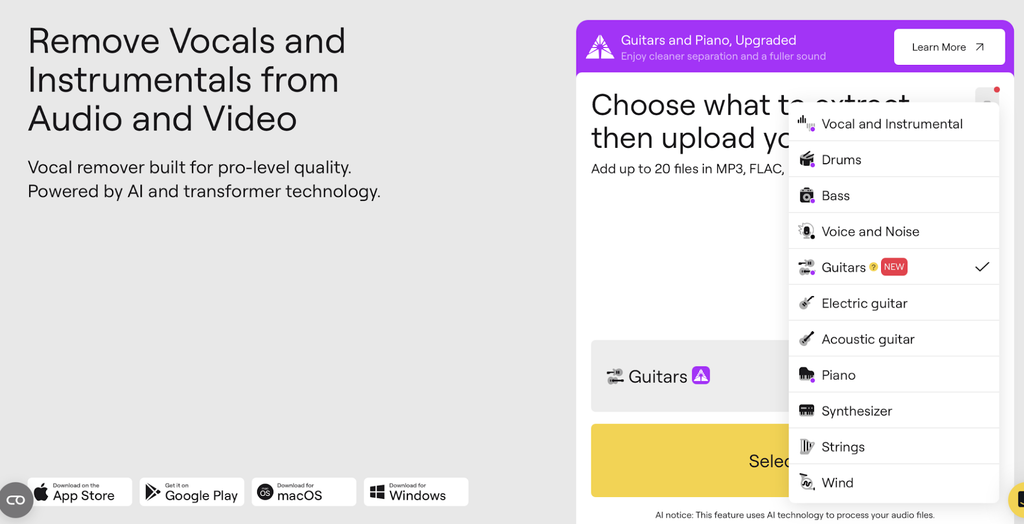
The move from separate Acoustic Guitar and Electric Guitar stems to a unified Guitars option sounds simple, but it reflects a more realistic understanding of how guitars appear in finished music. A guitar is rarely only one thing in a modern mix. It can be doubled, layered, re-amped, saturated, widened, tucked under a synth, or processed until it behaves like a pad, a texture, or a rhythmic bed.
That is where classification can become a liability. A model has to find the guitar, then decide which guitar type it belongs to. When that second step goes wrong, the separated file can lose the musical phrase the user wanted in the first place. LALAL.AI’s new Guitars stem removes that extra fork in the road.
The tradeoff is clear.
The combined Guitars stem does not separate acoustic guitars from electric guitars. If a song has acoustic strumming sitting under a distorted lead, they will come out together. Users who need those parts split can still use the older dedicated Acoustic Guitar and Electric Guitar stems, which remain available. The difference is that the new Andromeda option gives users a safer single-pass choice when preserving the full guitar performance matters more than sorting the instrument family.
That framing is important for real production work. In remixing, DJ edits, and sample flips, the first priority is often getting a musically complete stem that feels usable in a new context. Perfect taxonomy matters less than avoiding holes, missing phrases, and artifacts that make the extracted part collapse once it is placed against new drums or bass.
We have covered that remix problem from a few angles before, including our article on creating DJ edits from finished stereo files. The same lesson applies here: modern producers are often working with finished audio, and the quality of the extracted parts decides how far the new idea can go.
Piano Gets Rebuilt for Dense Mixes

LALAL.AI is also rolling out a rebuilt Piano separation stem on Andromeda, which may end up being just as relevant for producers working with older records, sample sources, demos, and live recordings. Piano is notoriously hard to isolate because it occupies a huge frequency range and each note can ring into the surrounding arrangement long after the initial hit.
That creates a different problem than guitars. Guitar separation struggles with type, layering, and processing. Piano separation struggles with range, sustain, and bleed. In dense passages, the part can smear into vocals, strings, pads, percussion tails, or room tone, which makes the extracted result feel less natural.
According to LALAL.AI, the rebuilt Piano model is designed to produce more natural separation in layered sections, with less bleed from surrounding instruments. The previous-generation Piano model remains available as well, which is a good choice for users who want to compare results or prefer how the older model handles certain material.
That comparison option matters because audio separation is never fully one-size-fits-all.
Different models can behave differently depending on source quality, arrangement, compression, reverb, and density. Keeping older versions available gives producers a way to choose by ear rather than being locked into a single assumption about the newest version.
For a broader look at where stem extraction sits in production workflows, our article on the best stem separation plugins remains a good reference point. The category keeps moving because producers are not only extracting vocals anymore. They are rebuilding access to musical parts buried inside finished mixes.

Will Vance is a professional music producer who has been involved in the industry for the better part of a decade and has been the managing editor at Magnetic Magazine since mid-2022. In that time period, he has published thousands of articles on music production, industry think pieces and educational articles about the music industry. Over the last decade as a professional music producer, Will Vance has also ran multiple successful and highly respected record labels in the industry, including Where The Heart Is Records as well as having launched a new label with a focus on community through Magnetic Magazine. When not running these labels or producing his own music, Vance is likely writing for other top industry sites like Waves or the Hyperbits Masterclass or working on his upcoming book on mindfulness in music production. On the rare chance he's not thinking about music production, he's probably running a game of Dungeons and Dragons with his friends which he has been the dungeon master for for many years.







![How It Was Made: Low Steppa & Roel – Dreamliner [Low Trax]](https://magneticmag.com/wp-content/uploads/2026/09/DSC07195-1024x608.jpg)