The Cayin HA-1A MK3 is the kind of desktop audio piece that makes the most sense once you stop thinking about headphone amps as purely technical boxes.
Yes, it has the specs, the tubes, the output options, the impedance matching, and the compact chassis.
The more interesting angle for producers, mix nerds, and serious listeners is that it creates a different kind of listening station, one built around slowing down, listening longer, and hearing records from a slightly more tactile place.
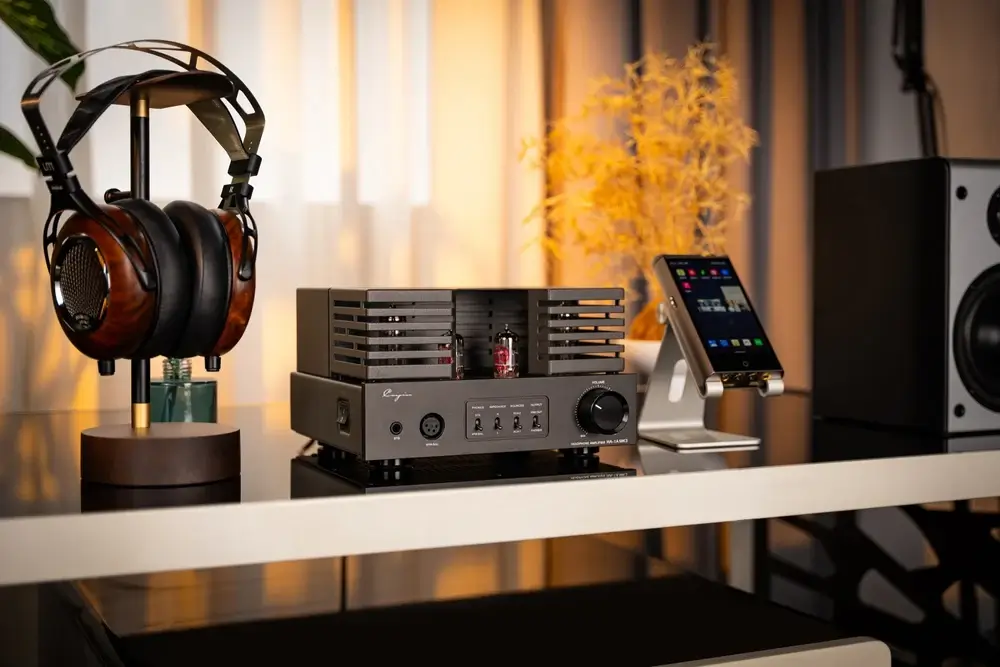
Available at Apos Audio for $999, the HA-1A MK3 is a Class-A tube headphone amplifier and preamp built around two JJ 12AU7/ECC82 tubes and two Electro-Harmonix EL84EH/6BQ5 tubes. Cayin pairs that tube circuit with dedicated power and output transformers, a fully analog path, an ALPS volume potentiometer, two pairs of RCA inputs, and a rear RCA PRE-OUT for active speakers or an external power amp.
For producers, this is not the piece you buy to replace flat studio monitoring. It is the piece you use when you want a dedicated listening chain that lets you step outside the DAW for a second and hear music like a listener again.
That can be reference listening, album playback, late-night headphone checks, vinyl-adjacent listening from a DAC, or a small desktop setup built around the idea that enjoying sound still has a place in the production process.
We have covered that wider desktop-studio conversation before in my Arturia AudioFuse 16Rig review, where the larger point was that modern producers are often building hybrid workspaces instead of one-size-fits-all rooms. The Cayin HA-1A MK3 fits neatly into that thinking. It is not only about amplification. It is about creating a dedicated listening corner that feels intentional.

The Tube Circuit Is the Main Draw
The HA-1A MK3 uses a Class-A vacuum-tube topology, which means the output stage stays active across the signal cycle instead of switching in and out for efficiency.
That usually comes with tradeoffs in heat and power use, but the listening argument is straightforward: linear operation, a smoother character, and the kind of tonal density people usually want from a tube headphone amp.
Cayin’s tube choice gives the amp a familiar hi-fi language. The 12AU7/ECC82 tubes handle the front-end character, while the EL84/6BQ5-family output tubes bring the circuit into a more muscular place. The product copy leans into tonal density, smooth presentation, and expressive playback, which is exactly the reason someone would look at a compact tube amp instead of another clean solid-state box on the desk.
That does not mean every producer should monitor through it while making critical mix decisions. Tube coloration can flatter records, and flattering playback is not always the same thing as brutally honest playback. Used correctly, that is actually the appeal. The HA-1A MK3 can sit as a second listening path, giving you a different emotional read on a track after the surgical work is done.
There is a real value in that. A mix can be technically balanced and still feel uninvolving. A tube chain can sometimes reveal whether the musical part of the record survives once you stop staring at meters. For electronic producers, that can be especially helpful when checking pads, vocals, synth harmonics, reverb tails, saturation, and the way low-mid information sits over time.
Headphone Matching Makes the Amp More Flexible
The HA-1A MK3 includes a two-position impedance selector, with Low covering 8 to 150 ohms and High covering 151 to 600 ohms. That gives the amp a broader pairing range across low-impedance planar magnetic headphones and higher-impedance dynamic models, which is important because headphone amps can fall apart when they are matched poorly.
The front panel gives users a 6.35 mm single-ended headphone output rated at 2,400 mW + 2,400 mW, plus a 4-pin XLR balanced output rated at 2,700 mW + 2,700 mW. Those are serious output figures for a desktop amp, and the connection options keep the unit from feeling locked into one cable ecosystem. You can run a more standard headphone setup from the quarter-inch output, or use a balanced cable with the XLR output when the headphone pairing supports it.
The rated frequency response is 20 Hz to 20 kHz at -3 dB, with headphone output THD listed at 0.3% at 1 kHz and 200 mW, and less than 5% at rated output power.
The headphone output signal-to-noise ratio is listed at 110 dB A-weighted. Specs alone never explain whether a tube amp will feel right with a given headphone, but they do show that Cayin is positioning this as a serious desktop component rather than a decorative tube box.
For headphone-focused readers, my AIAIAI TMA-2 Studio Wireless+ review is a good adjacent read because it approaches listening from the producer side. The Cayin is a different category entirely, but the shared question is the same: how do headphones change the way creators hear their work?

The Preamp Output Expands the Setup
The rear RCA PRE-OUT gives the HA-1A MK3 another use beyond headphones. It can serve as a tube preamplifier for active speakers or an external power amplifier, which makes the unit more flexible for a small listening room or desktop hi-fi setup. With two pairs of RCA inputs, it can sit between a DAC, streamer, turntable phono stage, or another line-level source and a compact speaker system.
That may be the better long-term argument for the amp.
A $999 headphone amp is a focused purchase, but a tube headphone amp that can also work as the preamp in a desktop system gives the unit a broader role. It can become the center of a small listening setup instead of a single-purpose piece that only comes alive when headphones are plugged in.
The preamp specs support that use case, with a maximum output voltage of 5 V, 9 dB gain, 0.1% THD at 2 V RMS, 105 dB A-weighted SNR, 750 mV input sensitivity, and 1.5 kohm output impedance. Again, the real test will be pairing, but the intent is clear.
Cayin built this as a compact analog hub for people who want tube character across headphone and speaker listening.
That matters for producers who need a way to leave the mix position without leaving the music. A small active-speaker setup fed through the HA-1A MK3 can become a playback station for records, references, or rough masters after the DAW has been closed. Sometimes that physical move, from work position to listening position, changes how you hear the song.
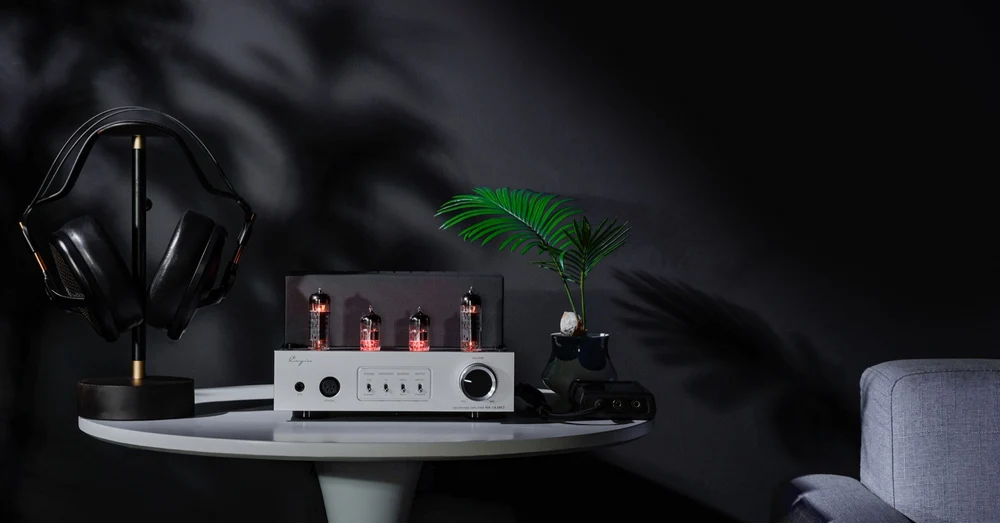
Cayin HA-1A MK3 Is Available at Apos
The Cayin HA-1A MK3 Tube Headphone Amplifier is available now through Apos Audio for $999.
The amp brings together Class-A tube amplification, JJ 12AU7/ECC82 and Electro-Harmonix EL84EH/6BQ5 tubes, dedicated transformers, impedance matching, 6.35 mm and 4-pin XLR headphone outputs, two RCA inputs, and RCA preamp output in a compact desktop chassis. For serious headphone listeners, it offers a focused analog path with enough power and flexibility to work across a range of headphone pairings. For producers, it may be even more interesting as a dedicated listening station that sits just outside the stricter monitoring chain.
That is the best way to think about it. The HA-1A MK3 is not trying to be the most neutral piece in the room. It is built to make listening feel physical, patient, and a little more dimensional. For anyone who spends all day in a DAW chasing tiny decisions, that kind of dedicated playback chain can be more than indulgence. It can be a way back into the reason the music was made in the first place.

Will Vance is a professional music producer who has been involved in the industry for the better part of a decade and has been the managing editor at Magnetic Magazine since mid-2022. In that time period, he has published thousands of articles on music production, industry think pieces and educational articles about the music industry. Over the last decade as a professional music producer, Will Vance has also ran multiple successful and highly respected record labels in the industry, including Where The Heart Is Records as well as having launched a new label with a focus on community through Magnetic Magazine. When not running these labels or producing his own music, Vance is likely writing for other top industry sites like Waves or the Hyperbits Masterclass or working on his upcoming book on mindfulness in music production. On the rare chance he's not thinking about music production, he's probably running a game of Dungeons and Dragons with his friends which he has been the dungeon master for for many years.