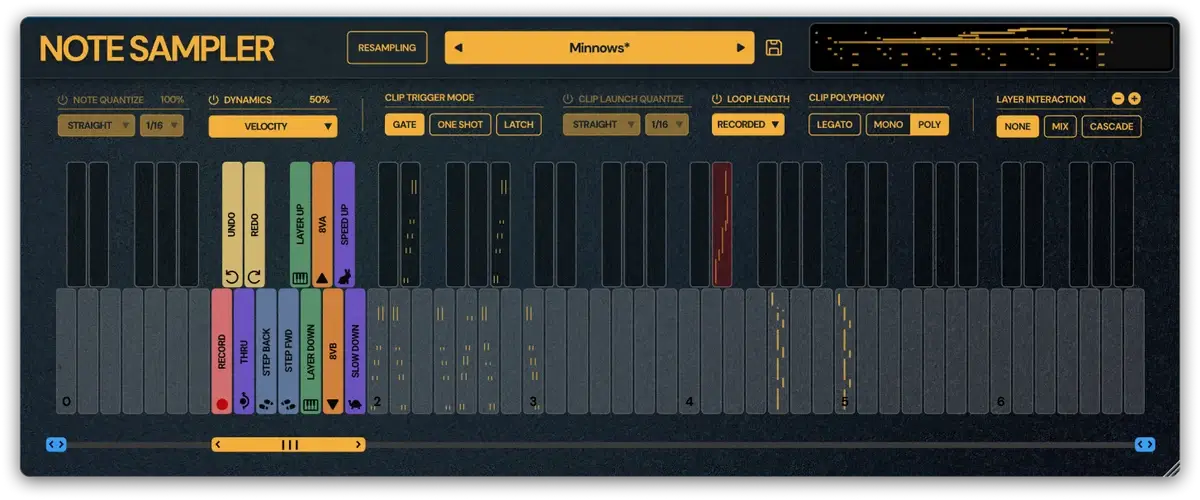
Osterhouse Sounds Note Sampler is built around a small but very producer-friendly idea: instead of dragging MIDI clips around a DAW timeline, you can record short musical ideas directly onto the keys of your piano and play them back by hand.
That makes the plugin feel less like a standard MIDI utility and more like a sketchpad for people who think best at the keyboard. Hold the record key, play something, let go, and the last key you played becomes the armed key for that clip. From there, the clip lives on the keyboard alongside normal notes, which means you can trigger ideas and keep playing at the same time.
That is the part that makes Note Sampler interesting.
It is not trying to replace the DAW timeline but it does give you a different place to think before ideas become locked into an arrangement. For composers, producers, and anyone who builds music from small motifs, that can be a faster way to test relationships between parts.
Note Sampler Makes MIDI Feel More Like an Instrument
Most DAWs are good at storing ideas, but they are not always good at letting you play with them. Once a phrase turns into a clip on the timeline, the next move often becomes editing, dragging, duplicating, trimming, and arranging. That workflow has its place, but it can pull you away from the physical act of trying ideas against each other.
Note Sampler keeps those ideas under your fingers.
A bass movement can sit on one key, a chord shape on another, a short melodic answer somewhere else, while the rest of the keyboard still works for normal playing. That makes the plugin especially useful for call-and-response writing, layering small phrases, and testing how different MIDI ideas behave when triggered together.
It also fits well with a compact MIDI keyboard setup. In my Launchkey 25 MK4 review, the main appeal was how much writing control can fit into a smaller controller when the workflow is handled well. Note Sampler works from a similar desk-level idea: the keyboard already in front of you can become a more active writing surface.
Resampling Lets You Bake Ideas Into New Notes
The resampling feature is where Note Sampler moves past simple MIDI clip triggering. You can combine ideas and bake them together onto new notes, which lets the plugin become a kind of recursive composition tool.
That means a few small fragments can become a larger phrase, then that phrase can become playable again from another key. It is a clean way to build variation without immediately committing everything to the DAW timeline.
For composers, that matters. A lot of writing happens in the space between an idea and an arrangement. Note Sampler gives that middle stage a more playable form. You can test combinations quickly, keep what feels alive, and bring the result back into the DAW when it is ready.
The MIDI monitor helps with that too. Osterhouse Sounds says you can drag the monitor into your DAW at any time to recover anything you played, which keeps the plugin from becoming a closed sandbox. You can experiment freely and still capture the useful parts.
Clipception Is the Weird Part, In a Good Way
The most unusual feature is called Clipception. Note Sampler can stack up to three keyboards inside one instance. With cascade mode turned on, notes played by one keyboard can trigger recordings in the next, which can trigger recordings in the next.
That sounds chaotic on paper, but it points toward the plugin’s deeper appeal. Note Sampler is less about building a perfect linear sequence and more about creating a small MIDI ecosystem where ideas can collide, trigger, and fold into each other. Used lightly, that could be a way to generate variations. Used heavily, it could become a writing system for complex pattern chains, layered MIDI phrases, or generative-feeling sketches that still come from your own playing.
That puts Note Sampler close to the kind of hands-on control thinking I covered in my Novation Launch Control XL 3 review. Different product category, but the same lesson applies: once a device or plugin lets you build a repeatable control system, it starts becoming part of how you write, not only how you edit.

Will Vance is a professional music producer who has been involved in the industry for the better part of a decade and has been the managing editor at Magnetic Magazine since mid-2022. In that time period, he has published thousands of articles on music production, industry think pieces and educational articles about the music industry. Over the last decade as a professional music producer, Will Vance has also ran multiple successful and highly respected record labels in the industry, including Where The Heart Is Records as well as having launched a new label with a focus on community through Magnetic Magazine. When not running these labels or producing his own music, Vance is likely writing for other top industry sites like Waves or the Hyperbits Masterclass or working on his upcoming book on mindfulness in music production. On the rare chance he's not thinking about music production, he's probably running a game of Dungeons and Dragons with his friends which he has been the dungeon master for for many years.