Laptop audio has always had a basic tradeoff.
The machines keep getting thinner and more powerful, but the speakers still have to work within a small physical space, which is a real limitation when games, films, and creator workflows increasingly depend on spatial detail. Audioscenic is trying to solve that problem from the software side, using AI-powered spatial audio to make sound feel like it is coming from the space around the listener rather than from the laptop itself.
The company’s latest implementation arrives inside the Lenovo Legion 7a gaming laptop, where Audioscenic’s technology uses AI listener sensing and adaptive spatial rendering to create a wider, more three-dimensional soundstage from the device’s built-in speakers. The goal is not simply to make laptop audio louder or broader but is instead to reproduce more of the original sound scene, from close-up details like dialogue and nearby effects to environmental cues that feel like they extend into the game space.
In the interview below, Angela Lee, Head of Business Development for Audioscenic, explains what the technology is doing inside the Legion 7a, why laptop speakers present such a specific challenge, and where spatial audio on personal computers may be heading next.
Her answers point toward a broader shift in consumer audio: better hardware still matters, but the next leap may come from software that understands the listener, the device, and the content in real time.
Interview With Angela Lee

For readers who have not heard Audioscenic yet, what is the simplest way to explain what your technology is doing inside the Lenovo Legion 7a?
Audioscenic is an AI-powered spatial audio technology that makes sound appear to come from the world around the listener instead of from the speakers themselves.
Rather than simply making audio louder or wider, our technology creates a more natural and immersive listening experience by adapting the sound to the listener in real time.
In the Lenovo Legion 7a, that means gameplay is more realistic and more engaging. It reproduces the experience as creators intended, without requiring additional speakers or external accessories.
What problem were you trying to solve for laptop audio users, especially gamers who do not always want to use headphones?
Gaming laptops have become incredibly powerful visually, but the audio experience has often remained constrained by the physical limitations of small speakers.
Headphones are excellent at creating intimate, close-up sounds, such as dialogue, whispers, or effects that feel as though they are happening right beside the listener. However, convincingly reproducing sounds that naturally extend out into the surrounding environment, known as externalization, remains one of the biggest challenges in spatial audio.
Some premium headphone systems use advanced on-device processing and head tracking to improve this perception, but the experience can vary depending on the implementation, the individual listener, and the listening conditions.
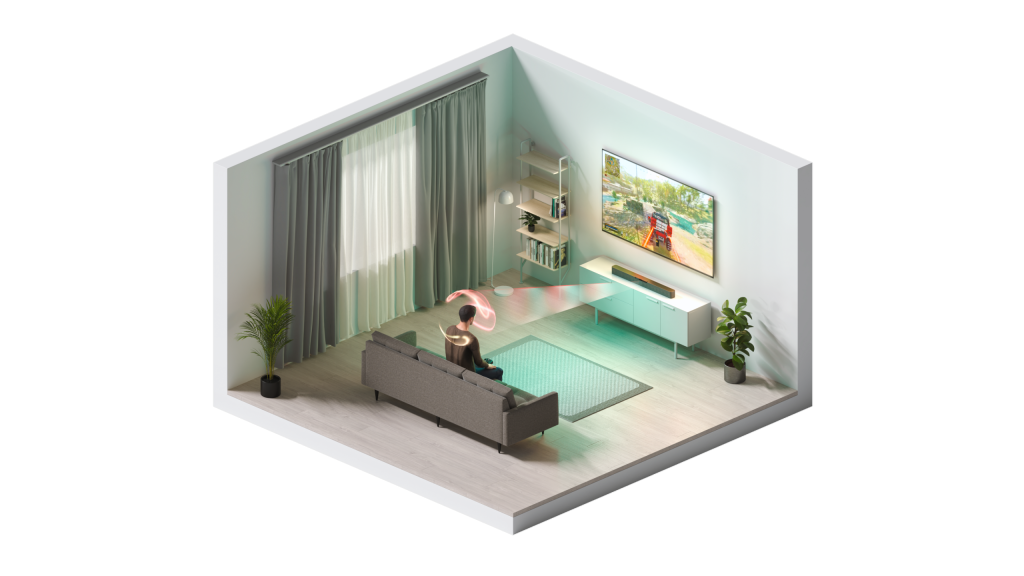
Our goal was to bring the best of both worlds to laptop speakers. By combining AI listener sensing with adaptive spatial rendering, Audioscenic reproduces the full depth of the original sound scene, from intimate sounds close to the listener to expansive environmental effects that extend naturally into the distance.
The result is a more natural, immersive, and engaging experience that helps players experience the game world as its creators intended, without always needing to rely on headphones.

How does Audioscenic help a player feel connected to the game environment without needing headphones?
Immersion is not just about hearing sound. It is about feeling where sounds exist within the virtual world.
Headphones naturally excel at reproducing intimate sounds that feel close to the listener, such as dialogue, whispers, or effects happening right beside you. Creating a convincing sense of distance and space, where sounds feel as though they exist naturally within the game world rather than simply coming from the device, is a much greater challenge.
Audioscenic brings these two experiences together.
Using AI listener sensing and adaptive spatial rendering, it reproduces the full depth of the original sound scene, from subtle sounds close to the player to distant environmental cues that extend naturally into the surrounding world.
The result is a more believable and immersive experience that helps players experience the game as its creators intended, directly from the laptop speakers.
Do smaller devices force you to make different choices than you would with a TV, soundbar, or desktop speaker system?
Absolutely.
Every product category has different acoustic characteristics and different ways people interact with it.
A laptop presents some of the toughest challenges. The speakers are very close together, the available acoustic volume is limited, and users sit much closer to the device than they would with a television or soundbar.
Rather than applying the same processing everywhere, we optimize our rendering specifically for each device. Our goal is always the same: to reproduce the original sound scene as faithfully as possible.
On a laptop, that means carefully balancing intimate sounds that belong close to the listener with a spacious, natural soundstage that extends beyond the device itself.

What did you learn from bringing Audioscenic into a gaming laptop that you did not learn from earlier product categories?
Gaming places unique demands on audio because players spend long periods immersed in highly dynamic virtual worlds.
Every detail, from a quiet conversation between characters to large-scale environmental effects, contributes to the experience.
One of the biggest challenges with laptops is that you are working within extremely tight physical constraints. There is only so much you can achieve by making speakers larger or changing the industrial design, especially as laptops continue to become thinner and more portable.
We learned that delivering a premium audio experience requires more than better hardware. It requires smarter rendering.
By combining AI listener sensing with adaptive spatial rendering, Audioscenic reproduces the full depth of the original sound scene, from intimate sounds close to the listener to expansive environmental effects that extend naturally into the game world.
Rather than relying on major hardware changes, we use intelligent software to unlock more from the speakers that are already there.
That reinforced our belief that the future of premium laptop audio will not be defined by bigger speakers alone, but by software that understands both the content and the listener, faithfully reproducing the experience as the game creators intended.

Where do you see spatial audio for laptops going over the next few years?
For many years, the industry has improved laptop audio primarily through hardware: better speakers, new amplifier technologies, and refined acoustic design.
Those innovations have delivered meaningful improvements, but there is a natural limit to how much can be achieved within the physical constraints of increasingly thin and portable devices.
We believe the next step-change will come from intelligent software. Rather than relying solely on hardware improvements, future systems will understand the listener, the device, and the content, adapting the audio in real time to faithfully reproduce the experience as its creators intended.
As AI becomes more deeply integrated into personal computers, spatial audio will become increasingly personalized and context-aware.
The future is not simply about making sound louder or wider. It is about reproducing the full depth of the original sound scene, from intimate close-up details to expansive environments, creating experiences that previously were not possible from laptop speakers alone.
That is the transition we are excited about: moving the industry from competing primarily on hardware specifications to competing on the quality of the listening experience.

Will Vance is a professional music producer who has been involved in the industry for the better part of a decade and has been the managing editor at Magnetic Magazine since mid-2022. In that time period, he has published thousands of articles on music production, industry think pieces and educational articles about the music industry. Over the last decade as a professional music producer, Will Vance has also ran multiple successful and highly respected record labels in the industry, including Where The Heart Is Records as well as having launched a new label with a focus on community through Magnetic Magazine. When not running these labels or producing his own music, Vance is likely writing for other top industry sites like Waves or the Hyperbits Masterclass or working on his upcoming book on mindfulness in music production. On the rare chance he's not thinking about music production, he's probably running a game of Dungeons and Dragons with his friends which he has been the dungeon master for for many years.