Physical modeling has always had a slightly strange promise inside music production.
On paper, it sounds like the most natural thing in the room. Instead of triggering samples, the synth models the behavior of strings, tubes, membranes, plates, bells, drumheads, and other resonant bodies. The result can feel closer to an instrument reacting than a static recording playing back.
In actual production, that realism can become the limitation. A modeled instrument can get locked too closely to the thing it is trying to imitate, while a subtractive synth can give you control but lose the organic instability that makes acoustic sound feel alive.
reFX Rippler sits right inside that gap.
The new VST, AU, and AAX instrument is built as a dual-layer physical modeling synth with a subtractive layer wrapped around it. That means the sound can begin with acoustic-style behavior, then get reinforced, bent, shaped, dirtied up, widened, or turned into something that has no real-life equivalent.
Exciters start the motion
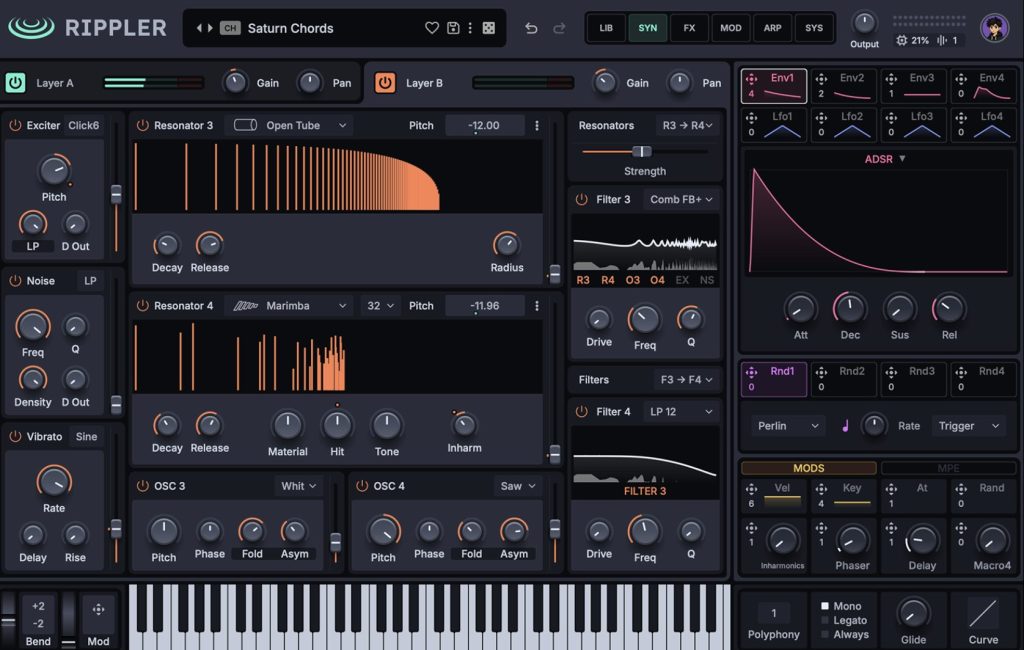
Rippler’s signal path begins with Exciters. Producers can choose from included sounds, import their own, or use sidechain input to start the resonant chain.
That is an important difference because the exciter determines how the resonators begin to react. A pluck, scrape, hit, pulse, noise burst, or external signal can push the instrument in a different direction before the resonator even has its say.
The exciter signal and noise generator then feed into two resonators, which mimic acoustic bodies such as tubes, membranes, bells, and strings. From there, the synth adds two oscillators and two filters, giving the sound a more familiar subtractive layer when the modeled behavior needs extra mass or focus.
That design is what makes Rippler feel closer to a full production instrument than a narrow physical-modeling experiment. You can build percussive hits, plucked tones, animated pads, bell-like material, string-like patches, unstable hybrids, or sidechained resonant textures without needing to choose between acoustic logic and synth control.
I wrote about the broader appeal of modeled instrument behavior in my article on Erica Synths’ Steampipe, and Rippler enters that same conversation from the plugin side. The shared idea is simple: the sound becomes more interesting when it reacts like a system instead of sitting there like a flat oscillator.
Modulation is where Rippler becomes less literal

The modulation system is one of the stronger parts of the spec.
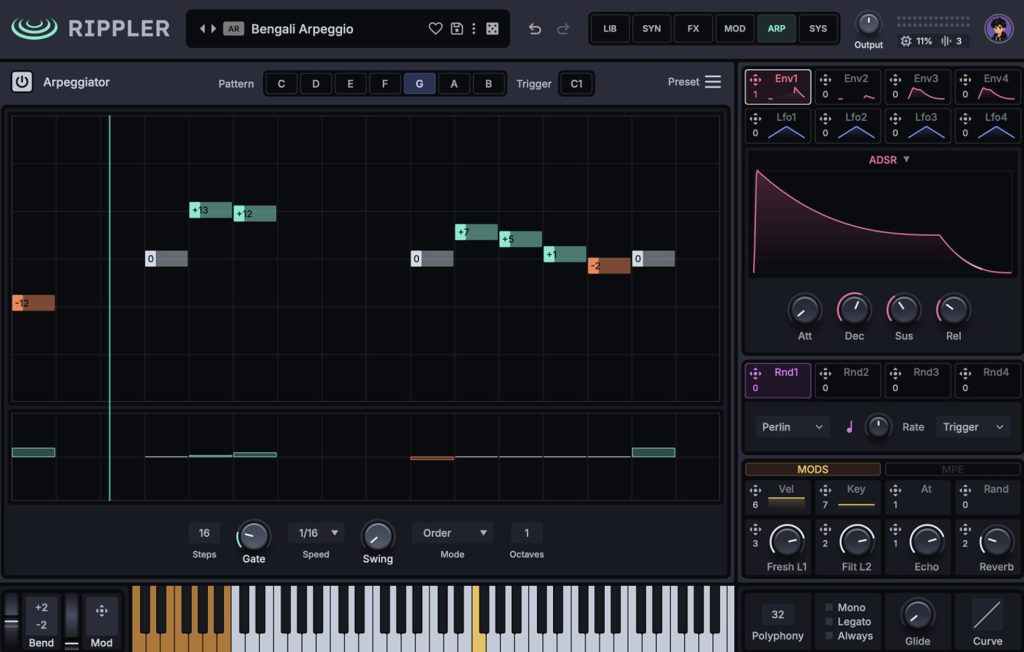
reFX says every parameter can be modulated by multiple sources, including envelopes and LFOs. The drag-and-drop system is built for fast assignment, while Mod Mapping lets producers shape each connection with custom response curves, including exponential, S-curved, and stepped behavior.
That is where Rippler moves away from “here is a modeled marimba” and toward a deeper sound-design instrument. Physical modeling can generate interesting tones quickly, but modulation decides whether those tones sit still or keep revealing new behavior. With Rippler, the movement can happen at several levels: exciter behavior, resonator parameters, oscillator blending, filtering, effect motion, performance expression, and layer interaction.
This connects well with my BLEASS Spectral Resonator review, where the exciting part was using resonant processing to transform ordinary sound into something more cinematic and strange. Rippler has a different architecture, but the same creative pull is there. Feed sound into a resonant system, then use modulation to keep it from becoming a static tone.
Rippler is best when realism becomes the starting point
The most interesting thing about Rippler is that it does not seem trapped by the usual physical-modeling pitch.
Yes, it can emulate real acoustic structures. Yes, it has pre-tuned models based on mathematical formulas and FEM analysis. Yes, it can make realistic and hyper-realistic sounds. But the better use case is using acoustic behavior as raw material for something less predictable.
That is where this kind of synth can matter in modern production. Producers already have access to endless sampled pianos, bells, mallets, strings, and percussion. What they often need is a way to make those kinds of gestures feel alive without sounding like another preset library.
Rippler gives reFX a synth that points in that direction.
Start with a resonant body. Excite it with your own sound. Modulate nearly everything. Add subtractive layers. Push it with MPE. Tune it outside the usual grid. Break it with effects. That is a more compelling pitch i think than realism alone, and it is the reason Rippler feels like a plugin sound designers will want to test before the intro price ends.

Will Vance is a professional music producer who has been involved in the industry for the better part of a decade and has been the managing editor at Magnetic Magazine since mid-2022. In that time period, he has published thousands of articles on music production, industry think pieces and educational articles about the music industry. Over the last decade as a professional music producer, Will Vance has also ran multiple successful and highly respected record labels in the industry, including Where The Heart Is Records as well as having launched a new label with a focus on community through Magnetic Magazine. When not running these labels or producing his own music, Vance is likely writing for other top industry sites like Waves or the Hyperbits Masterclass or working on his upcoming book on mindfulness in music production. On the rare chance he's not thinking about music production, he's probably running a game of Dungeons and Dragons with his friends which he has been the dungeon master for for many years.