What We’re Covering
I love it when an audio plugin invites experimentation the second you load it up. You throw it on a drum loop, tweak a couple knobs, and suddenly your clean groove sounds like it’s floating through deep space. BLEASS Spectral Resonator falls does a great job with this, but it also does a whole lot more.
Available through Plugin Boutique, Spectral Resonator is BLEASS’s deep dive into creative spectral processing. As you first read about it, it sounds intimidating. FFT analysis, harmonic partial generation, spectral filtering, up to 256 harmonics per voice. That sort of terminology usually points toward a plugin that requires a semester-long crash course in DSP before you can make music with it.
Thankfully, BLEASS continues to do what they’ve become very good at over the last few years: taking complex processing concepts and packaging them into something approachable, musical, and genuinely fun to use.
What It Actually Does
BLEASS describes Spectral Resonator as something beyond a traditional vocoder and I definitely agree with them.
The plugin analyzes incoming audio in the spectral domain and generates resonant harmonic layers based on that material. Those harmonics can then be stretched, shifted, blurred, detuned, filtered, frozen, and reshaped in all sorts of creative ways.
In practice, it behaves somewhere between a resonator, a vocoder, a shimmer reverb, and a sound design instrument.
Toss it on your vocals and you can get lush harmonic pads that track the phrasing of the singer (thanks in part to the MIDI side chain capability). Run drums through it and the transients bloom into metallic clouds and tuned resonances. Simple synth plucks become evolving ambient textures. Guitar lines turn cinematic almost instantly.
One of the strongest aspects of the plugin is how broad the usable range actually is. Some experimental processors only sound good at extreme settings. Spectral Resonator works surprisingly well in subtle doses too.
At around 20 to 30 percent wet, it can add movement and harmonic richness without completely taking over the source material. Push things harder and it moves into abstract territory fast.
Sound Quality
This is where the plugin really earns its price tag.
Spectral effects can sometimes sound brittle or sterile, especially when you start stacking harmonics aggressively. Spectral Resonator avoids that problem better than expected. The generated harmonics feel smooth, dimensional, and musical instead of harsh and clinical.
The Unison and Detune controls deserve special mention here. Dialing in multiple sub-voices creates these wide, chorused harmonic textures that feel almost synth-like, even when processing dry acoustic material.
The Blur parameter is another standout. Instead of producing muddy wash, it softens the harmonic structure in a way that resembles a hybrid between reverb diffusion and spectral smearing. Small amounts add atmosphere. Larger amounts create haunting ambient tails that can completely transform percussion or melodic loops.
The Freeze function is equally addictive. Capture a resonant moment, hold it indefinitely, then play around with filtering and harmonic controls while the frozen texture sustains underneath your mix.
For producers working in ambient, melodic techno, experimental electronica, cinematic scoring, or modern pop production, this thing can become a creative rabbit hole very quickly.

Ease of Use
One of BLEASS’s biggest strengths as a company is making advanced tools feel very accessible for the users. Spectral Resonator continues that philosophy exceptionally well.
Despite the depth available under the hood, you can get compelling results almost instantly. Throw on a preset, adjust the Dry/Wet knob, and you are already somewhere interesting.
The preset library itself is strong too. Many presets feel practical and mix-ready. They demonstrate different use cases without sounding overly exaggerated.
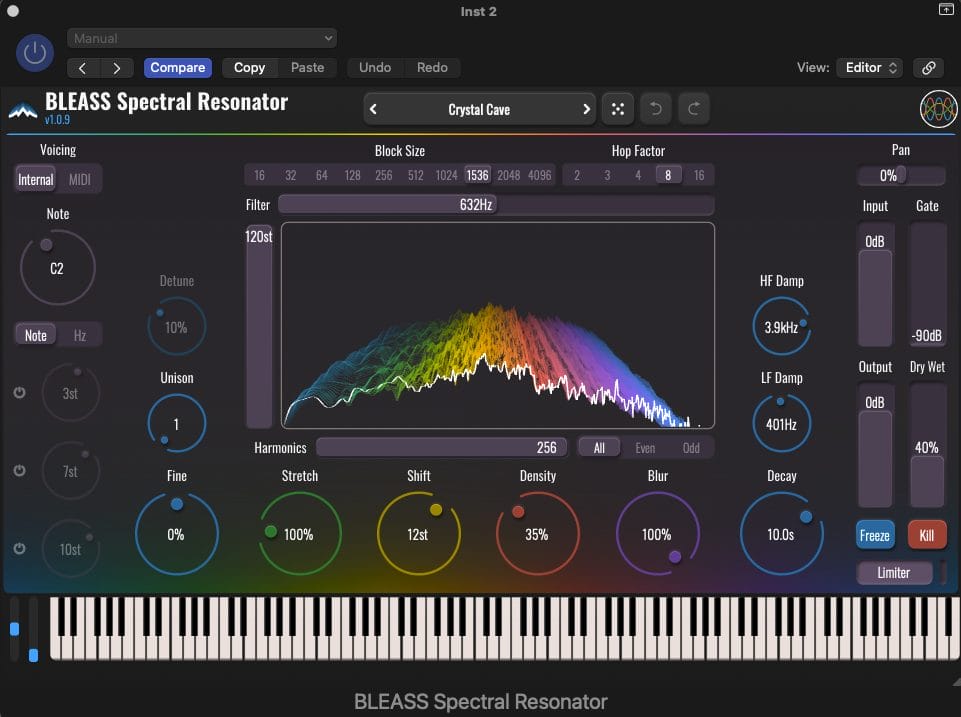
The plugin also encourages experimentation. Controls like Stretch, Density, and Shift interact in ways that create cool results without punishing the user with total chaos every time a knob moves.
That’s can be a difficult balance to achieve with spectral processing.
Even the more technical settings, such as Block Size and Hop Factor, are explained clearly enough that producers without a deep DSP background can understand why they matter. BLEASS deserves credit for not burying usability underneath technical jargon.
MIDI Control Makes Huge Difference
One feature that elevates Spectral Resonator above many competing creative effects is the MIDI implementation.
The plugin can operate using its own internal four-voice generator or respond directly to incoming MIDI with up to eight voices of polyphony.
This opens up an entirely different workflow.
Instead of passively processing incoming audio, you can actively “play” the harmonics being generated. Feed in a vocal or texture source, then use MIDI chords to reshape the harmonic output musically in real time.
For sound designers, this is where things get seriously inspiring.
Simple field recordings become playable pads. Drum loops become harmonic instruments. Noise textures suddenly feel orchestrated.
The glide and latch functions add even more performance-oriented possibilities.
CPU Performance and Use
Spectral processing can be demanding, and Spectral Resonator is no exception. Higher harmonic counts and larger processing blocks naturally increase resource usage.
That said, performance was better than expected considering how much is happening under the hood. For reference, I’m running an Apple Mac Mini (2024 with an M4 Pro).
The plugin also gives users direct control over quality-versus-performance trade-offs through the Block Size and Hop Factor settings. Producers working live can keep latency lower, while studio users can push fidelity further.
In actual production sessions, Spectral Resonator feels best used as a feature processor rather than something slapped across every channel. It shines when used intentionally on vocals, synths, percussion buses, or transition effects.
You could absolutely build entire ambient compositions around it, but it also works beautifully as a spice plugin for adding movement and harmonic detail in smaller doses.
Design and Visual Feedback
This might sound superficial, but visual feedback matters in creative plugins.
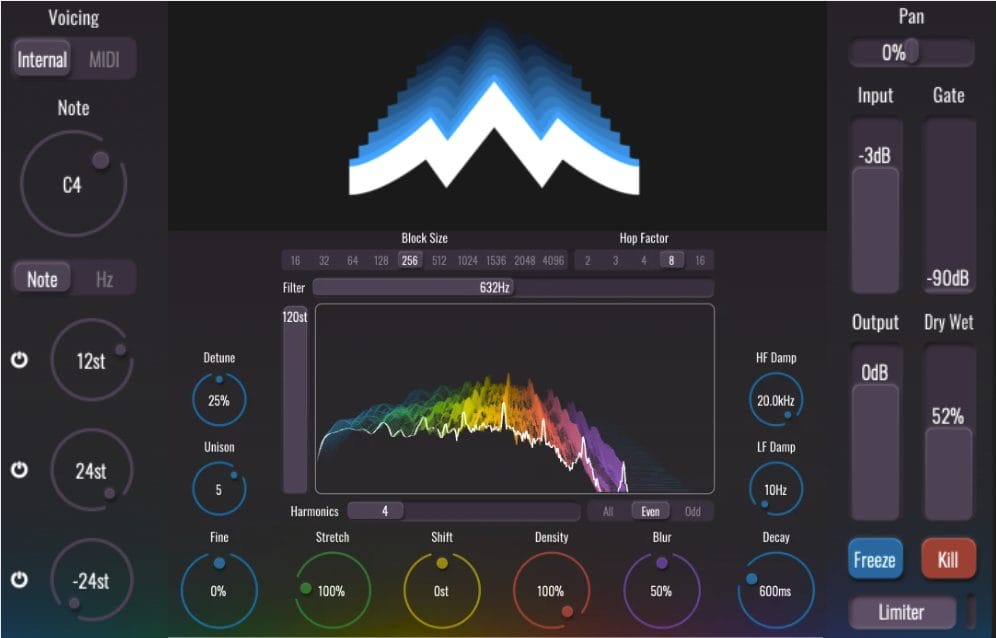
Spectral Resonator is simply enjoyable to look at. The animated rainbow spectrogram is not only aesthetically impressive, it also reinforces what your ears are hearing.
BLEASS consistently nails this combination of clarity and personality in their interfaces. The plugin feels modern without becoming cluttered.
Compared to many spectral processors that hide behind dense engineering layouts, Spectral Resonator helps users feel more comfortable just having fun with the process.
Value for Your Money
The current intro price of $59 (down from $79) ends June 1, 2026.
Spectral Resonator feels competitively positioned for what it offers.
There are more advanced spectral environments on the market, but many are significantly more expensive and far less accessible. BLEASS has found a sweet spot between depth and accessibility.
The inclusion of both desktop and iOS ecosystem support across BLEASS products also adds extra appeal for producers working across multiple setups.
If you already enjoy BLEASS plugins like Dragonfly, Granulizer, or Motion FX, this feels like a natural extension of their design philosophy.
Final Thoughts
BLEASS Spectral Resonator succeeds by making complex sound design feel playful rather than intimidating.
It can absolutely venture into experimental territory, but also as musical as you want to make it. The harmonics sound rich, the interface invites exploration, and the MIDI implementation turns the plugin into something much deeper than a standard effect processor.
More importantly, it sparks ideas quickly.
That’s what really separates good creative plugins from forgettable ones. Spectral Resonator consistently pushes audio into unexpected places while remaining easy enough to integrate into real-world sessions.
For producers looking to add movement, atmosphere, harmonic depth, and cinematic texture to their tracks without getting buried in technical complexity, this one is worth serious attention.
Keep up to date with BLEASS by giving them a follow on Instagram.

Nick Wax is a producer, singer/songwriter based in Seattle, WA. He has more than 2 decades networking in the music business. He’s passionate about connecting people through their shared love of electronic music. Most people know him as the guy who makes that one mashup they like. When he’s not nerding out in the studio, you can usually catch him hanging out with his wife and cats.





![Baby Audio HyperWarp Review: Why Less [Processing] Is More](https://magneticmag.com/wp-content/uploads/2026/10/Untitled-Design-88.png)