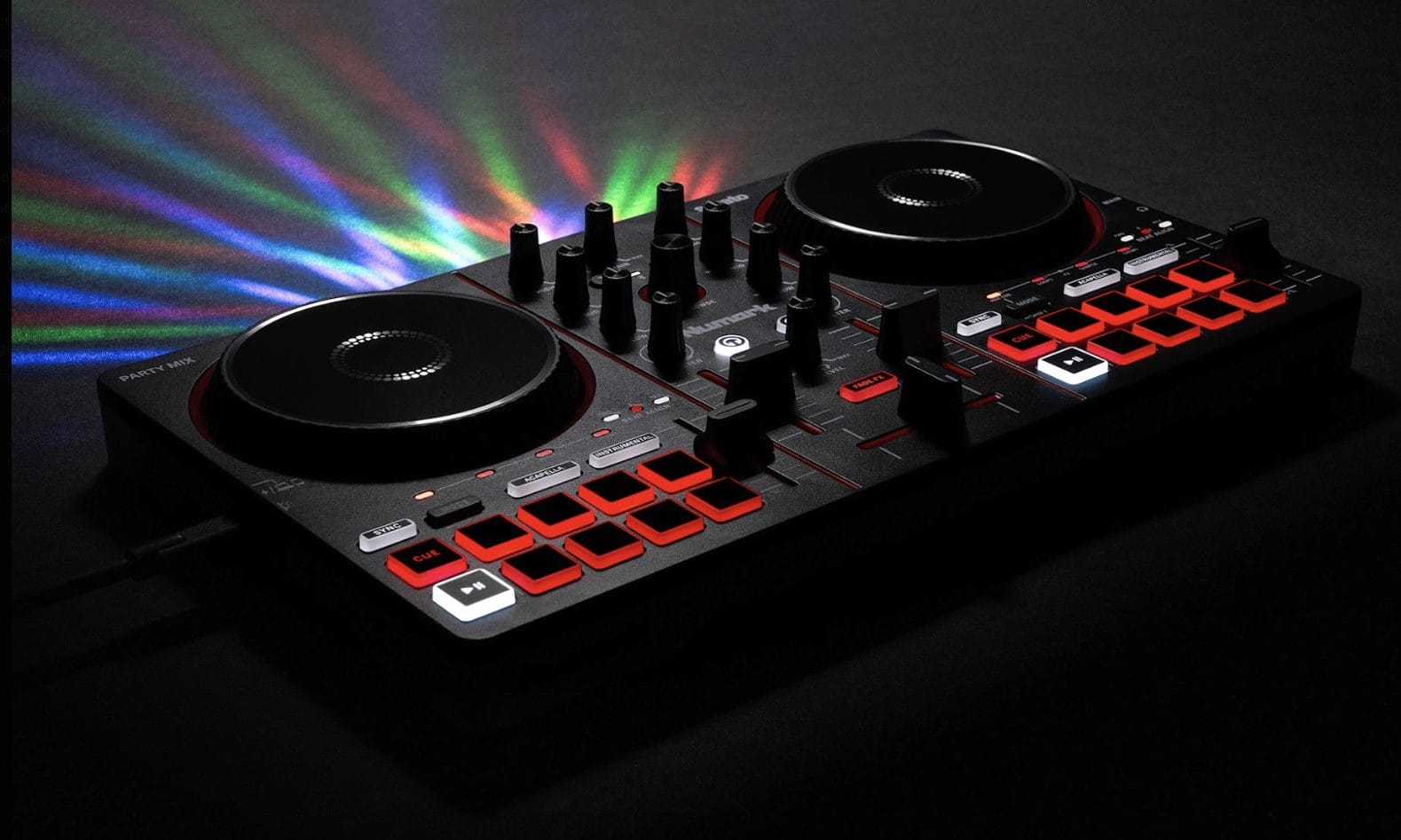
Numark has introduced two new DJ controllers aimed at the point where a lot of people first start learning how to mix: affordable hardware, familiar software support, and enough hands-on control to move beyond laptop-only practice.
The Party Mix III and MixTrack Go share similar core ideas, though they address different setup problems. Party Mix III continues the Party Mix line with a two-deck layout, built-in LED light show, doubled performance pads, Stems buttons, Fade FX, and Bluetooth MIDI. MixTrack Go strips the idea down to Numark’s most compact controller, priced lower and built for portability.
The appeal is direct. A new DJ can learn cue points, loops, basic EQ, stems, and crossfader movement without spending club-hardware money. A mobile DJ can also keep a small controller in a bag for low-pressure sets, prep work, or travel situations where larger gear would be excessive.

Numark Party Mix III Updates the Beginner DJ Controller With Stems and LED Feedback
Party Mix III is the higher-priced model of the two, coming in at $149. It keeps the series’ familiar identity through its built-in, rhythm-synced LED light show, while expanding the layout to eight performance pads per deck and dedicated pad modes for Cues, Loops, Sampler, Stems, and FX.
That is useful for beginners because the layout teaches several core DJ actions without forcing the user into a screen-only workflow. The pads give new DJs a physical connection to hot cues and loops, while the dedicated Instrumental and Acapella buttons make stems easier to reach during a mix.
Party Mix III also includes Beat Align indicators on each deck. That matters because sync can help new DJs get started, though learning manual timing remains part of the skill set. Visual timing feedback gives beginners a way to understand what is happening between tracks, rather than relying solely on software correction.
The built-in soundcard with speaker and headphone outputs also keeps the setup simple. A new user can connect headphones for cueing, send audio to speakers, and practice a basic DJ workflow without buying a separate interface.

Numark MixTrack Go Gives Mobile DJs a $99 USB-C Controller
MixTrack Go is the more compact option, priced at $99. It is USB-C bus-powered and can run from a computer, tablet, smartphone, power bank, or USB charging adapter, which makes it easier to use in practice spaces, casual parties, or travel setups.
The controller includes Stems control, Bluetooth MIDI, Fade FX, capacitive jog wheels, channel controls, filter controls, main gain, and pad modes for Cues, Loops, Sampler, and Stems. It also includes a built-in audio interface with main and headphone outputs, along with breakout cables.
The clearest use case is a DJ who wants something small enough to carry without sacrificing a familiar two-deck setup. It also gives experienced DJs a low-cost backup or travel tool with a standardized layout, which is important because tiny controllers can become awkward when the controls feel too removed from normal DJ hardware.
MixTrack Go is not designed as a club installation unit. It is a practical controller for learning, casual performance, portable practice, and setups with limited space or power access.
Stems Control and Fade FX Bring Current DJ Workflows to Lower Prices
The most important shared feature is the stem control. Each controller gives DJs access to instrumental and acapella separation, along with the Stems pad mode. That brings one of the most common current software workflows into hardware at beginner pricing.
For new DJs, stems can make the learning process more musical by allowing users to isolate or reduce parts of a track while learning transitions. A beginner can remove a vocal during a blend, bring an instrumental forward, or test how a hook works over a different groove without needing advanced remix preparation.
Fade FX is also designed to make transitions feel less intimidating. Since it is crossfader-activated, the effect follows a movement new DJs already understand. That lowers the barrier without removing the need to learn phrasing, timing, and track selection.
This sits far below the club-player tier I covered in my Pioneer DJ CDJ-3000 review, and that gap is the point. Numark is offering new DJs a more affordable way to practice modern software workflows before they move to larger hardware systems.
Which Numark Controller Fits the Use Case?
Party Mix III is the better fit for someone who wants a fuller learning layout, larger pad access, LED feedback, and a controller that feels closer to a small home performance setup. The $149 price still keeps it accessible, especially for a beginner who wants visible feedback and more physical controls.
MixTrack Go is the better fit for portability. At $99, it gives DJs a compact controller with core modern features, including Stems control and Bluetooth MIDI, while staying light enough for travel, casual practice, and quick setups.
The bigger idea is that Numark is placing current DJ software tools into hardware that does not require a major upfront investment. For people who want to learn DJing without investing in a full booth setup, Party Mix III and MixTrack Go offer two clear entry points.

Will Vance is a professional music producer who has been involved in the industry for the better part of a decade and has been the managing editor at Magnetic Magazine since mid-2022. In that time period, he has published thousands of articles on music production, industry think pieces and educational articles about the music industry. Over the last decade as a professional music producer, Will Vance has also ran multiple successful and highly respected record labels in the industry, including Where The Heart Is Records as well as having launched a new label with a focus on community through Magnetic Magazine. When not running these labels or producing his own music, Vance is likely writing for other top industry sites like Waves or the Hyperbits Masterclass or working on his upcoming book on mindfulness in music production. On the rare chance he's not thinking about music production, he's probably running a game of Dungeons and Dragons with his friends which he has been the dungeon master for for many years.