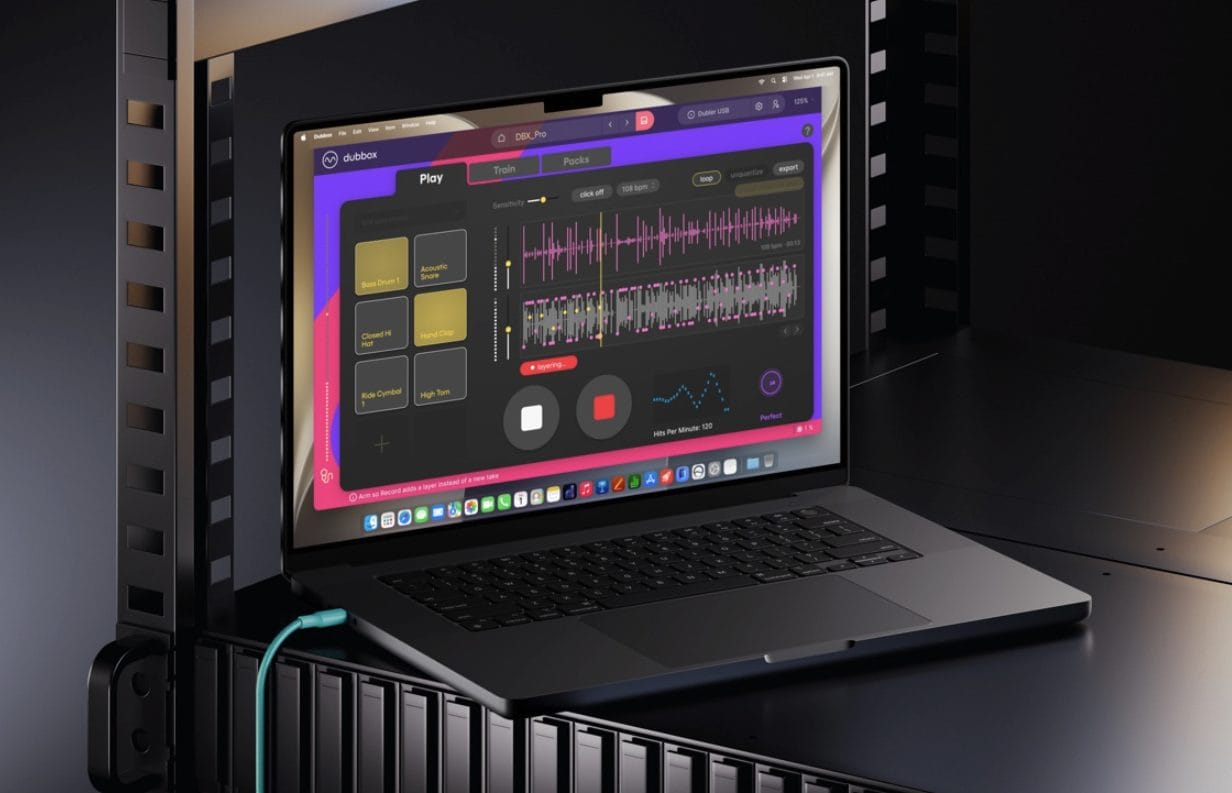
Vochlea has released DubBox, a standalone beatmaking app built for producers who hear drum ideas in their head and sketch them out with their mouth before they ever touch a piano roll. The app takes vocal percussion, learns the user’s own kicks, snares, hi-hats, and other mouth sounds, then maps those triggers to real drum samples in real time.
That sounds simple, but the idea solves a real production problem.
A lot of beat ideas start as rhythm before they become programming. You tap them on a desk, say them under your breath, hum the swing into your phone, or beatbox the pattern quickly so you do not lose it. The hard part is translating that human timing into a usable drum loop without flattening the feel when entering it in MIDI.
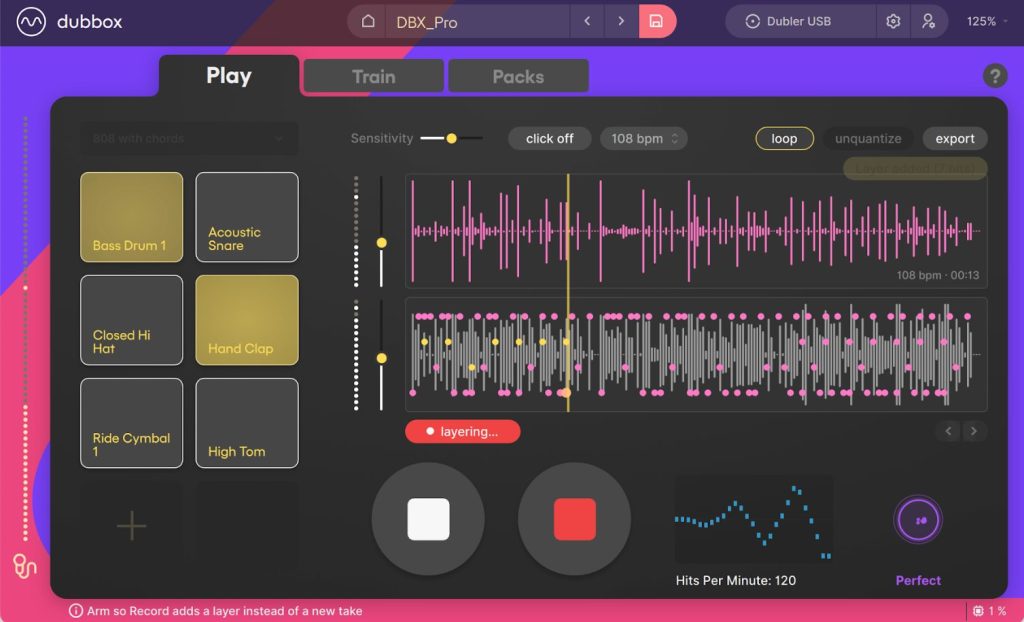
DubBox is designed for that gap as it records the performance, detects the natural BPM when needed, quantizes both the sample track and the original vocal, and exports the result as an input vocal, a sample track, a full mix, or a MIDI file, ready for any DAW.
How DubBox Turns Vocal Percussion Into a Drum Loop
DubBox lets users train up to eight vocal sounds per project. Each trigger can be mapped to one or more samples from the included kits or custom sample packs. Once mapped, the user performs on the Play screen, hearing the voice blended with real drums while recording.
The triggering is velocity-responsive, so harder vocal hits can trigger harder drum responses.
That is cool to think about because a groove is not only timing. It is also emphasis. A beatboxed kick and snare pattern can carry ghost notes, accents, and dynamic feel, and DubBox is built to preserve enough of that motion to keep the loop from feeling sterile.
The app also supports free takes without a click, recording to a click, quantized looping, overdubs, layered passes, and up to 20 takes in history. That gives producers room to perform quickly and then refine without losing the first idea.

Built-In Kits and Sample Editing Keep the App Self-Contained
DubBox includes 10 built-in sample packs, drag-and-drop sample import, and per-sample editing for gain, pitch, tone, drive, and filtering. It also includes choke groups, which are essential for building more natural drum behavior from samples that would otherwise cut each other off, such as closed and open hats.
That self-contained design matters because DubBox isn’t so much a DAW-dependent utility as it is a standalone tool, which makes sense for the target user. If the point is to catch a beat idea fast, opening a DAW, loading instruments, routing tracks, and configuring MIDI would defeat the purpose.
The export options are what make the standalone approach useful. A producer can leave DubBox with the raw vocal input, the sample performance, a mix, or MIDI. That means the sketch can stay rough, become a finished loop, or move into a full DAW session for further work.
DubBox and Dubler 2 Serve Different Voice-First Workflows
Vochlea is already known for Dubler 2, its voice-to-MIDI instrument built for controlling instruments inside a DAW. DubBox sits beside it with a narrower purpose. Dubler 2 turns the voice into a broader live controller for pitched and percussive performance. DubBox focuses on drums, loops, and finished beatmaking output inside one app.
That difference makes the product positioning clearer. DubBox is for the producer whose rhythm is already in their mouth and who wants to capture it quickly. Dubler 2 remains the larger voice-to-MIDI instrument for broader studio control.
That workflow distinction also connects with my article on how song structure can improve your lyrics, because early ideas often need a fast path from instinct into form. DubBox is dealing with rhythm instead of lyric writing, though the larger creative problem is similar: catch the idea while it still feels alive, then give it enough structure to become usable.
Pricing and Availability
DubBox is available now for Mac and Windows as a one-time purchase. Standard pricing is $69 / €69 / £59. Existing Dubler owners can add DubBox for $39 / €39 / £34.
For producers, beatmakers, and vocal-first writers, the appeal is direct. Beatbox the groove, train the app on your own sounds, map those sounds to samples, record the take, tighten it, overdub it, and export the result without rebuilding the idea from scratch.
DubBox works because it treats the voice as the first instrument in the chain. It does not replace the producer’s idea. It gives that idea a faster route into a finished drum loop.

Will Vance is a professional music producer who has been involved in the industry for the better part of a decade and has been the managing editor at Magnetic Magazine since mid-2022. In that time period, he has published thousands of articles on music production, industry think pieces and educational articles about the music industry. Over the last decade as a professional music producer, Will Vance has also ran multiple successful and highly respected record labels in the industry, including Where The Heart Is Records as well as having launched a new label with a focus on community through Magnetic Magazine. When not running these labels or producing his own music, Vance is likely writing for other top industry sites like Waves or the Hyperbits Masterclass or working on his upcoming book on mindfulness in music production. On the rare chance he's not thinking about music production, he's probably running a game of Dungeons and Dragons with his friends which he has been the dungeon master for for many years.