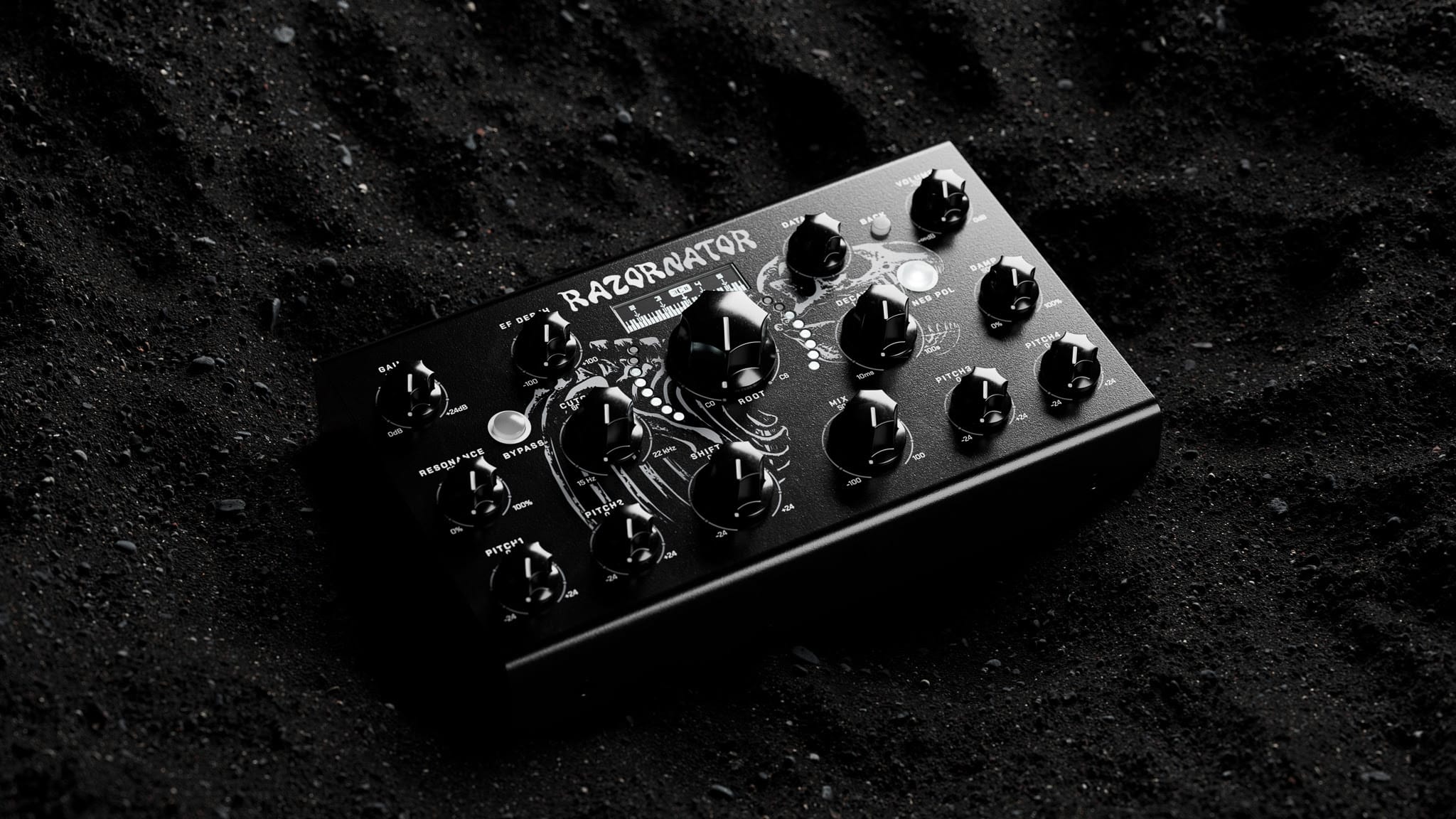
Erica Synths has opened preorders for Razornator, a compact desktop stereo FX unit built around five chromatically tuned resonating delay lines. The short version is that it takes incoming audio and reshapes the harmonic content through tuned resonance, with enough control to push it toward instrument bodies, rooms, structures, and other resonant objects.
Razornator is aimed at people who want an outboard box that changes the behavior of a sound, not a clean end-of-chain processor that sits quietly at the back of the mix. It can thicken, tune, overdrive, filter, and reshape incoming audio, which puts it closer to a playable processing instrument than a basic delay unit.
Five Tuned Resonators Are the Center of the Box
Razornator uses five delay-based resonators, each of which can be tuned chromatically. That tuning system is the main reason the unit feels musical on paper.
Instead of dealing with delay lines as loose pitch material, users can align the resonators into chord-like intervals. That matters for synths, drum machines, guitars, and sampled material because the processor can add harmonic structure that relates to the track instead of random ringing.
The envelope follower adds another layer of control by reacting to the incoming signal. That means the resonators can respond to how the source is played, which gives the unit a more connected feel in live sets and studio sessions.
The Signal Path Does a Lot Before and After the Resonance
The input stage can boost signals up to +24 dB, and Erica Synths says it can function as an analog overdrive. From there, the signal passes through a low-pass filter with resonance control before entering the five resonators.
After the resonators, the processed signal is summed and compressed, then blended with the dry signal and passed through EQ before reaching the balanced output stage.
That order is important. The processor is built to shape the signal before it becomes resonant, control it afterward, and then return it to the mix in a usable form. For anyone using external synths, drum machines, or guitar pedals, that keeps Razornator from feeling like a single-effect box with one fixed trick.
The same hands-on hardware thinking showed up in the article I wrote on Erica Synths’ Resonant Filterbank, which also treated stereo processing as something performers can play directly.
MIDI Control Makes It Useful Outside the Studio
All 12 parameters can be saved and recalled, and all parameters can be controlled over MIDI. The resonator tunings are also playable via MIDI, which should make the box especially useful for people who want outboard processing that can follow a sequence or live controller.
Preset morphing adds another performance angle. Instead of jumping from one stored setting to another, users can move between states and build changes into a set or arrangement.
The configurable footswitch input helps here too, especially for guitarists, hardware performers, or anyone who wants to trigger changes without taking a hand off the instrument or mixer.
Razornator also sits close to Erica Synths’ desktop effects line, including my coverage of the Nightverb desktop unit. Razornator takes that compact outboard format and focuses on tuned resonance, harmonic control, and MIDI-playable processing.
Price, Shipping, and Who This Is For
Razornator is priced at €490 before VAT. Erica Synths lists an estimated shipping date of July 3, 2026, with worldwide delivery via UPS and FedEx.
The clearest user is someone already working with hardware and looking for an effect that can be integrated into the writing process. Modular users, desktop synth users, guitarists, experimental producers, and live electronic performers all have a clear route into it.
Razornator gives them a stereo processor that can act like an overdrive, filter, resonator, performance tool, and harmonic shaper inside one metal box. That combination is specific enough to be useful and odd enough to feel very Erica Synths.

Will Vance is a professional music producer who has been involved in the industry for the better part of a decade and has been the managing editor at Magnetic Magazine since mid-2022. In that time period, he has published thousands of articles on music production, industry think pieces and educational articles about the music industry. Over the last decade as a professional music producer, Will Vance has also ran multiple successful and highly respected record labels in the industry, including Where The Heart Is Records as well as having launched a new label with a focus on community through Magnetic Magazine. When not running these labels or producing his own music, Vance is likely writing for other top industry sites like Waves or the Hyperbits Masterclass or working on his upcoming book on mindfulness in music production. On the rare chance he's not thinking about music production, he's probably running a game of Dungeons and Dragons with his friends which he has been the dungeon master for for many years.










![How It Was Made: Low Steppa & Roel – Dreamliner [Low Trax]](https://magneticmag.com/wp-content/uploads/2026/09/DSC07195-1024x608.jpg)