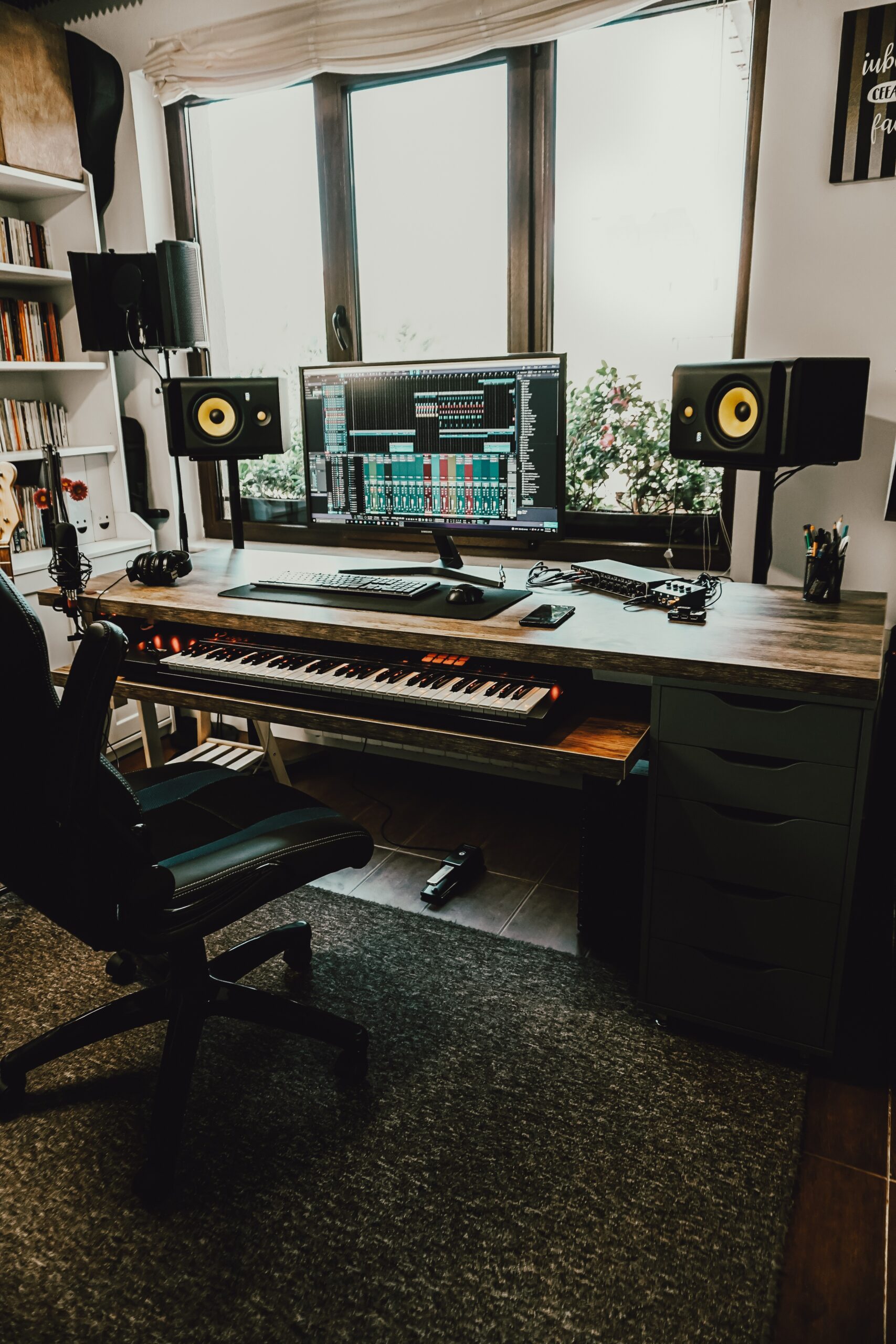
Whether you like it or not, your bedroom (and, by proxy, your studio) says a lot about you.
A minimal, monochrome studio devoid of anything but the essentials might suggest that you’re a focused and precise producer, and an eclectic studio desk with bold colors and more, all within arm’s reach, might say you’re an impulsive creative and idea generator.
Why You Need An Aesthetically-Pleasing Bedroom Studio
Most music studios also double as bedrooms or living spaces. You should also mind how others, like a member of the opposite sex or even your parents, may perceive your creative space if you ever plan on entertaining guests.
Check Out Deadmau5’s Home Studio Here For Inspiration <<<
Listen, I’ve been producing long enough to know while you’re on a date or at Thanksgiving that sharing that you’ve finally decided to become a “Music Producer” is far from a mic drop moment. On the contrary, it usually invites more hesitation and awkward questions about your life than it answers.
Questions such as:
“But what do you plan to do long term?”
“Are long do these phases usually last for you?”
“…Huh?”
“Can we get the check please?”
And if you ever do get a chance for anyone to see what your bedroom studio looks like (you know, where the *magic happens *), you’re only living up to their low expectations if it’s in shambles, college posters of Skrillex’s first EP hang without frames on the wall, and spiderwebs hang from the patch bays on your gear.
Local DJs might be able to get away with this bush league vibe, but we music producers simply cannot. So let’s dive into how to up your music studio aesthetic game and make your studio someplace you (and others) want to spend time in.
Your Studio Color Palette Should Be Subtle
Bold primary colors are for toddlers and show promotors. You’re a music producer, which means your studio music is a personal sanctuary that fosters creativity and activates a sense of mindfulness and playfulness.
So what colors should you choose exactly?
Off whites and warmer tones may create tranquil backdrops in which your mood lighting (more on this in a bit) can play across the walls, but there’s got to be something more dialed in. Rarely do you see the bigger studios of the professionals have white-washed walls? So what are you missing that they are not?
Colors substantially affect the brain’s processing, and the colors you choose to paint your room may just dictate the quality and/or quantity of your creative output. According to Digital Synopsis, Orange will boost your creative performance, Green will promote harmony and reduce eye strain, Red will increase brain activity, and Grey will encourage a lack of confidence.
Why did I include that last one? Because tons of articles suggest grey to be a masculine and calming color for bedrooms. And while this may work for a standard room, we simply can’t have that energy while we’re being creative.
Don’t go overboard with the intensity of these colors as well. Softer, warmer tones of the above colors will help facilitate the associated brain activity while avoiding the intensity of colors typically seen in your local venue’s green rooms.
Plants Bring A Studio To Life

Believe it or not, plants are a three-for-one winner in your music studios and are a simple necessity for your room.
First, plants add a touch of coziness and lived-in quality to your studio room and can help break up the monotony of equipment, wires, and other studio gear. Plus, plants and flowers are pretty to look at, as long as you don’t let them die.
This brings us to our second point. Plants provide proof of life. Remember that most people, members of the opposite sex or immediate family members, are likely worried about your prospects and life skills if you decide to become a “music producer.” But having a few living, or better yet thriving, plants in your room can prove to the nay-sayers that you at least hold some measure of responsibility.
And plants’ living nature (pun intended) means they are natural air purifiers. Sure, they won’t rid the room of stale socks or half-drank RedBulls. But they will provide a small amount of freshness to your room that might make all the difference.
Our Favorite Studio-Friendly Plant Life
Dragon Trees
Why are Dragon Trees so unique for studios? Because they thrive in a wide variety of spaces due to their leaves which range from green to purple. This allows them to thrive both in low and medium-light environments.
These plants grow fairly quickly, are deficient in maintenance, and remove harmful toxins in the air.
It’s a win/win/win!
Spider Plant
Spider plants are another one that is damn hard to kill… I mean, they are super low maintenance.
Spider Plants also thrive on indirect light and aren’t as big as the previously mentioned Dragon Trees. This allows Spider Plants to fit easily into anywhere in your bedroom studio, including your shelves, bookshelves, or studio desk. They also work hard to take out harmful pollutants like formaldehyde and benzene.
Lemon Button Fern
These ferns are purifying powerhouses and are also incredibly resilient. Because they don’t require as much water as standard ferns, they are about as low maintenance while also removing harmful toxins in the air.
And once again, they are small and compact and will fit perfectly anywhere in your studio!
Include Multiple Lighting Options
Nothing sets a vibe in a music studio more than lighting, and only relying on your overhead light fixture is a missed opportunity. But executing on some good mood lighting isn’t as easy as many decor magazines make it look, especially when we’re music makers, not Fung Shui’ers…
A general rule of thumb is to layer your ambient and mood lighting throughout your bedroom space.
Start by having a single dominant ambient light that covers the entire room in a shade or rotating (if you want to be fancy) shade of color(s). From there, use smaller light fixtures and smaller lamps to help accent the pockets of the room.
Because lighting is so essential to the vibe of a room, we may have a few more suggestions here than usual. But don’t worry; we break it down into primary ambient and supplementary lighting, so it’s easy for you.
Our Recommendations For Ambient Lights For Your Studio
GLW Super Bright
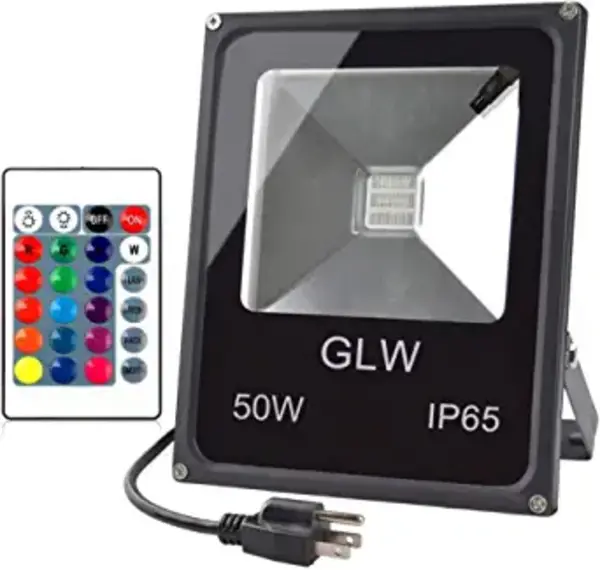
Okay, calm down, I know these are listed as RGB floodlights, but the ability to dim and choose from various colors makes this an easy pick for creating a nice base of colors in your studio.
The unit even recalls the settings from previous uses, so firing it up for tomorrow’s studio sessions is easier than expected. This is the move if you’re looking for a budget base lighting unit.
Our Recommendations For Complimentary Lighting For Your Bedroom
BlissGlow Strip Lights

Strip lights work well because they often give off a touch of light coloring while also being discreet and out of the way.
The BlissGlow lights are amazing just because of how affordable they are and how easy they are to set up.
And unlike many other RGB light strips, this option allows you to control each segment of the strip’s color for even more complete control over the vibe and aesthetic of your bedroom studio lighting.
Govee Gaming Lights
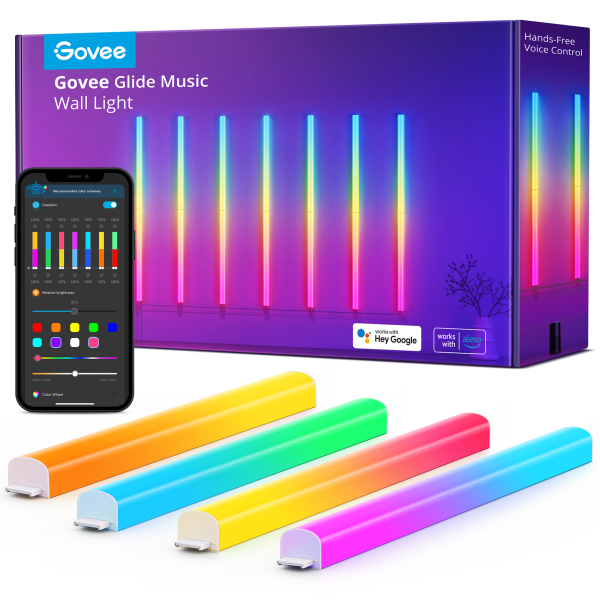
Offering just enough coverage to light up a small accent corner of your studio, these lights put out enough energy to warm up a room without blinding you from your DAW.
With some of the most accessible assembly options available for studio lighting, the Govee LED Wall Lights slot into any studio and aesthetic. Plus, you can control the dimmers, colors, and timings all through the native app on your phone! So you never need to leave the studio chair.
Nanoleaf Lines

Nanoleaf is a brand that has been in the game for what seems like forever, and I had always been trying to get my hands on them. I finally got a “smarter” pack of their lines series, and the versatility and overall brightness blew me away that these lights could emit. In just a single Smarter set of Nanoleaf lines, I could illuminate the entire studio in a multicolored chromatic spread which I can change at a moment’s notice depending on the color and vibe of the session.
Books Help More That You Think

The problem with bedroom studios is that you have very little control over the layout and arrangement options of the room. Professional producers can dump millions of dollars into custom-built, perfectly symmetrical rooms and treat them for sound.
Humble bedroom producers like us must be a bit more clever than that…
Finding ways to have furniture and room decor serve more than one purpose in your studio helps you get the most mileage out of the confined spaces you are typically secluded to. Bookshelves are the perfect example of this.
Lining a bookshelf at the back of your room gives you a place to store all the books you buy but never read; it also creates a natural diffuser that breaks up and absorbs the sound from your speakers. The imperfect angles and soft qualities of the pages and pines detract from the sound and absorb the noise, which prevents the sound from reflecting around the room.
Plus having a line of books about music, production, cooking, business, self-help, humor, fiction, fantasy, and more can make you look SUPER impressive to any invitee.
Have Plenty of Storage
While you can make music entirely in the box, most producers love using lots of toys and gear to create their tunes. And with gear comes even more necessities like wires, interfaces, mics, amps, and more, which all clog up the space fairly quickly.
That means having plenty of storage options is essential if you plan on keeping the gear you’re not actively using out of sight and mind. Because having one synth on your desk at all times might be an excellent flex to your date when they first see it, but having 15 scattered for all to see might make you look like a dweeb (since most non-producers have no idea what we do).
Local DJs can get away with having their Traktor controllers and after-market decks for all to see, but we’re producers, and we’re better than that!
But getting the most mileage out of the little square footage of your bedroom is no easy task and finding customizable storage shelves and containers is paramount.
So while designer shelves and spiffy bookcases might be an easy assumption when designing a room you hope to make aesthetically pleasing, they often rarely offer enough customization to fit your space perfectly.
Our Recommendations For Custom Music Studio Shelves
Modular Closets
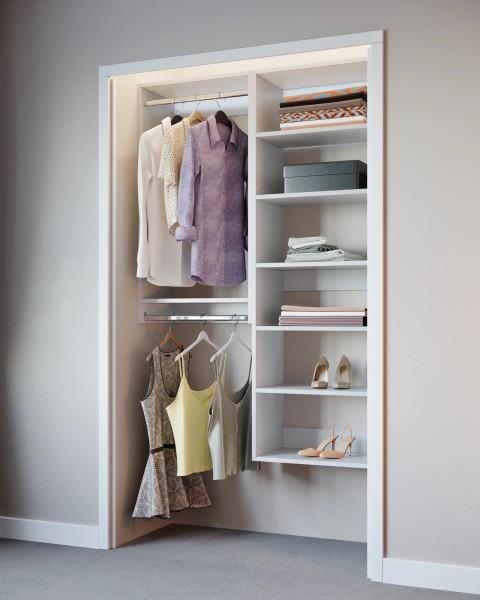
These shelves are unique in the simple fact that they are essentially the storage-container version of Legos. So don’t let the name on the unit fool you because you can arrange and assemble these shelves however you need.
I got my hands on what is called a Shoe Shelf Short Tower, but was able to quickly arrange it into a short, four-shelf tower to house my synths and cables.
And with various builds, shelves, heights, and other features, these things work perfectly. Buy a couple of different units, and you can mix and match parts and combine leftover material to get even more bang for your buck!
Tribesigns Closet Organizer
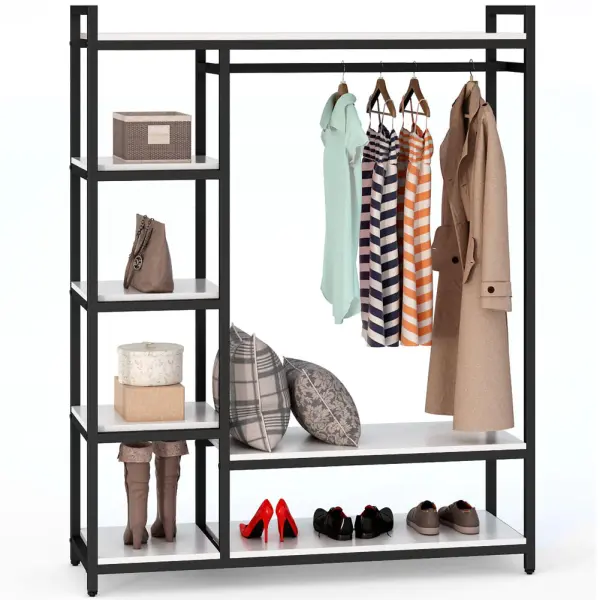
With apartments and condos trying to squeeze every inch of perceived value out of their listings these days, oftentimes, your “bedroom” doesn’t have any built-in closets for your clothes. If these are the lemons that your life situation has given you, look for a way to kill two birds with one stone and turn your clothes into less-than-ideal sound absorbers.
Free-standing closet organizers like the ones from Tribesigns allow you to get the most out of your small spaces, leaving you shelves to place your synths or gear and racks to hang your clothes. Place these racks in line with your monitors to prevent most of your sound from reflecting off the walls.
Is it perfect? No! But at least your family will see you’re trying (and you will have more room to organize your synths, toys, and threads).
Don’t Forget To Look Up
I’m going to make an educated guess and assume that most bedroom producers aren’t professionals. Sure, you might be incredibly talented with a few good signings, but that doesn’t mean you know every single in and out of your craft.
And producers at this level are great at adhering to most room treatment techniques. Yet I see so often many producers completely ignore the fifth wall of their music studio; the ceiling.
The ceiling is significant in bedroom studios, too, because in a bedroom where you spend such a long portion of your life staring at the ceiling in bed, having a subtle pattern or softer accent color can go a long way.
There are a few different options here that you can use to make the ceiling of your studio more aesthetically pleasing.
Painting The Ceiling
By painting the ceiling a slightly lighter version of your wall color, you give the impression that the ceiling is a bit lower than it is! This creates a sense of intimacy and comfort that many monochromatic studio rooms lack.
But be warned, as simple paint does little to absorb or control the sound reflections coming off the ceiling.
Add Treatment To The Ceiling
Treating your room can often be tricky. You could get the lightweight, cheap foam from Amazon, which does little to treat your room save for making it look like you tried to. You could also get heavy treatment panels that knock entirely out a room’s reflections, but then you’d risk the pieces falling on your face in the middle of the night.
This is where I actually advocate that you build panels yourself. With a bit of lightweight balsa wood and some lacquered fabric, you can make treatment panels that match your room’s style, vibe, and decor, and it will fit right into the rest of your aesthetic.
The video below shows you how to make your own for less than $30
Add A Ceiling Cloth
At the end of the day, the sound reflecting off of the ceiling is minimal.
So to remedy this, one might consider pinning a stylistic sheet or mandala tapestry to the ceiling to absorb many of these problem frequencies.
Sheets like this are often colored, patterned, and intricately designed, making them warm and comforting when hung above a standard ceiling light. The light filters through and creates new colors throughout the room!
Fair warning, these styles of clothes are often lumped in with crystal readings, Tarot cards, and incense which might give your date or your mom even more cause of concern (depending on the person of course).
Keep the Extras Simple
A studio should be a place of focus and thought – regardless of the overall style you are going for. While I can relate to some more wild-minded creatives who love being surrounded by toys and synths, there must be a method to the madness.
The method I tend to lean more heavily to, as a free-thinking creative, is that my workspace can be cluttered with my tools of the trade, but the surrounding environment cannot be. A few simple artworks on the wall, a couple of different mood lighting as mentioned above, and clean and direction organizational shelves or dressers, the standard bedroom furniture, you will have more than enough things occupying your space.
Decorate your bedroom studio’s walls only with things you need or like; anything outside will likely be considered clutter. As stated above, things that can serve two roles simultaneously, aesthetics AND soundproofing, should always get the highest priority here as real estate is incredibly limited in bedroom studios.
Our Recommendations For Studio Extras
Wooden Sound-Wave Wall Art
Having an eclectic smattering of wall decor might work for a standard bedroom, but keeping the vibe on brand in your studio will help facilitate creativity and keep you motivated during long hours at work.
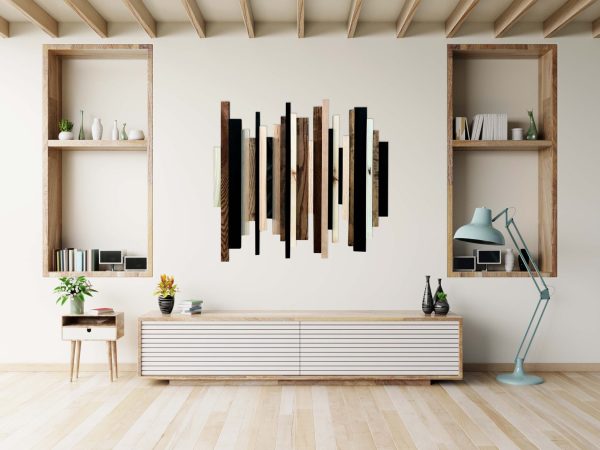
I stumbled across Clia Creation’s sound-wave wall art, knowing it would perfectly fit my studio. The handmade waveforms can be custom-made to replicate the sound of your voice or the shape of your latest kick drum. And the all-wood material keeps the aesthetic natural and minimal.
I love it in my studio, and I know you will too. Please look at all the artist has to offer on her website here.
Deskcise Pro V9
The FlexiSpot Deskcise Pro is a unique and innovative product designed for music producers looking to maximize studio space without sacrificing functionality. The all-in-one desk bike features a compact design that is perfect for smaller studios or home setups, and is equipped with several features to enhance productivity and creativity.
The built-in desk is spacious enough to accommodate a laptop, monitor, and other accessories. The bike can be used for exercise while working, helping boost energy and focus throughout the day. The Deskcise Pro also features a variety of storage compartments, including a side basket and a drawer, to keep essentials organized and within reach.

Combining a workspace and exercise equipment is a unique and practical solution for music producers who spend long hours in the studio. It allows them to stay active and healthy while working on music without sacrificing valuable studio space for a separate exercise area. Plus, the sleek and modern design of the Deskcise Pro adds a stylish and contemporary touch to any music studio aesthetic.
Overall, the FlexiSpot Deskcise Pro is a versatile and functional product perfect for music producers who want to optimize their workspace and prioritize their health and fitness. Its unique combination of functionality and style makes it an ideal addition to any music studio setup.

Will Vance is a professional music producer who has been involved in the industry for the better part of a decade and has been the managing editor at Magnetic Magazine since mid-2022. In that time period, he has published thousands of articles on music production, industry think pieces and educational articles about the music industry. Over the last decade as a professional music producer, Will Vance has also ran multiple successful and highly respected record labels in the industry, including Where The Heart Is Records as well as having launched a new label with a focus on community through Magnetic Magazine. When not running these labels or producing his own music, Vance is likely writing for other top industry sites like Waves or the Hyperbits Masterclass or working on his upcoming book on mindfulness in music production. On the rare chance he's not thinking about music production, he's probably running a game of Dungeons and Dragons with his friends which he has been the dungeon master for for many years.