Ableton Live has been a central production platform in electronic music for years, but that doesn’t mean producers have stopped asking for features available in other DAWs.
ARA integration has been a recurring request, dedicated step sequencing has often required additional devices or workarounds, and detailed mixing tasks can still involve moving between several parts of the interface. These limitations haven’t prevented anyone from making excellent music in Live, but they do affect how producers work once a project becomes complicated.
Ableton has now announced Live 13, and I think this update deserves attention for reasons extending beyond the new instruments and effects. ARA 2 support, a dedicated Step Sequencer, automatic capture of unrecorded parameter movements, and more comprehensive Rack controls address specific parts of the production process. The company is also expanding its native mixing capabilities with clipping, transient processing, multiband routing, and a collection of Softube effects.
The announcement arrived on November 10, 2026, with the full release scheduled for early 2027. A public beta is already available to eligible users, and anyone purchasing a qualifying Live 12 license during the current promotion will receive the corresponding Live 13 version when it launches. Here’s what I think producers should consider before deciding whether to upgrade.
ARA 2 and Capture Automation Address Two Longstanding Frustrations
I’d put ARA 2 near the top of the list because it changes how compatible audio editing plugins interact with Live. Instead of relying exclusively on conventional plugin workflows for detailed pitch and timing edits, producers will be able to open supported ARA processors directly within Arrangement View audio clips.
That means using software such as Melodyne to edit vocal timing and pitch while maintaining closer integration with the DAW’s timeline. Live 13 Suite will include Melodyne essential, and the beta already supports ARA processing on individual clips and take lanes. Ableton also provides options to render the edits into audio or remove the ARA processor when it’s no longer needed.
There are limitations. ARA support currently applies to Arrangement View, and Ableton allows one ARA plugin to be used across a project at a time. That makes it important to distinguish the announcement from unrestricted support for every possible ARA workflow. Nevertheless, it’s a meaningful development for producers who regularly edit recorded vocals and instruments.
Capture Automation addresses a completely different frustration. Live has supported capturing unrecorded MIDI performances for years, but producers haven’t always been able to retain the spontaneous parameter movements they make while exploring a sound. Live 13 extends that concept to automation, allowing knob adjustments, button presses, and other gestures to be captured afterward and converted into editable automation.
These additions build on the workflow changes we examined in our coverage of Ableton Live 12.4, which introduced improvements to audio connectivity, stem separation, and the relationship between Live and Ableton’s hardware.
Live 13 Adds a Dedicated Step Sequencer and New Instruments
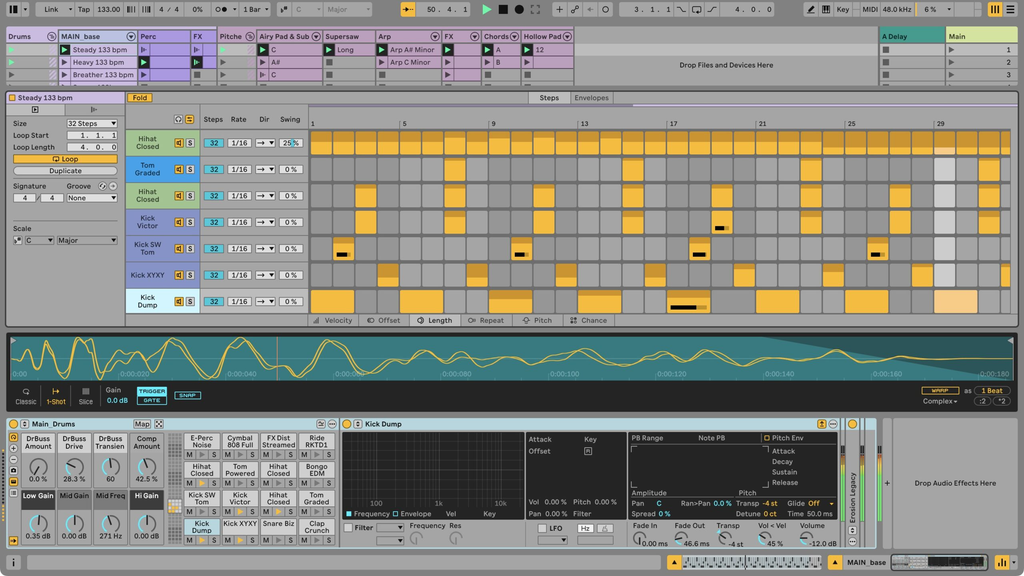
The new Step Sequencer is another feature I expect electronic producers to spend considerable time exploring. Rather than programming everything through conventional MIDI notes, users can create Step Sequencer clips with independently adjustable row lengths, playback speeds, and directions.
Individual steps support velocity, probability, repetition, timing offsets, and pitch adjustments. Rows can operate at different lengths, making it possible to develop polyrhythmic percussion patterns or melodic sequences that change over successive repetitions. The sequencer supports patterns of up to 128 steps, and users can convert between Step Sequencer clips and conventional MIDI notes.
The update also introduces Drum Synth, a collection of over 20 percussion synthesis engines designed for developing individual drum sounds. Instead of beginning with a sample and processing it until it fits the arrangement, producers can generate percussion directly from synthesis parameters and then modify its characteristics within Live.
This connects with my Ableton Move review, where I spent time examining how a limited set of immediate controls can change the way producers develop musical ideas. Live 13’s sequencer and new instruments extend the number of ways producers can develop patterns without constantly returning to the conventional piano roll.
Ableton Expands Racks and Finally Adds Native Clipping Tools
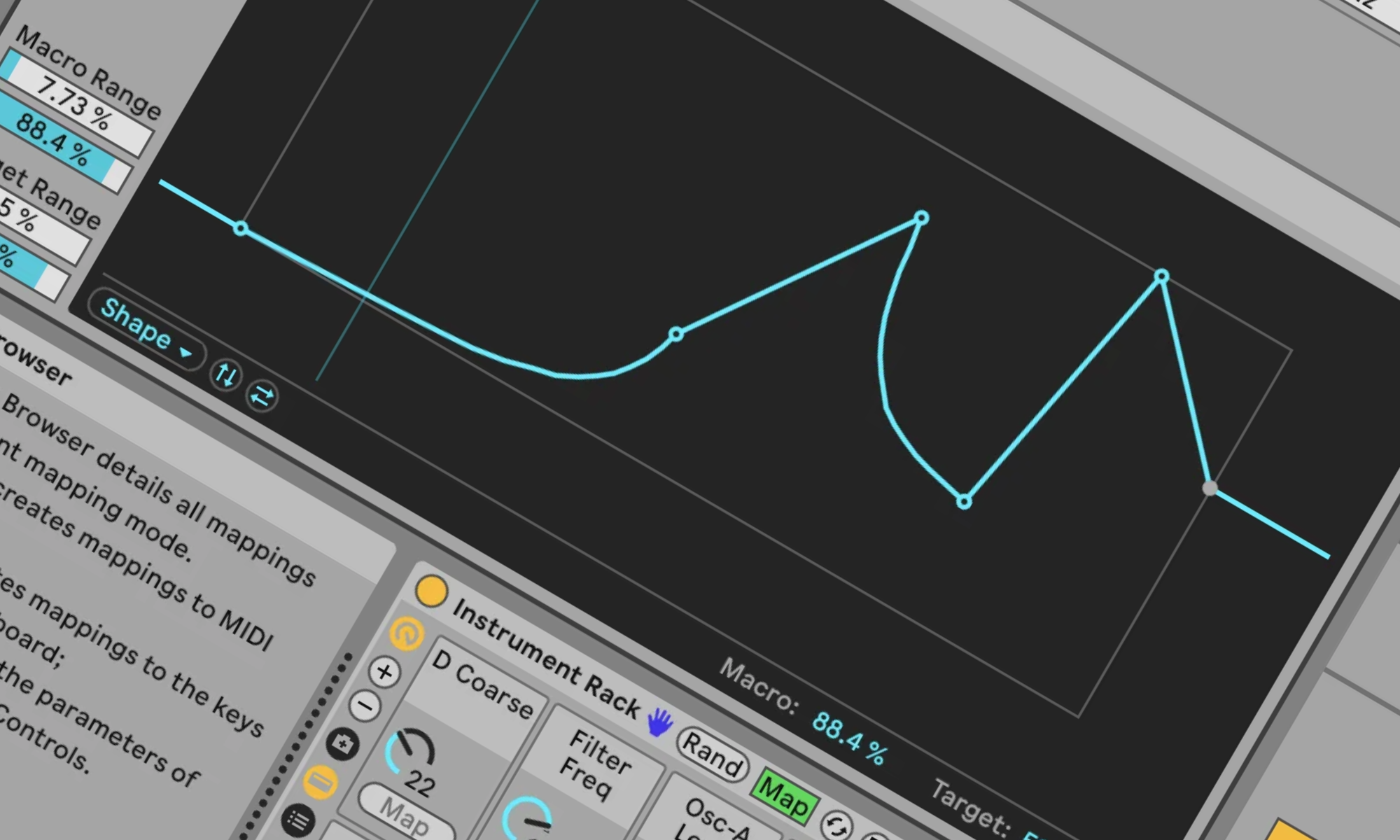
Racks receive a substantial update in Live 13, with support for up to 32 Macros, expanded parameter mapping, and custom mapping curves. That gives producers additional control when building elaborate instruments, performance systems, and effects chains.
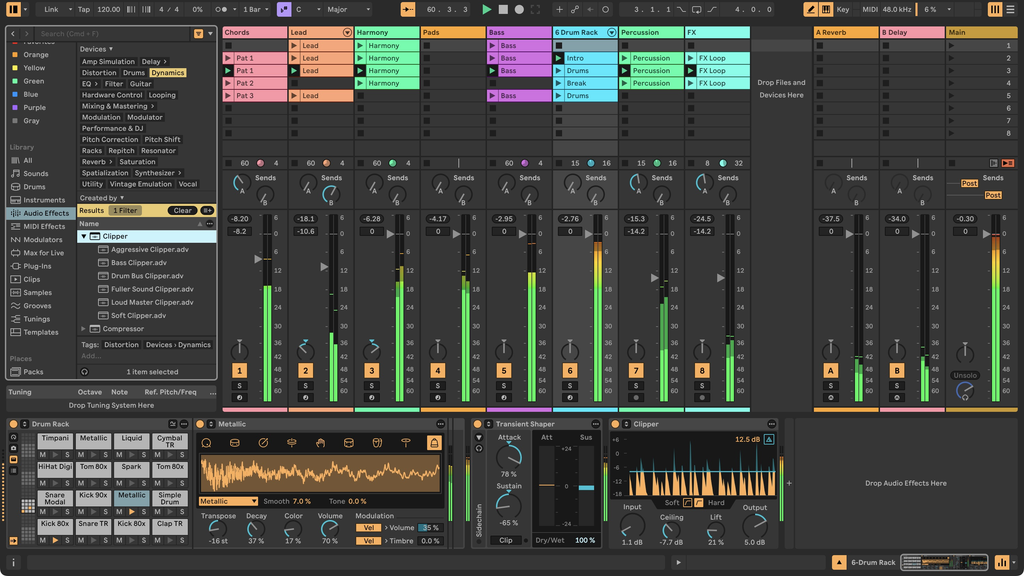
New Multiband and Mid-Side Racks provide more specialized signal routing. Multiband Racks allow producers to process different frequency regions independently, while Mid-Side Racks separate center and stereo information for further processing.
These additions should be particularly relevant for mixing electronic music, where producers frequently need to manage low-frequency information independently from high-frequency material or adjust the stereo presentation of an instrument without processing its center information identically.
Live 13 Suite also introduces Clipper and Transient Shaper. Clipper provides hard and soft clipping modes, visual feedback, and controls for managing signal peaks or introducing harmonic distortion. Transient Shaper concentrates on the attack and sustain characteristics of incoming audio, allowing producers to adjust the initial impact and decay of percussion and other instruments.
On the workflow side, Device Slots bring additional control directly into the mixer, allowing producers to view, toggle, and reorder devices without repeatedly navigating between tracks and their effects chains. Contextual Browsing similarly allows instruments and effects to be added, or presets replaced, from relevant parts of the interface.
Ableton Live 13 Pricing, Release Date, and Upgrade Options

Ableton Live 13 is scheduled for release in early 2027, although the company hasn’t announced a specific launch date. The public beta is available through Ableton’s beta program, with limited access for eligible Live Standard and Suite owners.
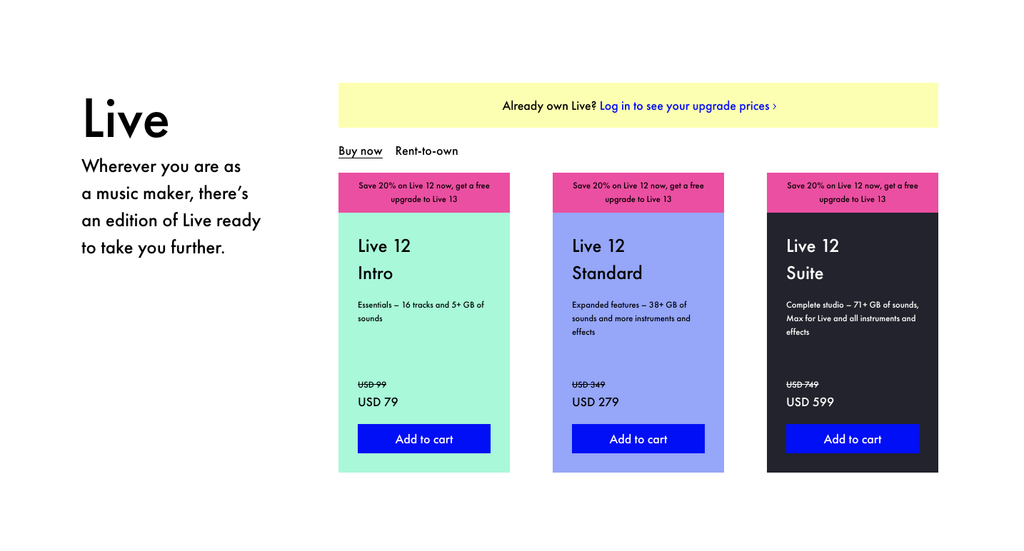
The company is currently offering 20% off Live 12 Intro, Standard, Suite, and qualifying upgrades. Customers who purchase or upgrade to Live 12 during the promotion will receive the corresponding Live 13 edition at no additional charge when the new version becomes available.
Existing Live 12 owners can also pre-order their Live 13 upgrade at a 20% discount. Upgrade pricing varies according to the license already registered to an Ableton account, so users should check their individual offer before purchasing.
Ableton Move, Push 3, and the Push Upgrade Kit are also discounted by 20% through November 30, 2026. Unlike the software promotion, the hardware discount has a specific closing date.
I wouldn’t characterize Live 13 as a complete reinvention of the software, and I don’t think that’s what most existing users need. The value is in changes to the operations producers perform regularly, particularly audio editing, MIDI programming, automation, sound design, and mixing.
ARA 2 could substantially improve the experience of working with recorded vocals, while Capture Automation addresses the common problem of losing parameter adjustments made during experimentation. The Step Sequencer introduces another approach to developing percussion and melodic material, and the new Rack and mixing features extend what can be accomplished with Live’s native processors.
For producers already comfortable with Live 12, I’d recommend examining the beta and the edition-specific feature list before committing to an upgrade. The new version appears particularly interesting for people who rely heavily on audio editing, extensive effects chains, or Push-based production.
Learn more on the official Ableton Live 13 page or read the Live 13 beta release notes.

Will Vance is a professional music producer who has been involved in the industry for the better part of a decade and has been the managing editor at Magnetic Magazine since mid-2022. In that time period, he has published thousands of articles on music production, industry think pieces and educational articles about the music industry. Over the last decade as a professional music producer, Will Vance has also ran multiple successful and highly respected record labels in the industry, including Where The Heart Is Records as well as having launched a new label with a focus on community through Magnetic Magazine. When not running these labels or producing his own music, Vance is likely writing for other top industry sites like Waves or the Hyperbits Masterclass or working on his upcoming book on mindfulness in music production. On the rare chance he's not thinking about music production, he's probably running a game of Dungeons and Dragons with his friends which he has been the dungeon master for for many years.