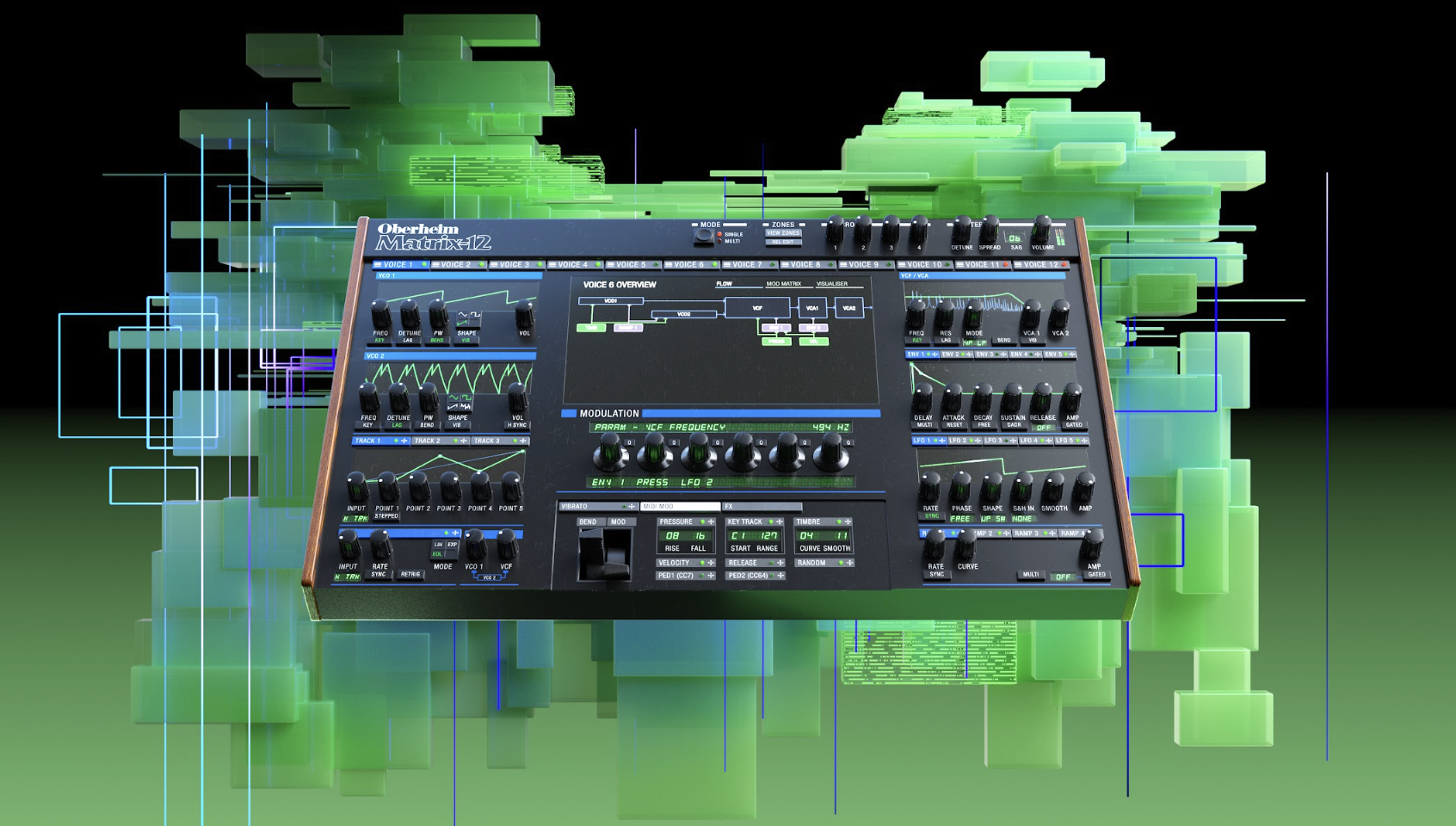
The Oberheim Matrix-12 was already a remarkably complicated synthesizer when it appeared in 1985. Its twelve voices each contained two oscillators, a filter with fifteen operating modes, five envelopes, five LFOs, and several additional modulation sources.
Producers could link parameters in ways most analog synthesizers of the period couldn’t, though programming those relationships meant navigating a relatively small set of displays and controls. GForce Software’s new Oberheim Matrix-12 revisits that original architecture and introduces an interface that makes the instrument considerably easier to program.
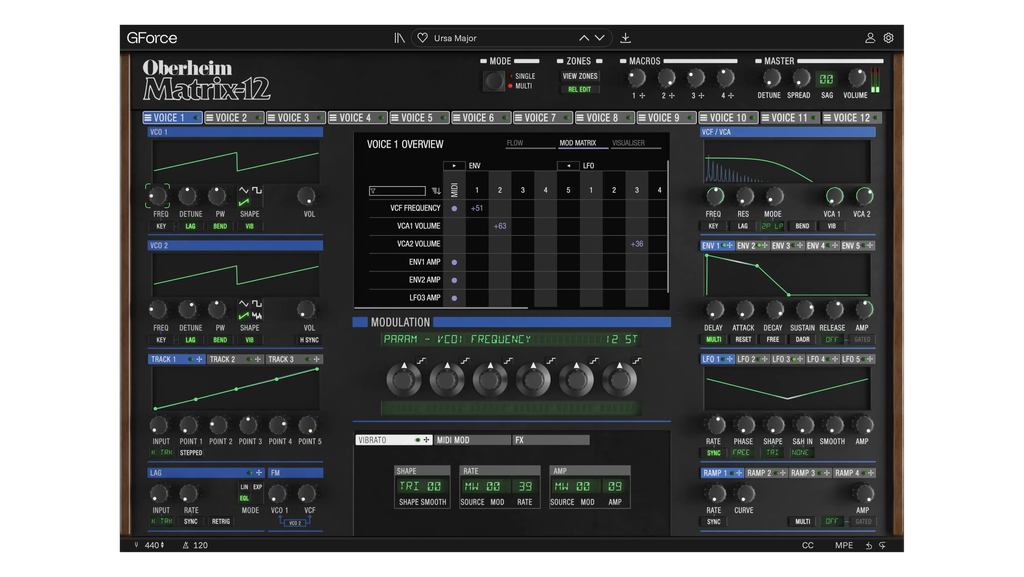
Developed in collaboration with Oberheim and Marcus Ryle, one of the original hardware designers, the software recreates the Matrix-12 and its predecessor, the Xpander, while adding features that take advantage of modern DAW environments. The instrument includes drag-and-drop modulation, visual signal routing, editable modulation displays, six keyboard zones, micro arpeggiators, and full MPE support. It also retains twelve-voice polyphony and the original synth’s approach to individual voice programming.
I’ve always appreciated synthesizers where modulation becomes part of the actual composition process rather than something you configure once and leave alone. The Matrix-12’s architecture is particularly interesting because modulation sources can control other modulation sources, allowing a patch to behave differently depending on how it’s played and how its internal parameters interact. Making those relationships visible could significantly affect how producers program the instrument, especially when working with several independent voices.
Why the Original Oberheim Matrix-12 Was So Different
The Matrix-12 arrived in 1985, following the introduction of the Oberheim Xpander in 1984. The earlier instrument provided six voices without an integrated keyboard, while the Matrix-12 expanded the architecture to twelve voices and incorporated a 61-note keyboard with velocity and release-velocity sensitivity.
The original hardware offered 27 modulation sources and 47 destinations per voice, letting musicians link oscillators, filters, envelopes, LFOs, and other parameters.
That degree of control was unusual for a polyphonic analog synthesizer at the time.
The Matrix-12 also included a fifteen-mode filter, providing several low-pass configurations alongside high-pass, band-pass, notch, phase, and combined filtering options.
For sound design, having that selection of filters within a single architecture allows considerably different harmonic treatments without changing instruments.
A producer could use a four-pole low-pass filter for a conventional analog pad, switch to a band-pass configuration for a narrower frequency emphasis, or combine filtering characteristics for more specialized sounds.
The synthesizer subsequently became associated with musicians including Vangelis, Depeche Mode, The Orb, and Technotronic.
Original Matrix-12 units remain relatively uncommon, particularly compared with more widely manufactured analog synthesizers. Maintaining an instrument from this period also involves the usual considerations associated with aging electronic components, calibration, repairs, and replacement parts.
Software recreation avoids those hardware requirements, though the accuracy of any emulation ultimately depends on how closely its modeled components reproduce the original instrument’s behavior.
GForce has developed its reputation around recreations of established synthesizers, particularly through its earlier work with Oberheim’s OB-series instruments.
The company’s relationship with Oberheim and Marcus Ryle gives this release a direct connection to the original development team. It is also worth distinguishing the licensing arrangement from the broader software market: Arturia has offered a Matrix-12 V instrument for years, while GForce’s release carries official Oberheim authorization.
How GForce Recreates the Matrix-12 Synthesis Engine
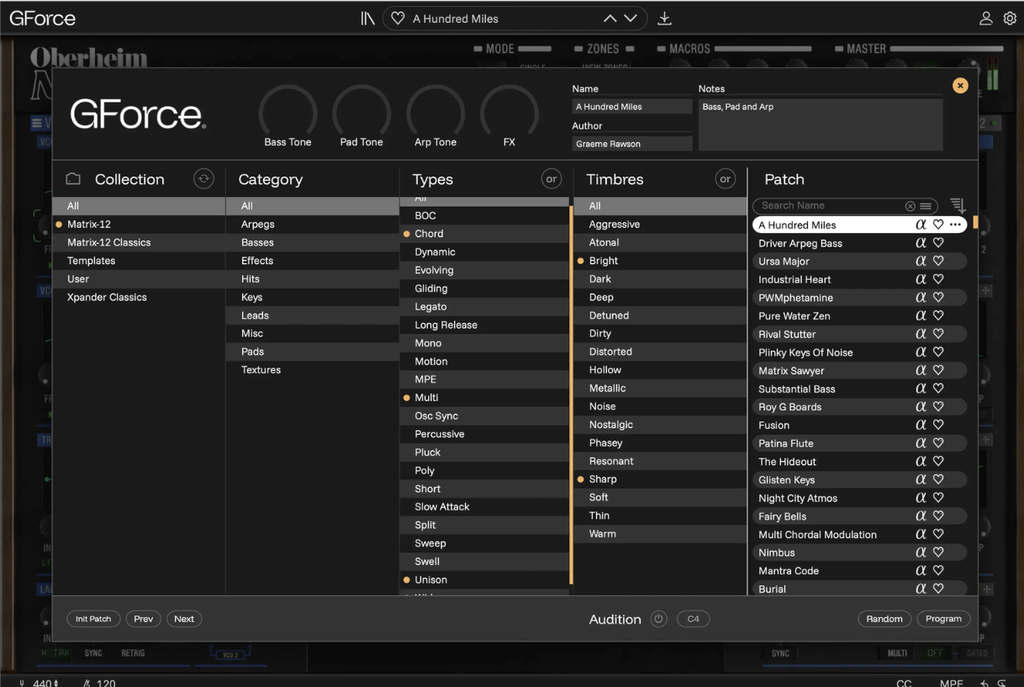
The GForce Matrix-12 retains the dual-oscillator architecture of the original hardware, with twelve individual voices available in its primary polyphonic mode.
Each voice contains two modeled voltage-controlled oscillators offering triangle, sawtooth, and pulse waveforms. The second oscillator also includes noise and hard synchronization, with frequency modulation available within the synthesis architecture.
The oscillators feed a fifteen-mode filter, followed by two VCAs.
That configuration provides the foundation for conventional analog synthesizer sounds, but the Matrix-12’s expanded modulation architecture is where the instrument becomes particularly interesting.
Each voice includes five envelopes, five LFOs, four ramp generators, three tracking generators, and a lag processor.
For example, one envelope could control filter frequency, another could affect an oscillator’s pitch, and a third could adjust the amount of modulation being applied elsewhere.
A tracking generator lets you remap an incoming control signal, so the relationship between a modulation source and its destination doesn’t have to remain linear.
The lag processor can smooth changes in control signals, introducing gradual transitions where an immediate parameter change would otherwise occur.
These functions provide several ways to create movement without relying on external effects or drawing additional automation inside a DAW.
The instrument also includes keyboard tracking, velocity, release velocity, pressure, pitch bend, modulation wheel control, random modulation, and full MPE compatibility.
MPE support matters for modern performance controllers because it lets individual notes respond independently to expressive gestures.
In our review of the Behringer DeepMind 12, we examined a different twelve-voice analog synthesizer with an extensive modulation system. The DeepMind uses an eight-bus modulation matrix, while the Matrix-12 is based on an architecture that gives individual voices a considerably larger collection of modulation sources and destinations.
The comparison helps establish why the original Oberheim remains technically interesting more than forty years after its introduction.
GForce Oberheim Matrix-12 Price and Compatibility
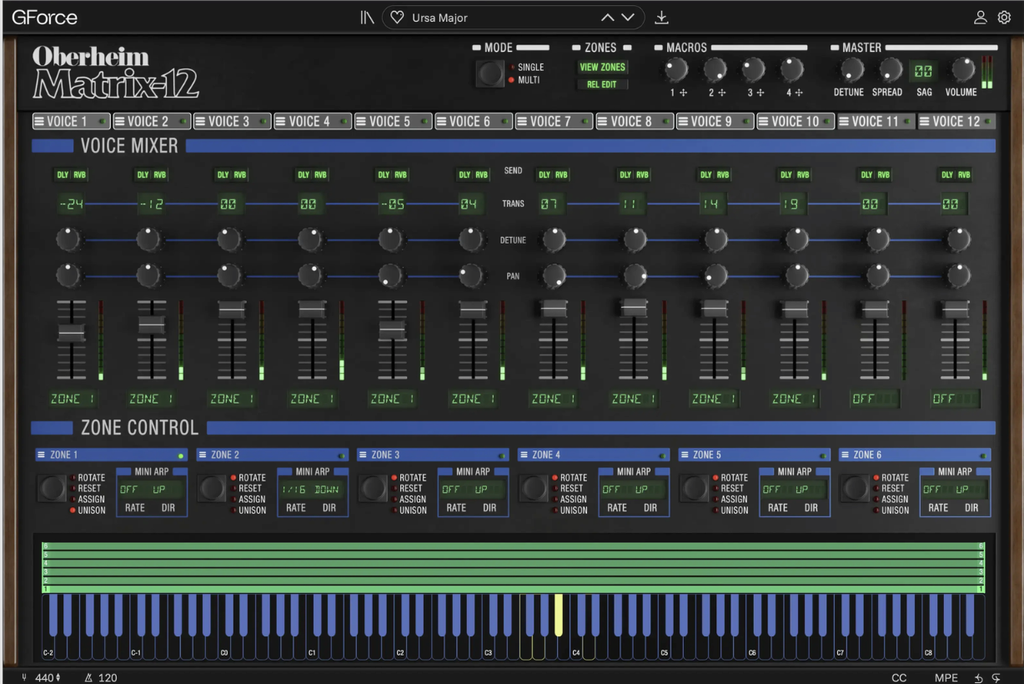
GForce Oberheim Matrix-12 launches November 5, 2026, for macOS and Windows.
The regular price is $119.99, £99, or €119.99, with introductory pricing of $83.99, £69, or €83.99 available until December 5.
A fourteen-day trial will also be available.
On macOS, the instrument supports standalone operation, Audio Units, AAX, VST, and VST3. Windows users receive standalone, AAX, VST, and VST3 versions.
The broader question for producers considering the instrument is whether they want the sound and programming architecture of an Oberheim Matrix-12 or simply another analog-style synthesizer.
The Matrix-12’s modulation system is substantially different from a conventional two-oscillator instrument with a handful of envelopes and LFOs. Its architecture rewards detailed programming, particularly when multiple voices, tracking generators, and modulation relationships interact.
GForce has retained those capabilities while introducing editing tools that could make the instrument considerably easier to understand.
The accuracy of the oscillator, filter, and envelope models still needs to be evaluated through direct testing, especially for producers comparing the software against original hardware or existing Matrix-12 emulations.
For now, the combination of official Oberheim development involvement, extensive modulation editing, multitimbral operation, and introductory pricing makes this a relevant release for producers interested in detailed analog synthesis.
GForce Oberheim Matrix-12 will be available November 5 from GForce Software.

Will Vance is a professional music producer who has been involved in the industry for the better part of a decade and has been the managing editor at Magnetic Magazine since mid-2022. In that time period, he has published thousands of articles on music production, industry think pieces and educational articles about the music industry. Over the last decade as a professional music producer, Will Vance has also ran multiple successful and highly respected record labels in the industry, including Where The Heart Is Records as well as having launched a new label with a focus on community through Magnetic Magazine. When not running these labels or producing his own music, Vance is likely writing for other top industry sites like Waves or the Hyperbits Masterclass or working on his upcoming book on mindfulness in music production. On the rare chance he's not thinking about music production, he's probably running a game of Dungeons and Dragons with his friends which he has been the dungeon master for for many years.