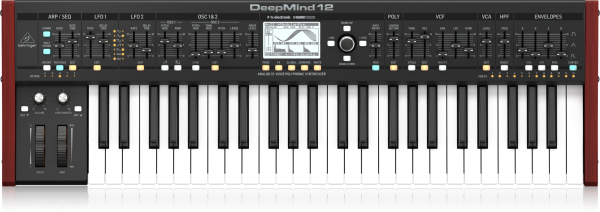
Whether you know it or not, you’ve heard the iconic sounds of this synth… or at least the synths from the Behringer DeepMind 12 49-key 12-voice Analog Synthesizer heavily draw its inspiration. You can listen to this polysynth’s soft and inspiring sounds across countless records that defined the sounds of jazz, pop, rock, and more throughout the 70s and 80s.
After playing with this synth for the better part of a month, I found it to be a faithful emulation of the original Juno synth.
Now, it’s not an official emulation or recreation. Let me explain why I think the Behringer DeepMind 12 49-key 12-voice analog synthesizer is one of the best and most modern alternatives to the original Juno 106.
Learn More About This Synth And Support Our Team Through Our Partnership With Sweetwater Here.
What Is The Behringer DeepMind 12?
Behringer set out to create the ultimate polysynth with this synthesizer, and they damn near came close.
This synth has 12 voices, an eight-bus modulation matrix, and even built-in Wi-Fi.
But its shining feature is in its duality, as it perfectly bridges the gap between analog warmth and irregularity and digital functionality and precision, including two digitally-controlled analog oscillators and multiple LFOs per voicing that work together to create pure analog bliss. Whether you want to make bass lines, soaring pads, or ripping leads, this synth’s ability to bridge the gap between retro analog flavor and digital clarity is second to none.
Need To Upgrade Your Arsenal Of Softsynths? Check Out The Most Impactful Ones We’ve Used In All Our Latest Productions HERE
Who Is The Behringer DeepMind 12 Made For?
This is a trick question because I’m a massive fan of this synth, and my gut reaction is to say that it’s for everyone, but that would sound corny. So let me break down who I think this synth is best suited for.
Hardware Noobs
Countless producers get into music production solely on software but eventually want to transition into hardware for a more unpredictable and natural sound. If this sounds like you, this is an excellent synth for that.
The price point is enough to make it a substantial investment, but most synths that accomplished laptop producers looking to get into hardware are about the same. Compared to many other synths on the market, the Behringer DeepMind 12 is user-friendly and avoids many of the semi-modular complications many other synths offer.
This is an excellent synth for getting into hardware with a low learning curve.
Retro Lovers
I’ve already said that this synth isn’t an official Juno emulation, but damn, I think it sounds similar. If you’re a producer looking to tap into the sounds of the past and put your modern flip on them, this is an easy recommendation.
Whether you want to add the soft and soaring pad sounds of progressive rock classics into your deep house tune or add the ripping bass lines of Michael Jackson into your Hyperpop production, this synth can tackle it all.
Searching for cost-effective synths? Discover ‘Best Affordable Polysynths: 7 Hardware Synthesizers You Won’t Go Broke Over’ – start your synth journey here.
Key Features Of The Behringer DeepMind 12
Here are some of my favorite features that caught my attention with this synth. Remember that there are more features than the three I will discuss.
I just wanted to shed some extra attention on these, as they genuinely impressed me after a few studio sessions.
It’s Accessible
The learning curve of the synth is way shorter than most other hardware devices I use because there is little to no menu diving. I know this is just a quality-of-life thing in the grand scheme, but it’s nice to see a synth where all the essential features have their dedicated menu button.
What you see is what you get! And any producer looking to transition from software to hardware will find this synth to facilitate that nicely.
The Keys!
As a lifelong piano player, I love adding dynamics and emotion through velocity. Until now, I have always given up on velocity-sensitive synths.
And while the velocity functionality has a bit to be desired compared to my composition keyboard, the manipulable velocity sensitivity and after-touch control curves on this synth are a great addition! Bravo Behringer
The Price
Okay, so I understand that just under one thousand dollars isn’t a tiny amount of cash, but for the quality of sound and amount of playability this synth has, it’s incredible.
Perhaps it’s because synth lovers like us are groomed to expect premium prices from synths after seeing Moog and Dave Smith release products with even heftier price tags. But when I saw the price tag, I expected a sub-par alternative for other pro-level synths that cost five times as much. But I was utterly wrong. This synth is built for pros but easy enough for everyone to love (at a price most producers can at least justify paying).
Are you curious about the Prophet Rev 2 and Ableton combo? Explore ‘How Paradoks Uses the Prophet Rev 2 with Ableton: Why It’s the Perfect Synth for His Fast Workflow’ – get into the workflow here.
What I Didn’t Like About The Behringer DeepMind 12
No synth is perfect, and I had a few gripes about this synth. Some of this is a bit nit-picky, but I would be doing you a disservice by not mentioning them!
So, let’s dive into some things I wasn’t stoked to see on this synth.
Load Times
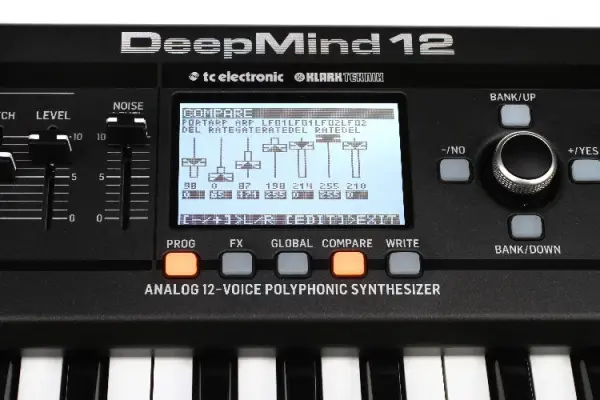
When I was scrolling through some of the onboard and downloadable presets that the Behringer DeepMind 12 comes with, there were a handful of moments when I experienced substantial load times.
I will add that it took only a few seconds for the presets to load into the synth and become playable. Still, when you are in the creative flow while producing music, seconds can be the difference between being in the flow state and getting distracted.
Second Oscillator
The most significant limitation of this synth is its oscillators. Sure, there are some workarounds, and you can get far with what you have, but this needs to be addressed.
Firstly, I couldn’t seem to find any sine or triangle waves at all. It cornered you into a square, saw, square, and a strange square-like wave on the second osc that relies on a peculiar tone adjustment to shape its waveform.
There are a few workarounds here if a workaround is even needed in the first place, including onboard EQ work and filtering. But these options take a bit of experimenting and fine-tuning.
Specs On The Behringer DeepMind 12
- Type:Keyboard Synthesizer with Sequencer
- Sound Engine:12-voice Analog Polysynth with Digital Effects
- Analog/Digital:Analog
- Number of Keys:49
- Type of Keys:Semi-weighted
- Aftertouch:Yes
- Velocity Sensitive:Yes
- Other Controllers:Pitchbend, Mod Wheel
- Polyphony:12 voices
- Number of Presets:1024 program memories – 8 banks (each with 128 programs)
- Oscillators:2 x DCO per voice
- Waveforms:Sawtooth, Pulse, Square
- LFO:2 x LFO per voice (sine, triangle, square, sawtooth, reverse sawtooth, sample & hold, sample & glide)
- Filter:Analog 2/4-pole Lowpass, Highpass
- Envelope Generator:3 x ADSR
- Number of Effects:4 FX engines (TC Electronic, Klark Teknik FX)
- Effects Types:Reverb, Delay, Chorus, Flanger, Rotary, Amp simulator, Phaser, EQ, Filter, Distortion, Compression, Gates
- Arpeggiator:Yes
- Sequencer:32-steps
- Audio Outputs:2 x 1/4″ TRS (main out)
- Headphones:1 x 1/4″
- USB:1 x Type B
- MIDI I/O:In/Out/Thru/USB
- Pedal Inputs:1 x 1/4″ (sustain/trigger), 1 x 1/4″ (pedal expression/CV in)
- Other I/O:Built-in Wi-Fi (2.4 GHz), Tablet remote control
- Software:DeepMind iOS app
- OS Requirements – Mac:OS X 10.6.8 or later, iOS 8 later
- OS Requirements – PC:Windows 7 or later, Android 6.0 or later
- Power Source:Standard IEC power cable
- Height:4.1″
- Width:32.4″
- Depth:10.1″
- Weight:18.5 lbs.
- Manufacturer Part Number:000-AC502-00010
Learn More About This Synth And Support Our Team Through Our Partnership With Sweetwater Here.

Will Vance is a professional music producer who has been involved in the industry for the better part of a decade and has been the managing editor at Magnetic Magazine since mid-2022. In that time period, he has published thousands of articles on music production, industry think pieces and educational articles about the music industry. Over the last decade as a professional music producer, Will Vance has also ran multiple successful and highly respected record labels in the industry, including Where The Heart Is Records as well as having launched a new label with a focus on community through Magnetic Magazine. When not running these labels or producing his own music, Vance is likely writing for other top industry sites like Waves or the Hyperbits Masterclass or working on his upcoming book on mindfulness in music production. On the rare chance he's not thinking about music production, he's probably running a game of Dungeons and Dragons with his friends which he has been the dungeon master for for many years.






![How It Was Made: Low Steppa & Roel – Dreamliner [Low Trax]](https://magneticmag.com/wp-content/uploads/2026/09/DSC07195-1024x608.jpg)