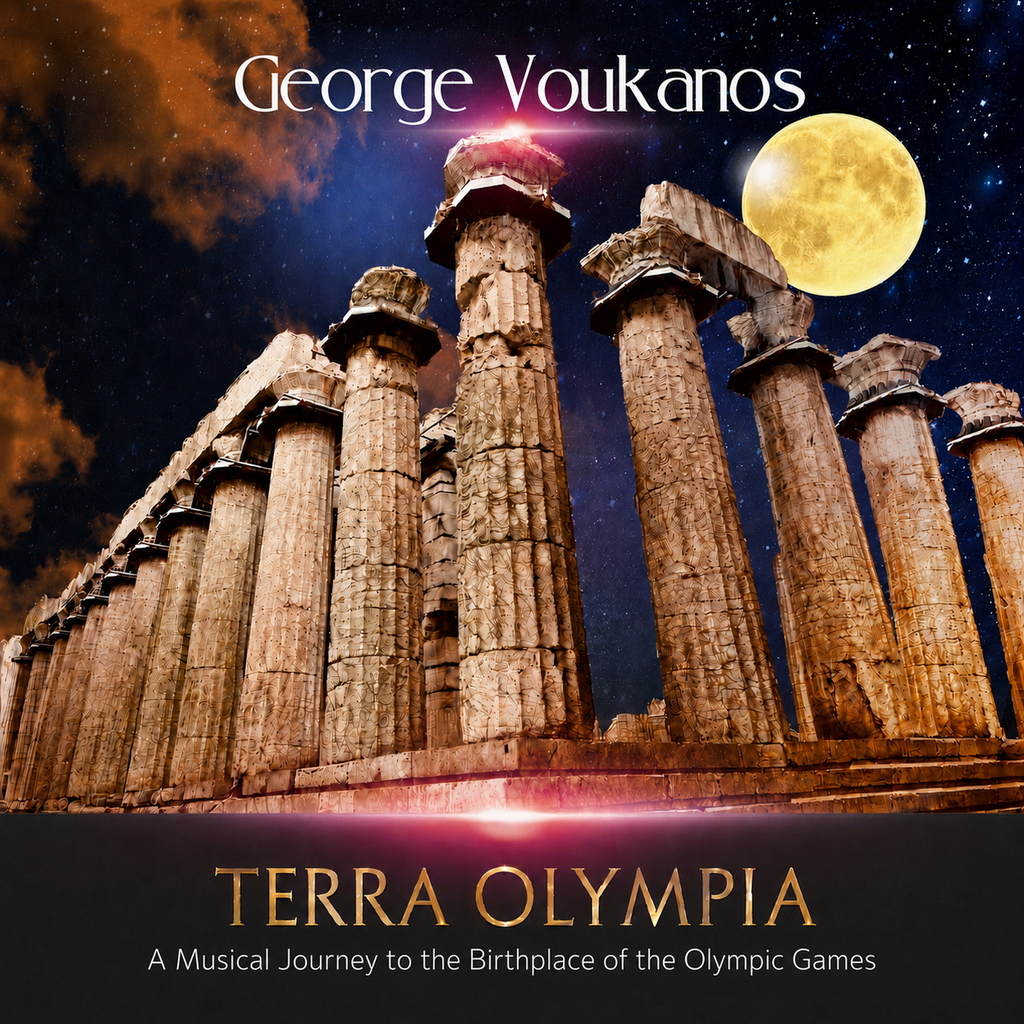
There is an easy version of a project like TERRA OLYMPIA, and George Voukanos seems aware of it from the start. A Greek composer returns to Ancient Olympia, writes music tied to memory and heritage, invokes mythology, light, landscape, and the Olympic idea, then lets the ancient world carry the emotional burden for him.
And while that alone has a real story behind it, it would also miss the most interesting part of what he is doing.
Voukanos is not treating TERRA OLYMPIA as a historical reconstruction, a documentary extension, or a museum piece with synthesizers placed over it, but instead he’s doing it all through his relationship with this world, which began in 2002, when he first entered the artistic landscape of Ancient Olympia while creating a documentary soundtrack for ERT, the Hellenic Broadcasting Corporation. More than two decades later, the new album is not built from that earlier music, nor from later live and audiovisual presentations at places such as the Ancient Theatre of Elis and the Temple of Apollo Epicurius.
The 2026 album is made from new compositions created specifically for this work.
That distinction changes the album’s center.
TERRA OLYMPIA is less about returning to the same place than finding out what a familiar place can sound like after the composer has changed. Voukanos brings family roots in Elis, years of symphonic, theatre, opera, television, and audiovisual work, and a growing interest in electronic sound as its own expressive language.
The discussion with him below gets into why the project feels like a restart, how music can create cinematic time without a film attached, and why the Olympic idea still matters to him as a human idea rather than a sporting one.
Interview With George Voukanos

You first explored Ancient Olympia for ERT in 2002. Why did 2026 feel like the right time to return to it?
I’m not sure I can say that I consciously chose 2026 as “the right year.” In many ways, I never completely left that world.
What began with the ERT documentary in 2002 stayed somewhere inside me: the landscape of Olympia, the mythology, the history, but also something more difficult to define, a feeling connected with the place.
More than twenty years passed, and during that time I changed both as a composer and as a person. I worked with orchestras, theatre, opera and audiovisual projects, travelled across different musical worlds and encountered different cultures. Inevitably, all of that changed the way I listen, write and understand music.
It also changed the questions that interest me. Today, when I think about Ancient Olympia, I don’t think only about history or archaeology. I think about ideas that remain deeply human: dignity, excellence, peaceful encounter, and the possibility of people from different cultures meeting on common ground.
Those ideas feel especially meaningful in the world we live in today.
So when TERRA OLYMPIA began to take shape, I didn’t want to recreate 2002. I wanted to meet Olympia again with everything I had lived since then.
Perhaps that is why the moment felt right: the place was still there, but I was no longer the same composer and the world was no longer the same world.
Sometimes returning to something important after many years is not really a return. It becomes a new beginning.
You describe TERRA OLYMPIA as a restart. What could you write today that you could not have written in 2002?
I think the biggest difference is not simply what I can write today technically. It is what I am able to leave unwritten.
In 2002, I was naturally a different composer. My instinct was to carry emotion more directly through melody, harmony, orchestration and musical development.
Today I trust space much more.
I trust atmosphere, repetition, texture and silence. I can allow a very simple musical idea to remain simple if that is what it needs. I no longer feel that every moment has to demonstrate something.
And this is also where electronic sound became important for TERRA OLYMPIA.
I didn’t come to electronic sound because I wanted to leave the orchestra behind. I came to it because I discovered colors, spaces and forms of movement that needed another language.
For me, a synthesizer is not a substitute for an orchestra. If I want an orchestra, I can write for an orchestra. Electronic sound has its own personality, its own space and its own way of carrying emotion.
Perhaps I could have used some of the same tools in 2002, but I don’t think I could have made the same artistic choices.
You need to live certain things before you can write them, and sometimes you need to live certain things before you can allow music to become simpler.
That is part of what I mean by Music of Life: life changes us, and the music must be allowed to change with us.
So the “restart” is not about rejecting the composer I was in 2002. It is about carrying everything forward with more experience, more freedom, and a deeper sense of what really needs to be said.
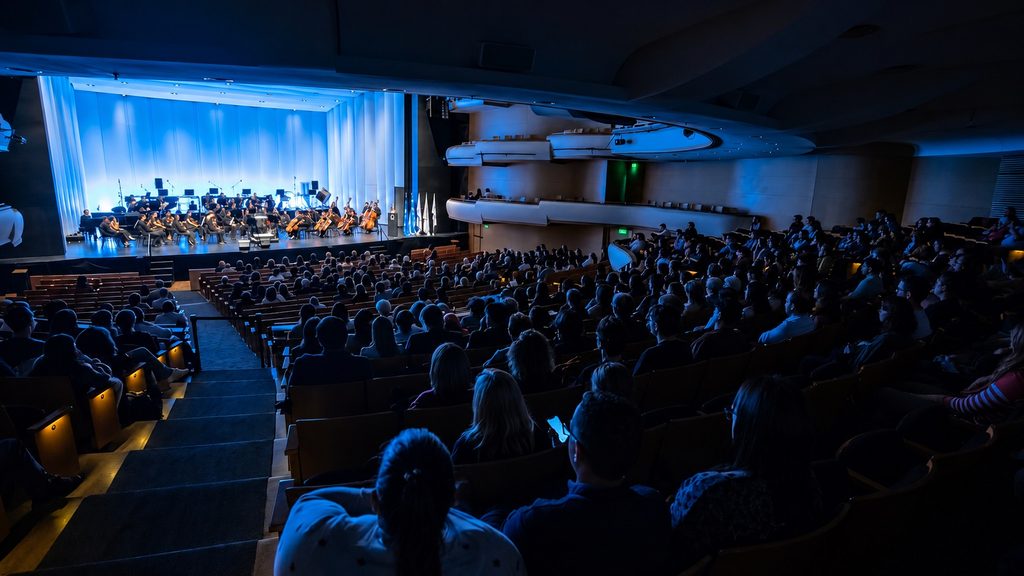
The album has a cinematic character and exists independently from a film. How do you shape dramatic movement when no film is setting the timing?
When there is no film, the music has to create its own film.
I am a very visual, and I would say deeply cinematic composer. I often see movement, landscapes, light, distance, characters or an imaginary scene while I am writing.
But when there is no actual film, something very interesting happens: the music becomes free to create its own dramatic time.
There is no editor telling me that a scene lasts thirty seconds. No image tells me exactly when an emotional turning point has to arrive.
I can allow a moment to breathe longer. I can delay an arrival. I can build tension and leave it unresolved. The music itself decides when the next door should open.
I think of each track almost as a journey with its own internal dramaturgy, a sequence of invisible images. Rhythm matters, but so do space and silence. Sometimes movement comes from adding something; sometimes it comes from taking something away.
What interests me is not to describe an imaginary film literally. I want to create enough emotional and visual space for the listener to enter the work freely and discover images that belong to them.
And that is one of the extraordinary freedoms of music: two people can listen to exactly the same piece and experience completely different worlds.
With cinema, music enters an existing world. With TERRA OLYMPIA, the music had to build the world itself.
That relationship between music, image and human emotion is something I would very much like to explore further in cinema and visual storytelling.
And perhaps one of the most beautiful things I could experience as a composer would be to know that a listener or, when images are involved, a viewer, has created an entirely personal film in their imagination while experiencing my music.
At that moment, the work no longer belongs only to me. It begins to live inside someone else.
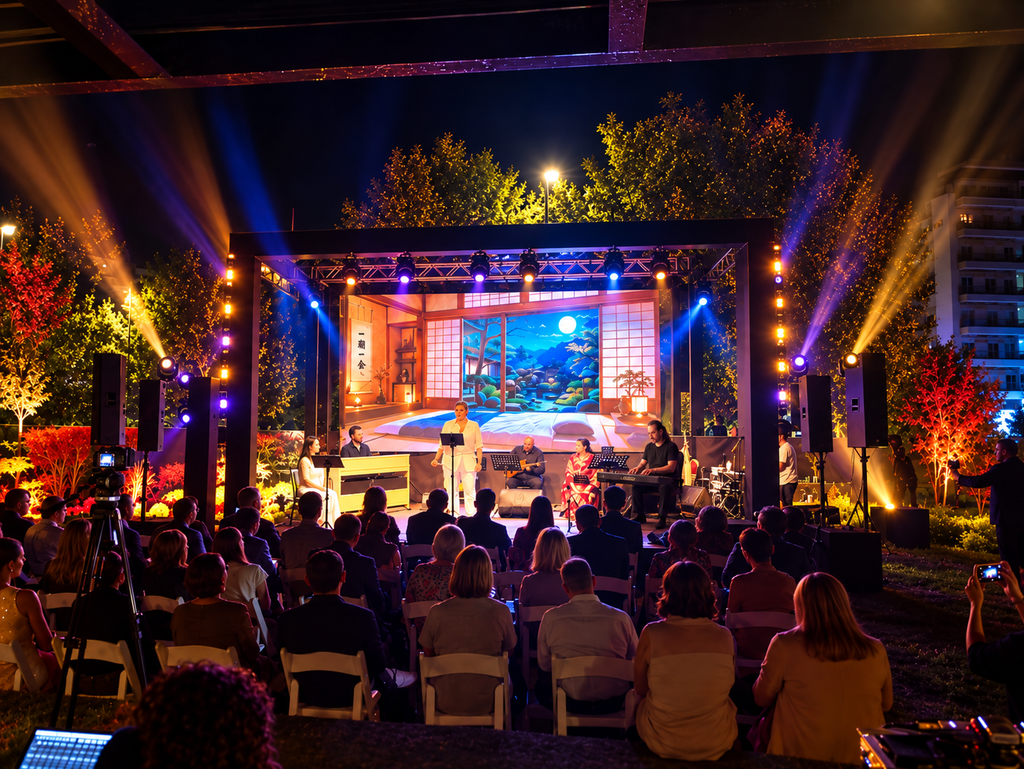
Which track best captures the difference between the composer you were in 2002 and the composer you are now?
I would probably choose “TERRA OLYMPIA,” the title track.
For me, it contains something essential about the relationship between where I come from and where I am now.
Melody is still there. That has always been part of me. Emotion is still there. But around them there is now a very different relationship with texture, rhythm, atmosphere and space.
Twenty-four years ago, my first instinct might have been to translate many of these emotions into orchestral terms. Today I can hear a synthesizer, an electronic texture, a pulse or even silence as an expressive voice in itself.
What matters to me is that artistic evolution should not require us to erase who we were.
I carry the composer of 2002 with me. I simply hear a much larger world around him now.
Every experience adds something to that world: people, places, cultures, joy, loss, memory, encounters. Eventually some of those things find their way into the music, even when we are not consciously looking for them.
So for me the title track contains both continuity and change.
The roots are the same. The musical horizon has changed.

What would you want a Los Angeles 2028 presentation to communicate about where your work is headed?
If TERRA OLYMPIA were to find a place in Los Angeles in 2028, I would not want it simply to say, “Here is music inspired by Ancient Greece.”
I would want it to communicate something much more contemporary: that cultural memory can still generate new forms, new sounds and new conversations.
The Olympic idea has followed my work for many years, but what continues to interest me is not nostalgia for the ancient world. It is the human idea beneath it: effort, excellence, dignity, peace, encounter between cultures, and that very human desire to move beyond our own limitations.
Today I also think that conversation has to include our responsibility toward one another and toward the planet we share.
We may speak different languages and carry different histories, but before all those differences we are human beings sharing the same world. Music has the extraordinary ability to remind us of that without needing to make a speech.
Los Angeles would be a particularly meaningful place for such a dialogue because it is a meeting point of cultures, technology, music, cinema and different forms of storytelling.
And that reflects something about where I feel my own work is heading: toward a freer dialogue between orchestra and electronics, music and image, live performance and new technology, always keeping human emotion at the centre.
I would love such a presentation to become more than simply a performance of an album. I imagine a musical and visual experience where sound, image, space, technology and live performance belong to the same world.
For me, Los Angeles 2028 is not about bringing the past to the future. It is about asking what the values we inherited can mean for the future.
Olympia once represented the possibility of people meeting beyond their differences. Perhaps one of its most important messages today remains remarkably simple:
We share one world.
That is a message I would be proud for my music to carry.
What did making TERRA OLYMPIA reveal about the composer you want to be after this album?
TERRA OLYMPIA reminded me that I don’t want to become a composer who is defined by one sound.
Earlier in my life, perhaps I felt more of a need to understand where I belonged: symphonic music, theatre, opera, audiovisual work, electronic music. Today I am much less interested in those boundaries.
What matters to me is whether an idea feels alive and truthful.
If it needs a symphony orchestra, I want to write for an orchestra. If it needs electronics, voices, theatre, images or silence, I want to have the freedom to follow it there. And I want to explore much more deeply the meeting point between music, cinema and visual storytelling.
That freedom is very close to what I call Music of Life.
Music of Life is not a genre. It is simply my belief that music begins with life itself: with people, love, loss, memory, nature, history, cultures, encounters and everything that changes us.
Technology can expand that language enormously. I embrace that possibility. But technology is still a tool.
Technology can expand the language, but it cannot decide what you need to say.
The human reason for making music remains at the centre.
And as I grow as an artist, I feel increasingly that art also carries a human responsibility. I don’t mean that every piece of music has to deliver a message. But I would like the world behind my music to stand for something human: dignity, dialogue, peace, respect for other cultures and respect for the world we share.
TERRA OLYMPIA gave me greater confidence to follow that path without worrying too much about whether a work fits comfortably into one category.
What I want to carry forward is not a particular sound, but the freedom I discovered while making it.
I want to remain curious. I want to continue meeting other cultures and other artists. I want to move further into cinema and visual storytelling. And I want every new project to take me somewhere I have not been before.
I don’t want my next work simply to sound like TERRA OLYMPIA.
I want the next work to ask me a new question.
Because for me there is never really a final destination.
There is always another horizon, another human story waiting to become music.
And perhaps, in the end, that is the simplest definition of Music of Life.

Magnetic byline note: This byline is used for staff produced updates and short announcements, often based on press materials and official release information. Editorial responsibility: David Ireland (Editor in Chief) and Will Vance (Managing Editor). About: https://magneticmag.com/about/ Masthead: https://magneticmag.com/masthead/ Contact: https://magneticmag.com/contact/