A lot of audio interfaces are sold on clean conversion, more I/O, and low-latency performance.
Those things matter, but they do not always answer the more interesting question for producers: what happens before the sound ever reaches the DAW?
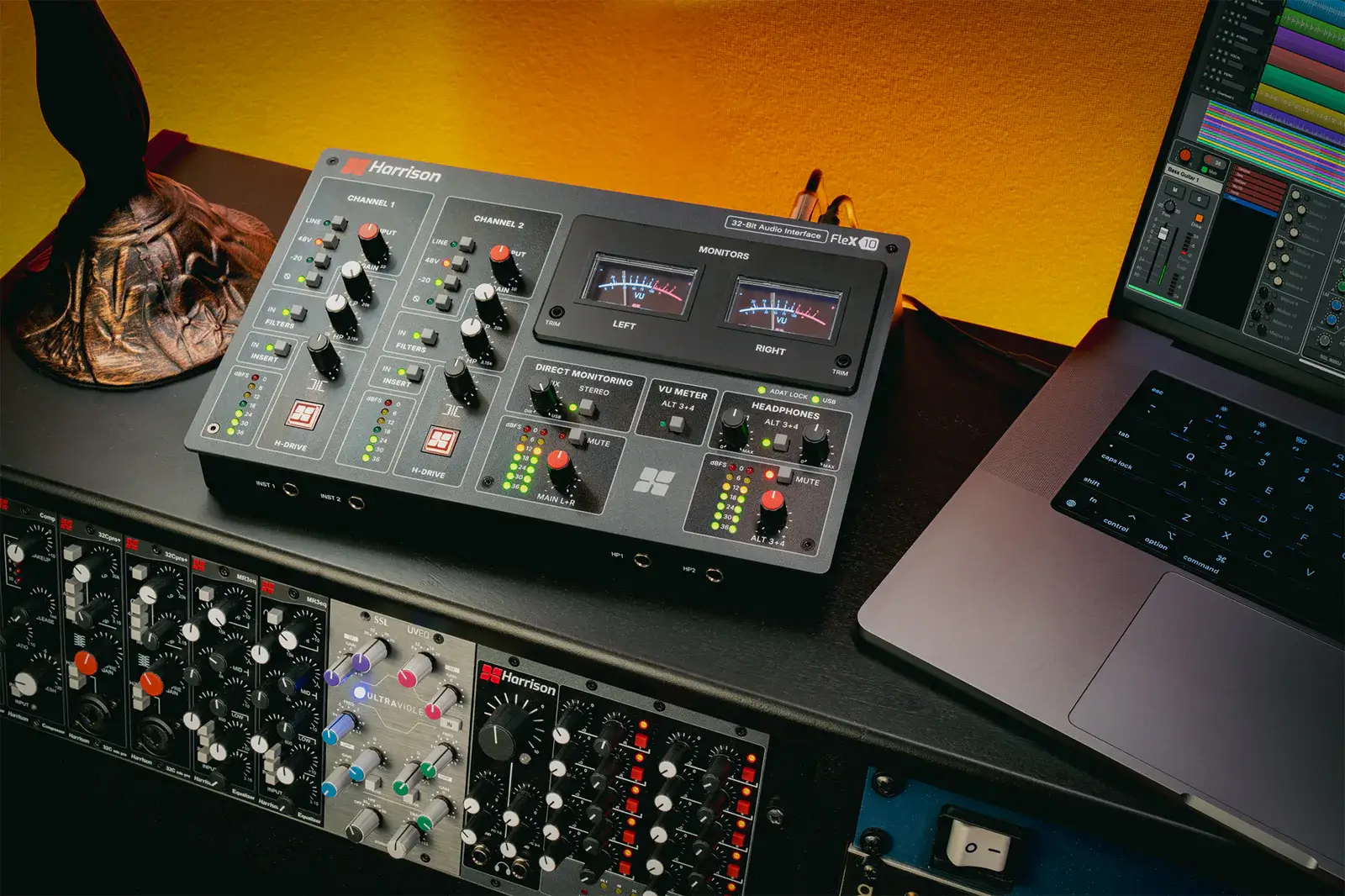
That is where Harrison Audio’s new Flex-10 feels more interesting than a normal desktop interface announcement. It is a 10-in/12-out USB-C and ADAT interface built for compact studios, mobile rigs, and hybrid producer setups, but the real hook is the front end. Flex-10 brings two Harrison mic preamps, H-DRIVE transformer saturation, classic high-pass and low-pass filters, and balanced insert points into a desktop unit built around modern 32-bit/192 kHz conversion.
That gives producers a choice at the first stage of the recording chain. They can capture a cleaner reference signal, push into warmer saturation, filter the source before it hits the session, or bring outboard gear into the recording path without turning the desk into a patchbay nightmare.
For producers working in small rooms, that kind of hands-on control can be more inspiring than another interface that only promises transparency.
To learn more about the Flex-10, please visit www.harrisonaudio.com or contact your local Harrison retailer.
The H-DRIVE stage is the main story
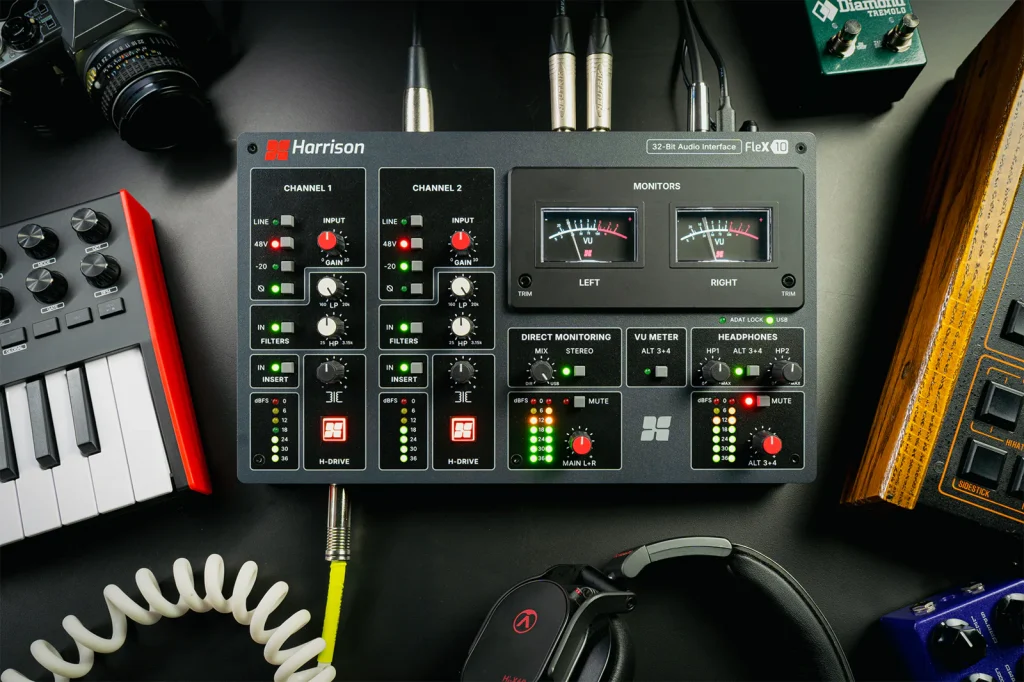
Flex-10 includes two H-DRIVE transformer circuits, one on each preamp channel.
That is the feature that gives the interface its personality. Harrison is drawing from the company’s long console heritage, and the point is to let users add real transformer saturation at the input stage rather than waiting to fake all of the character later with plugins.
That distinction matters.
Producers often spend a lot of time trying to make digital recordings feel less sterile after the fact. Flex-10 gives them a way to make that decision earlier. A vocal can be recorded with a little more density. A bass can be pushed into more attitude. A vintage synth or drum machine can hit the converters with some extra harmonic color. A guitar can come in with more edge before the session starts filling up.
This is not about making every source dirty. It is about having the option to commit earlier when the sound asks for it.
That is also why Flex-10 sits naturally beside my review of the Arturia AudioFuse 16Rig, where the bigger appeal was not only I/O count, but how well an interface can become the center of a producer’s hardware setup. Harrison’s approach is different, but the core question overlaps: can the interface do more than pass audio?
With Flex-10, the answer is clearly yes.
The filters make recording feel more intentional
The classic Harrison high-pass and low-pass filters on Flex-10 are pulled from the filter design of the company’s 32 Series consoles.
That is a smart addition because filters are one of the easiest ways to make better recording decisions before a take enters the DAW. A high-pass filter can clear low-end rumble from vocals, guitars, room mics, or acoustic sources. A low-pass filter can tame edge or narrow a sound before it starts fighting the rest of the track.
Most producers already use filters constantly in the mix. Having them on the way in changes the feel of the process.
It encourages commitment. It makes the input stage more active. It lets the producer shape the source while the artist is still performing or while the synth is still in front of them. That kind of tactile decision-making can be a big deal in a home studio, where the workflow often becomes too screen-heavy.
The Flex-10 also includes line level, 48V phantom power, a -20 dB pad, and phase inversion on each channel, plus two front-panel quarter-inch inputs for guitars, basses, vintage synths, drum machines, and other instrument-level sources.
For a compact desktop box, that is a clear producer-first layout.
ADAT keeps the interface from feeling boxed in
Flex-10 has eight channels of ADAT I/O, which is what keeps the interface from being limited to a small two-preamp setup.
That expandability matters because home studios rarely stay the same size. A producer may begin with a mic, a guitar, and a synth, then eventually add drum machines, outboard preamps, a 500 Series rack, hardware effects, or a second room’s worth of gear. ADAT gives Flex-10 a way to grow into those setups instead of becoming the first thing that has to be replaced.
Harrison points to pairing Flex-10 with the D510r 500 Series rack and D510UA ADAT interface to create a 10-in/12-out hybrid production rig. Even without that exact pairing, the logic is clear: Flex-10 can start as a desktop interface and later become part of a more expanded hardware system.
That puts it in the same general conversation as my article on audio interfaces for hardware synth setups, where the key issue is not only sound quality, but whether the interface has enough routing and expansion to keep up with the studio as it grows.
Flex-10 is aimed at that middle point: compact enough for the desk, expandable enough to avoid feeling temporary.
Monitoring is built for real studio use
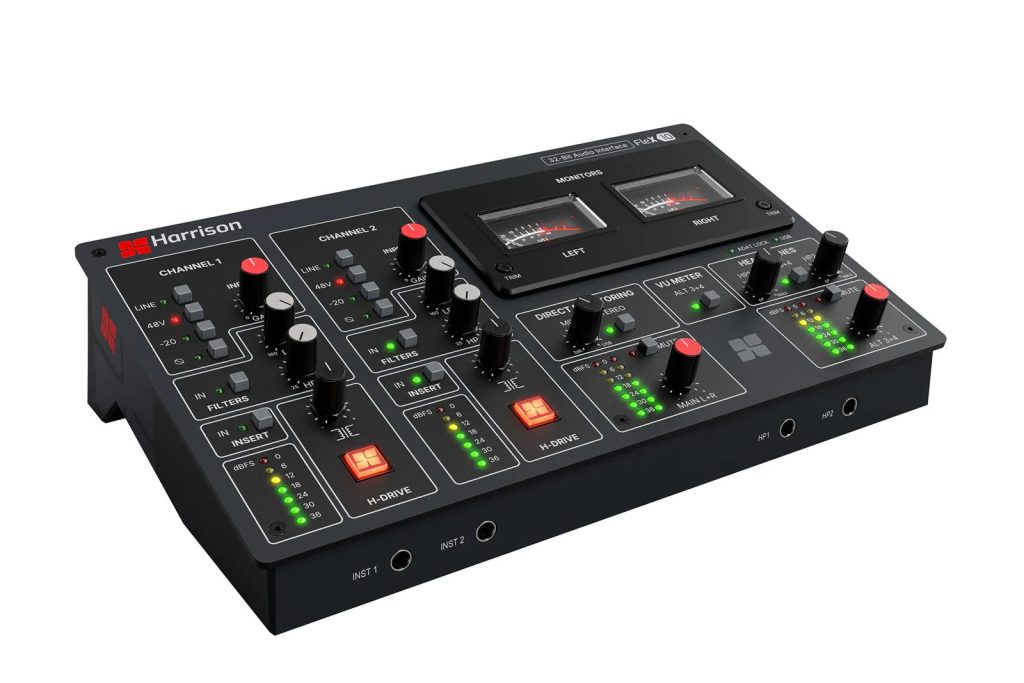
Flex-10 includes two independent monitor outputs with dedicated level controls, plus two headphone outputs.
That is the kind of detail that sounds ordinary until the session needs it. A producer may want one speaker pair for the main monitors and another for a secondary check. A songwriter may need one headphone feed while an engineer needs another. A small studio may need to flip quickly between monitoring setups without repatching the room.
The VU meters also give the interface a different relationship with the user.
Meters are not only visual nostalgia. They can help producers see level movement during recording and playback without staring only at the DAW. That matters because the whole Flex-10 concept is partly about pulling decisions back onto the desk: gain, saturation, filtering, monitoring, inserts, and level.
It is a small thing, but visual feedback changes how a piece of gear feels in use.
For producers who like tactile studio objects, VU meters can make an interface feel less like a utility box and more like part of the creative chain.
Inserts are the sleeper feature
Flex-10 includes a balanced insert point on each channel.
That may be one of the most important features for producers who still like hardware. It means compressors, 500 Series modules, EQs, pedals, or other analog processors can sit directly in the input path.
That opens a lot of real studio use cases.
A vocal chain can hit the Harrison preamp, move into a compressor, then return to the interface. A bass can be shaped before conversion. A synth can run through a boutique pedal or outboard color box on the way in. A producer can record through a preferred hardware chain without turning setup into a pile of cables.
It also fits the current hybrid-studio mindset. Many producers are not trying to build giant commercial rooms. They want one or two great front-end channels that feel good, sound good, and make tracking more fun.
Flex-10 seems built for exactly that kind of desk.
Mixbus 12 and the Creator Pack make it more complete
Flex-10 ships with a full license for Harrison Mixbus 12.
That matters because Mixbus extends the Harrison concept into the software side. The DAW is built around an analog console-inspired workflow and includes Harrison’s console EQ on every channel. For a new user, that means the interface is not arriving alone. It comes with a recording and mixing environment designed around the same heritage as the hardware.
The Harrison Creator Pack also bundles virtual instruments, plugins, loops, and samples from partners including Solid State Logic, Slate Digital, Sonible, Loopcloud, AAS, Native Instruments, IK Multimedia, and more.
That kind of bundle can help new producers move faster because the purchase covers more of the early studio chain: interface, DAW, effects, instruments, samples, and mix tools. It also gives existing producers a wider software package around a piece of hardware they may already be buying for the preamps and saturation.
For related context, our article on Harrison’s 32Classic Mix Strip showed how the company has been bringing its console language into smaller, more accessible production formats. Flex-10 feels like another move in that same direction.
Flex-10 is a desktop interface with a point of view
The Harrison Flex-10 is not trying to be the most anonymous interface in the room.
That is a good thing.
Its value comes from having a point of view: two Harrison preamps, transformer saturation, classic filters, inserts, VU meters, ADAT expandability, MIDI I/O, flexible monitoring, Mixbus 12, and a software bundle that turns the box into more of a complete production entry point.
For artists and producers who want their interface to stay invisible, there are plenty of clean utility options already. Flex-10 is for the producer who wants the recording stage to feel like part of the sound.
That does not mean every take needs to be saturated, filtered, and committed on the way in. It means the choice is there before the track becomes another pile of plugins.
That is the real appeal of Flex-10.
It puts a little console decision-making back on the desk, right where the recording begins.

Will Vance is a professional music producer who has been involved in the industry for the better part of a decade and has been the managing editor at Magnetic Magazine since mid-2022. In that time period, he has published thousands of articles on music production, industry think pieces and educational articles about the music industry. Over the last decade as a professional music producer, Will Vance has also ran multiple successful and highly respected record labels in the industry, including Where The Heart Is Records as well as having launched a new label with a focus on community through Magnetic Magazine. When not running these labels or producing his own music, Vance is likely writing for other top industry sites like Waves or the Hyperbits Masterclass or working on his upcoming book on mindfulness in music production. On the rare chance he's not thinking about music production, he's probably running a game of Dungeons and Dragons with his friends which he has been the dungeon master for for many years.