Getting a kick and bassline to work together is one of those production problems that can take considerably longer than it should, especially when the individual sounds seem fine on their own but start competing for space once the arrangement fills out.
Increasing the bass level rarely solves the underlying issue, and sometimes it makes things worse by adding more low-frequency energy to a mix that already has enough of it. What you actually need might be more harmonic information, a tighter envelope, additional transient impact, or better control over the frequencies the kick and bass occupy.
That’s the problem 2B Played Music is attempting to address with BassFrame, a dedicated low-frequency processor released in September 2026 that brings several bass enhancement techniques into one plugin. Instead of concentrating exclusively on EQ or saturation, BassFrame includes five different processing engines, with each designed to influence a particular characteristic of the incoming audio. The plugin also provides dedicated controls for frequency selection, harmonic enhancement, tonal balance, and parallel processing, giving producers different ways to adjust their low end without building an extensive effects chain.
The company is currently promoting BassFrame through a limited flash sale, reducing its advertised price from $89.99 to $24.99 with coupon code FLASH2499.
The promotion ends November 4, making this a short window for producers considering another low-frequency processing tool. The discount is particularly relevant because BassFrame includes several functions that would otherwise require separate processors, although whether those functions improve a particular mix depends on the original material and how they’re applied.
Five Processing Engines for Different Bass Problems

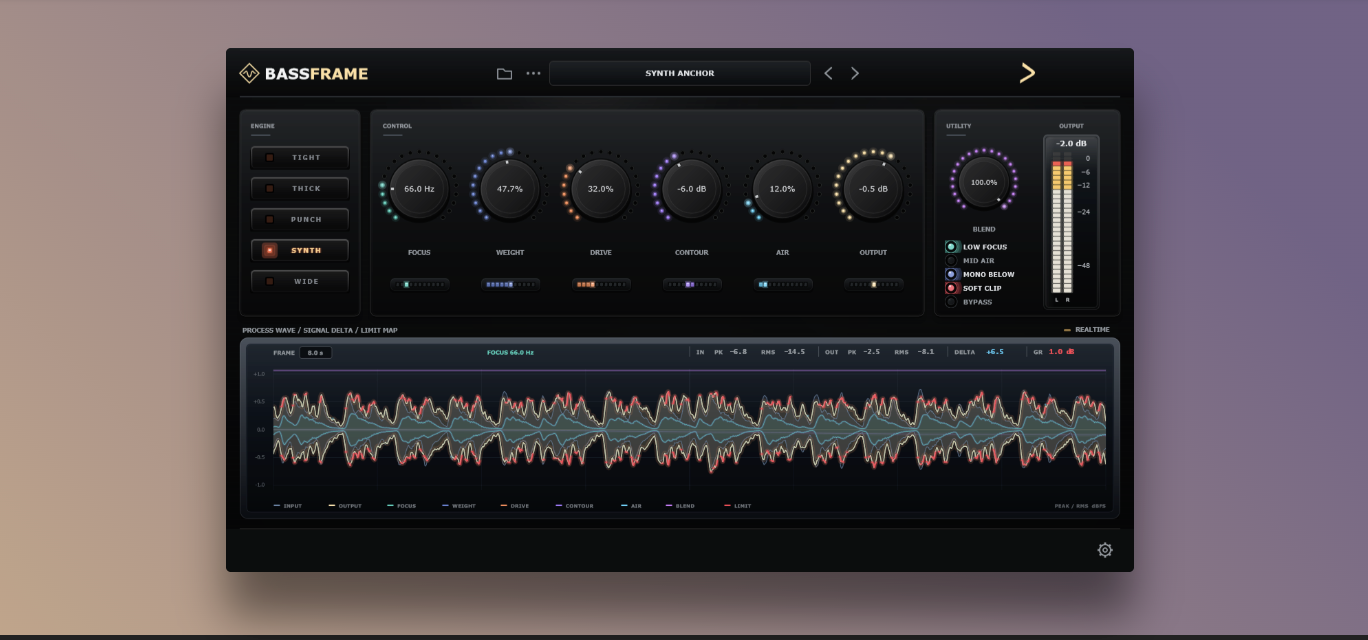
BassFrame’s main feature is its collection of five processing engines, each addressing a different aspect of low-frequency sound. TIGHT concentrates on controlling and defining the bass, while THICK introduces additional harmonic density and body. PUNCH focuses on attack and transient impact, making it appropriate for kick drums and other sounds that need greater definition at the beginning of each hit. SYNTH generates an octave-down layer that follows the detected pitch of the incoming signal, while WIDE expands upper bass harmonics without applying the same stereo treatment to the deepest frequencies.
That distinction between low-frequency level and perceived bass presence is important.
A bassline can contain considerable energy below 100 Hz while remaining difficult to hear on smaller speakers, particularly when the playback system cannot reproduce those frequencies effectively.
Adding higher-frequency harmonic content can help the bass stay audible without requiring an equivalent increase in sub-bass level. I discussed that relationship in my review of Soundtoys Decapitator, where harmonic saturation was particularly relevant for improving the presence of bass sounds across different listening systems.
BassFrame’s SYNTH engine addresses a different problem by generating an additional octave below the incoming material, potentially providing more extension when the original recording lacks sufficient low-frequency content. That approach requires careful attention to pitch detection, available headroom, and the relationship between the new layer and the original signal. We explored similar considerations in our coverage of Baby Audio’s SubCulture, another processor designed around pitch-aware bass generation. BassFrame offers additional processing modes beyond that function, allowing producers to select the type of enhancement according to the material they’re working with.
BassFrame Adds More Control Than a Standard Bass Enhancer
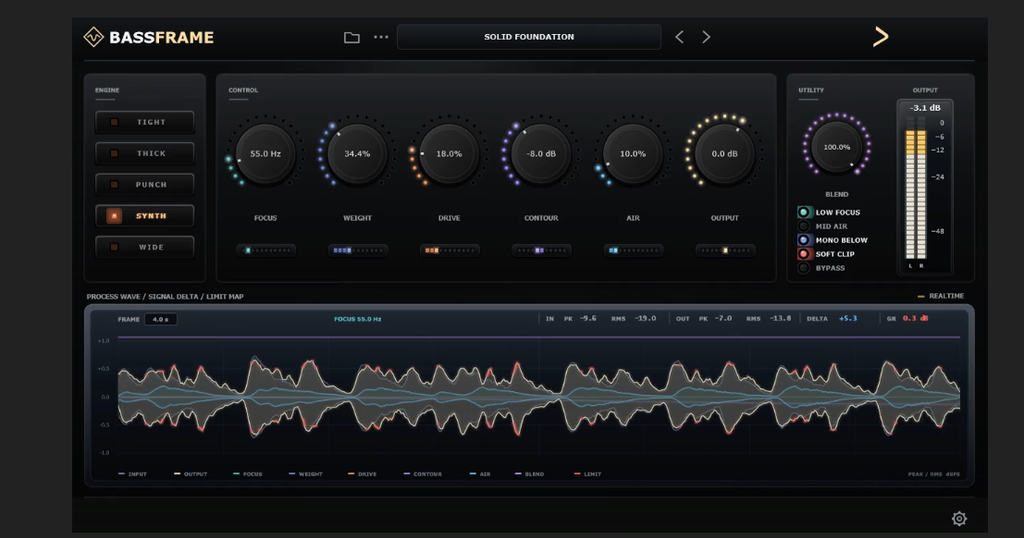
Beyond its five engines, BassFrame includes a FOCUS control that determines the frequency area receiving attention, with WEIGHT adjusting the amount of reinforcement. DRIVE introduces additional harmonics, while CONTOUR and AIR provide further control over tonal balance and higher-frequency definition. Additional functions include LOW FOCUS, MID AIR, and MONO BELOW, the latter helping keep the lowest frequency content centered when stereo enhancement is applied elsewhere.
The plugin also includes a BLEND control for parallel processing, which is especially useful when adding saturation or extra bass energy. Instead of applying the complete processed signal, producers can combine it with the original audio and adjust the result according to the surrounding mix. A SOFT CLIP control provides additional output peak management, while the real-time display shows input and output levels, gain reduction, and changes introduced by the processing.
For producers making house and techno, these controls could be particularly relevant when balancing kick drums against sustained or repeating basslines. In our How It Was Made feature with Angara, the duo discussed using phase adjustment, transient shaping, and visual analysis to manage the relationship between their kick and bass. BassFrame approaches some related low-frequency concerns through harmonic processing and tonal adjustment, although it should be considered an additional processing option rather than a substitute for appropriate sound selection, arrangement, and phase management.
BassFrame Flash Sale Pricing and Availability
2B Played Music’s advertised flash sale reduces BassFrame to 24.99 from 89.99, using coupon code FLASH2499 at checkout. The offer is scheduled to expire November 4, 2026. Because the discount is distributed through a promotional email and the public storefront displays different pricing according to region, customers should confirm their currency and final total before purchasing.
BassFrame supports VST3 and AAX on Windows and macOS, with AU available on macOS. It also includes 50 factory presets, a scalable interface, and a seven-day unrestricted trial for producers who want to evaluate the processing before committing to a purchase. Its five engines cover several different approaches to bass enhancement, from relatively restrained tonal adjustments to more pronounced harmonic processing and octave generation.
For producers who regularly spend time addressing low-frequency balance, BassFrame provides a collection of processing options within one interface. The most important consideration is still identifying what the source actually needs before applying additional processing, particularly because excessive bass enhancement can introduce masking, distortion, and unnecessary energy that makes a mix harder to control. At the advertised promotional price, however, the plugin is worth investigating for producers who want additional control over their kick drums, bass instruments, and low-frequency material.
More information and the trial are available through the official BassFrame product page.

Will Vance is a professional music producer who has been involved in the industry for the better part of a decade and has been the managing editor at Magnetic Magazine since mid-2022. In that time period, he has published thousands of articles on music production, industry think pieces and educational articles about the music industry. Over the last decade as a professional music producer, Will Vance has also ran multiple successful and highly respected record labels in the industry, including Where The Heart Is Records as well as having launched a new label with a focus on community through Magnetic Magazine. When not running these labels or producing his own music, Vance is likely writing for other top industry sites like Waves or the Hyperbits Masterclass or working on his upcoming book on mindfulness in music production. On the rare chance he's not thinking about music production, he's probably running a game of Dungeons and Dragons with his friends which he has been the dungeon master for for many years.