Table of Contents
Moog Music just announced something that’s about to hit all the right notes for synth lovers, producers, and live performers alike.
The new Moog Messenger is a compact monophonic analog synth that’s rich in tone, heavy in features, and surprisingly accessible. Officially landing in early June 2025, this is Moog’s answer to the modern-day monosynth — and it’s bringing wavefolding, redesigned filters, full-size keys, and serious modulation in a format that fits anywhere.
If you’ve been waiting for a synth that blends Moog’s iconic warmth with the control and flexibility needed in 2025, this might just be it.
At a Glance: What to Know About the Moog Messenger
- It’s Moog’s most accessible full analog synth — priced at $899 with a massive feature set
- Classic Moog ladder filter reimagined with multiple responses and bass-preserving resonance
- Wavefolding oscillators and a sub-oscillator with dynamic shape give it rich, evolving tone
Modern Sound Engine, Classic Mojo
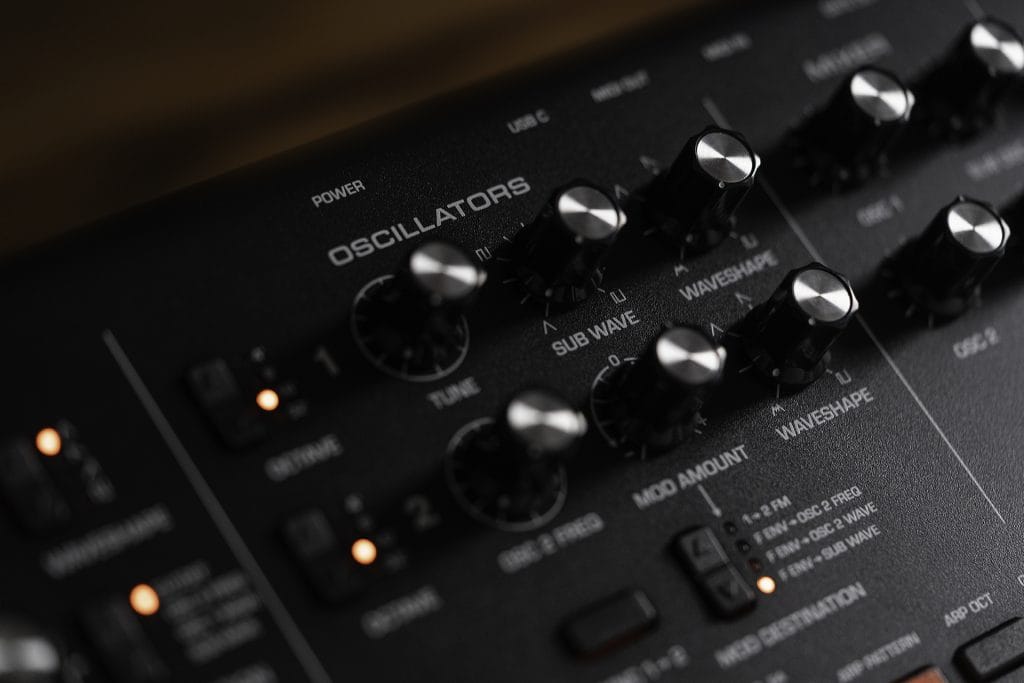
Let’s get into what makes the Moog Messenger tick. At the core, you’ve got two analog VCOs with continuously variable waveforms and built-in wavefolding. That’s not something you typically see on Moog gear, and it opens the door to way more harmonic content and textural variety than what the Minimoog or Grandmother ever offered.
There’s also a sub-oscillator with a fully morphable shape that adds serious low-end punch. Whether you’re making acid-style basslines, evolving cinematic drones, or tight mono leads, this synth responds with richness and control.
The filter section is where longtime Moog fans are going to lean in. You still get that signature transistor ladder filter, but it’s been overhauled. There are multiple filter modes (4-pole LP, 2-pole LP, BP, HP), and a resonance bass compensation switch that keeps the low end intact even when resonance is cranked. You can even switch back to the classic filter behavior if you’re after vintage authenticity.
Performance-Ready Interface Built for Real Musicians
The Messenger’s front panel layout makes it clear — this isn’t for menu diving. Every function gets a dedicated knob or button, keeping sound design immediate and intuitive. From LFO settings to envelope adjustments and sequencer controls, it’s all right there.
The full-size 32-key keyboard is semi-weighted, velocity-sensitive, and includes aftertouch. Moog clearly designed this for musicians who want that tactile response whether they’re on stage or in the studio. Add in 256 onboard presets, and you’ve got fast access to sounds that span classic to experimental.
The built-in sequencer is worth calling out. You get 64 steps, with probability options, parameter automation, and real-time recording. There’s also a versatile arpeggiator, rounding out a performance toolkit that rivals more expensive workstations.
Deep Modulation and Tight Integration

One of the Moog Messenger’s biggest strengths is its modulation engine. Two LFOs, each with its own modulation target and sync settings, give you plenty to work with. Then you’ve got two loopable ADSR envelopes that are velocity-sensitive and retrigger-friendly — perfect for pads, plucks, and complex rhythmic patches.
On the connectivity side, Messenger keeps things wide open. You get six CV patch points, an external audio input for running sounds through its filter, sustain and expression pedal jacks, and full MIDI I/O via 5-pin DIN and USB-C. That means it plays nice with DAWs, hardware rigs, Eurorack setups, and anything in between.
Heritage Meets Innovation — and It’s All Under $900
Moog says the Messenger is about honoring its history while opening up new sonic terrain, and that’s exactly what it does. For players new to synthesis, it’s a hands-on way to learn real synthesis with none of the frustrating roadblocks. For veterans, it’s a portable, deep, and expressive machine with enough power to anchor a rig or cut through a mix.
You’ve also got creative partnerships kicking off the release. Akai dropped a short film, Arrival of the Messenger, with an original score by Michael Stein (Stranger Things) made entirely with the Messenger. Plus, synth wizard Lisa Bella Donna is demoing the Messenger’s presets in a dynamic performance that showcases everything this little monster can do.
Conclusion: Moog Messenger Is Ready to Lead a New Analog Era
Whether you’re building your first setup or expanding a high-end rig, the Moog Messenger earns its place. It’s compact, affordable, and packed with modern tools — all while staying true to that unmistakable Moog identity. With new-school wavefolding, vintage-style tone, and deep modulation, this is more than a synth drop — it’s Moog signaling its next era.
Messenger hits stores June 2, 2025, for $899. Head to moogmusic.com for details and check it out on socials via @MoogSynthesizers and @MoogMusicInc.

Magnetic byline note: This byline is used for staff produced updates and short announcements, often based on press materials and official release information. Editorial responsibility: David Ireland (Editor in Chief) and Will Vance (Managing Editor). About: https://magneticmag.com/about/ Masthead: https://magneticmag.com/masthead/ Contact: https://magneticmag.com/contact/