VPORT’s Apple Vision Pro launch starts from a frustration every music fan knows: some of the best sets happen in rooms you simply cannot reach. The show is in another city. The travel costs too much. It falls on the wrong night. The venue is sold out. Or, more commonly, the event happens once, ends, and then basically disappears for anyone who was not there.
The Seattle-based immersive entertainment platform officially launched its Apple Vision Pro experience on September 20, 2026, bringing live-streamed and on-demand music performances to Apple’s spatial computing headset. Depending on the content, VPORT experiences can include standard 2D video, 360° viewing, 3D, and spatial formats designed to give fans a stronger sense of presence than a traditional fixed-camera concert video.
That matters because live music has always had a hard ceiling: the room.
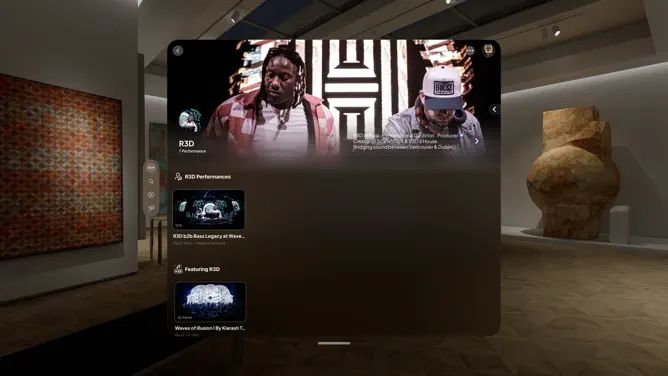
A venue can only hold so many people, and a night only lasts so long. VPORT is trying to stretch both limits at once by giving fans a way to watch performances live or return to them later, while giving artists, venues, promoters, and creators another way to earn from audiences outside the physical event.
This is not a replacement for being there. It should not be judged that way.
The better question is whether immersive viewing can make remote access feel more like an experience and less like watching a flat recap of something you missed. That is where Apple Vision Pro gives VPORT a more specific lane than a standard livestream platform.
Apple Vision Pro Gives VPORT a Clear Use Case

The Apple Vision Pro angle is important because immersive music platforms need hardware that can justify the extra production effort. A 360° or 3D concert capture does not mean much if the viewer is only watching it as another window on a laptop. On Vision Pro, supported performances can appear at real-world scale, with stereoscopic 3D where the original footage supports it, and viewers can look around the environment rather than staying locked to one fixed angle.
That changes the relationship between fan and footage.
A standard concert stream often asks the viewer to accept someone else’s edit of the night. VPORT’s more immersive format gives the viewer more agency inside the captured space, especially when the content supports 360° or spatial presentation. You are still remote, but you are not fully passive.
That is also why VPORT’s early work with artists and event partners including unders, Harbour Event & Convention Center, and Porta Music Festival is worth noting. The platform needs content that benefits from the format, not only any random set placed inside an app.
For more background on the creative implications of Apple’s headset, my earlier article on Apple Vision Pro and music creators is still a relevant companion. VPORT gives that broader idea a more concrete live-music application.
The Pricing Model Avoids the Subscription Trap

VPORT is not launching around a standard monthly subscription. Instead, fans can choose the events or performances they want to view. Paid content is offered at three per-minute tiers: US$0.03, US$0.05, and US$0.08 per minute, depending on the event or content. Free events can be watched without entering a credit card.
That model is interesting because it fits the way people already think about events. Most fans do not want every show from every venue.
They want the one set they missed, the one artist they care about, the one replay they want to revisit, or the one festival moment that feels worth sitting down for. Per-minute pricing gives VPORT a flexible structure without forcing every user into another monthly bill.
There are tradeoffs to think about though….
Per-minute pricing needs to feel transparent, especially for longer sets. Fans will want to understand what they are paying before they get pulled into an hour-long replay. But as a starting structure, it makes sense for a catalog where content value can vary significantly from one performance to another.
The artist and venue side is the more important part.
VPORT’s stated goal is to help artists, creators, venues, and promoters monetize beyond the room, during live performances and after the event has ended. That afterlife is where the model could become most meaningful. A live set no longer has to stop earning when the lights come up.
We have covered the business side of live-streamed music before in my interview with Darran Bruce on building one of electronic music’s longest-running livestream platforms. VPORT is not the same kind of platform, but it is working on the same fundamental problem: how live music can reach people who are not physically in the room.

Will Vance is a professional music producer who has been involved in the industry for the better part of a decade and has been the managing editor at Magnetic Magazine since mid-2022. In that time period, he has published thousands of articles on music production, industry think pieces and educational articles about the music industry. Over the last decade as a professional music producer, Will Vance has also ran multiple successful and highly respected record labels in the industry, including Where The Heart Is Records as well as having launched a new label with a focus on community through Magnetic Magazine. When not running these labels or producing his own music, Vance is likely writing for other top industry sites like Waves or the Hyperbits Masterclass or working on his upcoming book on mindfulness in music production. On the rare chance he's not thinking about music production, he's probably running a game of Dungeons and Dragons with his friends which he has been the dungeon master for for many years.