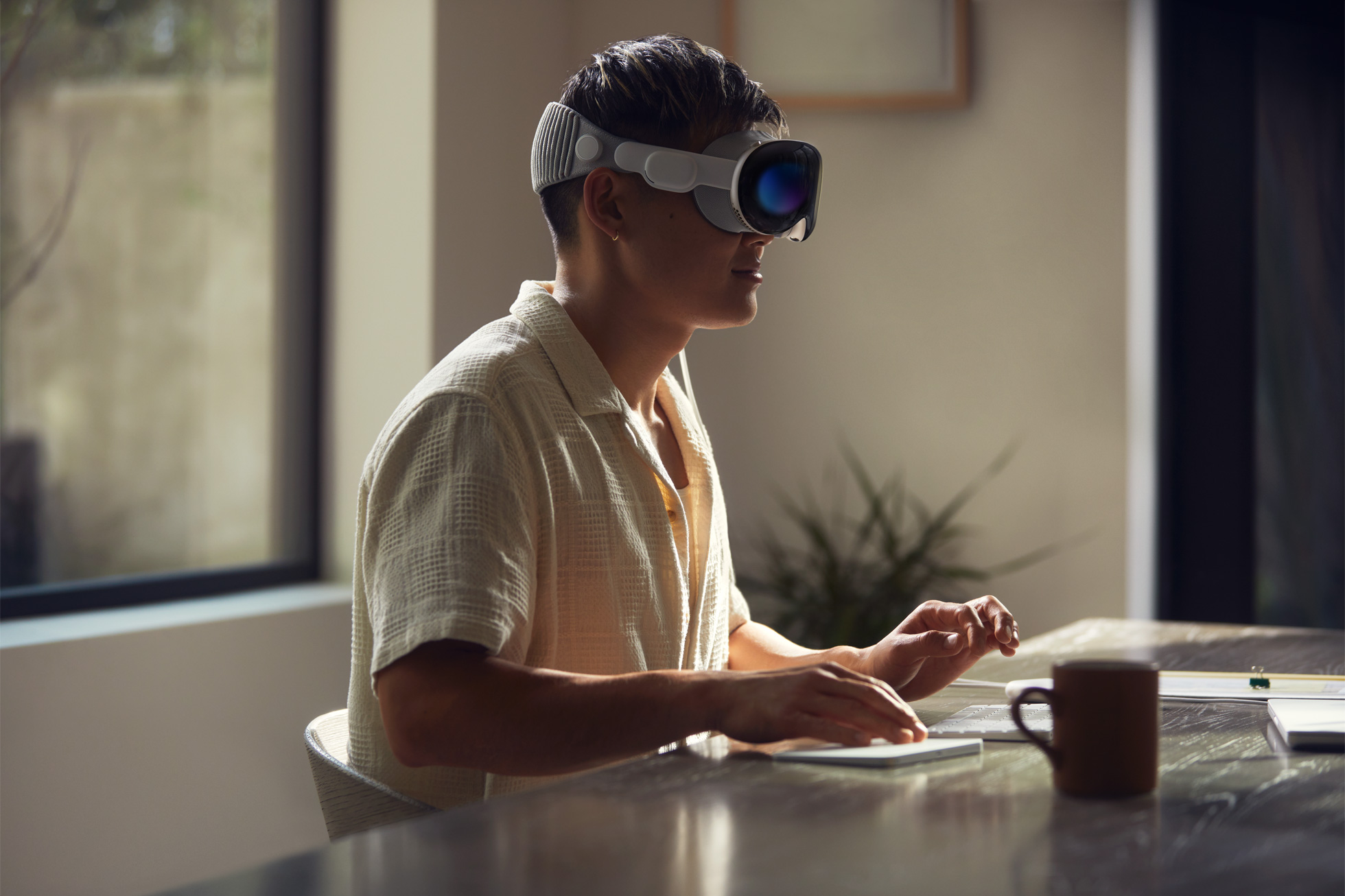
With Apple’s announcement at the beginning of June, everyone’s raving over, scared of, or somewhere in between regarding the Apple Vision Pro headset. During its WWDC presentation, Apple highlighted many recreational and office uses of the Vision Pro, including watching movies with infinitely large screens and having endless displays and windows for your work email and presentations. One area Apple did not address was the potential for creatives to work and create–besides developers, of course, who will have six months (give or take) to develop content for the Vision Pro when it launches “early next year.”
The introduction of more commonplace VR and AR hardware will create a new platform for artists to create and expand on their music. As of now, the Apple Vision Pro will launch for a very steep $3,499 in the US, but as with most firsts in Apple’s (and other brands’) product lines, there’s sure to be a more affordable version to follow. Most of the concepts below rely on Apple releasing that more affordable successor to the Vision Pro, however.
This will likely mean major labels and artists will be the first adopters of these opportunities like they were with Spotify Canvases and Dolby Atmos. Still, eventually, the availability of this technology will expand to the masses. Side note: David Guetta has already held his first DJ set while Pioneer offers DJing lessons, both in the “Metaverse,” however, Meta’s VR division is not doing well and has not generated nearly as much interest as Apple’s, likely partially because no one considers Meta a hardware company.
For artists and their tour teams
The Apple Vision Pro could become a gateway to enable visualization of a venue beforehand and simulate lighting and stage designs, enabling designers and artists to make the most of a venue space by allowing teams to preview the fruits of their designs. Especially with the wide range of lighting systems a venue might offer or have on hand, having the venue create a virtual template that lighting designers could use to design and test beforehand would enable them to make the most of the venue before they ever step foot in it.
This also would allow the artist(s) to preview these setups and plans beforehand and suggest changes, should they want any.
For artists and fans
One realistic use case of Apple’s future AR/VR headsets is for artists to create immersive visualizers, particularly for electronic music. With the right technology, this could add to the experience of listening to a song without the need for expensive VR software if (with affordable headsets in the future), the artist or someone on their team can build a simple, but complementary visualization that enhances the experience of listening to a song. There will surely be several third-party apps that will enable this, potentially even with the use of generative AI, eventually making a VR or AR version of a Spotify Canvas or Apple Music’s Animated Album artwork realistic and accessible for artists and fans alike.
Another way fans (and event organizers) could benefit from VR and AR technology (if it comes to the masses) is by creating VR live streams of concerts or festivals for those who can’t make it to the likes of Coachella because there’s work the next day or simply because you live too far. For smaller and independent artists, hosting virtual concerts would provide another way to expand their audience, without the geographic limitations or having to rent a venue.
For Engineers
When working with music in Dolby Atmos, you can usually see on your screen what sounds are positioned where through a visual representation surrounding your (the listener’s) head. However, when you have a ton of windows and controls on even a relatively large display, things can start to get messy. The Apple Vision Pro could provide a way to visualize these objects and bed tracks with AR, and could also use its adaptive technology to adjust the mix to a flat reference. Apple demonstrated how (using a number of built-in sensors) the Vision Pro could detect the objects and geometry of your environment, and tailor Spatial Audio to that. Whether this feature makes it to production is to be seen, but if it does, that would make this a really impressive tool, especially because even with the best speaker setups and acoustic treatment, it can be hard to monitor Atmos mixes in multiple and realistic environments.
For Other Sound Designers
There are an increasing number of relaxation and focus apps that leverage Spatial Audio on AirPods and other devices to help you get into focus in a conducive environment, and developers could create entirely new sensory experiences designed to help you focus or relax.
As more content is adapted and created for AR and VR applications, the possibilities will grow endlessly. The potential for new audio-visual experiences is unlimited, and there are already several video games that support Dolby Atmos. It’s likely that any video games that launch for visionOS will also support some form of Spatial Audio if not Dolby Atmos, and it probably won’t just be games.
Final Thoughts
The potential for the Vision Pro to help revolutionize how we interact with sound as we know it is there, especially once a more affordable version hits the market. With the current price point, large content providers and creators can bring some existing content and create new content before most consumers can access it. Not only is there plenty of potential for leisure, but as a utility for creators and professionals mixing in Atmos and similar applications.
We will keep you posted with the newest developments in this space. Until then, the possibilities are endless.