Granular processing can be one of the fastest ways to turn a plain sound into something that feels alive.
It can also become a mess almost immediately.
A vocal turns into a cloud. A synth becomes a smear. A drum loop gets pulled apart until the groove is gone. That can be great when the goal is pure abstraction, but most producers still need the result to work inside the track. Pitch needs to feel intentional. Timing needs to stay connected to the DAW. The effect needs to add motion without making the source unusable.
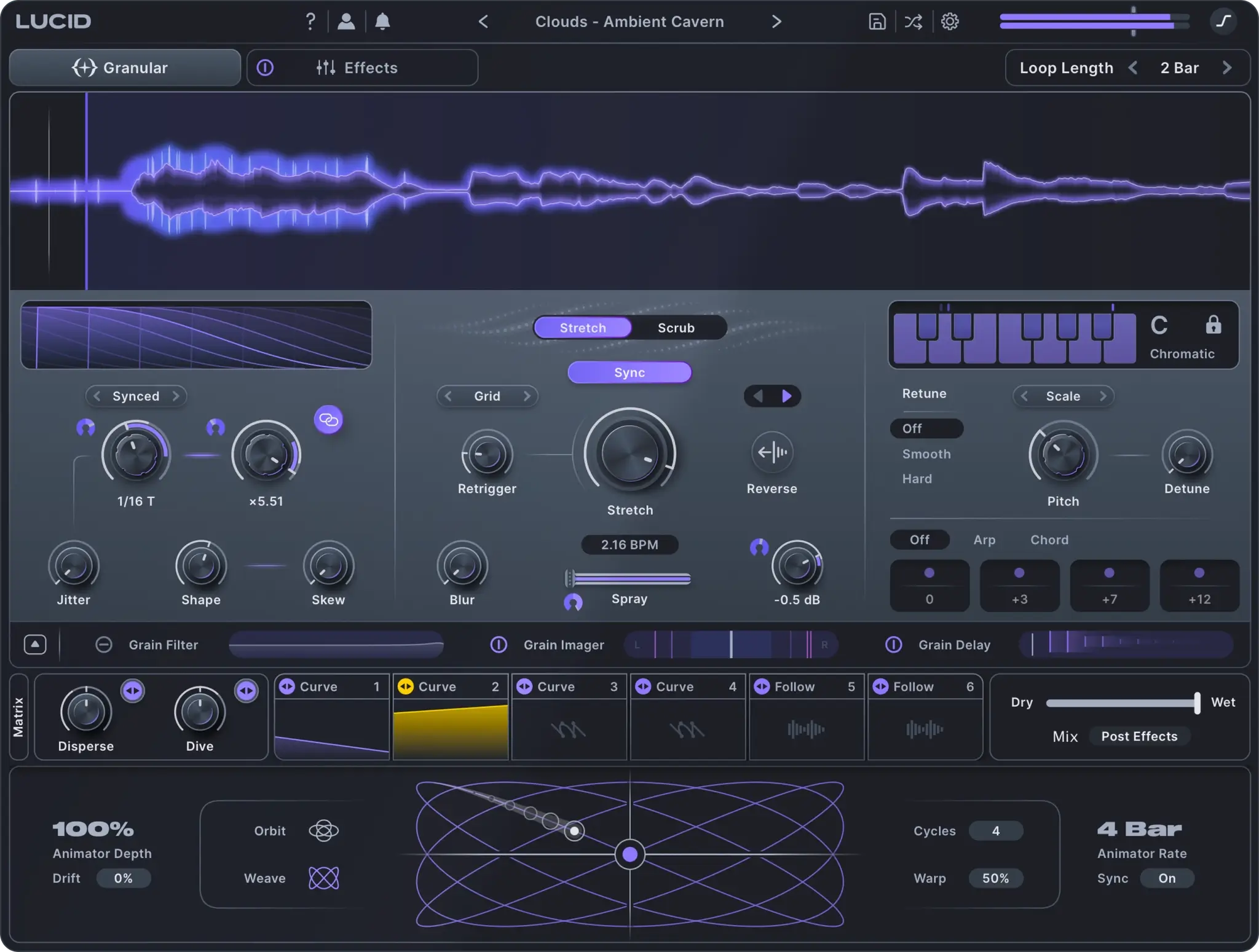
That is the vibe Minimal Audio is targeting with Lucid, a new granular effect built around scale-locking, timeline sync, harmonic delay, chord and arp modes, a modulation system, and 350 presets.
The pitch is simple enough: drop Lucid onto a sound, pull it apart grain by grain, and keep the result musical.
For producers who like granular effects but hate how quickly they can drift out of key or time, that’s what makes Lucid interesting.
Scale-locking is the headline feature
Lucid’s biggest idea is grain scale-lock.
Instead of letting each grain wander freely into whatever pitch relationship the effect creates, Lucid can retune every grain to a chosen key and scale in real time. That means a vocal, pad, guitar, synth, piano, drum loop, or resampled texture can be stretched into new harmonic material without the producer constantly fighting dissonance.
That matters because granular effects often sound inspiring for about ten seconds, then become hard to place in an arrangement. Lucid seems designed to keep the weird part while making the musical part easier to control.
Scale-locked grain behavior also offers a cleaner path to turning source material into shimmer, chords, harmonies, and arpeggiated spaces. The source can become more than a texture. It can become a harmonic layer that remains part of the track.
That idea fits next to the larger vocal and texture conversation in my article on plugins for vocal chops, where the voice becomes material for arrangement, hooks, atmosphere, and movement instead of only a traditional topline. Lucid pushes that same idea into granular territory.
Harmonic delay, chords, and arp modes make it playable
Lucid includes harmonic grain delay, grain chord modes, and arp modes.
That is where the plugin starts to feel more performance-oriented. A granular effect can make atmosphere easily, but playable harmony is harder. Lucid’s harmonic grain delay is aimed at scale-locked shimmer, harmonic trails, and arpeggiated spaces, while the chord and arp modes turn incoming sound into richer harmonic movement.
For producers, that opens a lot of direct use cases.
A dry vocal phrase can become a tuned harmony bed. A pluck can turn into a cascading delay pattern. A single sustained note can become a chordal texture. A drum hit can become a tonal rhythmic effect. A field recording can become something closer to an instrument.
The point is not only transformation. It is transformation with musical guardrails.
That is the part that separates Lucid from more chaotic granular processors. It still lets the source become something else, but it gives producers ways to steer the result toward a track instead of endlessly resampling and hoping something fits.
The Animator pad makes movement easier to perform
Lucid includes an Animator pad, which acts as an animated XY performance control for multiple parameters at once.
That kind of control matters in a plugin like this because granular effects usually come alive when they move. Static grain clouds can get old quickly. Motion is where the texture starts reacting, breathing, swelling, collapsing, and changing shape around the arrangement.
An XY pad gives producers a more immediate way to perform that movement. Push a texture wider. Pull it darker. Increase density. Move delay behavior. Add more modulation. Sweep the effect into a transition. Pull it back before the vocal returns. That is a better fit for creative flow than automating every parameter one lane at a time.
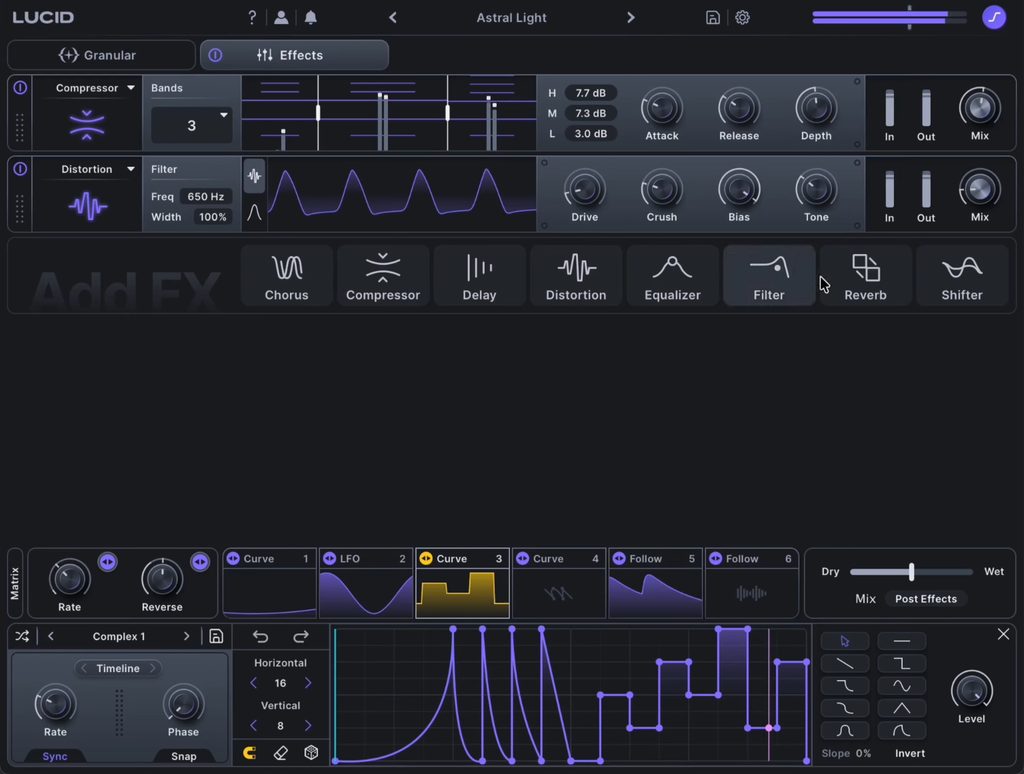
Lucid also uses the modulation system shared with Minimal Audio’s Current and Rift, with sequencers, envelope followers, and LFOs available to modulate parameters. That gives the plugin a deeper layer for producers who want evolving textures that respond to rhythm, dynamics, and programmed movement.
Lucid is built for sound design that stays musical
The best way to think about Lucid is as a granular effect that wants to stay inside the song.
That is its main creative advantage. It can take any source and rebuild it into new textures, rhythmic details, harmonies, delays, chords, and arpeggios, but the scale-lock and timeline sync keep the result from becoming detached from the track.
That makes it relevant for a lot of production styles: melodic house, ambient, experimental pop, bass music, indie electronic, cinematic scoring, vocal-driven dance tracks, and any arrangement that needs a sound to become more than its original recording.
It also fits with the larger question in my article on learning chord progressions for faster music production. Harmonic control changes how fast an idea can become a track. Lucid applies that thinking to granular processing, where pitch can otherwise be the first thing to break the illusion.
Pricing and compatibility

Lucid is available now at a $79 intro price.
The full price is $129. The plugin runs on macOS 10.11 and higher, including native Apple silicon, plus Windows 10 and higher. It supports 64-bit AAX, AU, VST2, and VST3 formats in major DAWs.
That compatibility gives it a fairly wide lane for producers working across Ableton Live, Logic, FL Studio, Studio One, Cubase, Pro Tools, and other plugin-friendly production setups.
For producers who already like Minimal Audio’s ecosystem, the shared modulation language with Current and Rift should also make Lucid feel familiar.
It is that it makes granular processing easier to use inside actual music.
Scale-locked grains, session-synced stretching and freezing, harmonic delay, chord and arp modes, per-grain shaping, stereo movement, a performance pad, deep modulation, and an effects rack all point toward one idea: take any sound apart without losing the song around it.
That is what a lot of producers need from granular processing.

Will Vance is a professional music producer who has been involved in the industry for the better part of a decade and has been the managing editor at Magnetic Magazine since mid-2022. In that time period, he has published thousands of articles on music production, industry think pieces and educational articles about the music industry. Over the last decade as a professional music producer, Will Vance has also ran multiple successful and highly respected record labels in the industry, including Where The Heart Is Records as well as having launched a new label with a focus on community through Magnetic Magazine. When not running these labels or producing his own music, Vance is likely writing for other top industry sites like Waves or the Hyperbits Masterclass or working on his upcoming book on mindfulness in music production. On the rare chance he's not thinking about music production, he's probably running a game of Dungeons and Dragons with his friends which he has been the dungeon master for for many years.