Table of Contents
Portable chargers are easy to overthink (at least I found myself doing so when the INIU SnapGo Air 10000mAh first got to my doorstep).
Specs matter, and I care about output, capacity, size, heat, and how fast something recharges. At the same time, the portable chargers that actually stay in my bag usually win for a simpler reason: they solve small problems without making me carry extra stuff. That is where the INIU SnapGo Air 10000mAh starts to make sense.
The SnapGo Air, also listed by INIU as the P781, is a 10,000mAh magnetic power bank with Qi2.2 25W wireless charging, 45W wired USB-C output, two USB-C ports, a built-in 0.4ft USB-C GoCord, a digital battery display, and a current price of $54.99 on INIU’s product page. On paper, that gives it the kind of spec sheet that should work for phones, earbuds, cameras, tablets, small lights, and the type of USB-C accessories that pile up fast if you write, travel, shoot content, or make music away from the desk.
That last part is where this charger clicked for me.
I spend a lot of time thinking about portable setups, and we have written before about building a mobile production setup that can work away from a normal studio. Power is always the boring detail until it becomes the reason the session stops.
The SnapGo Air is not the answer for running a full laptop rig all day, and it is not trying to be. It is a compact phone-first charger with enough flexibility to keep the rest of your small tech alive.
The Design Feels Built For Actual Daily Carry
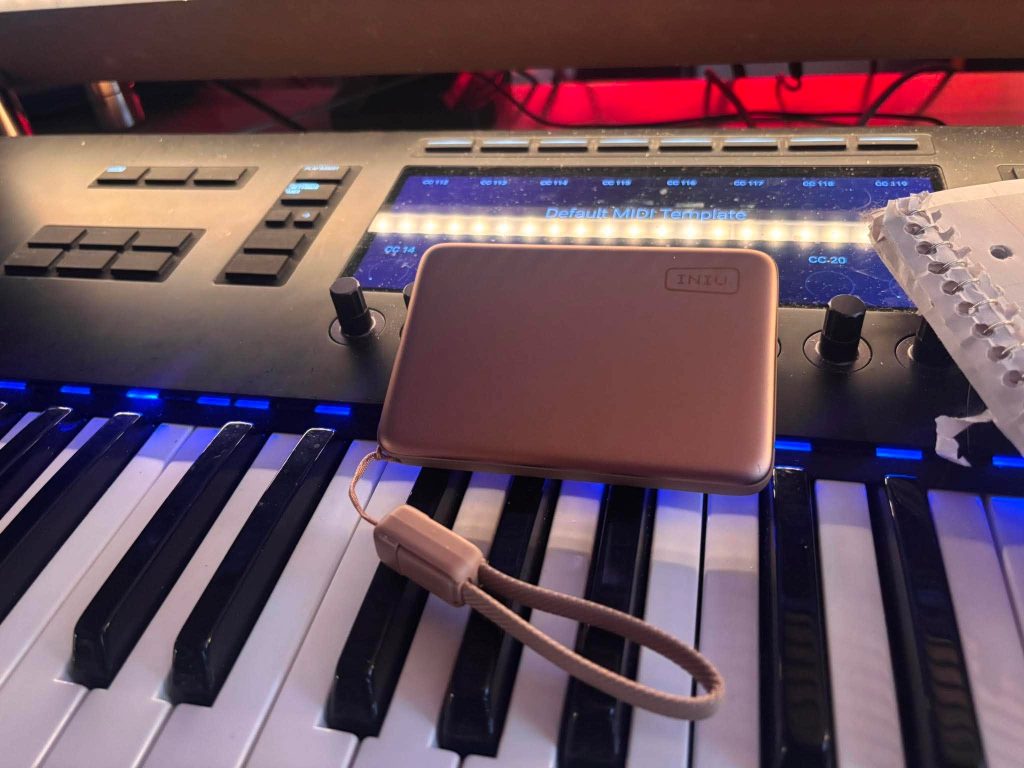
The first thing I noticed is how normal the SnapGo Air feels to carry.
That sounds like a low bar, though many battery banks fail there. Some are too thick for pockets. Some have weird shapes that make them annoying to stack with a phone. Some require a loose cable, which means you have to manage one extra item.
The SnapGo Air measures 4.1 by 2.8 by 0.5 inches and weighs 6.9oz, according to INIU. That 0.5-inch profile is the key detail. It makes the charger feel closer to a phone accessory than a brick you throw into a backpack. It is thin enough to slide into a tech pouch or pants pocket, and it feels natural enough on the back of a MagSafe-compatible iPhone that I would actually use it while walking around.
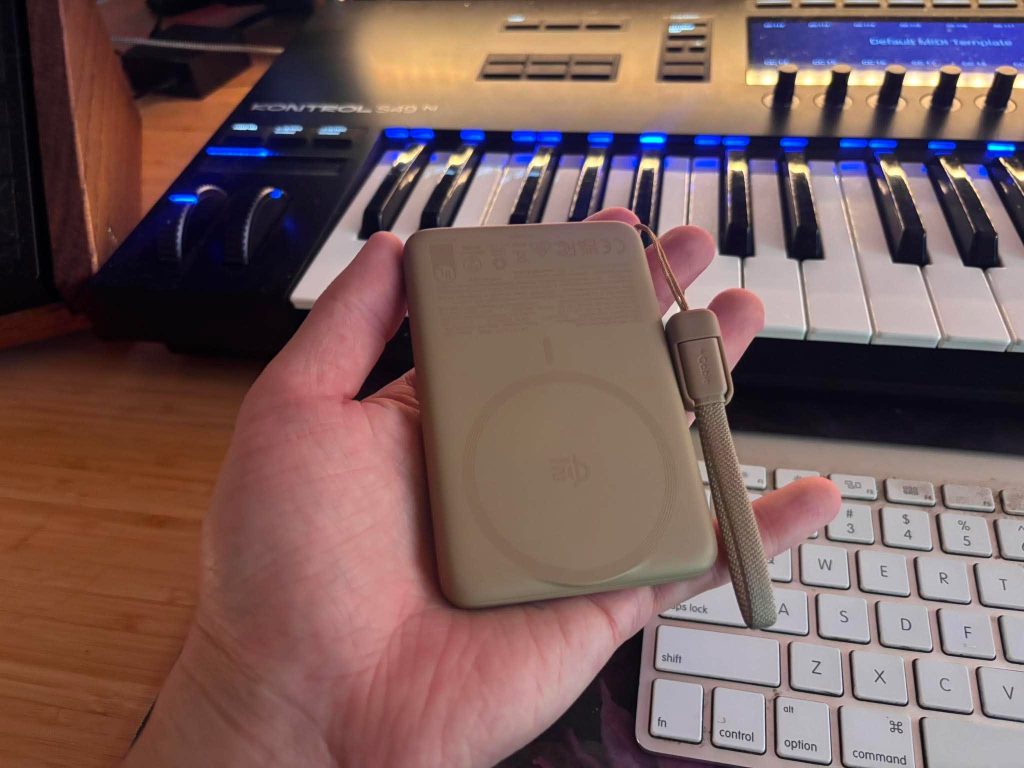
I also like that the front has an anodized aluminum feel, while the back is kept friendly to wireless charging. The finish looks clean without trying too hard, and the rounded corners make the whole thing easier to hold when it is attached to a phone. With magnetic battery packs, comfort matters because you are not always setting the phone down.
You are texting, checking directions, answering emails, or sitting in a cafe with the charger still connected.
The Built-In Cable Is The Best Part
The attached USB-C GoCord is the detail that makes the SnapGo Air feel useful beyond the spec sheet. INIU lists it as a 0.4ft / 12cm 60W USB-C GoCord, and in day-to-day use, that short cable solves one of the most common portable charging problems: having the battery bank and not having the cable.
I found that the cable works better as a practical attachment than as a carrying strap. You can remove it, although I do not see much reason to. It does not add much bulk, it does not really get in the way in a pocket, and it gives you a wired option for anything USB-C. That matters for headphones, cameras, small audio gear, portable lights, controllers, and tablets.
That kind of cable setup also fits the way a lot of people actually work now. I covered a portable second-screen setup for laptop work recently, and the bigger point with gear like that is always the same: the best portable gear reduces friction. The SnapGo Air does that. You can snap it onto a phone wirelessly, then use the attached USB-C cable for another device when needed.
Charging Performance: Great One At A Time, Limited When Split
The SnapGo Air is at its best when you use one charging method at a time.
Through a single USB-C port, INIU lists up to 45W output. That is enough for fast phone charging and light laptop top-ups, depending on the device. For wireless, it supports Qi2.2 25W output, although the full wireless speed depends on your phone model and software. INIU says iPhone 16 Plus, iPhone 16 Pro Max, and later models, excluding iPhone 16e, can reach Qi2.2 25W with iOS 26 or later, while iPhone 12 through iPhone 15 series models with iOS 17.4 or later charge at Qi2 15W.
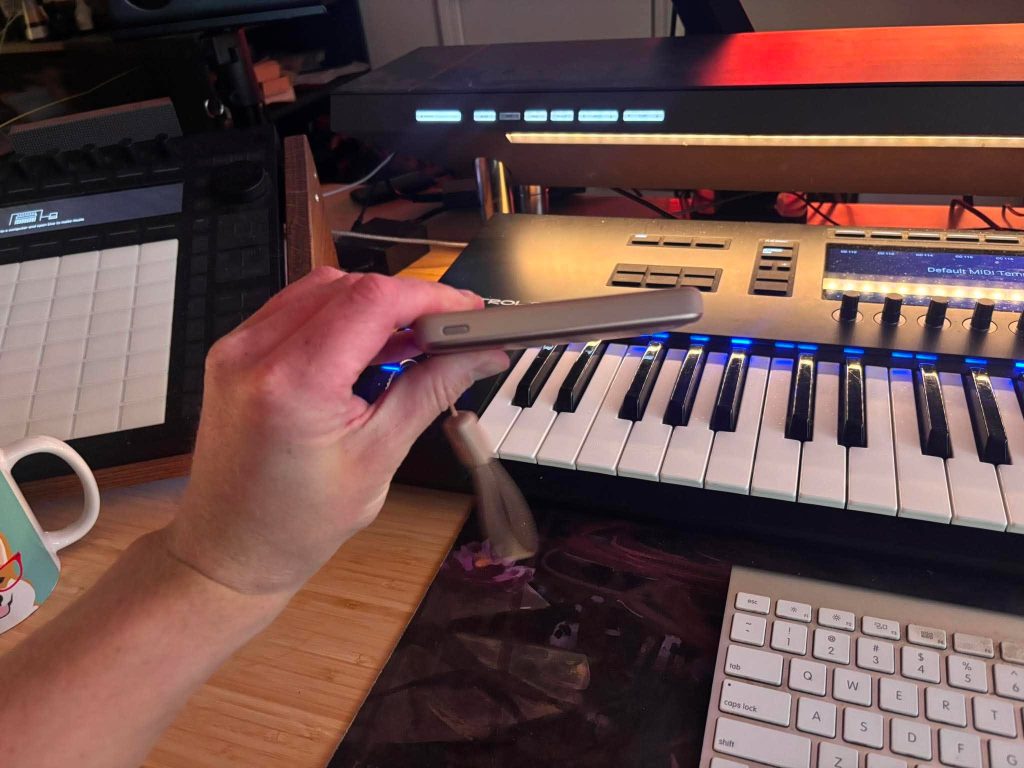
That distinction matters. “25W wireless” sounds simple, although your phone has to support that speed. For older MagSafe-compatible iPhones, you should expect 15W wireless charging instead. That is still useful, and for me, the convenience of magnetic charging is often the main reason to use it anyway.
The limitation shows up when you start connecting multiple devices.
INIU lists two USB-C ports plus wireless charging, and it says the power bank can charge three devices at once. That is technically true.
The detail buyers need to understand is the combined output. INIU lists OUT1 and OUT2 at up to 45W each when used individually, although OUT1 + OUT2 drops to 15W max, USB-C plus wireless drops to 15W max, and total output across two USB-C ports plus wireless is also 15W max.
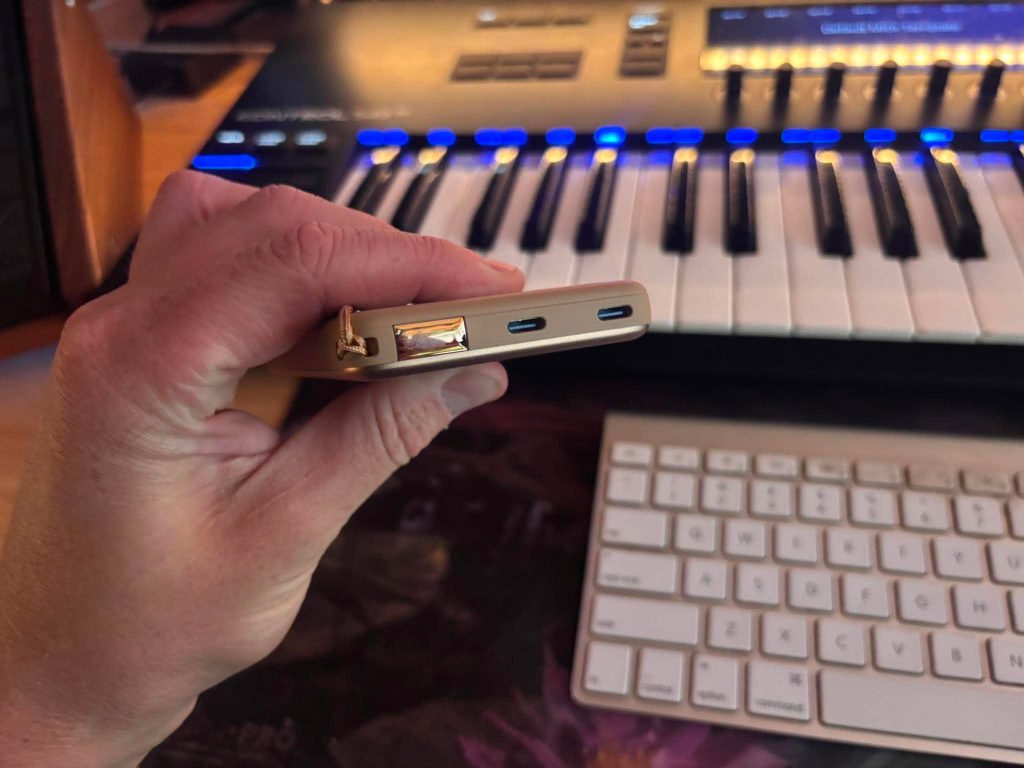
That changes how I would use it. I would not buy the SnapGo Air as a fast multi-device charger. I would buy it as a single-device fast charger that can handle emergency top-ups for extra accessories. If your phone is low, use one USB-C port and take the speed. If you are walking around, snap it on wirelessly and take the convenience. If your earbuds or camera need a few percent, the extra outputs are there.
The Display Helps More Than Expected
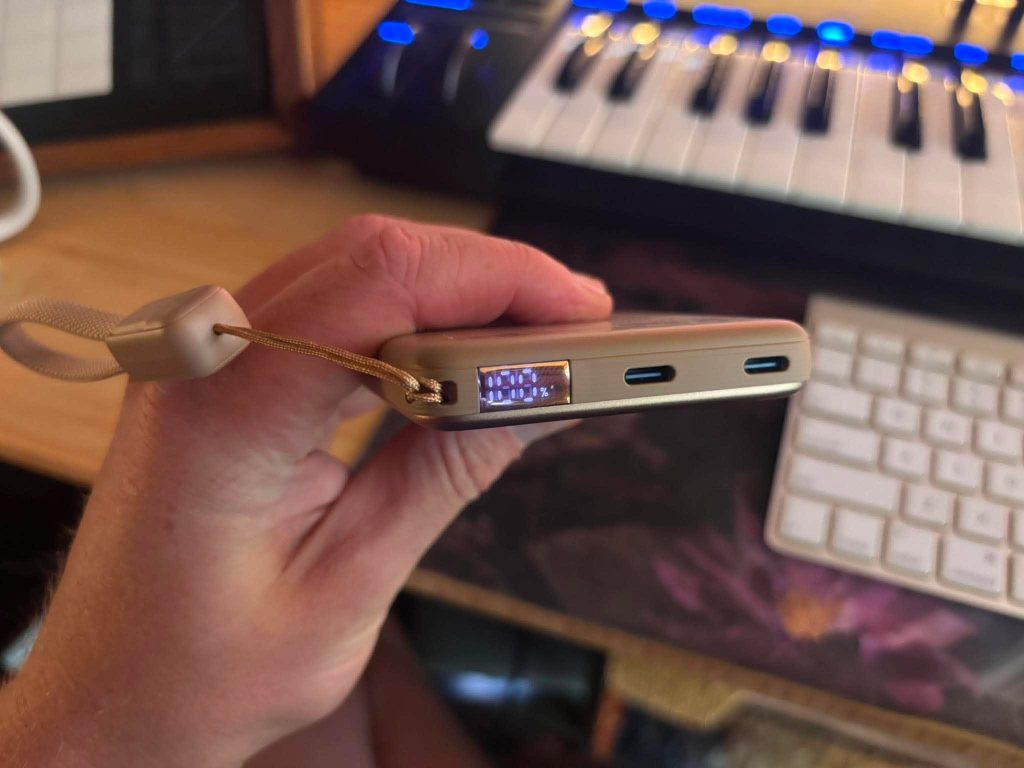
I like the digital battery display because it removes guesswork. A lot of small power banks still use dots or vague icons, and those are fine until you need to know whether you should recharge the bank before leaving the house. A real percentage readout is just easier.
INIU also says the SnapGo Air can fully recharge in 1.8 hours under proper conditions, and it supports up to 27W input. The product FAQ notes that recharge time can change with temperature and charging conditions because the unit can adjust charging power to protect battery health. That is worth knowing because a slim power bank pushing fast wired output and magnetic wireless charging has to manage heat carefully.
I would rather have the charger slow itself down when it needs to than run hotter than it should. Heat control is one of those things that does not look exciting on a product page, although it matters after months of daily use.
Who This Is For
I think the SnapGo Air makes the most sense for people who want a compact battery bank that lives in a daily bag.
It is useful for commuters, travelers, content creators, and music producers who need to keep small USB-C devices charged between stops. It is also a good fit for iPhone users who want magnetic charging without giving up wired USB-C output.
It makes less sense if you want to charge a laptop at high speed for an extended period, or if you regularly need to fast-charge multiple devices simultaneously. For that, I would look at a larger power bank with higher total output and a bigger battery.
Final Take
The INIU SnapGo Air works because it keeps the boring parts of portable charging simple. The form factor is slim, the magnetic charging is convenient, the USB-C output is fast when used on its own, the attached cable is genuinely useful, and the digital display makes the battery level clear.
The main downside is the shared output limit. Once you connect multiple devices, the 15W total ceiling keeps it from feeling like a true multi-device fast charger. That does not ruin the product. It just defines the right use case.
I would treat the SnapGo Air as a phone-first power bank with useful backup charging for smaller gear. Used that way, it makes a lot of sense. It is easy to carry, easy to use, and practical enough to earn a permanent spot in a daily tech pouch.

Will Vance is a professional music producer who has been involved in the industry for the better part of a decade and has been the managing editor at Magnetic Magazine since mid-2022. In that time period, he has published thousands of articles on music production, industry think pieces and educational articles about the music industry. Over the last decade as a professional music producer, Will Vance has also ran multiple successful and highly respected record labels in the industry, including Where The Heart Is Records as well as having launched a new label with a focus on community through Magnetic Magazine. When not running these labels or producing his own music, Vance is likely writing for other top industry sites like Waves or the Hyperbits Masterclass or working on his upcoming book on mindfulness in music production. On the rare chance he's not thinking about music production, he's probably running a game of Dungeons and Dragons with his friends which he has been the dungeon master for for many years.