Carbon Electra 2 feels like Scaler Music taking on the synthesis side that can get a little too technical, then pulling it closer to actual writing. A lot of synth plugins offer endless modulation, oscillator modes, routing, and effects, which is useful, but it can also leave the musical idea buried behind the sound design. Carbon Electra 2 seems designed to fix that gap.
The big idea here is musical control.
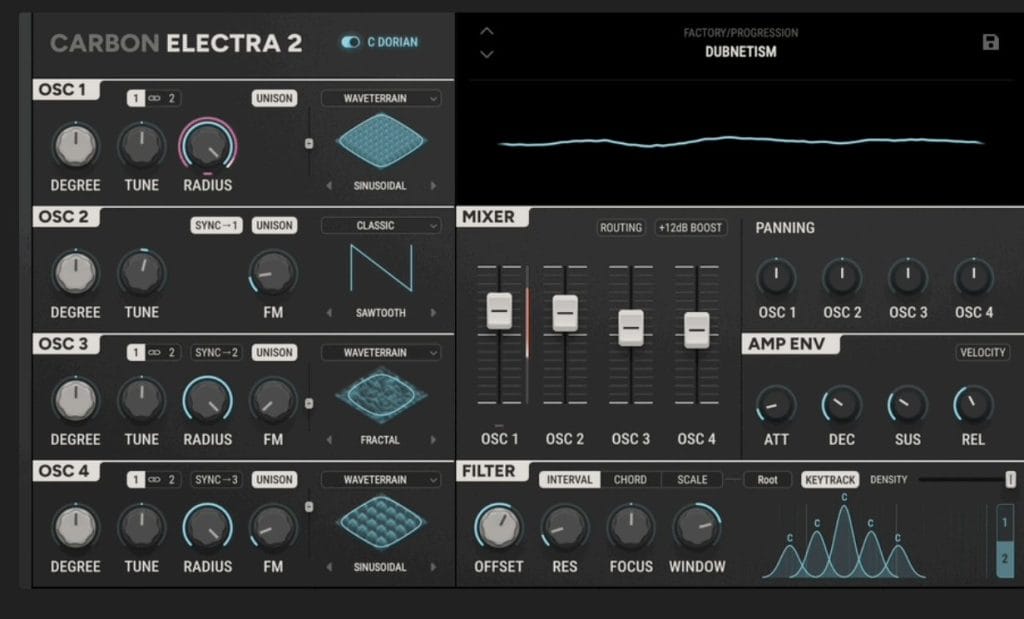
The plugin has four oscillators, classic waveform options, wavetable modes, and a new waveterrain oscillator system, but the feature most closely tied to Scaler’s identity is Scale Lock. Oscillators, filters, and the note and chord sequencer can remain connected to a chosen scale, so the sound design can continue to respond to the harmony rather than drifting away from it.
That is a smart move for a synth like this. Scaler Music already has a reputation for tools that help producers think through chords, progressions, and harmonic choices, and Carbon Electra 2 brings that thinking inside the instrument itself. It is still a synth, but it feels like one made by a company that knows many producers start with harmony first.
Waveterrain Oscillators Give Carbon Electra 2 Its Weirdest Hook
The waveterrain oscillator mode is the part that will probably get the most attention from sound designers. Instead of working only with standard waveforms or wavetable movement, users can upload .png terrain images and use those shapes to affect oscillator behavior.
That is a pretty nerdy feature in the best way. It gives producers another route for creating tone, and it also makes the synth feel less tied to the usual subtractive or wavetable workflow. Terrain size, movement, and edge behavior can all change how the sound reacts, giving the oscillator section a visual angle without turning it into a gimmick.
The rest of the synth engine gives users plenty to build from, too. There are four independent oscillators, unison support, cascading FM, per-oscillator controls, and a central mixer for blending sources. The routing can also be reworked between oscillators and filters, which should make the plugin useful for layered patches, basses, evolving sequences, and thicker chord material.
Scale Lock Is The Real Scaler Music Move
The feature that feels most important is still Scale Lock. The note and chord sequencer can stay inside a selected scale, chord mode can program diatonic progressions with extensions and inversions, and the filter system can respond to scale notes, chord tones, or interval relationships.
That is the sort of feature that can change how producers actually use the synth. Instead of writing a progression in one plugin, pulling up a synth in another, then hoping the modulation choices still serve the musical idea, Carbon Electra 2 keeps those pieces closer together. It lets the sound design follow the writing a little more naturally.
The modulation system also looks built for fast movement.
There is a multi-shape step sequencer, three LFOs, amp and modulation envelopes, visual destination lists, and an effects section with delay, distortion, chorus, EQ, and reverb that can be reordered and modulated. The plugin also includes 362 presets, with artist presets from Carl Cox, Timo Garcia, Faze Action, and Christian Laffitte.
For producers who like Scaler’s chord-first way of thinking, Carbon Electra 2 looks like a natural extension of that approach. It gives you a synth engine with enough depth to design sounds properly, but it keeps scale, chord, and sequence behavior close to the center, which is probably the main reason this one feels different from other standard synth updates.
Existing Carbon Electra owners can upgrade for $39 through My Products or the original place of purchase.

Will Vance is a professional music producer who has been involved in the industry for the better part of a decade and has been the managing editor at Magnetic Magazine since mid-2022. In that time period, he has published thousands of articles on music production, industry think pieces and educational articles about the music industry. Over the last decade as a professional music producer, Will Vance has also ran multiple successful and highly respected record labels in the industry, including Where The Heart Is Records as well as having launched a new label with a focus on community through Magnetic Magazine. When not running these labels or producing his own music, Vance is likely writing for other top industry sites like Waves or the Hyperbits Masterclass or working on his upcoming book on mindfulness in music production. On the rare chance he's not thinking about music production, he's probably running a game of Dungeons and Dragons with his friends which he has been the dungeon master for for many years.