SoundCloud’s 2026 Music Intelligence Report is less about chart winners and more about where music scenes start before they have clean names. That is the part worth paying attention to. It looks at fan behavior, comments, reposts, likes, genre movement, and scene formation as early signals for where music is heading.
The short version is that SoundCloud is still one of the clearer places to watch music form in public. Scenes are being built through listener activity, artist interaction, local style, and social discovery. For artists, DJs, labels, and managers, the report is a reminder that early fan behavior can matter before larger streaming numbers arrive.
Direct answer: SoundCloud’s 2026 Music Intelligence Report says music discovery is becoming more scene-led, social, and genre-fluid. The main takeaways are that SoundCloud users spend 43% of U.S. listening time with current music, electronic music is growing fast, UK underground rap is scaling quickly, and “Liked By” discovery can drive stronger engagement.

What Is The SoundCloud 2026 Music Intelligence Report?
The SoundCloud 2026 Music Intelligence Report is SoundCloud’s second public report on listening behavior, artist growth, and scene formation across the platform. The report focuses on what happens before a sound gets fully named, categorized, or absorbed into larger industry systems.
That matters because SoundCloud is not only a place where fans stream finished records. It is also a place where unfinished scenes, rough uploads, edits, DJ tools, local movements, and early fan groups can take shape in public.
The main point is simple: SoundCloud believes its social signals can show where music is moving earlier than traditional charts can.
What Are The Key Facts From The Report?
| Topic | What SoundCloud Reported | Why It Matters |
|---|---|---|
| Current music listening | U.S. SoundCloud users spend 43% of listening time with current music, compared with about 24% across the wider industry | SoundCloud listeners are still highly oriented toward new music |
| Social discovery | Tracks found through another user’s “Liked By” section are over 3x more likely to lead to likes, reposts, or comments | Fan behavior can push early tracks faster than passive listening |
| Genre spread | Listeners spend 4% less time with their top genre than they did in 2019 | Fans are moving across styles more often |
| Electronic music | Electronic music has been SoundCloud’s fastest-growing genre over the last three years | Electronic scenes remain central to SoundCloud’s identity |
| Upload share | Electronic uploads rose from roughly one in four tracks in 2020 to over one in three in 2025 | More producers are using the platform for electronic releases |
| UK underground rap | UK underground rap streams rose nearly 300% in 2025 | Local rap scenes can scale quickly when fan networks form early |
| Eclectic New Indie | Plays jumped more than 2.5x in 2025, with 89% Gen Z fans | Younger listeners are helping blur indie, rap, folk, and punk lines |
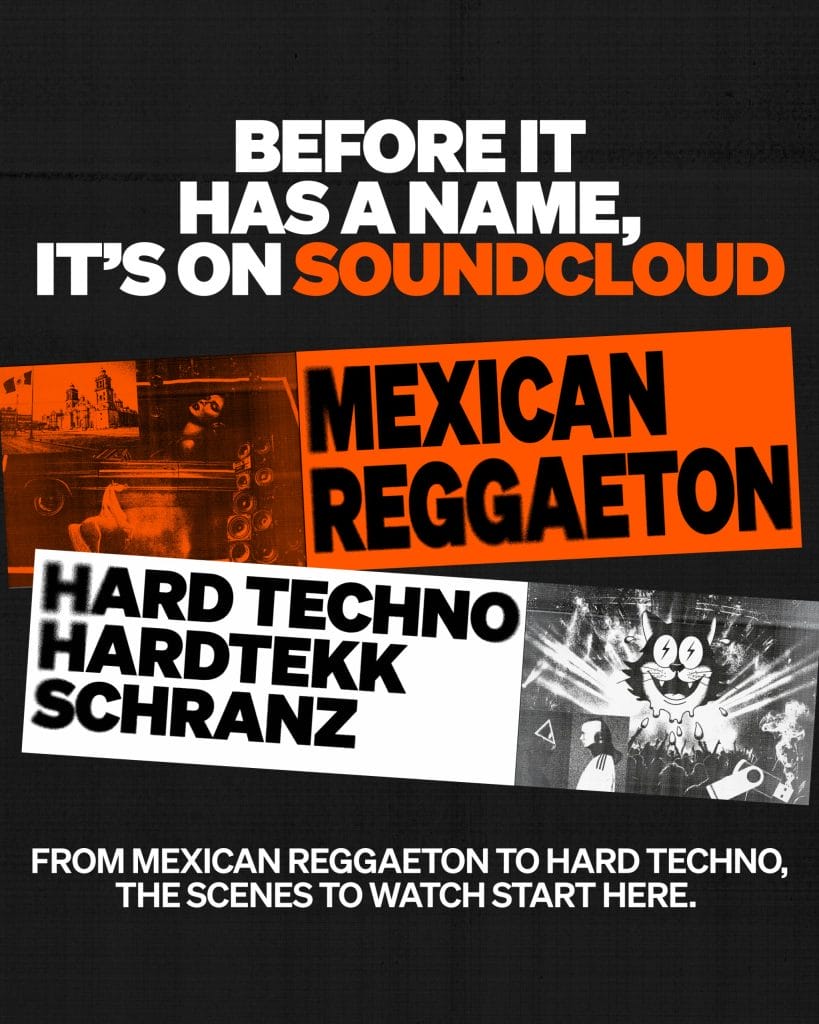
| Mexican reggaeton | Plays rose 81% in the past year | Latin scenes are mutating quickly through local and online communities |
What Does The Report Say About Discovery?
The discovery section is the most important part for independent artists. SoundCloud says listeners who play a track through another user’s “Liked By” section are over three times more likely to like, repost, or comment on that track themselves.
That means social context matters. A track can mean more when it arrives through a listener with taste, a friend, a peer, a DJ, or another artist’s activity. This is different from algorithmic recommendation alone.
It also matches what many artists already know from experience. A repost from the right person can be more powerful than a larger but colder placement. A small group of listeners who comment and repost can create movement before the wider industry sees anything happening.
This also connects to older SoundCloud questions around quality and trust. Years ago, we covered how Soundcloud Lowers Sound Quality Uploads Half, which showed that artists have always cared about how SoundCloud handles the listening experience. The 2026 report shifts the focus from audio quality to behavior, but the larger point is the same: the platform matters because artists use it to find real listeners early.
What Does The Report Say About Electronic Music?
Electronic music remains one of SoundCloud’s clearest areas of growth. SoundCloud says electronic music has been its fastest-growing genre over the last three years. It also says electronic uploads rose from roughly one in four tracks in 2020 to over one in three in 2025.
That is a major signal for producers and DJs. SoundCloud is still a place where electronic subcultures can form around edits, remixes, club tools, regional styles, and producer circles.
The report points to regional scenes including Vinahouse, Colombian guaracha, baile funk, Spanish breakbreak, and Southeast Asian breakbreak. It also calls out faster club tempos, hard techno, UK garage, minimal tech house, and U.S. growth around several dance-music scenes.
For DJs, that means SoundCloud still has value as a discovery tool. It is one of the places where you can find edits, remixes, early tracks, and local movements before they move into cleaner commercial release channels.
If you are using SoundCloud to find music for sets, this connects naturally with the article I wrote on 7 Awesome DJ Software Tools You Should Probably Know About In 2026. Software helps you play and organize the music, but SoundCloud can still help you locate early tracks that may not be sitting in the same pools as everything else.
FOLLOW SOUNDCLOUD: INSTAGRAM | TIKTOK | FACEBOOK
What Does The Report Say About Hip-Hop?
The report pushes back against the idea that hip-hop is simply declining. SoundCloud’s point is that hip-hop is mutating through scenes, local styles, and hybrid production.
UK underground rap is one of the clearest examples. SoundCloud says streams for the scene rose nearly 300% in 2025. It also points to artists such as fakemink and EsDeeKid as examples of artists who moved from early SoundCloud signals toward larger attention.
The report also discusses how hip-hop is pulling from guitar-driven music, alternative rock, electronic production, ambient textures, jerk, grime, drill, and regional rap lineages. The bigger takeaway is that hip-hop’s influence is spreading across styles even when charts tell a narrower story.
That point lines up with our Alexander Spit interview, where he talked about being exposed to many kinds of music and said, “I know it when I hear it.” That is a good way to think about SoundCloud’s current scene data. Some of the most important new sounds start messy, mixed, and hard to label.
What Does The Report Say About Gen Z?
Gen Z is central to several of the report’s key scenes. SoundCloud says Eclectic New Indie has an 89% Gen Z fanbase, while Mexican reggaeton has a 78% Gen Z listener base. The report also says UK underground rap and newer indie scenes have grown quickly among listeners who are mostly Gen Z.
The takeaway is not simply that young listeners use SoundCloud. The point is that younger listeners are helping create scene language by moving across genres, reposting early tracks, following niche artists, and participating before larger press or playlist systems arrive.
For artists, this means a small but active younger audience can be a serious signal. The wrong move is to ignore it because it has not converted into huge streaming numbers yet.
What Does The Report Say About Older Music?
The report also notes that music older than 18 months accounted for a greater share of listening in 2025. That might seem like the opposite of the current-music point, but it fits the larger pattern.
Listeners are hunting for new music and also returning to older tracks. That means discovery is not only about release date. It is about whether a track becomes newly relevant inside a scene, playlist, repost chain, edit culture, or social trend.
For artists, this should change how you think about catalog. An older upload can still matter if it gets picked up by the right listeners. A track that felt quiet at release can gain a second life if the scene around it catches up.
That is exactly why Avoure’s story around “Halo” is relevant here. In Why Avoure Took His Biggest Song Down And What Brought It Back, he explained that the track began as a free SoundCloud upload and built meaning through listener comments before getting its later official release. That is a real example of the type of delayed value SoundCloud can create.
What Does The Report Mean For Labels And Managers?
For labels and managers, the report says early attention should be judged by behavior, not only scale.
If a track gets a small number of streams but high comments, reposts, saves, and repeat listeners from a focused scene, it may deserve more attention than a larger track with cold traffic. SoundCloud’s data suggests that the people around a track can matter as much as the number beside it.
Labels should watch:
| Signal | What It Can Mean |
| Reposts from scene-adjacent artists | The track is moving through peer networks |
| Repeat comments from the same listeners | The listener base is forming a habit |
| “Liked By” spread | Fan discovery is happening socially |
| Cross-genre tags | The track may be part of a hybrid scene |
| Early city or region clusters | A local scene may be forming |
| DJ support | The track may be moving from upload culture into rooms |
The point is to find the social behavior behind the number. SoundCloud’s report makes a strong case that culture often moves through people first, then charts later.
What Are The Main Artist Takeaways?
The report gives artists four clear takeaways.
First, do not treat SoundCloud as only a place to park uploads. If the platform’s value is social discovery, then activity around the upload matters.
Second, pay attention to scene language. Tags, comments, reposts, track titles, and artist bios can all help describe what is forming.
Third, do not assume genre boundaries are fixed. The report’s biggest examples are built around mixed inputs: indie and rap, reggaeton and plugg, UK rap and electronic production, hard techno and faster club culture.
Fourth, keep older tracks active. If a track starts getting comments or reposts months later, that may be a new signal, not a random bump.
What Should You Do Next If You Are An Artist?
Start with this checklist.
| Step | What To Do |
| Audit your SoundCloud page | Update bio, links, artwork, tags, and pinned tracks |
| Review your last ten uploads | Look for comments, reposts, likes, and follower growth |
| Identify early supporters | Track users who return, comment, or repost |
| Follow nearby artists | Build peer visibility inside your scene |
| Repost carefully | Share music that fits your lane and audience |
| Test unreleased ideas | Use private links or limited uploads to gather feedback |
| Connect platforms | Link SoundCloud to Instagram, TikTok, Twitch, Bandcamp, and your site |
| Watch old tracks | Look for catalog songs gaining new attention |
If you are building a wider artist funnel, our piece on How To Add Music To Instagram Post pairs well with this report. SoundCloud can help a track form early. Instagram can help you frame it visually and keep it moving through short-form promotion.
Why Is SoundCloud Still Relevant In 2026?
SoundCloud is still relevant because it has a different social function than many streaming platforms. It is not only a final-release destination. It is a place where artists can upload quickly, fans can comment directly on tracks, scenes can form around repost networks, and rough ideas can still create real momentum.
That does not mean every artist needs to build a full strategy around SoundCloud. It means artists should understand what the platform is good at. It is especially valuable for early discovery, edits, remixes, DJ tools, underground scenes, young listener clusters, and catalog tracks that might return later.
SoundCloud has also been adding tools that fit this position, including follower-only release tools, new social discovery features, and its SoundCloud Sessions partnership with Twitch. Those moves support the same idea as the report: artist growth is increasingly tied to direct fan activity, not only passive streams.

Raised in upstate New York, I was always a big fan of music but never really listened to electronic music. Within the first month of attending Florida State University and meeting some new friends, I was introduced to the rave scene. After seeing Ekali at my first show, I was instantly hooked. Since then, I have dived into every subgenre of electronic music, picked up DJing, and mixed for clubs and different entertainment events in Tallahassee. Once graduating with degrees in marketing and hospitality, I was hired for a sales position. However, I recently decided to leave my sales job to pursue my dream of working in the music industry. Currently, I run Magnetic Magazine's Melodic Techno Charts, along with my role as a PR and marketing specialist for different artists and labels. Some of my favorite artists are REZZ, Kyle Watson, TOBEHONEST, San Pacho, Josh Baker, HUGEL, ARTBAT, Vintage Culture, Ganja White Night, CamelPhat, Green Velvet, Jungle, Milky Chance, Paco Versailles, Franc Moody, and RÜFUS DU SOL. My favorite festivals are Hulaween (by far), EDC Orlando, and all the different venues during Miami Music Week. Outside of music, I love sports (especially hockey, soccer, tennis, basketball, and spike ball), going to the movies, working out, sushi, Chick-fil-A, food in general, and hanging with my dog Maui and my cat Loki. Feel free to reach out to me via my email or on IG, I love expanding my network of friends and business opportunities!