Table of Contents
2026 update: The FlexiSpot E7 Plus remains a current model, and the base is listed at $499.99 during FlexiSpot’s summer promotion, down from $599.99. The newer E7 Plus Max now sits above it for buyers who need four motors, while the standard E7 Plus remains the lower-cost four-leg option.
I first reviewed the FlexiSpot E7 Plus after two months of daily studio use. I have continued using it into 2026 with an ultrawide display, monitor riser, controllers, keyboards, and other hardware. The main reason it has stayed in my room is simple: the motorized base raises a heavily loaded production setup without the front-to-back movement I had experienced with lighter desks.
This is still an office standing desk instead of a purpose-built recording desk. You add the desktop, monitor riser, rack storage, keyboard tray, and cable routing according to your room. That approach is appealing when load capacity and height adjustment sit above built-in rack bays or a fixed studio layout.
Quick answer: The FlexiSpot E7 Plus remains worth buying in 2026 for producers with heavy monitors, wide displays, keyboard rigs, or shared workstations. The base currently starts at $499.99 and lifts up to 440 pounds. Buy it for four-leg support and customization, then budget separately for the desktop, cable routing, and studio-specific accessories.
| Quick verdict | My 2026 take |
|---|---|
| Current starting price | $499.99 sale price for the base, normally $599.99 |
| Best fit | Gear-heavy home studios and hybrid office rooms |
| Main advantage | Four-leg base with a 440-pound lifting limit |
| Main concern | Cable routing and keyboard storage need separate purchases |
| Height range | 26 to 51.6 inches without a desktop |
| Final recommendation | Buy when a two-leg desk moves under your current load |
First Impressions After Unboxing The FlexiSpot E7 Plus 4-Leg Standing Desk

FlexiSpot products always arrive cleanly packaged, and this one was no different. It’s heavier than most of their two-leg desks, and that extra weight immediately makes sense once you start unpacking it. The frame is solid, the parts are labeled clearly, and the finish looks as modern as anything you’d expect in a professional workspace.
Aesthetics weren’t really my focus this time. I’ve owned studio desks that leaned into design-first thinking, and while they looked great, the function always took a hit somewhere. I wanted something reliable, something that could actually hold everything I throw at it.
The E7 Plus nailed that right away.
That said, it still looks clean. The frame lines are minimal, and the black finish fits into any studio setup without pulling attention away from gear. The overall footprint is larger than my previous desk, which is exactly what I needed. It gave me the space to keep my riser, keyboards, and still have room to breathe.
Is the FlexiSpot E7 Plus worth buying in 2026?
Yes, for producers who have outgrown a lighter two-leg standing desk or need one large surface for production and office work. The E7 Plus remains current, and its $499.99 promotional base price keeps it below many purpose-built studio desks. FlexiSpot lists a 440-pound lifting limit, a 540-pound static limit, four height memories, and compatibility with tops from 47 to 80 inches long.
The recommendation depends on what you need the desk to do. The E7 Plus gives you a steady motorized base and room to choose the surface. It does not include rack bays, an integrated keyboard shelf, or enclosed cable routing as part of the standard base.
Buy it when your current desk moves while you type, play keys, or adjust hardware. Skip it when you want studio furniture that ships with a dedicated controller tray and rack spaces already planned.
How much does the FlexiSpot E7 Plus cost in 2026?
FlexiSpot currently lists the E7 Plus base at $499.99 during its summer promotion, with a regular price of $599.99. Desktop material and size raise the checkout total, and accessories such as a cable tray or under-desk drawer are separate.
That pricing needs to be read carefully. The headline number applies to the base, so a 72-inch bamboo or solid-wood configuration can cost considerably more after the surface is selected.
The current price is still lower than the $799.99 regular figure shown in my original 2025 review. That makes the base easier to recommend in 2026, especially for producers who already own a suitable desktop or want to source one locally.
Setup and Build Experience
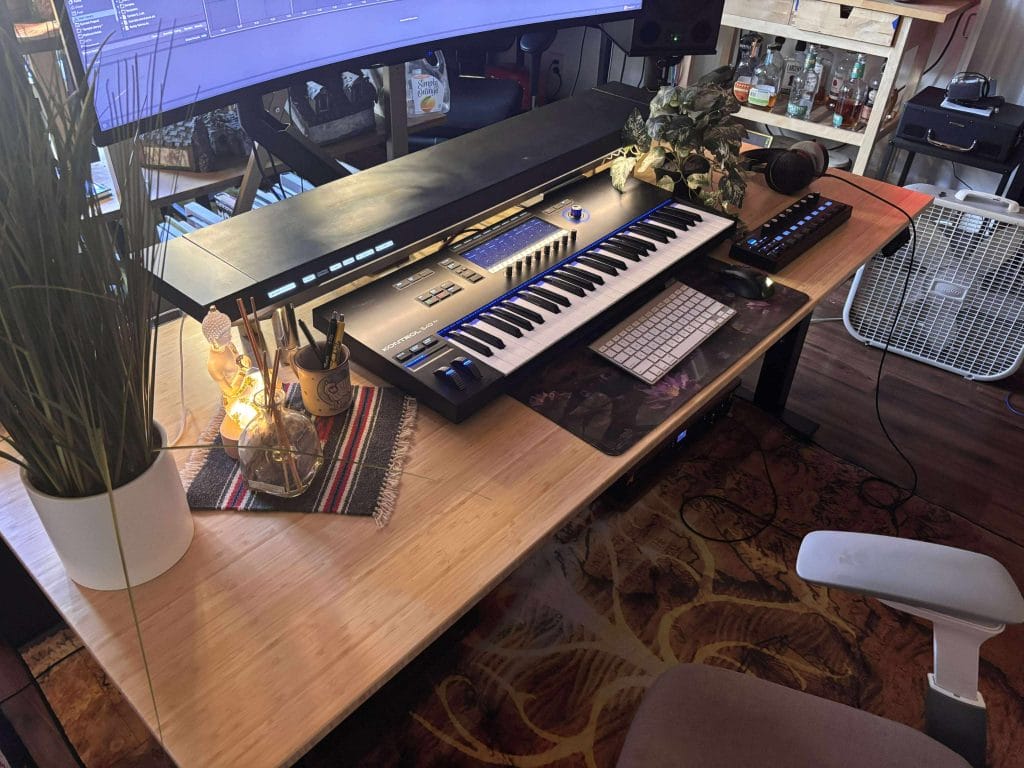
Putting this together took a little longer than usual. Most FlexiSpot desks are up and running in about fifteen minutes. This one took closer to thirty because of the cross-linking supports and the extra structural reinforcement that come with that 500-pound rating. The process itself was straightforward, but the parts are heavier and require a bit more alignment finesse.
Once everything locked into place, it felt secure in a way that gives you confidence before you even power it on. The extra bracing under the desktop is the reason for that lift strength, and it’s also what eliminates flex when you’re leaning into your keyboard or resting your forearms while mixing. I can literally put my body weight on one side and it doesn’t shift or squeak.
Everyday Use and Studio Stability
Over the last two months, I’ve been using the E7 Plus daily, and it hasn’t wavered once. The lift motion is incredibly smooth, almost silent, and steady enough that I can move between sitting and standing with my monitors still powered on. Nothing shakes, nothing rattles, and there’s no moment where you feel like something might tip.
I’ve tried raising it while the full setup was running—two 8-inch nearfields on isolation pads, a 49-key MIDI controller, a MacBook Pro dock, and a stack of rack gear. The motors lifted everything quietly, and the transition didn’t cause even a hint of vibration in the speakers. That’s huge for producers because any movement in the listening field can throw off perspective. Here, it stays locked in.
The four-leg connecting frame design is the real reason for that stability. Most desks rely on dual-column frames, which is fine for lightweight setups, but once you start adding synths, monitor stands, and risers, they start to sway. With four legs, the weight distribution keeps the whole surface rigid, and that makes a difference when you’re hitting keys, adjusting knobs, or even writing with hardware connected.
Quiet Performance for Recording Spaces
Noise matters in a studio, and this desk stays silent. The motor hum is barely audible even in a treated room. I’ve recorded ambient takes and soft vocals right beside it, and you wouldn’t pick up any mechanical noise even with a sensitive condenser mic active nearby. The transitions are smooth enough that you can adjust height mid-session without breaking focus or interrupting what you’re tracking.
Compared to other desks I’ve used, this one feels engineered with more attention to that noise profile. It’s not just fast—it’s consistent. The stop and start points don’t jerk, which is another thing that keeps everything on the desk stable while moving.
Dialing In Ergonomics That Actually Work
The E7 Plus comes with a small digital keypad where you can program four height presets. I’ve got mine set up for three main positions: one for mixing while seated, one for synth programming, and one for standing editing sessions. It makes it easy to jump between setups throughout the day without thinking about it.
The range goes from 26 to 51.6 inches, which easily covers anyone from short to tall. For me, that means I can move from sitting at an office chair to standing comfortably at ear-level with my monitors without needing to adjust their height. It’s a nice improvement over two-stage legs that top out sooner.
In practical terms, the ergonomics help more than expected. Standing for an hour during editing or idea sessions keeps energy levels up, and that alone has made a difference in how I pace long days. The muscle fatigue I used to feel after a few hours at a fixed height setup is gone.
In-Studio Workflow and Practical Advantages
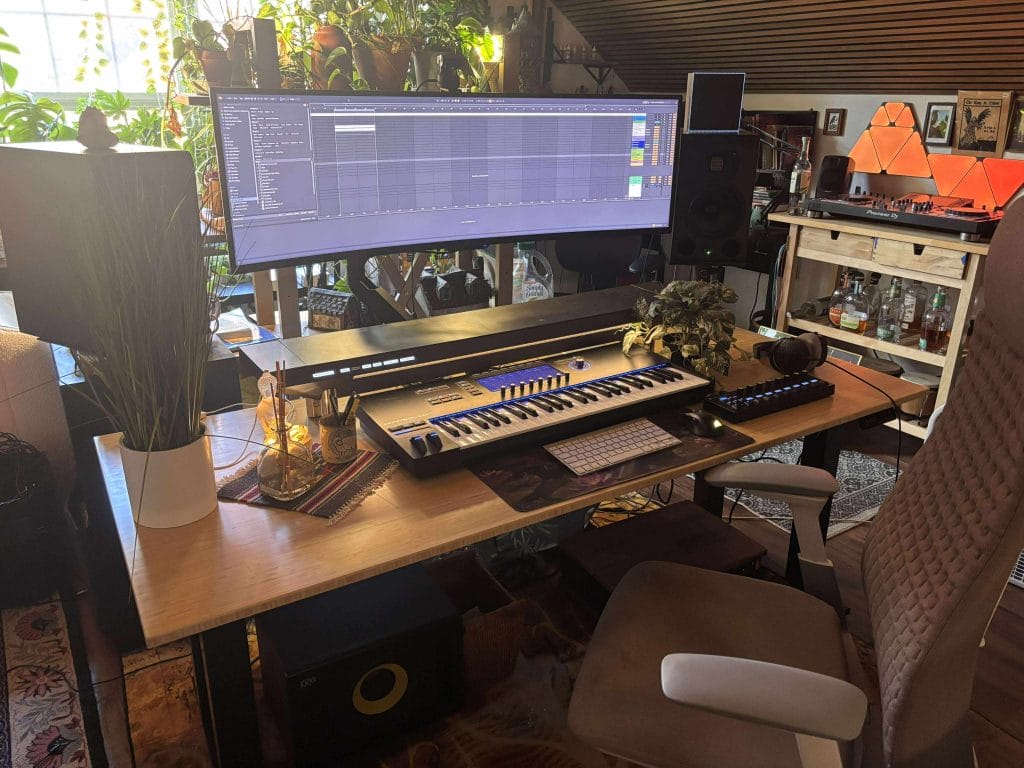
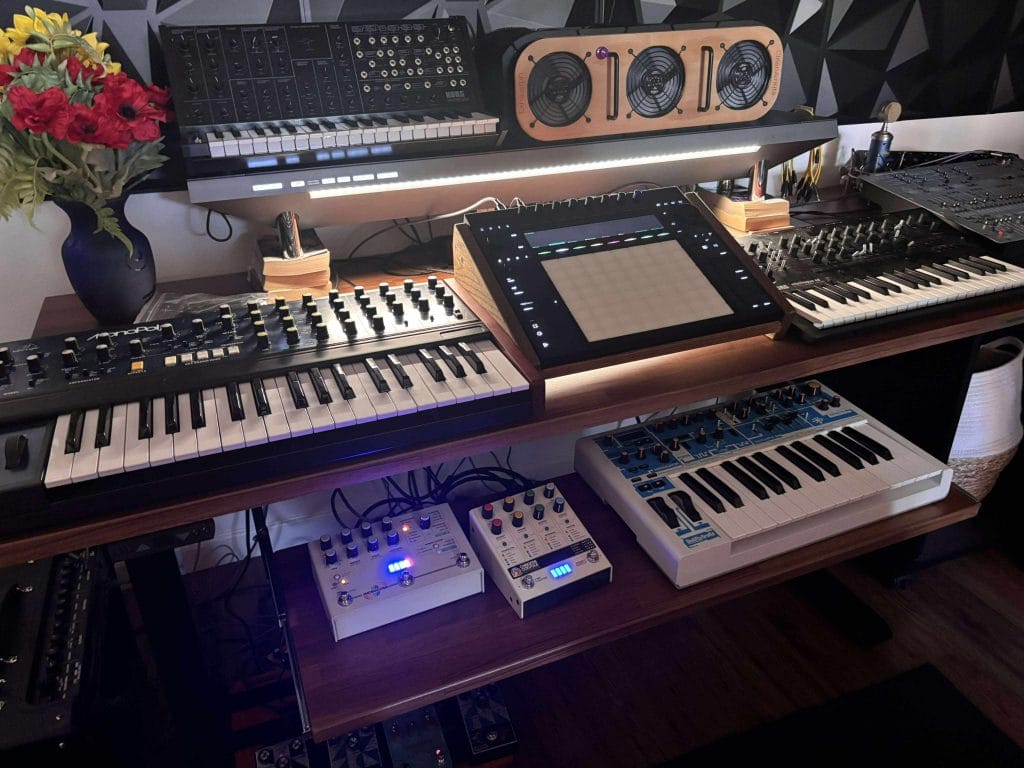
My setup includes a wide display, monitor elevation, multiple controllers, keyboards, an interface, and rotating desktop hardware. The E7 Plus has continued to raise that setup without the side movement or motor errors I encountered on a lighter sit-stand desk.
The four-leg base is the main reason. A wide top places monitor arms and speakers far from the center, and the rear legs reduce the leverage that makes many two-leg desks move. FlexiSpot also leaves room behind the rear rail for monitor clamps and under-desk accessories.
The lifting number still needs planning. The 440-pound rating includes everything moving with the base, including the chosen top. Add the mass of the desktop before estimating how much equipment can be carried.
My Wavebone Starship review showed why this calculation matters. That desk has a 300-pound published limit that includes its own surface, and a dense keyboard setup eventually triggered its protection system. That experience is what pushed me toward the higher lifting margin of the E7 Plus.
Design, Materials, and Aesthetic Fit
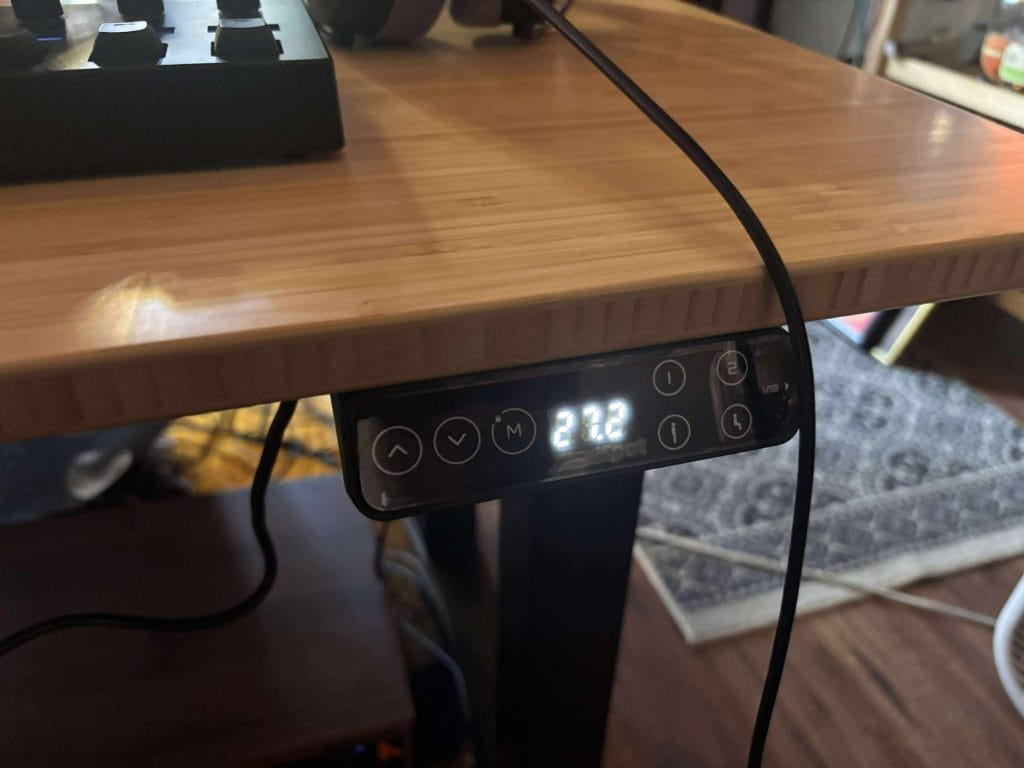
FlexiSpot offers several desktop options—bamboo, chipboard, solid wood, and rubberwood—and each changes the look slightly. Mine has a clean dark finish that blends with studio gear without adding glare from lights or monitors. The edges are smooth, and the feel is sturdy without sounding hollow when tapped.
The style leans modern but neutral. That’s ideal for studio environments because it doesn’t compete visually with gear or acoustic panels. Everything sits balanced. The frame paint is consistent and hasn’t chipped despite two months of heavy use and occasional knocks from moving stands around.
The Real Value for Producers
At $499.99 on sale (regularly $799.99), the E7 Plus hits a sweet spot for serious producers. There are cheaper options that move up and down, but they rarely hold this kind of load or stay this stable. Most “studio desks” in this price range are static, meaning no motorized adjustment at all.
For comparison, my previous desk cost more and couldn’t handle my full keyboard rig. That makes this one an easy recommendation if you need something that grows with your setup. Between the lift range, build quality, and quiet operation, it covers what you’d expect from a premium desk without creeping into the custom-furniture price bracket.
FlexiSpot’s warranty and track record also add confidence. They’ve been consistent about support and replacement parts, which matters if you’re investing in something that literally holds your entire creative workstation.
Who This Desk Makes Sense For
Buy the E7 Plus when your studio includes an ultrawide display, monitor arms, a heavy keyboard, or a monitor riser loaded with smaller devices. It also fits hybrid rooms where one surface handles production and daily writing.
The four memory buttons work well when different tasks need different heights. I use a seated position for detailed mix work and a higher setting for playing keyboards or handling label administration.
That approach matches what Ross Lara described in his Archipelago Studios tour. His sit-stand desk lets him stand during stem exports and administrative work, which is a sensible way to use height changes according to the task instead of remaining upright all day.
Skip it when the studio has a light laptop setup or one small pair of monitors. A lower-cost two-leg base can carry that setup and takes less room.
Skip it when you need built-in rack bays, a full controller shelf, and permanent studio routing from the first day. The Platform Studio Desk By Output Review covers a fixed-height desk designed around those studio needs. Its starting price is higher, yet the furniture includes production-specific placement that the E7 Plus leaves to the buyer.
Skip it when cable routing is the main problem. A desk add-on may solve that problem without replacing the desk.
How does it compare with the Platform Studio Desk?

The E7 Plus is the better choice for height changes and heavier equipment. The Platform is the better fit for producers who want a dedicated keyboard tray and rack placement without planning separate accessories.
The tradeoff concerns layout. Platform sets the monitor shelf, keyboard area, and rack location for you. The E7 Plus gives you a large surface and lets you choose those pieces according to the room.

My Platform Studio Desk By Output Review is worth reading before buying either desk because it shows how a studio-specific layout can improve equipment access while creating limits for writing and general office work.
Does the E7 Plus work in a family home studio?
Yes, as long as cable access and the motor controls are planned around children. The standard E7 Plus has four presets and USB-C charging, while the newer Max adds a child lock. Keep power strips mounted away from small hands and leave enough cable slack for the full height range.
A shared room also needs separate listening plans. My PuroQuiet Plus Headphone Review covers volume-limited noise-canceling headphones for children, which can help when a parent is working nearby and a child needs their own media without using adult studio headphones.
For creators filming reviews or production content from the same room, my article on how to make a home studio look good on camera explains how cable placement, lighting, and visible gear can support filming without disrupting daily production.

Will Vance is a professional music producer who has been involved in the industry for the better part of a decade and has been the managing editor at Magnetic Magazine since mid-2022. In that time period, he has published thousands of articles on music production, industry think pieces and educational articles about the music industry. Over the last decade as a professional music producer, Will Vance has also ran multiple successful and highly respected record labels in the industry, including Where The Heart Is Records as well as having launched a new label with a focus on community through Magnetic Magazine. When not running these labels or producing his own music, Vance is likely writing for other top industry sites like Waves or the Hyperbits Masterclass or working on his upcoming book on mindfulness in music production. On the rare chance he's not thinking about music production, he's probably running a game of Dungeons and Dragons with his friends which he has been the dungeon master for for many years.