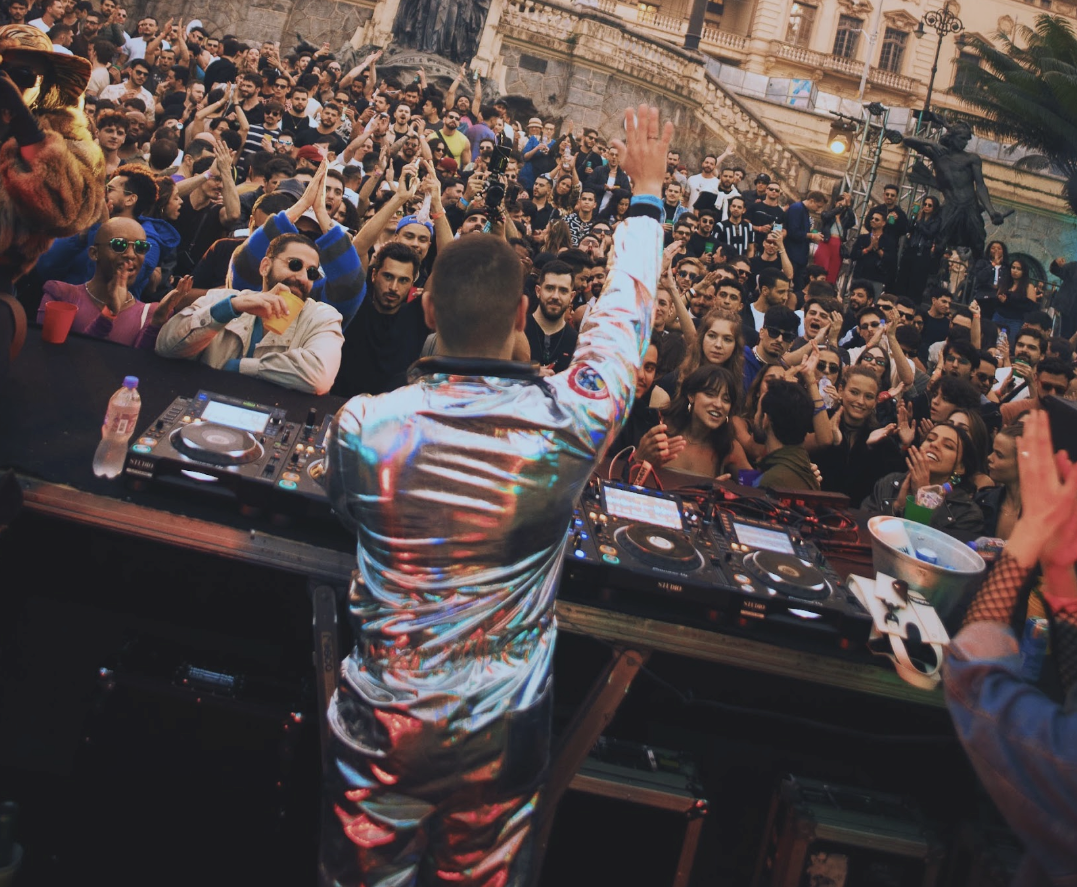
For Pedro Gariani, music has always been about more than the dancefloor. The Brazilian DJ, producer and curator has built his sound around the meeting point between house, club culture and the rich musical traditions of his home country, from samba and disco to funk carioca, Latin rhythms and the sounds embedded in Brazil’s cultural memory.
That connection comes into sharp focus on his latest release, “Saci”, out now on ¡Queer y Latina!. Inspired by one of Brazil’s most iconic folklore characters, the track turns a story Gariani grew up with into a percussion-driven club record, bringing Brazilian identity and dancefloor energy together in a distinctly contemporary way.
But the influences behind Gariani’s sound stretch far beyond a single track. Some are records he grew up with, others are songs that have created unforgettable moments in his DJ sets, while others demonstrate the way Brazilian and Latin American music can continually evolve, travel and find new life on the dancefloor.
From Gilberto Gil and Sérgio Mendes to Gloria Gaynor, Furacão 2000 and Layo & Bushwacka!, Gariani takes us through ten records that have left a mark on the way he listens, DJs and produces, and explains why each one continues to resonate with him today.
1. Gilberto Gil, “Sítio do Picapau Amarelo”
This song was an important reference while I was producing Saci, my second single for ¡Queer y Latina!. Sítio do Picapau Amarelo is very connected to Brazilian popular culture and to the universe created by writer Monteiro Lobato, where Saci, one of the most famous characters in Brazilian folklore, also appears.
Gilberto Gil’s version brings together Brazilian music, imagination and a strong sense of cultural memory. While I was working on Saci, it helped me think about how I could bring this universe into a club track and still keep its Brazilian identity.
2. Stevie Wonder, “I Just Called to Say I Love You”
I played this track as the closing song of my set at one of Cardume’s anniversary parties in Praça Ramos de Azevedo, a public square in downtown São Paulo. It became one of the most special moments I have ever had as a DJ.
The connection with the crowd was incredible. For a few minutes, it really felt like everyone was experiencing the same thing together. It also reminded me that a closing track does not need to be the hardest or most unexpected song of the night. Sometimes a song that everybody knows can become completely different because of the moment, the place and the people around you. It is still one of my favorite songs to close a set.
3. Gloria Gaynor, “Never Can Say Goodbye”
I played this at the end of my New Year’s Eve set at Cardume NYE last year, just after midnight. It became a real moment of collective catharsis, with the whole crowd singing, dancing and celebrating the beginning of a new year together.
That moment stayed with me because it represents one of the things I love most about the dancefloor. A song can be very personal, but when thousands of people experience it together, it becomes something else. Disco has always had this emotional and collective side, and that is still a big influence on the way I DJ and think about music.
4. Billy Ocean, “Caribbean Queen”
This is one of my favorite songs. I love the groove, the atmosphere and especially all the effects and production details throughout the track. There is so much happening in the arrangement, but everything feels effortless and incredibly danceable.
It is the kind of record I never get tired of listening to, and whenever I find the right moment in a set, I love playing it. It represents a lot of what attracts me to music: groove, character and a production that creates its own atmosphere.
5. Sérgio Mendes, “Fanfarra (Cabua-Le-Le)”
Sérgio Mendes became known around the world for songs like “Magalenha” and “Mas Que Nada”, but this is probably my favorite track of his. To me, it sounds like Carnival, Rio de Janeiro and Brazil all at once.
I love the samba school drums and the energy they bring to the song. There is something incredibly powerful and joyful about it. For me, this track is pure Brazil, and it represents a side of Brazilian music that has always inspired me.
6. Gloria Estefan and Miami Sound Machine, “Conga”
“Conga” is one of those songs that has always made me dance. I love the percussion, the groove and the energy of the track.
There is something very Latin in the way the rhythm drives the whole song, but at the same time it is a huge pop record. I think that combination has always stayed with me and probably influenced the way I connect rhythm and dance music in my own work.
7. Tapioca Discos, “Preto Velho”
This is another Brazilian track that means a lot to me. It has a very strong percussive side, but it also brings in a completely different reference through a traditional Umbanda chant, a Brazilian religion with African roots.
Brazilian music is incredibly rich because there are so many different cultural and musical layers within the same country. That variety has always inspired me. I love discovering how rhythm, spirituality, tradition and club music can meet in completely different ways.
8. Totó la Momposina, “El Pescador”
“El Pescador” is a song that keeps finding its way back into electronic music. Over the years, I have heard its vocals appear in different edits, remixes and reinterpretations, and from time to time it comes back to the dancefloor in a completely new form.
I love that about it. It shows how a song that is so connected to Colombian culture and tradition can keep travelling through different generations and musical contexts while still carrying such a strong identity.
9. Furacão 2000, “Techno Boxe”
This track comes from the early 2000s era of funk carioca, but almost 27 years later it still sounds incredibly current to me.
Funk carioca has always been one of the most original sounds to come out of Brazil, but in recent years it has gained much more space both inside and outside the country. You can hear its rhythms and production ideas appearing more and more in pop and electronic music around the world.
I think “Technobox” is a great example of how forward-thinking that sound already was. It reminds me that some of the most interesting ideas in Brazilian club music were already there decades ago.
10. Layo & Bushwacka!, “Love Story”
Speaking of funk carioca, I couldn’t leave this one out. “Love Story” was sampled in “Boladona” by Tati Quebra-Barraco, one of the most iconic funk carioca tracks of the 2000s.
Over the years, the original track, “Boladona” and the different edits and remixes bringing the two together have given me many great moments on the dancefloor. I really like this connection between a classic electronic track and such an important record in Brazilian funk.
Boladona with Love Story Sample:

Magnetic byline note: This byline is used for staff produced updates and short announcements, often based on press materials and official release information. Editorial responsibility: David Ireland (Editor in Chief) and Will Vance (Managing Editor). About: https://magneticmag.com/about/ Masthead: https://magneticmag.com/masthead/ Contact: https://magneticmag.com/contact/








![How It Was Made: Lang Father i(Junkyard Dog) [Welofi]](https://magneticmag.com/wp-content/uploads/2026/10/Press-Pic_2-1024x576.jpg)